Lending

Lending protocols form the backbone of the decentralized money market, allowing users to lend or borrow digital assets without intermediaries. Using smart contracts, platforms like Aave and Morpho automate interest rates based on supply and demand while requiring over-collateralization for security. The 2026 lending landscape features advanced permissionless vaults and institutional-grade credit lines. This tag covers the evolution of capital efficiency, liquidations, and the integration of diverse collateral types, including LSTs and tokenized RWAs.

14066 Articles
Created: 2026/02/02 18:52
Updated: 2026/02/02 18:52
Cardano (ADA) Bulls Target $5, But 4 New Tokens Could Outperform

Cardano (ADA) Bulls Target $5, But 4 New Tokens Could Outperform

The post Cardano (ADA) Bulls Target $5, But 4 New Tokens Could Outperform appeared on BitcoinEthereumNews.com. Cardano (ADA) is showing strong hands right now, with bulls eyeing the $5 level. Momentum has returned, the charts look healthier, and confidence is creeping back into the market. But truth be told, while ADA has plenty of believers, there are four fresh tokens catching the eye: Polygon (POL), Ozak AI, Aave, and Pendle. This mix of old guard and new contenders creates a story worth watching. ADA may grab headlines, but when you look closely, the others might just run harder. Let’s break it down, one token at a time. Polygon POL Adoption is Accelerating Polygon’s upgrade machine hasn’t slowed down. Heimdall v2 and the Bhilai Hardfork cut transaction times to seconds, making the network more practical for large-scale use. On top of that, the shift from MATIC to POL adds new staking options and beefs up security, giving holders fresh reasons to stay involved. What makes this even more compelling is the real-world stamp of approval. Government-backed blockchain programs, plus that huge $100 million bond issuance, show why analysts keep placing Polygon among the top crypto bets for 2025. It’s not just hype. The fundamentals look rock solid, and adoption is spreading far beyond crypto-native circles. Ozak AI Taps into Two Booming Sectors AI and blockchain, put them together, and you get Ozak AI. The project sits right in the middle of these two fast-growing industries, and that positioning alone gives it serious weight. The $OZ token presale has already pulled in over $2.37 million, with 817 million tokens sold at $0.01 each. The listing target is $1, with long-term ambitions aimed much higher. But here’s where things get interesting. Ozak AI runs on a Decentralized Physical Infrastructure Network (DePIN), pairing blockchain with IPFS for scalable, secure, and fail-free data storage. That’s not just tech jargon, it’s a…

Author: BitcoinEthereumNews
Why XRP cloud mining often looks like a Ponzi scheme

Why XRP cloud mining often looks like a Ponzi scheme

The post Why XRP cloud mining often looks like a Ponzi scheme appeared on BitcoinEthereumNews.com. Homepage > News > Business > Why XRP cloud mining often looks like a Ponzi scheme Crypto’s appeal has drawn many to promises of fast money, and cloud mining platforms, especially those involving XRP, have jumped on this. Marketed as a simple way to get passive income, XRP cloud mining claims to give crazy returns—maybe 100% to 800% APR—without needing expensive gear or special skills. But hidden beneath the shiny claims are big risks, with many platforms looking a lot like Ponzi schemes. With BTC still making headlines and prices above $120,000 in August 2025, we must look closely at the shady world of XRP cloud mining because of its misleading practices and unsustainable setups. Unlike BTC, which uses energy for its proof-of-work mining to protect its blockchain, XRP runs on a pre-mined system where all 100 billion coins were made at the start. Because of this significant difference, XRP can’t be mined like BTC or Ethereum. Instead, XRP cloud mining platforms usually have users fund deals that supposedly mine other cryptos, like BTC or Ethereum, with payouts in XRP. Platforms such as Jope Miner or MiningToken say you can get daily returns by renting computer power from remote data centers. The idea sounds great: invest XRP, relax, and watch the money come in. But the truth is much darker. The main risk is that they aren’t open about what they do. Many XRP cloud mining platforms don’t share important details about their work, like where their mining sites are, what hardware they use, or how they make money. Unlike normal mining, where you can check hash rates and energy costs, cloud mining is a mystery. Users just have to believe their claims of “green data centers” or “AI hash power.” In July alone, platforms were caught promising up to…

Author: BitcoinEthereumNews
BlockDAG’s $385M Presale Momentum Surpasses Solana $305 Ambition and AAVE $400 Target in 2025

BlockDAG’s $385M Presale Momentum Surpasses Solana $305 Ambition and AAVE $400 Target in 2025

Solana’s whale-driven rally and AAVE’s DeFi revival fuel optimism, yet BlockDAG’s $385M presale and $0.03 entry price secure its place as the crypto with the most potential in 2025.

Author: Blockchainreporter
MetaMask Adds Google and Apple Login to Simplify Self-Custodial Wallet Access

MetaMask Adds Google and Apple Login to Simplify Self-Custodial Wallet Access

MetaMask has launched social login functionality, allowing users to create and recover self-custodial wallets using Google or Apple accounts, eliminating the need to manually manage traditional 12-word Secret Recovery Phrases while preserving complete user control over private keys. The feature combines familiar Web2 authentication with advanced cryptographic techniques, including Threshold Oblivious Pseudorandom Functions and Shamir Secret Sharing to ensure no single entity can access wallet credentials. Two-Step Setup Maintains Security While Eliminating Seed Phrase Management Users sign in with Google or Apple credentials and create a unique password, which together unlock locally-generated Secret Recovery Phrases without compromising self-custody principles. MetaMask emphasizes that neither the company nor social login providers can retrieve private keys or recovery phrases independently, maintaining the wallet’s decentralized security model. “No single entity, not even MetaMask, can access all of the pieces needed in order to retrieve your SRP, preserving the self-custodial nature of your wallet,” the company said. The innovation addresses common user errors, including lost seed phrases and inadequate backup practices, which cause significant crypto losses among mainstream users. Social login enables seamless cross-device wallet restoration while requiring both valid social authentication and user-created passwords for recovery. MetaMask joins other major wallets, including Phantom and Trust Wallet, in offering social authentication options, with the feature powered by Web3Auth infrastructure acquired by Consensys in June 2025. Sacrificing Security for Simplicity? MetaMask’s implementation uses distributed key management to split encrypted wallet data across independent server nodes, ensuring no single party controls sufficient information for unauthorized recovery. The system generates random encryption keys on the client side and distributes them using Shamir’s Secret Sharing among multiple key-share holders.Source: GeeksForGeeks Recovery requires both valid social login tokens and user passwords to reconstruct encryption keys. Server-side rate limiting prevents brute force attacks, while encrypted Secret Recovery Phrases remain stored as ciphertext, requiring multiple authentication factors for decryption. The password becomes critical as MetaMask cannot recover lost passwords, making strong password creation essential for wallet security. Users maintain the option to export traditional 12-word recovery phrases as a backup, providing fallback access that is independent of social accounts. However, some security trade-offs include dependency on Google or Apple account access and potential privacy implications from sharing OAuth metadata. The system requires the continued operation of MetaMask’s key-share servers and social login providers, creating availability dependencies that are absent from traditional seed phrase storage. Fortunately, technical reviews also indicate that the approach reduces single-point failures common with handwritten seed phrases, while introducing different risk vectors related to password management and identity provider reliability. The cryptographic design preserves self-custody principles through client-side encryption and distributed key architecture. Stablecoin Launch Positions MetaMask as Full-Service Financial Platform MetaMask announced plans for MetaMask USD (mUSD), making it the first self-custodial wallet to issue a native stablecoin integrated across its ecosystem of decentralized applications. The token will launch on Ethereum and Linea networks with plans for real-world payment integration through the MetaMask Card by year-end. The stablecoin initiative builds on governance proposals that have been circulating since August, outlining partnerships with Stripe for payment infrastructure and the M⁰ network for decentralized issuance. mUSD aims to serve as a base currency across MetaMask’s 30 million-user ecosystem, while supporting DeFi protocols for lending and yield opportunities. Development coincides with growing corporate stablecoin adoption following the passage of the GENIUS Act, which established federal regulatory frameworks that distinguish stablecoins as payment tools rather than investment products. Major corporations, including Western Union, Interactive Brokers, and Remitly, have announced plans to integrate stablecoins for payment modernization. The stablecoin market has expanded to over $250 billion in capitalization, with Federal Reserve Governor Christopher Waller acknowledging that 99% of stablecoin value links to U.S. dollars. This positioning could help maintain dollar dominance as a global reserve currency through increased international accessibility. Looking forward, MetaMask’s technical and stablecoin updates aim to target mainstream adoption by reducing technical barriers while maintaining self-custody principles that distinguish cryptocurrency from traditional banking services. Users will access integrated financial services, including payments, swaps, and cross-chain bridging, directly within the wallet interface, while maintaining complete control over their assets

Author: CryptoNews
Sygnum Partners with Ledn to Advance Tokenized Credit with $50M BTC Loan

Sygnum Partners with Ledn to Advance Tokenized Credit with $50M BTC Loan

This partnership includes provision of $50M in a $BTC-collateralized syndicated loan. It focuses on increasing accessibility of tokenized private credit.

Author: Blockchainreporter
Why Crypto Whales Are Flocking to These 3 Best Crypto to Invest: Arctic Pablo Coin Tops the List

Why Crypto Whales Are Flocking to These 3 Best Crypto to Invest: Arctic Pablo Coin Tops the List

Arctic Pablo Coin, SLERF, and Comedian headline the best crypto to invest in 2025, mixing high ROI, presale perks, and meme-driven community momentum.

Author: Blockchainreporter
Top Ethereum-Based Altcoin to Buy as ETH Skyrockets in August

Top Ethereum-Based Altcoin to Buy as ETH Skyrockets in August

As Ethereum continues to soar meteorically in August, investors in the crypto market are shifting towards promising Ethereum-based altcoins that can ride with ETH. Mutuum Finance (MUTM) is among them, making headlines with its innovative DeFi solutions, attracting investors’ attention. Mutuum Finance (MUTM) is priced at $0.035 in presale phase 6. The project investors are […]

Author: Cryptopolitan
DeFi startup Gondor secures angel funding to unlock Polymarket liquidity

DeFi startup Gondor secures angel funding to unlock Polymarket liquidity

Gondor, a DeFi startup backed by Maven11 Capital and others, has completed an angel round to launch a lending protocol that lets traders borrow against their Polymarket positions. Gondor, a decentralized finance startup building a “DeFi layer for prediction markets,”…

Author: Crypto.news
Citigroup's Strategic Move into Cryptocurrency Services

Citigroup's Strategic Move into Cryptocurrency Services

One of the largest financial institutions globally, Citigroup, is now venturing into the realm of cryptocurrencies, specifically focusing on stablecoin custody and payment services. This strategic move is influenced by recent regulatory developments in the U.S. that encourage traditional banks to adopt these technologies. The resurgence of President Donald Trump has catalyzed significant changes in the financial landscape, including the incorporation of cryptocurrencies such as Bitcoin into the treasury strategies of major corporations. This shift is supported by legislative frameworks like the GENIUS Act and the One Big Beautiful Act (OBBA), which provide much-needed regulatory clarity for stablecoin issuers. A Closer Look at Stablecoin Custody and Payment Services Stablecoins offer a digital alternative to traditional currencies by being pegged to stable assets like the U.S. dollar. Their ability to facilitate quick, low-cost, and secure transactions across borders makes them invaluable in today’s digital economy. Tether (USDT) currently leads this market segment in both capitalization and volume. According to a recent McKinsey report, the stablecoin sector has witnessed substantial growth, projecting to expand to a $2 trillion market by 2028. Why Citigroup is Embracing Stablecoins The enactment of the GENIUS Act in July 2025 has cemented stablecoins' role in the financial ecosystem, prompting Citigroup to engage actively in this space. The GENIUS Act mandates that all stablecoin issuers back their tokens with secure assets, such as government securities or cash, ensuring their stability and reliability. Biswarup Chatterjee, Citigroup’s global head of partnerships and innovation, emphasized that the bank's robust infrastructure for managing substantial corporate treasuries will now also support the secure management of digital assets. Digital Innovations and Future Prospects Citigroup is not stopping at stablecoin custody. The bank has also been piloting blockchain-based financial solutions that facilitate the transfer of tokenized U.S. dollars between accounts in major cities like London, New York, and Hong Kong. Moreover, Citigroup is poised to launch its own stablecoin which might compete with other major tokens like USDC and USDT. This initiative could revolutionize the speed and cost of cross-border payments, giving Citigroup a competitive edge in the financial market. The blending of traditional banking with cryptocurrency technology not only enhances Citigroup’s service offerings but also sets a precedent for other financial institutions to follow, potentially leading to more widespread adoption of cryptocurrency in mainstream finance. Disclaimer: This article is provided for informational purposes only. It is not offered or intended to be used as legal, tax, investment, financial, or other advice.

Author: Coinstats
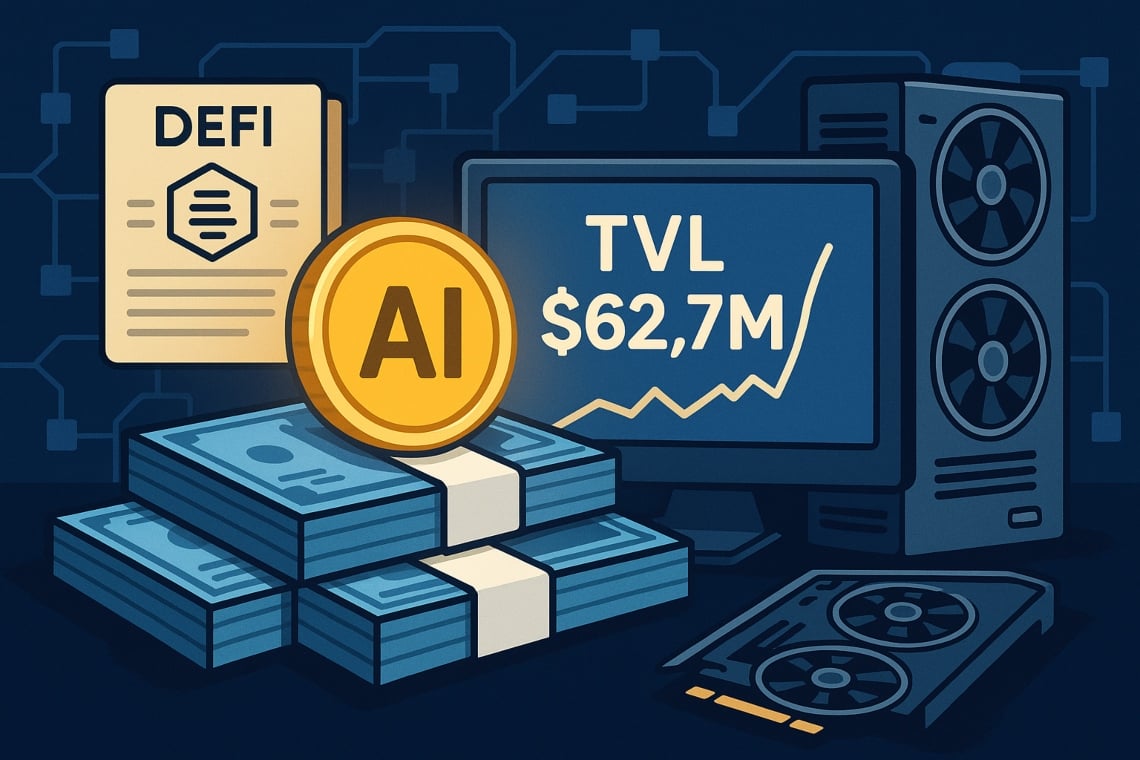
USD.AI explodes to $62.7M in TVL: the “GPU-based” stablecoin drives non-dilutive loans for AI

USD.AI explodes to $62.7M in TVL: the “GPU-based” stablecoin drives non-dilutive loans for AI

The protocol of Permian Labs has reached $62.7 million in TVL after a Series A round of $13 million led by Framework Ventures.

Author: The Cryptonomist