DeFi

DeFi eliminates intermediaries by using smart contracts on blockchains to provide financial services like lending, borrowing, and trading. In 2026, the "DeFi 3.0" era is defined by Institutional DeFi and the integration of Real-World Assets (RWA). From liquidity provisioning on Uniswap to advanced lending on Aave, this tag tracks the evolution of autonomous financial systems, yield optimization, and the rise of AI-driven portfolio management in the decentralized economy.

68514 Articles
Created: 2026/02/02 18:52
Updated: 2026/02/02 18:52
What Is BlockDAG? A Technical Overview of Its DAG-PoW Hybrid Blockchain

What Is BlockDAG? A Technical Overview of Its DAG-PoW Hybrid Blockchain

The post What Is BlockDAG? A Technical Overview of Its DAG-PoW Hybrid Blockchain appeared on BitcoinEthereumNews.com. As the blockchain industry matures, users and developers demand systems that are both secure and scalable without adding unnecessary complexity. BlockDAG positions itself as a practical solution to these expectations. By combining Directed Acyclic Graph (DAG) architecture with traditional Proof-of-Work (PoW) consensus, the network introduces a hybrid model aimed at increasing speed, throughput, and accessibility, all while retaining the core benefits of decentralization and network security.  This article breaks down how BlockDAG’s layered technical structure supports real-time applications, efficient development, and wide user adoption.  Technical Framework: DAG Meets Proof-of-Work BlockDAG is structured as a hybrid Layer-1 blockchain that merges two core components: a Directed Acyclic Graph for structural speed and a PoW engine for secure consensus. Instead of validating one block at a time like traditional chains, the DAG component enables the simultaneous confirmation of multiple blocks. This model reduces wait times and increases transaction processing capacity without sacrificing the decentralized reliability of mining. This structural shift brings practical advantages. By allowing blocks to run in parallel, BlockDAG improves data flow and lowers latency, particularly during high network activity. Meanwhile, the PoW consensus ensures that the network remains trustless and resistant to manipulation, as miners must still expend real computational effort to validate transactions. “BlockDAG is a hybrid PoW-based layer 1 blockchain, offering a novel implementation of DAG structure for faster and scalable execution.” ,  BlockDAG Keynote 3  Developer Ecosystem and EVM Compatibility BlockDAG is fully compatible with the Ethereum Virtual Machine (EVM), allowing developers to use standard Ethereum tools and write smart contracts in Solidity. This means that existing dApps can migrate to BlockDAG with minimal changes, and development teams can continue using familiar platforms such as MetaMask, Truffle, or Hardhat. Additionally, the platform supports both code-based and no-code deployment environments. A user-friendly dashboard allows non-developers to deploy smart…

Author: BitcoinEthereumNews
Solana 100K TPS Record Isn’t Enough To Break Remittix’s Stranglehold On The Market

Solana 100K TPS Record Isn’t Enough To Break Remittix’s Stranglehold On The Market

The post Solana 100K TPS Record Isn’t Enough To Break Remittix’s Stranglehold On The Market appeared on BitcoinEthereumNews.com. Making recent headlines was the fact that Solana recently hit an all-time high of 107,540 transactions per second. This feat solidified Solana’s reputation as the fastest blockchain in stress tests.  However, analysts observe that the real-world throughput is much lower at 1,000 TPS. It is creating concerns over scalability outside the lab. Investors seeking the best crypto to buy now are increasingly looking at utility-driven tokens like Remittix (RTX).  This project has raised over $20.4 million in the ongoing presale. That shows how much attention this newcomer has drawn, and it could be one of the top altcoins. Solana Latest News Highlights Growth Amid Volatility Solana is currently trading around $179, with recent technical patterns indicating caution. On the four-hour chart, SOL broke below a wedge formation guiding the price since early August. It is now testing support near the 200-EMA at $178.47.  Resistance has formed at the 50-EMA ($183.43) and 100-EMA ($185.89). The supply clusters are between $186 and $188, limiting the upward momentum. A close above $190 is crucial to neutralize the short-term bearish bias. source: TradingView According to the latest Solana news, Messari Protocol Services reported strong growth in DeFi total value locked and real-world assets (RWA) on Solana. The RWA value has increased 124% year to date, reaching $390 million.  Ondo Finance’s USDY remains a leading project in this space. It is backed by U.S. Treasuries, holding a market cap of $175.3 million. While these developments highlight Solana’s ecosystem expansion, market analysts suggest that raw TPS and DeFi TVL alone may not determine the best crypto to buy now. Remittix Continues to Capture Investor Attention Remittix is gaining traction for its utility-first approach, which contrasts with many high-speed blockchains that struggle to deliver real-world impact. With over 610 million tokens sold at $0.0969 each, Remittix has…

Author: BitcoinEthereumNews
Before Ethereum Had Smart Contracts, It Had Believers — Lyno AI Finds Its Own Early Supporters

Before Ethereum Had Smart Contracts, It Had Believers — Lyno AI Finds Its Own Early Supporters

Lyno AI resembles the very beginning of Ethereum, and it is attracting the followers of its new vision. Its AI-driven cross-chain arbitrage protocol design, in a decentralized fashion, has been arousing major investor interest. Such presale hype shows that it is believed to transform the nature of decentralized finance. Why Lyno AI Captures Attention Lyno […] The post Before Ethereum Had Smart Contracts, It Had Believers — Lyno AI Finds Its Own Early Supporters appeared first on Live Bitcoin News.

Author: LiveBitcoinNews
Thumzup Acquires Dogehash, Sets Eyes on Utility-Scale Dogecoin Mining

Thumzup Acquires Dogehash, Sets Eyes on Utility-Scale Dogecoin Mining

TLDR: Thumzup completes all-stock deal to acquire Dogehash, adding 2,500 Scrypt ASIC miners for Dogecoin mining. Dogehash shareholders receive 30.7M Thumzup shares; new Nasdaq ticker XDOG confirmed for fourth quarter 2025. Mining operations focus on renewable energy sites in North America with additional rigs expected by year-end. Combined platform plans Dogecoin Layer-2 staking via DeFi [...] The post Thumzup Acquires Dogehash, Sets Eyes on Utility-Scale Dogecoin Mining appeared first on Blockonomi.

Author: Blockonomi
As AI Rewires Crypto, Lyno AI Emerges as the Token Powering Next-Gen Arbitrage

As AI Rewires Crypto, Lyno AI Emerges as the Token Powering Next-Gen Arbitrage

With the cryptocurrency scene being rewired by AI, a new wave of decentralized trading is appearing with new protocols. Lyno AI drives this change, which uses artificial intelligence to re-imagining arbitrage possibilities. This technology combines machine learning and blockchain technology, and provides autonomous trading algorithms over a variety of platforms. Why Lyno AI Stands Out […] The post  As AI Rewires Crypto, Lyno AI Emerges as the Token Powering Next-Gen Arbitrage appeared first on Live Bitcoin News.

Author: LiveBitcoinNews
Is Little Pepe the next memecoin to watch in 2025?

Is Little Pepe the next memecoin to watch in 2025?

New memecoins like Little Pepe, alongside ADA, DOGE, HBAR, and LINK, could turn a $1,000 investment into $50,000 by 2025. #partnercontent

Author: Crypto.news
Tether Taps Former White House Crypto Council Chief Bo Hines for Strategic Advisory Role

Tether Taps Former White House Crypto Council Chief Bo Hines for Strategic Advisory Role

The post Tether Taps Former White House Crypto Council Chief Bo Hines for Strategic Advisory Role appeared on BitcoinEthereumNews.com. Key Insights: Tether has appointed Bo Hines, former Executive Director of the White House Crypto Council under President Trump, as Strategic Advisor Hines brings policy expertise, legislative experience, and a deep understanding of stablecoin regulation As part of Tether’s leadership team, Hines will shape and execute the company’s U.S. expansion USDT giant Tether, the largest stablecoin issuer by market capitalization, has just made a power play in its expansion into the U.S. market with the appointment of Bo Hines as Strategic Advisor for Digital Assets and U.S. Strategy. Hines recently held the post of Executive Director of the White House Crypto Council under President Donald Trump. Besides, he also has a bucketload of experience in navigating regulatory hurdles at the highest level. Bo Hines’ Appointment Comes Hot Off the GENIUS Act The stablecoin sector has been in overdrive lately following Circle’s billion-dollar IPO and the passing of the GENIUS Act, which provides legal clarity to stablecoin issuers at last. Under the terms of the Act, stablecoins are treated differently from securities and commodities, and must be fully backed 1:1 by reserves. After years of opacity for operators within the U.S., the GENIUS Act provides a welcome dose of regulatory clarity that opens the door for greater adoption, while introducing new guidelines and compliance obligations for issuers like Tether. With the strategic appointment of Hines, Tether is throwing its hat into the ring as one of the industry’s largest companies navigates the changing landscape of digital assets in the U.S. Not All Smooth Sailing for Tether Tether’s USDT stablecoin boasts the largest market cap at above $165 billion. However, the firm has faced questions about regulatory oversight, transparency, and reserve management, recently opting out of the European equivalent to the GENIUS Act, MiCA. However, Hines’s reputation and experience at the federal…

Author: BitcoinEthereumNews
Radiant Capital hacker doubles $53M stash via ETH trading

Radiant Capital hacker doubles $53M stash via ETH trading

The post Radiant Capital hacker doubles $53M stash via ETH trading appeared on BitcoinEthereumNews.com. The hacker behind last year’s $53 million Radiant Capital exploit has nearly doubled the value of the stolen funds through a well-timed Ethereum trading strategy. Summary The Radiant Capital hacker increased stolen funds from $53M to $94M through ETH and DAI trading. The October 2024 attack exploited Radiant’s multisig wallet using macOS malware. Attribution points to North Korea-linked AppleJeus, with little chance of recovery. According to on-chain analyst EmberCN’s Aug. 19 X post, the hacker had earlier sold 9,631 Ethereum (ETH) at an average of $4,562 for 43.9 million Dai (DAI), only to buy back 2,109.5 ETH for $8.64 million DAI once prices pulled back to $4,096. The wallet now holds 14,436 ETH and 35.29 million DAI, a portfolio worth $94.63 million. This represents a gain of more than $41 million over the initial value of the stolen funds. Blockchain analytics firm Lookonchain noted that the decision to keep most of the assets in ETH during its rally played a major role in the increased balance. 啊,好家伙,这 Radiant Capital 黑客竟然玩起波段来了😂:他不是在一周前以 $4,562 的均价卖出了 9,631 枚 ETH 换成 4393.7 万 DAI 嘛。这几天 ETH 回调了,他在过去 1 小时里又用 $864 万 DAI 以 $4,096 的价格重新买回了 2109.5 枚 ETH… 现在 Radiant Capital 黑客持有 14,436 枚 ETH+3529 万… https://t.co/hO4MbNPrjd pic.twitter.com/ihLYhpmNAV — 余烬 (@EmberCN) August 20, 2025 From $53 million heist to $94 million stash The October 2024 breach of Radiant Capital, a multi-chain decentralized finance protocol, was one of the most damaging attacks of the year. By compromising the multisignature wallet of its core team through a macOS-specific malware called INLETDRIFT, the attacker siphoned tokens from lending pools on Arbitrum (ARB) and BNB (BNB) Chain.  At the time, the stolen assets were quickly converted into 21,957 ETH, then valued at about $53 million when Ethereum was trading near $2,500. Rather than liquidating the holdings, the hacker held…

Author: BitcoinEthereumNews
Morning Update | 19 August 2025

Morning Update | 19 August 2025

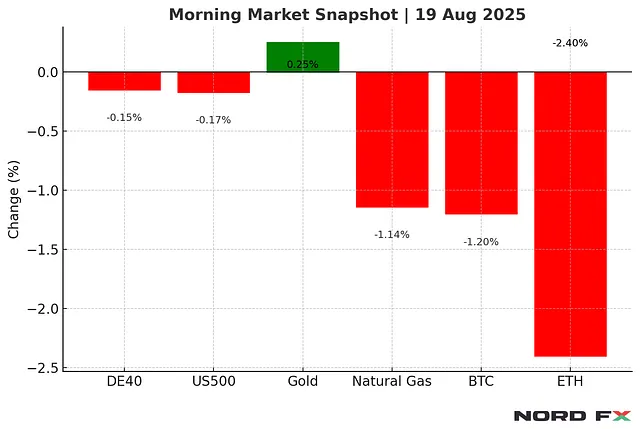
Asian markets started Tuesday calmly 😌, with focus still on talks at the White House 🏛️. Discussions on Ukraine–Russia peace remain frozen ❄️, as both sides stand firm on their key conditions: 🇺🇦 Ukraine — restoring pre-war borders 🇷🇺 Russia — no foreign troops on Ukrainian soil.The US, EU, and Ukraine are preparing detailed security guarantees within 10 days ⏳, while NATO confirmed that ground troop deployment was not part of the talks.📉 Before Europe’s cash session, futures are slipping:🇩🇪 DE40 -0.15%🇺🇸 US500 -0.17%S&P reaffirmed the US rating at AA+/A-1+ with a stable outlook, noting high deficits and rising debt 📑.📆 Today’s macro calendar is light — investors are watching Canada’s CPI, corporate news, and geopolitical updates.✨ Market snapshot:Gold regains some ground, supported by a mild EUR/USD rebound 💶💵.Forex: Low volatility, with the yen 🇯🇵 stronger and the Australian dollar 🇦🇺 weaker.Energy: Natural gas 🔥 -1.14% on forecasts of lower demand.Crypto: Bitcoin 💎 -1.2%, Ethereum 🚀 -2.4%.Stay tuned with NordFX for timely updates and smart trading decisions 📈🤝📊 Morning Update | 19 August 2025 🌏 was originally published in Coinmonks on Medium, where people are continuing the conversation by highlighting and responding to this story.

Author: Medium
The Stablecoin War: USDC vs Decentralized Alternatives

The Stablecoin War: USDC vs Decentralized Alternatives

Stablecoins have quietly become the backbone of the crypto economy. They serve as the bridge between volatile digital assets and the stability of fiat currencies, making them indispensable for trading, lending, and global payments. But the stablecoin space is far from settled. Today, the market is dominated by Tether (USDT) and USD Coin (USDC). Yet a new wave of decentralized alternatives is emerging, challenging the very foundations of what stable digital money should look like. The question is no longer whether stablecoins are here to stay — it’s which model will shape the future of digital finance.USDC: Regulation and Trust as a StrategyUSDC, issued by Circle, positions itself as a transparent, regulated, and institution-friendly stablecoin. Backed by monthly attestations and partnerships with regulated banks, USDC has gained significant traction in the U.S. and among companies that prioritise compliance.USDC has found strong adoption in DeFi protocols and as a preferred on-ramp for institutions. Its temporary depeg during the Silicon Valley Bank collapse in 2023 raised concerns about reliance on the U.S. banking system, yet Circle’s rapid recovery reinforced its commitment to transparency.The strategy behind USDC is clear: it seeks to be the bridge between traditional finance (TradFi) and decentralized finance (DeFi), aligning with regulators and institutional players. Its challenge is scaling globally while remaining compliant in an increasingly fragmented regulatory environment.Decentralized Alternatives: The Crypto-Native ApproachBeyond USDT and USDC, a new generation of decentralized stablecoins is attempting to solve the centralization problem. Projects like DAI (MakerDAO), FRAX, and LUSD (Liquity) offer alternatives that are not dependent on a single entity or traditional banking system.DAI pioneered the model, backed by crypto collateral like ETH. However, over time, DAI itself became partially dependent on USDC, raising concerns about true decentralization.FRAX introduced a hybrid model, partially algorithmic and partially collateralized, showing that experimentation is still alive in stablecoin design.LUSD focuses on pure crypto collateral and immutable rules, offering an uncompromising approach to decentralization.The appeal of these stablecoins lies in their resilience against censorship and banking risks, making them attractive for crypto-native users. Still, they face challenges of scale, liquidity, and sometimes complexity compared to centralized giants.The Strategic Battle: Regulation vs Adoption vs DecentralizationThe stablecoin war is more than a competition of tokens — it’s a clash of visions.USDT bets on ubiquity and liquidity, prioritizing accessibility over regulatory alignment.USDC bets on compliance and institutional trust, aligning itself with the future of regulated digital finance.Decentralized alternatives bet on crypto-native values, resisting central control and censorship.The outcome may not be a single winner but a multipolar stablecoin ecosystem, where different coins serve different audiences: traders, institutions, and decentralized communities. The bigger question is how governments and central banks respond — especially as CBDCs (Central Bank Digital Currencies) loom on the horizon.Stablecoins are no longer just tools for traders; they are becoming the core infrastructure of global crypto markets and potentially, the future of money itself. USDT continues to dominate through liquidity and accessibility, USDC builds trust through regulation and compliance, and decentralized stablecoins push forward with censorship resistance and crypto-native design.The “Stablecoin War” will not be decided overnight. Instead, we are likely heading toward a diverse ecosystem where centralized and decentralized models coexist, shaped by regulation, user demand, and innovation. For crypto enthusiasts, builders, and investors, understanding this battle is crucial — because stablecoins are not just about stability. They’re about who controls the future of money in the digital era.If you found this article insightful, don’t miss out on future content! Subscribe to my Medium profile and follow me for weekly updates. Every other day, I publish new articles exploring the latest trends, innovations, and insights in technology, governance, and beyond. Join me on this journey of discovery, and together, let’s explore the endless possibilities of our rapidly evolving world.The Stablecoin War: USDC vs Decentralized Alternatives was originally published in Coinmonks on Medium, where people are continuing the conversation by highlighting and responding to this story.

Author: Medium