Dapp

Dapps are digital applications that run on a P2P network of computers rather than a single server, typically utilizing smart contracts to ensure transparency and uptime. In 2026, Dapps have achieved mass-market appeal through Account Abstraction, allowing for a "Web2-like" user experience with the security of Web3. This tag covers the entire ecosystem of decentralized software—from social media and productivity tools to governance platforms and identity management.

4941 Articles
Created: 2026/02/02 18:52
Updated: 2026/02/02 18:52

Fintel’s Strategic $100M SOL Investment: What It Means for Crypto

Fintel’s Strategic $100M SOL Investment: What It Means for Crypto

BitcoinWorld Fintel’s Strategic $100M SOL Investment: What It Means for Crypto The cryptocurrency world is buzzing with significant news: Nasdaq-listed Fintel Corporation (FTEL) has secured a substantial $100 million financing facility. This isn’t just any corporate financing; the company plans to use these funds for strategic purchases of SOL, the native cryptocurrency of the Solana blockchain. This Fintel SOL investment marks a notable move, highlighting growing institutional interest in the digital asset space. What does this bold step mean for Fintel, Solana, and the broader crypto market? Let’s dive in. What Does Fintel’s $100M SOL Investment Entail? Fintel Corporation, known for its data analytics and financial technology services, is making a definitive push into the crypto arena. GlobeNewswire reported that the $100 million financing facility is earmarked specifically for acquiring SOL tokens. This move signifies more than just a treasury allocation; it represents a deliberate strategy to engage with and potentially benefit from the burgeoning Solana ecosystem. Such an explicit Fintel SOL investment from a Nasdaq-listed entity provides a strong signal to the market. Company: Nasdaq-listed Fintel Corporation (FTEL) Funding: $100 million financing facility Purpose: Strategic purchases of SOL (Solana) Source: GlobeNewswire report This action by Fintel demonstrates a clear belief in the long-term value and potential of Solana. It positions Fintel not just as a technology provider but also as a direct participant in the digital asset economy. Why Solana? The Strategic Rationale Behind This Fintel SOL Investment Solana has emerged as a prominent blockchain, celebrated for its high transaction speeds and low costs. These technical advantages make it an attractive platform for various decentralized applications (dApps), NFTs, and DeFi projects. Fintel’s decision to specifically target SOL for its investment reflects a calculated assessment of Solana’s ecosystem and future prospects. Scalability: Capable of processing thousands of transactions per second. Cost-Effectiveness: Extremely low transaction fees. Developer Activity: A growing and vibrant developer community. Ecosystem Growth: Rapid expansion of DeFi, NFT, and Web3 projects. This strategic Fintel SOL investment suggests that the corporation sees Solana as a key player in the evolving digital infrastructure. It’s not merely buying a digital asset; it’s investing in a foundational technology. What Are the Broader Implications of Fintel’s Strategic Move? An institutional Fintel SOL investment of this magnitude carries significant weight for the entire cryptocurrency market. It could potentially: Boost Solana’s Credibility: A Nasdaq-listed company’s backing adds a layer of legitimacy and institutional validation to Solana. Attract More Institutional Capital: Other traditional finance entities might view Fintel’s move as a precedent, encouraging their own exploration of crypto investments. Influence Market Sentiment: Positive news from a publicly traded company can create a ripple effect, potentially driving up demand and price for SOL. Diversify Corporate Portfolios: It highlights a growing trend among corporations to consider digital assets as part of their treasury management or strategic growth initiatives. This development underscores a shift in how mainstream finance perceives cryptocurrencies, moving beyond speculative trading to strategic asset allocation. Potential Challenges and Opportunities for Fintel’s SOL Investment While the Fintel SOL investment presents exciting opportunities, it also comes with inherent challenges. The cryptocurrency market is known for its volatility, and regulatory landscapes are still evolving. Opportunities: Capital Appreciation: Potential for significant returns if Solana’s value increases. Ecosystem Integration: Fintel could explore integrating its financial data services with the Solana blockchain. Innovation: Position itself at the forefront of digital asset adoption. Challenges: Market Volatility: SOL’s price can experience rapid fluctuations, impacting the investment’s value. Regulatory Uncertainty: The evolving legal framework for cryptocurrencies poses risks. Technological Risks: Potential for network outages or security vulnerabilities, though Solana has improved. Fintel’s leadership will undoubtedly navigate these factors, aiming to maximize the benefits while mitigating the risks associated with such a substantial digital asset holding. Looking Ahead: The Future of Fintel’s SOL Investment This initial $100 million Fintel SOL investment could be just the beginning. Depending on market performance and strategic objectives, Fintel might choose to expand its holdings or integrate Solana more deeply into its business operations. This bold move positions Fintel as an early institutional adopter of a major blockchain, potentially paving the way for future innovations in the intersection of traditional finance and decentralized technology. It will be fascinating to observe how this investment unfolds and what strategic partnerships or product developments might emerge from it. Conclusion: Fintel Corporation’s $100 million financing facility dedicated to purchasing SOL is a landmark event. It not only demonstrates a strong belief in Solana’s potential but also signifies a broader trend of institutional confidence in the cryptocurrency market. This strategic Fintel SOL investment highlights the ongoing convergence of traditional finance and digital assets, promising exciting developments for investors and the wider crypto community. As Fintel embarks on this new chapter, the industry will be watching closely to see the long-term impact of this significant institutional embrace of Solana. Frequently Asked Questions (FAQs) 1. What is Fintel Corporation? Fintel Corporation (FTEL) is a Nasdaq-listed company specializing in financial technology and data analytics, providing insights and tools for investors and financial professionals. 2. Why is Fintel investing in SOL? Fintel is making a strategic Fintel SOL investment due to Solana’s high transaction speeds, low costs, and growing ecosystem, which they believe offers significant long-term value and potential for integration with their services. 3. What is Solana (SOL)? Solana is a high-performance blockchain platform designed for decentralized applications and crypto projects, known for its scalability and efficiency. SOL is its native cryptocurrency, used for transactions and network governance. 4. How does this investment impact the broader crypto market? An institutional Fintel SOL investment of this scale can boost Solana’s credibility, attract more institutional capital to the crypto space, and positively influence overall market sentiment by demonstrating mainstream corporate adoption of digital assets. 5. Are there risks associated with Fintel’s SOL investment? Yes, like all cryptocurrency investments, it carries risks such as market volatility, potential regulatory changes, and technological vulnerabilities inherent in blockchain platforms. Fintel will need to manage these risks carefully. If you found this insight into Fintel’s strategic move illuminating, share this article with your network! Help us spread the word about significant institutional shifts in the cryptocurrency landscape and spark further discussions on the future of digital assets. To learn more about the latest crypto market trends, explore our article on key developments shaping institutional adoption of digital assets. This post Fintel’s Strategic $100M SOL Investment: What It Means for Crypto first appeared on BitcoinWorld.

Author: Coinstats
LayerZero Foundation Announces Buyback of 50 Million ZRO Tokens

LayerZero Foundation Announces Buyback of 50 Million ZRO Tokens

TLDR LayerZero Foundation repurchases 50 million ZRO tokens from early investors to reduce supply. ZRO launched in June 2024 with a $3B valuation, with 8.5% of tokens distributed via airdrop. LayerZero connects over 50 blockchains and has facilitated 100 million cross-chain messages. The buyback reflects LayerZero’s long-term confidence and commitment to its token’s growth. LayerZero [...] The post LayerZero Foundation Announces Buyback of 50 Million ZRO Tokens appeared first on CoinCentral.

Author: Coincentral
Crypto-Native Autonomous Agents: A New Era of Decentralized AI

Crypto-Native Autonomous Agents: A New Era of Decentralized AI

Crypto-Native Autonomous Agents: A New Era of Decentralized AI The evolution of artificial intelligence (AI) and blockchain technology has paved the way for a new paradigm in decentralized systems: crypto-native autonomous agents (CNAAs). These agents combine the intelligence of AI with the transparency, security, and decentralization of blockchain, enabling automated decision-making, asset management, and transaction execution in crypto ecosystems. This intersection is creating opportunities for smarter decentralized finance (DeFi), autonomous marketplaces, and efficient blockchain-based governance. In this blog, we explore what crypto-native autonomous agents are, how they operate, their real-world applications, and why they are poised to redefine decentralized systems. Understanding Crypto-Native Autonomous Agents A crypto-native autonomous agent is an AI-powered program designed to operate natively within blockchain networks. Unlike traditional AI agents, which often rely on centralized servers, CNAAs execute tasks, make decisions, and interact with decentralized networks without centralized oversight. This decentralization ensures that these agents are trustless, transparent, and resistant to manipulation. Key characteristics of CNAAs include: Autonomy: They can perform tasks and make decisions independently based on predefined rules and learning algorithms. Crypto-native integration: They operate directly within blockchain ecosystems, utilizing tokens, smart contracts, and decentralized data. Interoperability: CNAAs can communicate with other agents, protocols, and dApps across multiple blockchains. Transparency and immutability: All actions and decisions are recorded on-chain, making their behavior verifiable and auditable. By combining AI decision-making with blockchain-based verification, these agents reduce the need for human oversight while increasing trust in decentralized operations. How Crypto-Native Autonomous Agents Work? Crypto-native autonomous agents function through a combination of AI algorithms, smart contracts, and blockchain infrastructure. Their workflow typically involves the following steps: Data Acquisition CNAAs continuously gather data from decentralized sources such as on-chain transactions, decentralized oracles, and crypto market feeds. Decision Making Using machine learning models, CNAAs analyze the data to make informed decisions. For example, an agent could determine the optimal time to trade a token or execute a staking strategy. Smart Contract Execution Once a decision is made, the agent interacts with smart contracts to perform actions automatically. These actions are verifiable and irreversible on the blockchain. Learning and Adaptation Advanced CNAAs incorporate reinforcement learning, allowing them to adapt strategies based on previous outcomes, market changes, and network conditions. This autonomous workflow enables decentralized systems to function efficiently without central authorities, enhancing security, reducing costs, and improving transaction speeds. Applications in Decentralized Finance (DeFi) One of the most significant use cases for crypto-native autonomous agents is in DeFi. Here, CNAAs can automate complex financial strategies, offering both efficiency and intelligence.

  1. Automated Trading AgentsCNAAs can act as autonomous trading bots, executing buy and sell orders across decentralized exchanges (DEXs) based on AI-driven predictions. Unlike traditional bots, these agents operate directly on-chain, reducing reliance on centralized intermediaries and improving trust.
  2. Liquidity Provision and Yield FarmingAutonomous agents can manage liquidity pools, optimize yield farming strategies, and rebalance portfolios dynamically. By analyzing market trends, these agents ensure maximum returns while minimizing risks for users.
  3. Risk Assessment and ManagementAI algorithms embedded in CNAAs can assess market volatility, smart contract vulnerabilities, and token risks in real-time. This predictive capability helps users make safer investment decisions and reduces the likelihood of losses due to unforeseen events. Enhancing Decentralized Marketplaces CNAAs are also transforming decentralized marketplaces by automating bidding, pricing, and trading processes. For example: NFT Marketplaces: Agents can evaluate NFT values, execute trades, and manage collections automatically. Tokenized Assets: CNAAs facilitate trading and management of tokenized real-world assets such as real estate or commodities, ensuring transparency and efficiency. Automated Auctions: Crypto-native agents can conduct on-chain auctions, adjusting bids and allocations dynamically based on demand and supply. This level of automation reduces friction in decentralized markets, encourages participation, and increases overall market efficiency. Governance and Decentralized Organizations Crypto-native autonomous agents play a crucial role in Decentralized Autonomous Organizations (DAOs). By automating governance functions, these agents ensure decisions are executed fairly and transparently: Voting Automation: CNAAs can tally votes, execute proposals, and distribute rewards automatically, minimizing human error. Resource Allocation: Agents manage treasury funds and project allocations based on predefined rules or AI-optimized strategies. Proposal Evaluation: Advanced CNAAs can assess the potential impact of governance proposals using predictive analytics, enabling informed decision-making. This automation strengthens trust in decentralized governance, as all actions are recorded and verifiable on-chain. Cross-Chain Interoperability Modern blockchain ecosystems are often fragmented, with assets and protocols spread across multiple networks. CNAAs facilitate cross-chain operations by: ✦Executing transactions across different blockchain networks seamlessly. ✦Bridging liquidity and ensuring arbitrage opportunities are optimized. ✦Monitoring cross-chain token performance and responding autonomously to market changes. This interoperability ensures that decentralized agents can operate efficiently in a multi-chain environment, enhancing liquidity and user experience. Security and Trust in Autonomous Agents Security is a critical concern for autonomous systems. CNAAs address this challenge through several mechanisms: Smart Contract Verification: Actions are executed via verified smart contracts, reducing the risk of manipulation. On-Chain Transparency: Every transaction and decision is recorded on the blockchain, making it auditable and immutable. AI-Driven Threat Detection: Some agents incorporate AI models to detect anomalies, identify potential exploits, and respond proactively. Decentralized Architecture: By operating in a decentralized manner, CNAAs reduce single points of failure and increase system resilience. These measures make crypto-native autonomous agents more secure than traditional centralized automation solutions. Real-World Use Cases Decentralized Asset Management: CNAAs manage crypto portfolios automatically, optimizing returns and balancing risk without human intervention. NFT Valuation Agents: AI-powered agents analyze NFT marketplaces to determine fair pricing, detect trends, and suggest optimal purchase or sale strategies. Yield Optimization: CNAAs automatically reallocate funds across liquidity pools to maximize yield, taking into account gas fees and market conditions. Cross-Chain Arbitrage: Agents monitor price discrepancies across chains and execute profitable trades autonomously. Governance Automation in DAOs: CNAAs ensure proposals are executed efficiently, funds are allocated correctly, and governance rules are enforced. These examples demonstrate how CNAAs are enabling smarter, faster, and more secure operations in the decentralized ecosystem. The Future of Crypto-Native Autonomous Agents As blockchain and AI technologies evolve, CNAAs are expected to become more sophisticated and widely adopted. Key trends include: Integration with AI-Powered Prediction Markets: Agents will analyze complex datasets to forecast trends and opportunities across DeFi and NFT markets. Enhanced Personalization: CNAAs will offer custom strategies tailored to individual user preferences and risk profiles. Decentralized AI Marketplaces: Agents will collaborate in marketplaces to buy, sell, and trade AI services autonomously. Self-Improving Algorithms: Reinforcement learning will allow CNAAs to continuously improve their decision-making capabilities. Broader Adoption in Traditional Finance: Financial institutions may integrate CNAAs for asset management, compliance, and risk assessment. The combination of AI intelligence and decentralized execution positions CNAAs as a critical component in the next generation of blockchain-based systems. Challenges and Considerations Despite their potential, CNAAs face several challenges: Regulatory Uncertainty: Cross-border operations and financial automation may face legal hurdles. Algorithmic Bias: AI models may inherit biases from training data, impacting decision-making. Scalability: High transaction costs and network congestion on some blockchains can limit agent performance. Interoperability: Ensuring seamless operation across multiple blockchains remains a technical challenge. Security Risks: While blockchain adds security, vulnerabilities in smart contracts or AI models can still be exploited. Addressing these challenges will be crucial for the broader adoption and success of crypto-native autonomous agents. Conclusion Crypto-native autonomous agents represent a new era of decentralized AI, combining intelligence, autonomy, aemond blockchain security. From DeFi trading and yield optimization to NFT marketplaces and DAO governance, these agents are redefining the possibilities of decentralized systems. By enabling autonomous decision-making, transparent operations, and cross-chain interoperability, CNAAs reduce the need for centralized oversight while increasing trust and efficiency. While challenges such as regulatory uncertainty and scalability remain, the ongoing evolution of AI and blockchain technologies promises to address these issues, paving the way for broader adoption. The era of crypto-native autonomous agents has arrived, offering a glimpse into a future where decentralized AI empowers users, businesses, and networks to operate smarter, faster, and more securely. Those who embrace these innovations today are likely to be at the forefront of blockchain’s next transformation.
Crypto-Native Autonomous Agents: A New Era of Decentralized AI was originally published in Coinmonks on Medium, where people are continuing the conversation by highlighting and responding to this story

Author: Medium
US and UK Explore Crypto Regulatory Collaboration – Which Are the Best Cryptos to Buy Now?

US and UK Explore Crypto Regulatory Collaboration – Which Are the Best Cryptos to Buy Now?

The US and the UK have joined forces to streamline crypto regulations. Specifically, the US Treasury Department and His Majesty’s Treasury plan to launch the Transatlantic Task Force for Markets of the Future – a joint effort to simplify cross-border investment. While the US has made some progress on the crypto front during the Trump […]

Author: Bitcoinist
Cardano Price Outlook, Solana Updates and ChatGPT’s Best Crypto To Buy Ahead of Q4

Cardano Price Outlook, Solana Updates and ChatGPT’s Best Crypto To Buy Ahead of Q4

Cardano eyes $1.50, Solana targets $300, but ChatGPT’s top Q4 pick is Layer Brett—an Ethereum L2 meme coin with $3.9M raised and a 12,000% rally forecast.

Author: Blockchainreporter
Why Bitcoin Hyper’s Layer-2 Could Make Bitcoin Relevant for Developers & Modern Demands

Why Bitcoin Hyper’s Layer-2 Could Make Bitcoin Relevant for Developers & Modern Demands

Bitcoin is arguably the most popular cryptocurrency in the world. When someone talks about crypto, they’re almost always referring to Bitcoin. $BTC commands around 57% of the total crypto market cap, sitting at $2.52T. Most of the crypto rags-to-riches stories you’ve heard are more often than not attributed to Bitcoin. However, despite all the pomp […]

Author: Bitcoinist
Retail Is Doing the Same with Bitcoin Hyper

Retail Is Doing the Same with Bitcoin Hyper

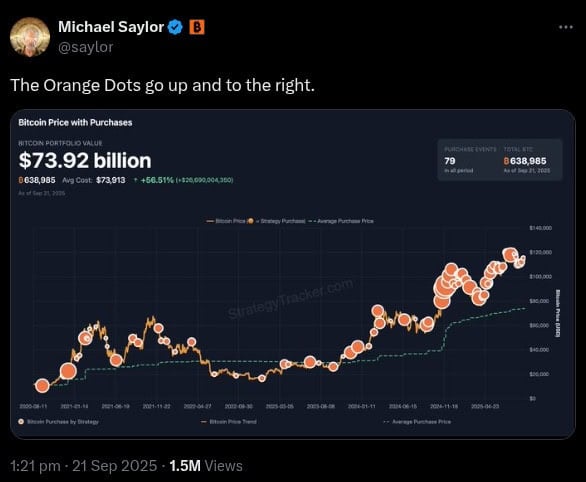
The post Retail Is Doing the Same with Bitcoin Hyper appeared on BitcoinEthereumNews.com. Strategy continues to dominate as the world’s largest corporate Bitcoin holder as the company announces another $BTC purchase amid falling prices. Michael Saylor’s investment company issued a press release stating it had bought another 850 $BTC for $99.7M, averaging out at $117K per Bitcoin. Today, Strategy holds over $72B in $BTC and shows no signs of slowing down even in a rocky crypto market. To achieve the accumulation, Strategy sold nearly $100M of its own stock, showing serious confidence in the future of Bitcoin even though the gap from its recent ATH of $124K has widened, with the $BTC price down at $113K. It’s that same investor confidence in Bitcoin that’s seeing a new token – Bitcoin Hyper ($HYPER) – rack up massive funds in its presale. With plans to introduce a revolutionary Layer-2 designed to unleash Bitcoin’s full potential, $HYPER has grabbed the attention of retail investors. Why is Strategy Buying Bitcoin Now? Strategy (listed on the Nasdaq as MSTR) stocks hit a five-month low at around $320 in early September, prompting a shift towards $BTC, which is outperforming MSTR. While MSTR has seen a 6.2% decline over the last month, $BTC has seen only a 1.6% loss in the same period. While retail investors are spooked by the volatile performance of $BTC, following its fall from a recent ATH, institutional investors like Saylor believe the dip is an opportunity to scoop up cheap Bitcoin that will inevitably rise after the current period of volatility is over. Source: X/@saylor As we can see, Strategy has an overall purchase history that reflects this attitude. Even during the crypto lull in 2022, Strategy continued dollar-cost averaging its Bitcoin reserves, expecting that the industry would recover. This isn’t the first time Strategy has sold its own stock to purchase $BTC, either. Saylor’s…

Author: BitcoinEthereumNews
PEPE Falls, Polygon Rises as BlockDAG Nears $410M in 2025

PEPE Falls, Polygon Rises as BlockDAG Nears $410M in 2025

The post PEPE Falls, Polygon Rises as BlockDAG Nears $410M in 2025 appeared on BitcoinEthereumNews.com. Crypto News 23 September 2025 | 14:55 See how PEPE dips while Polygon climbs. BlockDAG secures almost $410M, 3M+ users, 19,900 miners, and a live demo. Could it be 2025’s strongest coin pick? Market shifts in 2025 show two clear stories: hype-driven coins facing turbulence and adoption-focused projects showing strength. PEPE has once again come under pressure, falling after a whale sold millions, sparking doubts about its future. Polygon (POL), however, is on the rise, backed by strong partnerships and usage. Both remain widely discussed among top coins to watch, but their long-term paths look very different. BlockDAG (BDAG) is carving its own space. With its flat price at $0.0013 in Batch 30, the project raised almost $410M, selling 26.3B coins and building a base of 312,000 holders. Big players also stepped in with purchases over $4 million, while deals with the Seattle Seawolves and Orcas have boosted visibility across mainstream audiences. PEPE Price Drop Raises New Concerns PEPE has once again faced sharp pressure. A whale sold more than $4.8 million worth of holdings, sparking a steep fall in value. This event shows how fragile memecoins can be when a few large players make moves. While PEPE still manages to outperform many rivals in its category, the sudden drop highlights how sentiment-driven projects remain unstable. The fall has shifted attention toward projects with clear foundations and measurable adoption. Short-term rallies may still appear, but PEPE’s reliance on hype makes it a weaker option for those seeking coins with more reliable growth. Without stronger adoption or practical uses, long-term strength is uncertain. For now, PEPE keeps fueling conversations in the market. Yet it remains a high-risk example of how memecoins can generate excitement but still struggle to build lasting value. Polygon Price Surge Signals Strength Polygon (POL) has been gaining…

Author: BitcoinEthereumNews
Strategy Buys a $100M Bitcoin Dip: Retail Is Doing the Same with Bitcoin Hyper

Strategy Buys a $100M Bitcoin Dip: Retail Is Doing the Same with Bitcoin Hyper

Strategy continues to dominate as the world's largest corporate Bitcoin holder as the company announces another $BTC purchase amid falling prices.

Author: Brave Newcoin
PEPE Struggles, Polygon Advances While BlockDAG’s Partnerships and Live Demo Boost Buyer Trust

PEPE Struggles, Polygon Advances While BlockDAG’s Partnerships and Live Demo Boost Buyer Trust

Market shifts in 2025 show two clear stories: hype-driven coins facing turbulence and adoption-focused projects showing strength. PEPE has once […] The post PEPE Struggles, Polygon Advances While BlockDAG’s Partnerships and Live Demo Boost Buyer Trust appeared first on Coindoo.

Author: Coindoo