

Why Bitcoin Hyper’s Layer-2 Could Make Bitcoin Relevant for Developers & Modern Demands
Bitcoin is arguably the most popular cryptocurrency in the world. When someone talks about crypto, they’re almost always referring to Bitcoin.
$BTC commands around 57% of the total crypto market cap, sitting at $2.52T. Most of the crypto rags-to-riches stories you’ve heard are more often than not attributed to Bitcoin.
However, despite all the pomp and ceremony around the ‘digital gold,’ it’s still not a complete cryptocurrency when compared to the likes of Ethereum and Solana.
Beyond being one of the best wealth creators of the past decade, Bitcoin has done little to advance the development of crypto blockchains themselves.
Bitcoin is still not compatible with smart contracts, dApps, or the broader Web3 space. Here’s where Bitcoin Hyper ($HYPER) comes into the picture.$HYPER is a Layer-2 Bitcoin solution that solves the issues of scalability, speed, and transaction costs, adding a whole new arm of utility to the network.
In this article, we’ll discuss $HYPER in detail and explain why it’s arguably the best crypto to buy in 2025.
Problems with Bitcoin
Bitcoin can currently process just seven transactions per second. Compare this with Solana’s average of 65K transactions per second.
In a recent test run in April 2025, Solana even clocked 100K transactions per second. Against such massive throughputs, Bitcoin still has a mountain to climb.
Also, the current Bitcoin block time is 10 minutes. This means it takes Bitcoin 10 minutes to add a new block of transactions to the blockchain.
By contrast, Solana has a block time of only 0.4 seconds. In other words, by the time Bitcoin processes one transaction, Solana can process around 1.5K.
This sluggishness also translates into higher transaction costs. The average cost on Bitcoin is $0.84 per transaction, which might not seem like a lot for large transfers.However, it makes micro-transactions and small interactions quite expensive. Solana, on the other hand, has an average cost of just $0.00025 per transaction.
All in all, it’s easy to see why developers gravitate toward the likes of Solana and Ethereum for Web3 applications.
This is a massive missed opportunity for Bitcoin, as it’s losing out on potential revenue. For instance, Solana has generated $1.25B in revenue year-to-date, while Ethereum sits at $523M.
A more developer-friendly, faster, and cheaper Bitcoin blockchain could open new doors of alternate revenue for the network.
$HYPER Turbocharges Bitcoin with More Speed
But what if the same speeds – or at least comparable ones – were introduced on the Bitcoin network?
That’s exactly what Bitcoin Hyper ($HYPER) aims to achieve through its Solana Virtual Machine (SVM) integration, aka the very execution environment that powers Solana’s high throughputs.
SVM’s secret sauce is parallel execution: a model where multiple transactions are processed simultaneously, as long as they’re not related to each other.
This stands in stark contrast to Bitcoin’s one-at-a-time approach, which is simply not enough in today’s fast-moving blockchain environment.
Bitcoin Hyper is a Layer-2 (L2) solution, meaning it’s built on the Bitcoin Layer-1 blockchain. As with any L2, transactions are processed off-chain. That said, you don’t end up compromising the security of Layer-1 Bitcoin in the process, which makes it a win-win.In this setup, Bitcoin Hyper batches the results of all transactions and sends them to the Bitcoin mainchain, giving you the dual benefits of fast execution and Bitcoin’s top-notch security.
Build dApps and Execute Smart Contracts on Bitcoin
Bitcoin Hyper not only solves the problem of speed on the Bitcoin blockchain but also opens up a new realm of dApps and Web3 compatibility through its non-custodial, decentralized canonical bridge.
This bridge serves as the connecting point between Bitcoin’s Layer-1 and its Layer-2 solution.
Here’s how it works: let’s say you hold one Bitcoin and want to engage with a dApp. Currently, that’s not possible; you’d have to convert your Bitcoin into another cryptocurrency, such as Ethereum or Solana.

With the canonical bridge, however, you can send your Layer-1 Bitcoin to the bridge, which verifies and locks it. In return, it mints you an equivalent amount of Layer-2 Bitcoin tokens as wrapped $BTC.
These L2 tokens can then be freely used across dApps, the Web3 space, NFT marketplaces, and more. We’re talking staking, lending, borrowing, and just about everything else you can imagine under the Web3 umbrella.This means you don’t have to give up the security of Bitcoin to participate in Web3 – something that wasn’t possible before.
Why Should You Buy $HYPER Now?
$HYPER is not like other BTC-themed cryptocurrency projects that simply want to cash in on Bitcoin’s popularity or bull run.
It has actually gone back to the drawing board and solved key problems on the Bitcoin blockchain, which makes it one of the best altcoins to buy right now.
Needless to say, a solution-based crypto platform that adds real utility to the most popular cryptocurrency is an unmissable investment opportunity.
This is why the Bitcoin Hyper ($HYPER) presale has been a huge success, having already raised more than $17.7M.
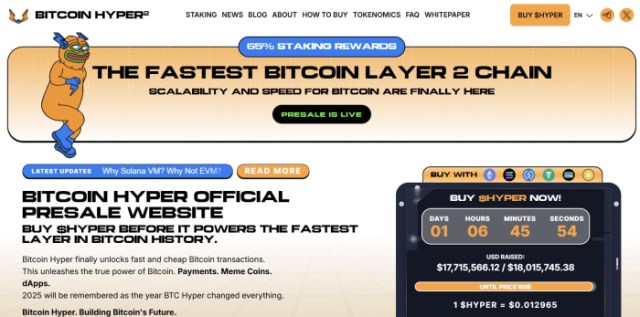
And it’s not just retail enthusiasm driving the numbers; several crypto whales have been spotted scooping up large chunks of $HYPER in multiple transactions.
For example, two whales recently bought $17.6K and $12.9K worth of $HYPER respectively. That’s the kind of institutional confidence worth paying attention to.
Each token today is available at $0.012965, which you can stake for 65% APY. And according to our $HYPER price prediction, it has the potential to soar to $0.32 by the end of 2025, offering mouth-watering returns of over 2,300%.The next token price increase is less than two days away, so you may not get another chance to buy $HYPER at this low price. Interested? Here’s a step-by-step guide on how to buy Bitcoin Hyper.
Visit $HYPER’s official website to learn more about how it’s bringing Bitcoin up to modern blockchain standards.
Disclaimer: None of the above is financial advice. Crypto is highly risky and unpredictable, so kindly always do your own research before investing.
Authored by Krishi Chowdhary, Bitcoinist – https://bitcoinist.com/bitcoin-hyper-layer2-makes-bitcoin-relevant-for-developers
You May Also Like

The Role of Blockchain in Building Safer Web3 Gaming Ecosystems
- Immutable Ownership of Assets Blockchain records can be manipulated by anyone. If a player owns a sword, skin, or plot of land as an NFT, it is verifiably in their ownership, and it cannot be altered or deleted by the developer or even hacked. This has created a proven track record of ownership, providing control back to the players, unlike any centralised gaming platform where assets can be revoked.
- Decentralized Infrastructure Blockchain networks also have a distributed architecture where game data is stored in a worldwide network of nodes, making them much less susceptible to centralised points of failure and attacks. This decentralised approach makes it exponentially more difficult to hijack systems or even shut off the game’s economy.
- Secure Transactions with Cryptography Whether a player buys an NFT or trades their in-game tokens for other items or tokens, the transactions are enforced by cryptographic algorithms, ensuring secure, verifiable, and irreversible transactions and eliminating the risks of double-spending or fraudulent trades.
- Smart Contract Automation Smart contracts automate the enforcement of game rules and players’ economic exchanges for the developer, eliminating the need for intermediaries or middlemen, and trust for the developer. For example, if a player completes a quest that promises a reward, the smart contract will execute and distribute what was promised.
- Anti-Cheating and Fair Gameplay The naturally transparent nature of blockchain makes it extremely simple for anyone to examine a specific instance of gameplay and verify the economic outcomes from that play. Furthermore, multi-player games that enforce smart contracts on things like loot sharing or win sharing can automate and measure trustlessness and avoid cheating, manipulations, and fraud by developers.
- Cross-Platform Security Many Web3 games feature asset interoperability across platforms. This interoperability is made viable by blockchain, which guarantees ownership is maintained whenever assets transition from one game or marketplace to another, thereby offering protection to players who rely on transfers for security against fraud. Key Security Dangers in Web3 Gaming Although blockchain provides sound first principles of security, the Web3 gaming ecosystem is susceptible to threats. Some of the most serious threats include:

Vitalik Buterin Challenges Ethereum’s Layer 2 Paradigm
