Lending

Lending protocols form the backbone of the decentralized money market, allowing users to lend or borrow digital assets without intermediaries. Using smart contracts, platforms like Aave and Morpho automate interest rates based on supply and demand while requiring over-collateralization for security. The 2026 lending landscape features advanced permissionless vaults and institutional-grade credit lines. This tag covers the evolution of capital efficiency, liquidations, and the integration of diverse collateral types, including LSTs and tokenized RWAs.

14494 Articles
Created: 2026/02/02 18:52
Updated: 2026/02/02 18:52
Understanding Aave’s 55% lending share and what it means for $290 support

Understanding Aave’s 55% lending share and what it means for $290 support

The post Understanding Aave’s 55% lending share and what it means for $290 support appeared on BitcoinEthereumNews.com. Key Takeaways How strong are AAVE fundamentals now? Revenue climbed to $192 million with a 55% share, supported by $28.4 billion in Active Loans. What signals does AAVE’s price show? Token traded at $292 support, down 2%, with a breakout likely if loan demand and revenue momentum persist. Aave  [AAVE] showed strong signs of renewed revenue momentum from borrowers on the Ethereum [ETH] network recently. According to Token Terminal data, Aave’s protocol revenue on Ethereum surged to $192 million, with a lending Market Share of 55%. The latest weekly run rate reflected $3.08 million, signaling steady growth in user activity. Source: Token Terminal Borrowing activity is driving growth The real story lies in Aave’s loan book. Active loans on the protocol have surged past $28 billion, continuing an uptrend that’s been building steadily in recent months. Historically, increased borrowing demand has translated into higher protocol revenue, as users pay fees that strengthen Aave’s financial fundamentals. This surge also signals broader momentum across Ethereum’s DeFi ecosystem. The expansion in lending activity reinforces the view that investors are increasingly shifting toward decentralized finance over centralized lenders. More borrowing typically means stronger revenue and growing confidence in DeFi protocols. Price action yet to catch up Interestingly, AAVE’s price has not mirrored the surge in protocol revenue. The token traded in a sluggish range, with its prices shrinking by 2% over the last 24 hours, at press time, leaving a gap between fundamentals and investor sentiment. Price tested a confluence of a demand zone near $290 and an ascending trendline support. Source: TradingView Having said that, such gaps between fundamentals and price rarely persisted. Either enthusiasm around the token might catch up with the growth in Aave’s revenues, or the momentum in lending activity could cool. For now, the fundamentals looked stronger than price…

Author: BitcoinEthereumNews
Blockchain-Based RWA Specialists Bring $50M to Apollo's Tokenized Credit Strategy

Blockchain-Based RWA Specialists Bring $50M to Apollo's Tokenized Credit Strategy

The post Blockchain-Based RWA Specialists Bring $50M to Apollo's Tokenized Credit Strategy appeared on BitcoinEthereumNews.com. Blockchain-based real world asset (RWA) specialists Centrifuge and Plume have launched the Anemoy Tokenized Apollo Diversified Credit Fund (ACRDX), backed by a $50 million anchor investment from Grove, a credit infrastructure protocol within the Sky Ecosystem. The fund gives blockchain investors exposure to Apollo’s diversified global credit strategy, spanning direct corporate lending, asset-backed lending and dislocated credit, a type of mispriced debt due to market stress and lack of liquidity. ACRDX will be distributed through Plume’s Nest Credit vaults under the ticker nACRDX, making the strategy accessible to institutional investors on-chain. By packaging Apollo’s portfolio in tokenized form, the fund aims to lower entry barriers and increase transparency for investors seeking exposure to private credit markets, according to a press release. Apollo, a $600 billion-plus asset manager, is one of several traditional finance firms active n exploring blockchain rails. Its digital assets head Christine Moy said the initiative expands access to institutional-grade strategies while helping “build the onchain DeFi economy” alongside Grove and Centrifuge. The product combines Apollo’s investment management with Centrifuge’s tokenization infrastructure and Plume’s real-world asset–focused blockchain. Chronicle will serve as oracle provider, and Wormhole will handle cross-chain connectivity. Subject to approval, Anemoy will oversee the fund as manager. Source: https://www.coindesk.com/business/2025/09/16/blockchain-based-rwa-specialists-bring-usd50m-to-apollo-s-tokenized-credit-strategy

Author: BitcoinEthereumNews
Tokenized Deposits Go Global: Japan’s SBI Shinsei Teams Up with Partior, DeCurret

Tokenized Deposits Go Global: Japan’s SBI Shinsei Teams Up with Partior, DeCurret

The post Tokenized Deposits Go Global: Japan’s SBI Shinsei Teams Up with Partior, DeCurret appeared first on Coinpedia Fintech News Great news – Japan’s SBI Shinsei Bank is stepping into blockchain-powered payments with a new global partnership.  The bank has signed an MoU with Singapore’s Partior and Japan’s DeCurret DCP to develop a settlement system for tokenized deposits that works across multiple currencies. Here are the details you can’t miss!  Faster Payments, Lower Costs The …

Author: CoinPedia
BitMine’s $11 billion Ethereum bet – Risky gamble or strategic masterstroke?

BitMine’s $11 billion Ethereum bet – Risky gamble or strategic masterstroke?

The post BitMine’s $11 billion Ethereum bet – Risky gamble or strategic masterstroke? appeared on BitcoinEthereumNews.com. Key Takeaways Why does BitMine’s ETH bet matter? BitMine has bagged 2.15 million ETH worth $11 billion. In doing so, it’s chasing a 5% supply target while holding $284 million in unrealized losses. How is it different from MicroStrategy? Unlike MSTR’s debt-fueled BTC stack, BitMine is diversifying with equity plays. BitMine has become the world’s largest Ethereum [ETH] holder. In fact, with over 2.151 million ETH valued at nearly $11 billion, it’s edging closer to its ambitious 5% supply target. However, it’s also worth noting that with an average entry of $4,632, the stack’s sitting on $284 million in unrealized losses. According to AMBCrypto, this is a key metric in sizing up whether BitMine’s Ethereum play is a risky gamble or a strategic masterstroke. BitMine provides latest holdings update BitMine just dropped its latest AUM numbers, clocking in at $10.77 billion. The stack includes 2,151,676 ETH at an average entry of $4,632,192 BTC – A $214 million equity slice in Eightco (NASDAQ: ORBS), and $569 million in free cash. It’s a solid mix of core crypto holdings and strategic bets. Simply put, BitMine isn’t just stacking ETH. Eightco is a prime example. For context, in a recent strategic move, BitMine invested $20 million in Eightco to back its pivot into Worldcoin [WLD] and crypto-driven ventures. Source: TradingView (BMNR/USD) Strategically, BitMine is charting a different path than MSTR. While MicroStrategy is stacking 638k BTC worth $74 billion on the back of debt, BitMine (NASDAQ: BMNR) is putting its capital to work across revenue-driving plays. In turn, making diversification the name of the game. In essence, even with the stock off 94% from its $880-peak, the treasury’s cash flow has been solid. That keeps its Ethereum stack positioned as an alpha-chasing play, not a core revenue driver. ETH holdings serve as high-risk,…

Author: BitcoinEthereumNews
‘This is absurd:’ Crypto community pushes back as Bank of England proposes stablecoin caps

‘This is absurd:’ Crypto community pushes back as Bank of England proposes stablecoin caps

UK regulators propose caps on stablecoin ownership to protect financial stability. The crypto industry criticizes the plan as costly, unnecessary, and counterproductive, to say the least. The Bank of England‘s plan to impose strict limits on stablecoin ownership reportedly drew…

Author: Crypto.news
Saudi Awwal Bank partners with Chainlink to leverage CCIP and CRE in blockchain innovation pact

Saudi Awwal Bank partners with Chainlink to leverage CCIP and CRE in blockchain innovation pact

The post Saudi Awwal Bank partners with Chainlink to leverage CCIP and CRE in blockchain innovation pact appeared on BitcoinEthereumNews.com. Saudi Awwal Bank (SAB) has entered a strategic agreement with Chainlink to strengthen its digital transformation agenda. The partnership brings to Saudi banking Chainlink’s Cross-Chain Interoperability Protocol (CCIP) and Chainlink Runtime Environment (CRE), a step towards onchain financial services. The CCIP facilitates secure cross-chain transfers of assets and data. This functionality bridges decentralized applications and traditional financial platforms, opening up the path for the seamless integration of tokenized assets, programmable contracts, and real-time settlement mechanisms. CRE provides SAB with a developer-friendly platform for testing, building, and deploying next-generation banking tools reliably and securely. In a tweet on X, SAB noted, “This collaboration marks a pivotal step in our commitment to drive Financial Innovation in Saudi Arabia.” Through these technologies, SAB has the ability to test new applications such as automated lending, tokenization of physical assets, and faster cross-border payments. Tokenization is relevant to financial markets, where stocks, bonds, and real estate can be digitally represented for easier and safer transactions. Smart contracts can also make loans and insurance contracts more efficient by automating the process and cutting down on paperwork and operational delay. Saudi Awwal Bank (@alawwalsab), one of Saudi Arabia’s largest banks with over $100 billion in total assets, is leveraging several Chainlink services to facilitate the deployment of next-generation onchain applications in Saudi Arabia. Under the innovation agreement, SAB is… https://t.co/DAvUawI3Yg pic.twitter.com/Zhlm1GJdGp — Chainlink (@chainlink) September 16, 2025 Chainlink aligns with Saudi Arabia’s vision 2030 The collaboration is in line with Saudi Arabia’s wider Vision 2030 initiative, which focuses on innovation in financial services. Earlier this year, in a message on his vision for 2030, Saudi Arabia’s Crown Prince Mohammed bin Salman said the kingdom would “turn the Public Investment Fund into the world’s largest sovereign wealth fund. Our nation holds strong investment capabilities, which we will harness…

Author: BitcoinEthereumNews
From $0.035 to $10? Mutuum Finance (MUTM) Named Top Crypto to Buy for the 2025–26 Bull Run

From $0.035 to $10? Mutuum Finance (MUTM) Named Top Crypto to Buy for the 2025–26 Bull Run

Mutuum Finance (MUTM) is predicted to skyrocket from $0.035 to hit $10 in 2025, making it one of the top talked-about cryptos. Mutuum Finance is currently in its sixth phase of presale. The tokens are being sold at $0.035 per MUTM. The project has raised over $15.85 million and has over 16,340 holders. In contrast […]

Author: Cryptopolitan
Saudi Awwal Bank (SAB) taps Chainlink to drive blockchain innovation

Saudi Awwal Bank (SAB) taps Chainlink to drive blockchain innovation

Saudi Awwal Bank partners with Chainlink to advance onchain finance, tokenization, and digital banking in line with Saudi Vision 2030 goals.

Author: Cryptopolitan
Crypto Looks at Fed Interest Rate Cut as Trump Shakes Up Central Bank

Crypto Looks at Fed Interest Rate Cut as Trump Shakes Up Central Bank

The post Crypto Looks at Fed Interest Rate Cut as Trump Shakes Up Central Bank appeared on BitcoinEthereumNews.com. As the US Federal Reserve prepares to adjust interest rates on Wednesday, a broader shake-up at the central bank could have serious implications for crypto markets. The Fed is expected to cut interest rates tomorrow, in a move that traditionally signals a rally in crypto markets: Lower yields on assets like bonds mean riskier assets like crypto are more attractive. The expected rate cuts come amid a political battle and a new appointment to the Federal Reserve. US President Donald Trump’s administration has charged Fed governor Lisa Cook with mortgage fraud as it seeks her removal. Meanwhile, the Senate has confirmed White House economic adviser Stephen Miran to the board of governors. The charges against Cook and the effort to nominate an individual with ties to the administration could mean a less independent Federal Reserve, which plays an important role in setting crypto policy. Bitcoin price spiked in 2021-2022 amid low US interest rates. Source: Trading Economics What a political Federal Reserve means for crypto policy The Trump administration is seeking to remove Cook — a Biden-era appointee — as it aims to exert more control over the Federal Reserve. On Aug. 25, the White House X page posted a letter in which Trump fired Cook, accusing her of making false statements on one or more mortgage agreements. Cook denied the accusations and refused to step down. Her legal team said the charges were motivated by politics and that the White House is “scrambling to invent new justifications for its overreach.” Cook herself said that it is “unprecedented and illegal.” On Monday, the appeals court in Washington blocked the White House from removing Cook from her position at the Federal Reserve. This will allow her to maintain her post while the case is pending. Trump sought to remove Cook on…

Author: BitcoinEthereumNews
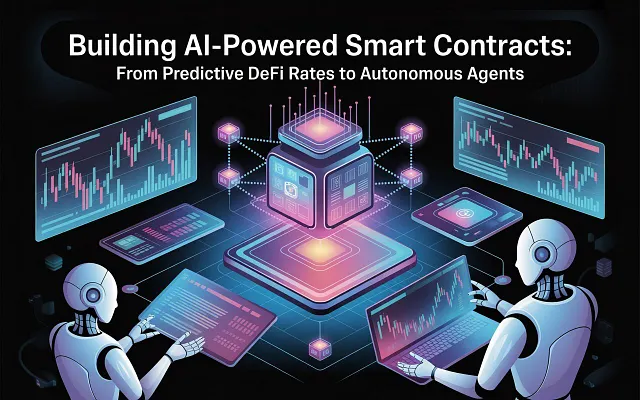
Building AI‑Powered Smart Contracts: From Predictive DeFi Rates to Autonomous Agents

Building AI‑Powered Smart Contracts: From Predictive DeFi Rates to Autonomous Agents

Smart contracts have become the foundation of decentralized applications and the broader blockchain economy. They introduce a model where rule-based execution removes intermediaries, making transactions faster, cost-effective, and transparent. With the growing complexity of decentralized finance (DeFi), NFT ecosystems, and digital identity systems, the integration of artificial intelligence (AI) into smart contracts is creating a new class of dynamic, responsive, and autonomous digital agreements. Businesses exploring decentralized applications are no longer just thinking about static contracts that execute a fixed set of instructions. They want intelligent contracts capable of analyzing data, adjusting conditions, and interacting with external systems in real-time. This is where AI‑powered smart contracts are making a significant impact. Companies offering Smart Contract Audit Services and development expertise are now engaging in projects where intelligence is embedded into the very logic of decentralized systems, making them adaptive and business-centric. This blog explores the concept of AI‑powered smart contracts, how they work, practical examples such as predictive DeFi rates, autonomous agent workflows, and why they matter to startups, enterprises, and financial institutions. It also lays out the development process, challenges, and the role expertise plays in making these solutions reliable. What Are AI‑Powered Smart Contracts? Traditional smart contracts are written in languages such as Solidity (Ethereum) or Rust (Solana), with the logic defined at the creation stage. Once deployed, these contracts only operate within the coded parameters and blockchain environment. They rely on oracles or off-chain data feeds to fetch updates but act as static executors of conditions. AI‑powered smart contracts extend this approach by integrating artificial intelligence and machine learning models into the decision-making logic. Instead of waiting for fixed inputs, these contracts can process real-time data, analyze patterns, and even predict future outcomes. For example: A DeFi liquidity pool agreement that can adjust interest rates dynamically based on predicted demand. An insurance contract that automatically validates claims through predictive fraud detection models. A supply chain agreement that validates delivery time expectations using predictive logistics data. In essence, AI adds a layer of cognitive flexibility to the deterministic nature of smart contracts. Why Businesses Should Care About AI‑Powered Smart Contracts For companies evaluating blockchain strategies, AI‑embedded smart contracts are relevant because they introduce automation that goes beyond execution — they introduce adaptability. Businesses that rely on evolving market data, customer profiles, and external conditions no longer need manual updates or human oversight for every change. Key benefits include: Dynamic pricing: Smart contracts that read live market data and adjust token prices automatically. Fraud reduction: AI‑enabled anomaly detection integrated into crypto transactions. Cost savings: Long-term process automation with reduced reliance on human intervention. Scalability: Contracts that can manage more complex logic as industries evolve. Improved customer trust: Users engage with smarter financial and business products that respond to real-time insights. For forward-looking organizations, these benefits mean smarter products in DeFi, tokenized assets, digital identity management, and cross-industrial applications. Core Components: How AI and Smart Contracts Work Together The combination of blockchain and AI requires a modular system. Businesses developing AI‑powered smart contracts must combine these elements effectively: Smart Contract LogicThe base layer coded in Solidity, Rust, or Vyper. It defines the rules and execution structure. AI ModelsAlgorithms that allow prediction, classification, and recommendation. These models can be deployed on-chain (basic AI logic) or off-chain (more resource-intensive models). OraclesGateways that bring external data, model outputs, or real-world events back onto the blockchain. AI contracts rely on trustworthy and tamper‑resistant oracles. Data PipelinesTraining AI requires data. Data from DeFi markets, supply chains, IoT devices, or customer interactions must be aggregated, cleaned, and structured for modeling. Consensus and Verification Unlike regular decentralized consensus (PoW, PoS), AI‑driven decisions may require additional verification methods to maintain trust. Predictive DeFi Rates: A Use Case Example DeFi protocols rely heavily on interest rate models that determine borrowing costs, lending returns, and risk assessment. Traditionally, these rates are defined by static formulas or governance voting. AI‑powered smart contracts open a more advanced mechanism — predictive DeFi rates. Here’s how: Historical transaction data is analyzed with AI models to detect demand patterns. Contracts predict future borrowing activity and automatically adjust rates. Rates can also adapt to macroeconomic data (such as inflation figures brought into the blockchain by trusted oracles). Borrowers and lenders get a fairer model, while liquidity providers mitigate risks. Businesses in the financial technology sector can integrate such models to introduce innovative DeFi products that differentiate them from existing services. Autonomous Agents in Smart Contracts One of the most exciting implications of combining AI and blockchain is the creation of autonomous agents — self-governing units capable of executing complex sequences of transactions, negotiations, or verifications. Consider an autonomous agent in logistics: A shipment container has a digital identity linked to an AI model on the blockchain. The contract autonomously verifies shipping routes, predicted delays, and customs documents. Payment milestones are auto-executed as checkpoints are validated. The agent negotiates with multiple stakeholders (shipping firms, ports, customs authorities) — all without human involvement. Such autonomous contracts extend the scope of blockchain beyond financial applications to global industries like real estate, healthcare, and trade. Development Process: Building AI‑Powered Smart Contracts For businesses working with Smart Contract Development companies, the process can be broken into key stages:

  1. Defining Objectives Clear understanding of what the contract must achieve. Examples: predictive interest rates, fraud detection, supply chain monitoring.
  2. Data Preparation Identifying clean and relevant datasets, essential for training AI models that will be linked to contracts.
  3. Model Training Selecting AI methods such as regression, reinforcement learning, or neural networks depending on requirements.
  4. Integration with Smart Contracts Deploying models or their outputs through oracles and APIs. The contract must remain secure, auditable, and efficient even with AI logic.
  5. Testing and Smart Contract Audit Before mainnet deployment, contracts undergo testing, simulations, and a detailed Smart Contract Audit, which includes not only vulnerabilities in on‑chain code but also in data pipelines and AI model integrity.
  6. Deployment and Monitoring Live contract execution across blockchain networks with monitoring tools to validate performance. Challenges and Considerations Businesses planning AI‑powered contract adoption must address these challenges:
Gas costs: More complex contracts require higher execution fees. Transparency in AI: Black-box models can cause disputes; explainability is vital. Model decay: AI models require retraining with updated data. Data quality: Biased or incomplete data can lead to faulty contract outcomes. Regulation: DeFi and AI both face evolving regulatory scrutiny. Addressing these concerns early smooths the adoption journey. Real-World Applications for Businesses InsuranceAI‑driven smart contracts flag fraud by analyzing claim patterns. HealthcareAutonomous AI contracts validate health‑data integrity and track drug distributions. Supply ChainsContracts predict delays and settle disputes using verified external data. Energy Trading AI models forecast usage and settle micro-transactions in near-real time. Decentralized Identity Adaptive contracts authenticate access to digital services securely. These industries are finding tangible value in combining AI’s predictive capabilities with blockchain’s immutability. The Role of Smart Contract Development Companies For organizations, building AI‑powered smart contracts from scratch is often impractical. It requires blockchain architects, AI engineers, auditors, and integration experts. This is why specialized Smart Contract Development companies play a key role. They not only deliver secure smart contracts but also integrate AI features and conduct ongoing audits to maintain efficiency and compliance. Conclusion AI‑powered smart contracts are taking decentralized applications to new levels of intelligence and functionality. From predictive DeFi rates to self-operating agents, these contracts provide a glimpse of how automation and decision-making can coexist on the blockchain. For businesses and financial institutions, this technology unlocks ways to build more adaptive, intelligent, and secure decentralized solutions. However, success in this field depends on expertise, reliable audits, and robust development methodologies. If your business is ready to explore AI‑powered Smart Contracts — whether for DeFi, enterprise automation, or digital identity — the right development partner makes all the difference. Take the next step in building intelligent blockchain solutions. Partner with Codezeros for Smart Contract Development and gain access to secure, business-ready AI‑powered contracts that align with your goals. Building AI‑Powered Smart Contracts: From Predictive DeFi Rates to Autonomous Agents was originally published in Coinmonks on Medium, where people are continuing the conversation by highlighting and responding to this story

Author: Medium