Index

A crypto Index provides a way for investors to gain diversified exposure to a specific basket of digital assets through a single tokenized product. These indices often track specific sectors, such as DeFi, DePIN, or RWA, and are automatically rebalanced via smart contracts. In 2026, AI-managed thematic indices have become the gold standard for passive investing, allowing users to track the "blue chips" of the Web3 economy without manual portfolio management. This tag covers index methodology, rebalancing frequency, and the benefits of diversified crypto baskets.

25066 Articles
Created: 2026/02/02 18:52
Updated: 2026/02/02 18:52
Dollar falls against major currencies as US stocks underperform peers at worst level since 1993

Dollar falls against major currencies as US stocks underperform peers at worst level since 1993

The dollar just got steamrolled. It’s now lower against every single major currency, and US stocks are trailing the rest of the world by the widest margin since 1993. It’s been four months since the “Sell America” trade began dumping US stocks, bonds, and the dollar in one coordinated hit. Now things have calmed down, […]

Author: Cryptopolitan
Sterling Surges: Unpacking the Impact of Robust UK Economic Data

Sterling Surges: Unpacking the Impact of Robust UK Economic Data

BitcoinWorld Sterling Surges: Unpacking the Impact of Robust UK Economic Data In the dynamic world of global finance, even traditional currency movements can send ripples across various asset classes, including the increasingly interconnected cryptocurrency market. Recently, the Sterling exchange rate experienced a significant uplift, a development that caught the attention of traders and investors alike. This surge was primarily driven by the release of stronger-than-expected economic indicators from the United Kingdom, painting a more optimistic picture for the nation’s economic health. What is the Sterling Exchange Rate Doing? The British Pound (GBP), often referred to as Sterling, demonstrated a robust appreciation against major currencies following the latest data releases. This upward movement reflects a renewed confidence in the UK economy’s resilience. The immediate reaction in the Sterling exchange rate saw it strengthening against the US Dollar (USD) and the Euro (EUR), among others. This immediate response highlights how sensitive currency markets are to economic news, especially when it deviates significantly from forecasts. Traders observed a swift shift in sentiment, pushing the GBP higher as market participants priced in the improved economic outlook. Decoding the UK Economic Data: The PMI Story At the heart of Sterling’s recent ascent lies the UK economic data, specifically the Purchasing Managers’ Index (PMI) figures. PMI surveys are crucial gauges of economic activity, providing insights into the manufacturing, services, and construction sectors. A reading above 50 indicates expansion, while a reading below 50 suggests contraction. The recent data revealed an unexpected rebound, particularly in the services sector, which dominates the UK economy. This stronger-than-anticipated performance signaled a potential recovery path, defying earlier pessimistic projections. Here’s a breakdown of what the recent PMI data revealed: Services PMI: This sector, representing a significant portion of the UK’s GDP, showed a notable increase, indicating renewed business activity and consumer spending. This strength is often a key driver for overall economic sentiment. Manufacturing PMI: While perhaps not as strong as services, the manufacturing sector also showed signs of stabilization or slight expansion, contributing to the overall positive picture. Composite PMI: This combined index, reflecting activity across both manufacturing and services, registered a reading well above the 50-mark, signaling broad-based economic expansion. These figures are compiled from surveys of purchasing managers in various companies, making them a timely and often accurate predictor of economic trends. Why is Strong Purchasing Managers’ Index Data Important? The significance of a robust Purchasing Managers’ Index extends beyond mere numbers. It offers a forward-looking perspective on economic health, influencing monetary policy decisions by central banks like the Bank of England (BoE). Strong PMI data can suggest inflationary pressures or economic resilience, potentially leading the BoE to consider tightening monetary policy, such as raising interest rates, sooner than anticipated. Higher interest rates typically make a currency more attractive to foreign investors seeking better returns on their investments, thereby supporting its value. This positive outlook can also boost consumer and business confidence, fostering a virtuous cycle of economic activity, encouraging investment, and potentially leading to job creation. Analyzing GBP Performance in the Current Climate While the recent PMI figures have provided a significant boost, understanding overall GBP performance requires a look at the broader economic landscape. Factors such as inflation trends, global economic sentiment, geopolitical developments, and the Bank of England’s stance on interest rates all play a role. Currently, the UK faces persistent inflation, which the BoE is actively trying to combat. Stronger economic data, while positive for growth, could also imply that inflation might be stickier, potentially requiring more aggressive rate hikes to bring it back to target. This nuanced interplay of factors keeps the GBP in a dynamic state, subject to continuous re-evaluation by market participants. Other influences on GBP performance include: Inflation Outlook: Higher-than-expected inflation could prompt the BoE to maintain a hawkish stance, supporting the GBP. Interest Rate Differentials: The gap between UK interest rates and those of other major economies impacts capital flows and currency appeal. Global Risk Appetite: In times of global uncertainty, investors often flock to safe-haven currencies, which can affect GBP. Political Stability: Domestic political developments and stability can also influence investor confidence in the UK economy. What are the Broader Forex Market Trends? The uplift in Sterling is not isolated; it’s part of larger Forex market trends that are constantly evolving. Globally, central banks are grappling with inflation, recession fears, and varying economic recoveries post-pandemic. The US Dollar’s strength, the Eurozone’s challenges, and Japan’s unique monetary policy all contribute to the complex tapestry of currency movements. Sterling’s recent rise, driven by domestic data, shows that while global forces are strong, localized economic resilience can still carve out distinct paths for individual currencies. Traders will be closely watching for sustained positive data and any shifts in the BoE’s communication to gauge the longevity of this GBP strength. This recent movement underscores the importance of fundamental analysis in currency trading, where economic data releases can swiftly alter market dynamics and influence global investment strategies. Key Aspects and Actionable Insights The recent Sterling surge highlights several key aspects for investors and market watchers: Benefits: Increased Investor Confidence: Strong economic data often signals a healthier investment environment, attracting foreign capital into UK assets. Potential for Stronger Economic Recovery: Positive PMI figures suggest that the UK economy might be more resilient than previously thought, leading to a faster rebound. Improved Purchasing Power: A stronger Sterling means that UK consumers and businesses can purchase foreign goods and services more cheaply, benefiting importers. Challenges: Sustaining Momentum: While promising, one strong data point does not guarantee a sustained recovery, especially amid ongoing global economic uncertainties and geopolitical tensions. Persistent Inflationary Pressures: Strong growth could exacerbate inflation, potentially requiring the Bank of England to implement further restrictive monetary policies, which could temper growth later. Risk of Data Volatility: Economic data can be volatile, and future releases might not be as positive, leading to potential reversals in currency strength. Actionable Insights for Traders and Investors: Monitor Upcoming Releases: Keep a close watch on future UK economic releases, especially inflation, retail sales, and labor market data, as these will provide further clues about the economy’s direction. Analyze Bank of England Statements: Pay attention to any speeches or minutes from the Bank of England’s Monetary Policy Committee. Their forward guidance on interest rates will be crucial for the Sterling’s trajectory. Consider Portfolio Diversification: For those with exposure to various asset classes, understanding how traditional currency strength impacts other markets, including commodities and even cryptocurrencies, can inform diversification strategies. Risk Management: Given the inherent volatility of currency markets, employing robust risk management strategies is essential when trading or investing based on economic data. Conclusion The recent surge in the Sterling exchange rate, propelled by encouraging UK PMI data, marks a significant moment for the British economy. It underscores the profound impact of robust economic indicators on currency valuations and broader market sentiment. While the path ahead remains subject to global and domestic challenges, this positive development provides a fresh wave of optimism for the UK’s economic trajectory. For those navigating the intricate world of finance, understanding these fundamental shifts in UK economic data is paramount to making informed decisions and anticipating future market movements. To learn more about the latest Forex market trends, explore our article on key developments shaping the Sterling and other major currencies’ liquidity and institutional adoption. This post Sterling Surges: Unpacking the Impact of Robust UK Economic Data first appeared on BitcoinWorld and is written by Editorial Team

Author: Coinstats
XRP Price Prediction: Token Drops 16% as Smart Money Dumps 80% of Holdings in 30 Days

XRP Price Prediction: Token Drops 16% as Smart Money Dumps 80% of Holdings in 30 Days

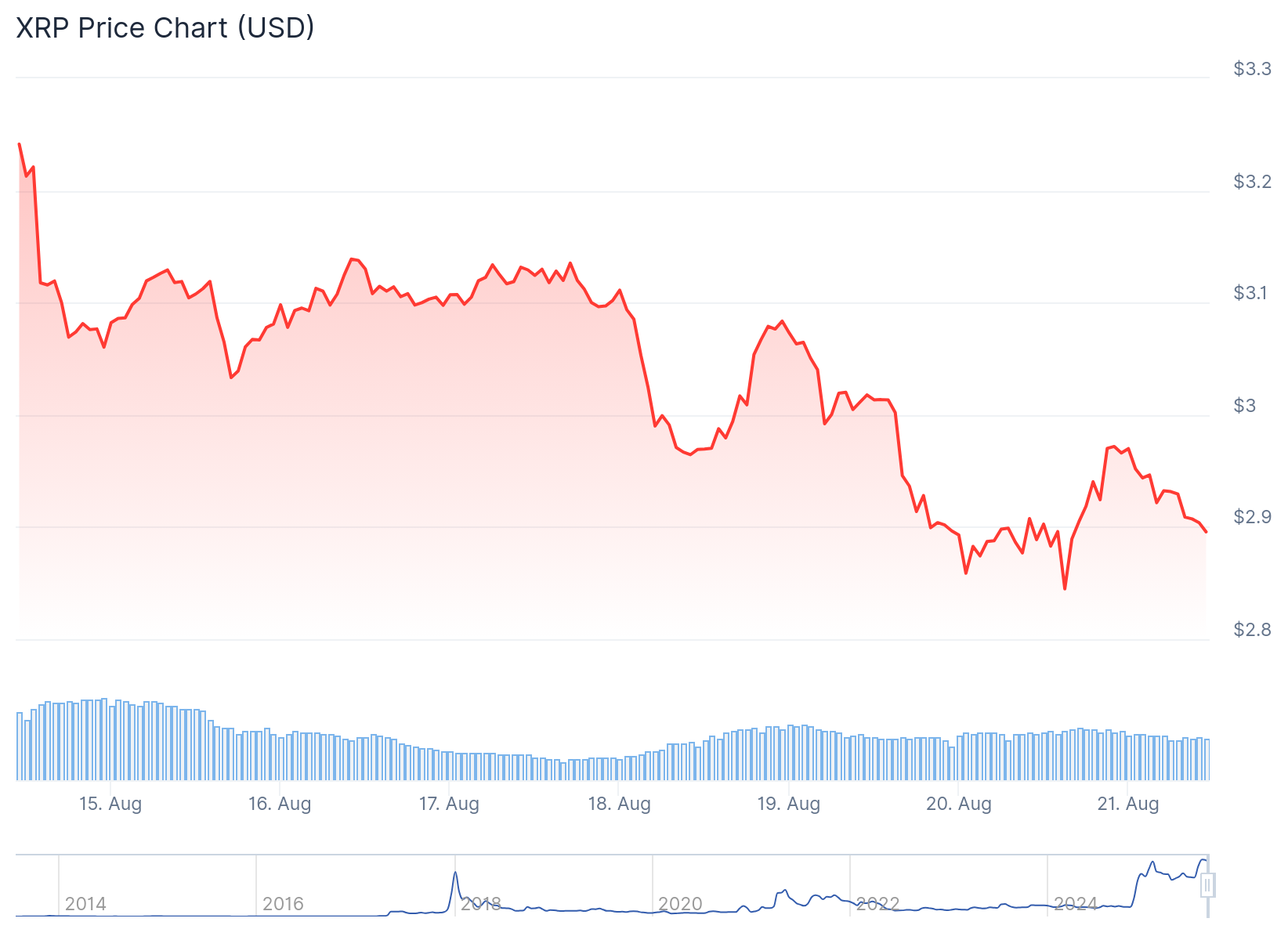
TLDR XRP has dropped 16.8% over the past 30 days, trading at $2.93 Smart money investors reduced XRP holdings by 80% in the last month Network activity declined with weekly transactions down 14.8% and active addresses falling 2.1% Technical analysis shows bearish patterns with price breaking below key support levels Futures traders turned bearish with [...] The post XRP Price Prediction: Token Drops 16% as Smart Money Dumps 80% of Holdings in 30 Days appeared first on CoinCentral.

Author: Coincentral
Critical Month Approaches for XRP: Two Very Important Events Will Be Concluded – Here Are the Details

Critical Month Approaches for XRP: Two Very Important Events Will Be Concluded – Here Are the Details

The post Critical Month Approaches for XRP: Two Very Important Events Will Be Concluded – Here Are the Details appeared on BitcoinEthereumNews.com. Ripple and XRP may come to the fore in October with both legal and regulatory developments. Attorney Bill Morgan highlighted two critical decisions expected to be announced around the same time: the U.S. Securities and Exchange Commission’s (SEC) final decision on spot XRP ETF applications and the U.S. Office of the Comptroller of the Currency’s (OCC) review of Ripple’s national bank license application. These two developments could be turning points for XRP’s future and Ripple’s role in the global financial sector. The SEC has postponed its decision on spot XRP ETF applications filed by CoinShares, Grayscale, and 21Shares for the second time, moving the deadline to the end of October 2025. This deadline cannot be extended under US law, so the SEC will have to either approve or reject the applications next October. A potential approval would allow regulated investment products linked to XRP’s spot market to be listed on US exchanges, significantly expanding access for institutional and individual investors. Ripple’s application to the OCC for a national bank license in the US could be finalized in October. The OCC is required by law to respond to the application, submitted on July 2nd, within 120 days. If approved, Ripple would join the ranks of nationally recognized US banks and expand beyond payment technologies into banking operations. Furthermore, the company’s extensive XRP holdings on its balance sheet could provide significant leverage in this process. According to Bill Morgan, October could be a “decisive turning point” for Ripple and XRP, as decisions from both the SEC and OCC will play a critical role in the token’s adoption and Ripple’s long-term strategy. *This is not investment advice. Follow our Telegram and Twitter account now for exclusive news, analytics and on-chain data! Source: https://en.bitcoinsistemi.com/critical-month-approaches-for-xrp-two-very-important-events-will-be-concluded-here-are-the-details/

Author: BitcoinEthereumNews
Crypto Sector Records Upsurge Driven by Altcoins

Crypto Sector Records Upsurge Driven by Altcoins

Altcoins drive cautious optimism as Bitcoin ($BTC) and Ethereum ($ETH) rise as well as DeFi and NFT volumes surge, and China is exploring yuan stablecoins.

Author: Blockchainreporter
Ethereum price stalls below $4.3K as sell pressure rises

Ethereum price stalls below $4.3K as sell pressure rises

The post Ethereum price stalls below $4.3K as sell pressure rises appeared on BitcoinEthereumNews.com. Ethereum price is struggling to hold momentum below $4,300 as overheated futures markets and rising exchange reserves create short-term selling pressure. Summary Ethereum trades near $4,290, holding below $4,300 after a 16% monthly gain. Rising exchange reserves and sell-heavy futures flows point to short-term pressure. Technicals are mixed, but ETF inflows and treasury demand support the medium-term outlook. As of this writing, Ethereum’s price (ETH) is up 2.2% over the previous day, trading at $4,290. The token has hovered between $4,080 and $4,776 over the last seven days, losing 9% during that time but maintaining a 16% monthly gain. Only 12% separates ETH from its peak of $4,878 set in November 2021. Ethereum on-chain and derivatives outlook Market analysts are pointing to a split in Ethereum’s structure. While futures activity is beginning to overheat, spot markets are still largely stable. CryptoQuant contributor XWIN Research Japan noted in an Aug. 21 analysis that exchange reserves have slightly increased, indicating that there are more coins for sale. Furthermore, the cumulative delta data shows that there are more sell orders than buy orders, which suggests that traders are reluctant to open new long positions near current levels. Futures volume maps also show clusters of activity near recent highs, a pattern that often precedes forced liquidations and notable price swings. The mix of slow spot flows and overheated futures has put Ethereum in a delicate position. In the short term, stretched leverage may force ETH back toward the $3,950–$4,100 range if a wave of liquidations hits the market. However, the medium-term outlook is still positive. Institutional exchange-traded fund inflows, the growing use of ETH in corporate treasuries, and Ethereum’s expanding role in real-world asset tokenization continue to provide strong underlying demand.  The report suggests that once leverage resets and sell-dominant flows subsides, Ethereum might begin…

Author: BitcoinEthereumNews
Indian Rupee ticks down despite strong flash India’s PMI data

Indian Rupee ticks down despite strong flash India’s PMI data

The post Indian Rupee ticks down despite strong flash India’s PMI data appeared on BitcoinEthereumNews.com. The Indian Rupee falls marginally to near 87.20 against the US Dollar. India’s flash HSBC PMI expanded at a faster pace in August. FIIs continue to pare stakes from Indian stock markets. The Indian Rupee (INR) ticks down to near 87.20 against the US Dollar (USD) during the European session on Thursday. The USD/INR pair edges higher even as preliminary India’s private sector Purchasing Managers’ Index (PMI) data for August has come in stronger. The Composite PMI rises to near 65.2 from 61.1 in July as activities in both manufacturing and the services sectors expanded at a faster pace. “The Services flash PMI touched an all-time high of 65.6, led by a sharp pick up in new business orders, both export and domestic. The Manufacturing flash PMI rose further, inching closer to the 60-mark, led by a smart rise in new domestic orders. Growth of new export orders, however, remained unchanged at July’s levels. Margins improved as the rise in output prices was much faster than that for input costs,” Pranjul Bhandari, Chief India Economist at HSBC, said. On a broader note, the Indian Rupee trades firmly as the announcement of Goods and Services Tax (GST) reforms by Indian Prime Minister Narendra Modi on the Independence Day has increased investors’ confidence that the Reserve Bank of India (RBI) will be reluctant to adopt an aggressive monetary easing approach. On August 15, India’s PM Modi announced that the government will unfold GST 2.O in which taxes on goods will be reduced to boost consumption. The impact is clearly visible on Indian stock markets, which have risen significantly since the announcement. Nifty 50 is up almost 1.5% to near 25,070. The 50-stock basket hit a fresh four-week high around 25,150. Contrary to Nifty50’s outperformance, overseas investors have been paring stakes from Indian…

Author: BitcoinEthereumNews
Render (RENDER) Tests Support While Sui (SUI) Faces Downside – Key Levels to Watch

Render (RENDER) Tests Support While Sui (SUI) Faces Downside – Key Levels to Watch

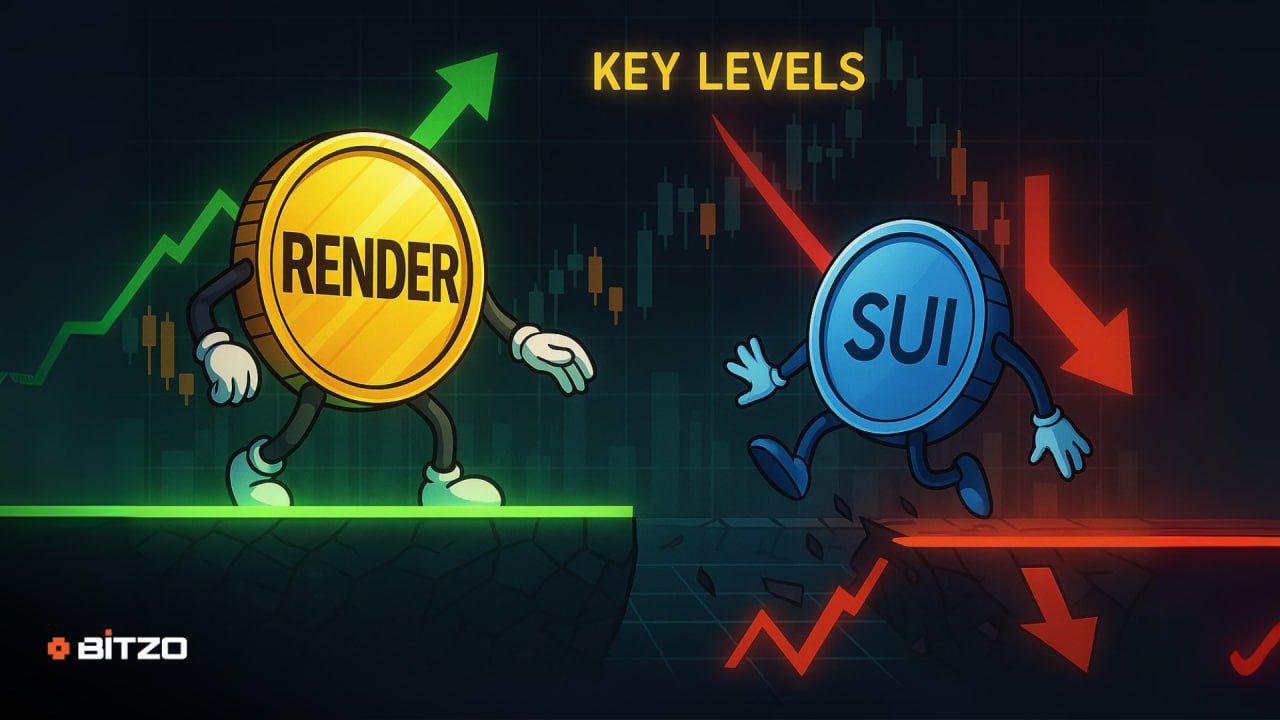
Two notable cryptocurrencies are experiencing contrasting movements. Render (RENDER) examines its stability, while Sui (SUI) deals with potential drops. This article dives into the critical levels that could hint at their future performance, helping investors understand which assets might be poised for growth. Uptrend Shadows Amid Steep Declines and Support Battles RENDER behavior reveals a consistent downtrend in recent trading sessions. The price has fallen notably over the past month by nearly 17%, while a longer six-month view shows a decline of nearly 20%. Losses are evident on both short and medium-term charts, indicating that sellers are in control. Price movements have trended downwards steadily with little sign of rally, and oscillators and momentum measures have remained negative. Current prices trade within a range from about $2.94 to $4.62. The nearest key levels include support near $2.14 and resistance around $5.51. Bears seem to dominate, with indicators suggesting insufficient momentum to break higher. The coin lacks a definitive upward trend and remains under selling pressure, although support at $2.14 offers a potential floor. Traders might consider short-term plays between resistance at $5.51 and the support level, with a focus on price reactions around these levels for potential trading opportunities. Sui Price Analysis: Recent Drop With Stable Six‑Month Trend Sui experienced a 10.56% drop over the past month, while the six-month change showed a slight gain of 0.61%. This price movement indicates a sharp short-term decline contrasting with the generally steady performance observed over the half-year period. A weekly loss of 10.46% highlights the recent bearish sentiment, although the modest increase over six months suggests some stability. The lack of significant recovery indicators in the past month reflects cautious trading behavior, with sharp short-term volatility paired with a consolidated trend over a longer duration. Currently, the coin trades within a range of approximately $2.70 to $4.49. Immediate support stands near $1.78, crucial for preventing further declines. Primary resistance is at $5.36, with a secondary resistance at $7.16, serving as targets for short-term moves. The Awesome Oscillator at -0.13 and the Momentum Indicator at -0.40 suggest bearish pressure, while the Relative Strength Index at 44.14 indicates a market that is vulnerable to continued declines. Traders may watch the $1.78 support closely for potential rebounds and target $5.36 for exits on upward movements. Some may consider shorting if the price falls below $1.78, while others might wait for a breakout before entering long positions. Prudent risk management is essential as market conditions remain fluid. Conclusion RENDER is testing a critical support level, indicating potential for either a rebound or further decline. On the other hand, SUI is experiencing a downward trend, suggesting it may face additional pressure. Monitoring these key levels will be crucial for investors looking to make informed decisions about their positions in both RENDER and SUI. Disclaimer: This article is provided for informational purposes only. It is not offered or intended to be used as legal, tax, investment, financial, or other advice.

Author: Coinstats
Ethereum price stalls below $4,300 as analyst warns of sell-side pressure

Ethereum price stalls below $4,300 as analyst warns of sell-side pressure

Ethereum price holds near $4,290 as analysts weigh sell-side pressure against strong long-term demand.

Author: Crypto.news
Google enters TeraWulf: $3.2 billion to convert Bitcoin mining into AI data centers

Google enters TeraWulf: $3.2 billion to convert Bitcoin mining into AI data centers

Google becomes the main shareholder of TeraWulf (WULF), to convert Bitcoin mining sites into data centers for AI.

Author: The Cryptonomist