

- USDT 本位合约交易以 USDT 结算的永续合约
- USDC 本位合约交易以 USDC 结算的永续合约
- USD1 本位合约交易以USD1结算的永续合约
- 币本位合约交易以其他加密货币结算的永续合约
- 合约赚币资金生息,仓位加成,高达 20% 收益!
- AI 策略想法变策略,AI 智能执行
- 网格交易自动交易,自动捕捉波动获利
- 跟单交易 × AI跟随资深交易员,或结合 AI 制定策略
- 模拟交易零风险模拟合约交易
- 合约概览探索合约工具、产品和功能
- GOLD 合约全天候畅享顶级流动性与杠杆交易
- OIL 合约全天候畅享顶级流动性与杠杆交易
- SILVER 合约0 费率随时交易,畅享顶级流动性与灵活杠杆
- BTC 合约市场最低手续费,高倍杠杆极致体验
- ETH 合约市场最低手续费,高倍杠杆极致体验
- ZEC合约0 费率、最高150x 杠杆、21x+ 高杠杆,可开仓空间第一
- 福利中心轻松领取 $10,000 体验金
- 活动中心更高奖励,0 费率
- 邀请好友邀请 1 位好友,赢取 140 USDT
- Anthropic Pre-IPO 热潮赢取 ANTHROPIC(PRE)、NVIDIA H200 GPU 及更多奖励
- 中期选举行情盛典交易TradFi赢取 GOLD(XAUT)、SLVON 等更多奖励!
- Launchpad优质币种,早期认购,折价专享
- Airdrop+充值、交易,领取多重大奖
- 阳光普照持有 MX 赚取新币空投
- 美股收益率榜首 独得 $10,000$100 持仓即可挑战
- 0 费率交易热门合约,享限时0费率
- M-Day 合约专场交易合约,领每日大额奖励
- 合约亏损补贴享三重保障,赢取 $5,000 等值 XAUT
What Role Did EIP-7702 Authorizations Play in the Binance Hack?
The Binance securityincident has drawn attention not only because of the scale of the suspicious wallet activity, but also because of one technical detail visible shortly before major Ethereum assets began moving: a batch of EIP-7702 authorizations.
That detail quickly pushed EIP-7702 into the center of the discussion. The Ethereum account-delegation mechanism allows a normal externally owned account, or EOA, to temporarily execute smart contract logic. In the Binance incident, blockchain researchers identified an EIP-7702 delegation shortly before assets were transferred from a Binance-linked hot wallet.
But there is an important distinction.
The presence of an EIP-7702 authorization does not by itself prove that EIP-7702 was exploited.
Binance's initial investigation instead points toward a compromise of operational infrastructure. The exchange said a DevOps engineer's laptop may have been compromised, allowing an attacker to access a service container and submit unauthorized withdrawal transactions. Binance also said it had found no evidence that wallet private keys were leaked.
That makes the incident particularly important for understanding modern wallet security. A private key can remain inside protected infrastructure while an attacker abuses another system that is permitted to request legitimate signatures.
This article explains what EIP-7702 appears to have done in the incident, why reports of multiple authorizations attracted attention, and why the difference between key theft and signing-infrastructure compromise matters.
What Happened in the Binance Security Incident?
Suspicious activity involving Binance-linked hot wallets began attracting attention on October 30, 2026.
On-chain investigators observed large transfers from wallets associated with the exchange to newly created addresses. Early estimates varied considerably as researchers tracked transactions across Ethereum, Bitcoin, Tron and other networks.
Binance subsequently acknowledged a security incident and began investigating the source of the unauthorized transactions. The exchange temporarily suspended deposits and withdrawals while carrying out security checks.
In its October 30 security update, Binance said its initial investigation suggested that a compromised DevOps engineer's laptop allowed an attacker to gain access to a service container and submit unauthorized withdrawal transactions.
The exchange estimated the overall impact at approximately $6.3 billion at that stage of the investigation and said roughly $3 billion of affected assets had been frozen on-chain. Binance also stated that it would cover losses using its SAFU fund and company funds.
Most importantly for the technical discussion, Binance said:
It had found no evidence of a wallet private key leak.
That statement changes how the reported EIP-7702 activity should be interpreted.
Instead of asking only whether an attacker stole a hot-wallet private key, the more relevant question becomes whether a compromised internal system was able to request or facilitate a valid authorization from protected signing infrastructure.
Why Did EIP-7702 Become Part of the Investigation?
EIP-7702 was introduced with Ethereum's Pectra upgrade to give externally owned accounts some of the capabilities normally associated with smart contract wallets.
Traditionally, an Ethereum EOA is controlled by a private key. It can sign transactions, transfer assets and interact with smart contracts, but its own account does not contain programmable execution logic.
EIP-7702 changes that relationship.
It allows an EOA to authorize another contract's code to act as its execution logic while preserving the original Ethereum address.
This enables useful account-abstraction features such as transaction batching, gas sponsorship and more advanced permission systems.
It also means that an EIP-7702 authorization deserves substantially more attention than a conventional token approval.
During analysis of the Binance incident, researchers reported that an address funded through Tornado Cash submitted multiple EIP-7702 authorizations involving a Binance-linked Ethereum hot wallet shortly before major asset transfers occurred.
One authorization reportedly matched the wallet state and became effective.
Approximately three minutes later, significant assets began leaving the wallet.
The timing naturally made the authorization an important part of the investigation.
It still does not tell us how the valid authorization was obtained.
How Does an EIP-7702 Authorization Work?
The easiest way to understand the mechanism is to think of EIP-7702 as allowing an ordinary Ethereum account to temporarily say:
"Use this smart contract's execution logic when my account receives calls."
A simplified flow looks like this:
Ethereum EOA
     │
     │ Signs an EIP-7702 authorization
     ▼
Delegation is assigned
     │
     ▼
Delegate smart contract
     │
     │ Provides executable logic
     ▼
Original EOA can execute
smart-contract-style behavior
The original account does not disappear.
Its address, balances and existing on-chain history remain intact. What changes is the code that can be executed through that account.
EIP-7702 also includes safeguards. Authorizations are tied to account state, including a nonce, and can be replaced or revoked. They are therefore not arbitrary instructions that anyone can attach to another person's wallet.
A valid authorization still requires legitimate cryptographic authorization from the relevant account.
That point is central to understanding the Binance incident.
If an attacker successfully installs malicious delegation logic, the important security question is not simply:
"Did the attacker use EIP-7702?"
It is:
"How did the attacker obtain authority to create a valid EIP-7702 authorization?"
Why Were Multiple EIP-7702 Authorizations Reported?
Security researchers examining the transactions reported that the attacker submitted a batch containing approximately 50 authorizations associated with different nonce values.
At first glance, "50 authorizations" can sound like 50 wallets were compromised.
That is not necessarily what happened.
Ethereum accounts maintain a nonce that changes as transactions are executed. An EIP-7702 authorization must correspond to the appropriate account state.
If an attacker knows which wallet they want to target but cannot reliably determine what nonce will be valid when a transaction reaches the network, they can prepare authorizations for several possible nonce values.
Only the authorization matching the wallet's valid state would succeed.
This technique is sometimes described as nonce spraying.
The important implication is that the existence of 50 authorization entries does not necessarily mean 50 successful permissions, 50 compromised private keys or 50 separate wallet attacks.
Instead, the pattern may have been designed to increase the probability that one previously obtained authorization would match the target account's state when submitted.
That creates another question:
Who—or what internal system—had the authority to create the underlying signature?
This is where Binance's preliminary findings become especially relevant.
Private Key Theft and Signing Infrastructure Compromise Are Different Problems
Many discussions of cryptocurrency security reduce wallet protection to one principle:
Protect the private key.
That remains essential, but institutional wallets are considerably more complicated.
An exchange may use hardware security modules, signing services, policy engines, withdrawal services, access-control systems and other infrastructure around the underlying key.
An attacker may therefore attempt to compromise the process that requests a signature rather than extracting the private key itself.
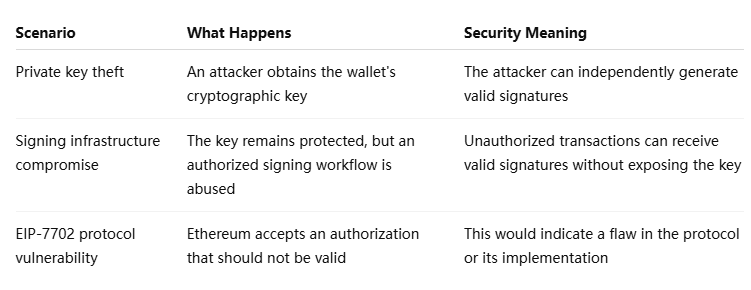
Binance's preliminary investigation currently points much more closely toward the second scenario.
The exchange said a compromised DevOps laptop may have allowed access to a service container capable of submitting unauthorized withdrawal transactions, while explicitly stating that it had found no evidence of private-key leakage.
That distinction is significant.
A hardware-protected private key can technically remain secure while the surrounding infrastructure produces a signature for something that should never have been approved.
Did EIP-7702 Cause the Binance Hack?
Based on currently available information, there is no public evidence that a vulnerability in EIP-7702 itself caused the Binance security incident.
This distinction is critical.
An attacker using a legitimate protocol feature does not automatically mean that the feature was broken.
Consider a simpler example.
If an attacker obtains legitimate credentials for a bank account and initiates a transfer through the bank's normal payment system, the fact that the bank's transfer infrastructure executed the payment does not prove that the transfer protocol itself was defective.
A similar distinction applies here.
EIP-7702 may have provided the execution mechanism through which a successfully authorized account could delegate its behavior to malicious code.
But EIP-7702 normally requires valid authorization.
The unresolved question is how that authorization became possible.
Binance's preliminary explanation suggests that investigators are examining compromised operational infrastructure rather than an Ethereum protocol failure.
Therefore, the most accurate interpretation at this stage is:
EIP-7702 appears relevant to the execution path being investigated, but it has not been established as the root vulnerability.
What Has Been Confirmed and What Remains Under Investigation?
Because large security incidents evolve rapidly, distinguishing confirmed findings from transaction-level analysis is especially important.
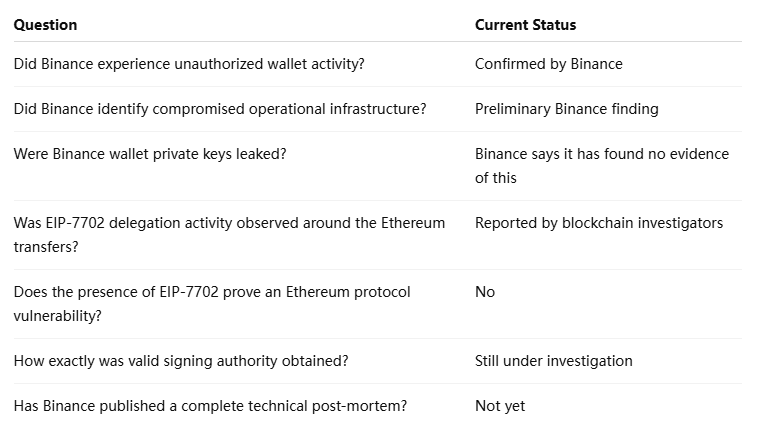
This distinction matters because blockchain transactions provide excellent visibility into what occurred on-chain, but they do not necessarily reveal how an internal signing system was compromised.
Researchers can observe delegations, transfers and contract interactions.
They cannot determine from blockchain data alone whether a signature was created after a private key was stolen, whether an internal service legitimately requested it, or whether a compromised workflow caused a protected signer to authorize malicious instructions.
That requires evidence from inside the affected infrastructure.
Why Signing Infrastructure Matters as Much as Private-Key Storage
Institutional cryptocurrency security increasingly consists of several layers.
The first is key security.
Where is the private key stored? Can it be extracted? Is it protected by a hardware security module or another cryptographic custody system?
The second is signing security.
Which services are allowed to request signatures from the protected key? What authentication, policies and approval mechanisms must those services satisfy?
The third is authorization security.
Even if a request is cryptographically valid, what exactly is the account being asked to authorize?
This third layer becomes increasingly important as smart accounts and account delegation become more capable.
A conventional token transfer may move a fixed amount of one asset.
A delegation may instead change how an account can execute future instructions.
For security teams, the difference means that signature validation alone is no longer sufficient.
The transaction's meaning must also be evaluated.
Why EIP-7702 Changes Wallet Security Assumptions
EIP-7702 is powerful precisely because it extends what an ordinary Ethereum account can do.
A wallet can gain programmable features without migrating assets to a completely new smart contract wallet.
For consumer wallets, this can improve usability.
For sophisticated institutional infrastructure, it can support more advanced execution policies.
But additional programmability creates additional authorization surfaces.
A malicious ERC-20 approval typically gives another address permission over one token.
A malicious EIP-7702 delegation can potentially influence how an account executes much broader classes of actions.
That does not make EIP-7702 inherently unsafe.
It means wallets, exchanges and custody providers should treat delegation authorization as a high-risk security operation.
An EIP-7702 signature should not be evaluated only as cryptographically valid.
Security systems should also ask whether the delegation target is expected, whether its bytecode has been reviewed, whether the requested authorization fits the account's normal behavior, and whether internal policy allows that account to delegate execution at all.
What Should the Binance Post-Mortem Clarify?
Binance has said that a detailed technical post-mortem will be published once its investigation is complete.
Several questions will determine how the industry ultimately interprets the incident.
First, how did the attacker gain access to the signing path?
The preliminary DevOps explanation identifies a potentially compromised part of the infrastructure, but the complete chain from that access to a valid blockchain authorization remains important.
Second, what exact role did EIP-7702 play?
Investigators will need to determine whether delegation was required to execute the Ethereum transfers, how the authorization was prepared and why internal controls allowed it.
Third, were private keys ever exposed?
Binance currently says there is no evidence of private-key leakage. A complete forensic report could provide more detail about how keys were isolated from the compromised infrastructure.
Finally, which control should have stopped the transaction?
For institutional security teams, this may be the most valuable question of all.
A technically valid signature should not automatically mean an operationally valid transaction.
The strongest custody systems separate cryptographic authorization from business authorization.
What Does This Mean for Ordinary Ethereum Wallet Users?
The Binance incident involves institutional infrastructure and should not automatically be interpreted as evidence that ordinary Ethereum wallets are exposed to the same attack path.
A personal self-custody wallet and an exchange hot-wallet system operate very differently.
However, EIP-7702 introduces an important lesson for individual users as well:
A delegation signature deserves the same level of caution as other powerful wallet permissions.
Users should carefully verify what a wallet is asking them to sign, particularly when an unfamiliar website requests an account delegation.
A malicious delegation should not be confused with an ordinary login signature.
Users should also rely on established wallet interfaces that clearly identify delegation requests and flag suspicious contracts.
The key security principle remains simple: do not judge a signature only by whether it transfers funds immediately. Some signatures change what an account will be permitted to do later.
The Bigger Lesson: Wallet Security Is Moving Beyond Private Keys
The Binance security incident highlights a broader evolution in blockchain security.
For years, the industry's dominant assumption was straightforward:
Protect the key, protect the wallet.
That model is becoming incomplete.
Modern institutional wallets often depend on layers of infrastructure around the key—APIs, signing services, withdrawal engines, policy systems, access controls and automated execution environments.
Account-abstraction mechanisms such as EIP-7702 add another layer by allowing wallets to delegate execution logic.
As a result, cryptocurrency security increasingly depends on three separate questions:
Who controls the key?
Who can request a signature?
And what authority does that signature actually grant?
A system can succeed at the first question while failing at the second or third.
That appears to be one of the most important issues raised by the Binance investigation so far.
FAQ
Was EIP-7702 the cause of the Binance hack?
Not confirmed. Binance’s preliminary findings point to compromised operational infrastructure, while EIP-7702 appears to have been part of the authorization path under investigation.
Were Binance private keys stolen?
Binance said it found no evidence of wallet private-key leakage in its initial investigation.
What is EIP-7702?
EIP-7702 allows an Ethereum EOA to delegate execution logic to smart-contract code while keeping the same wallet address.
Why were multiple EIP-7702 authorizations observed?
They may have been prepared across different nonce values to match the target account state. This does not necessarily mean multiple wallets were compromised.
Are ordinary Ethereum users affected?
There is no evidence of a network-wide Ethereum wallet compromise. Users should still be cautious with unfamiliar delegation or signing requests.
Is revoking token approvals enough?
Not always. ERC-20 approvals and EIP-7702 delegation are separate permissions, so removing a token approval does not automatically remove account delegation.
Conclusion
The appearance of EIP-7702 in the Binance incident makes the mechanism an important part of the technical investigation, but available evidence does not establish that EIP-7702 itself was compromised.
Binance's preliminary findings instead suggest that an attacker may have compromised a DevOps engineer's laptop, gained access to an operational service container and submitted unauthorized withdrawal transactions. The exchange says it has found no evidence of wallet private-key leakage.
The distinction matters.
If a protected signing system can be induced to authorize malicious instructions, attackers may not need to steal the private key at all.
EIP-7702 can increase the consequences of such authorization because it allows an Ethereum account to delegate programmable execution logic. But using that capability maliciously and finding a vulnerability in the protocol are two different things.
Until Binance releases its complete technical post-mortem, EIP-7702 is best understood as a component in the reported execution path—not as the confirmed root cause of the incident.
For exchanges, custody providers and wallet developers, the larger lesson is already clear: modern wallet security must protect not only private keys, but also the systems that request signatures and the permissions those signatures create.
Risk Disclaimer: This article is for informational and educational purposes only. Cryptocurrency and blockchain systems involve technical, operational, and market risks. Readers should independently verify security information and use appropriate risk controls when managing digital assets.


评论
仅可选择预设评论和表情符号