TLDRs: Ola Electric shares fell 7.1% after SoftBank reduced its stake to 15.68%. The stock hit a low of ₹59.32 amid broader shareholder sell-offs. Revenue halved to ₹828 crore (approx. $99 million) in Q1 FY26; net loss widened to ₹428 crore (approx. $51 million). PLI approval for Gen 3 scooters expected to improve profitability from [...] The post OLA ELECTRIC MOBILITY LTD (OLAELEC.NS): Shares Fall 7.1% After SoftBank Cuts Stake appeared first on CoinCentral.TLDRs: Ola Electric shares fell 7.1% after SoftBank reduced its stake to 15.68%. The stock hit a low of ₹59.32 amid broader shareholder sell-offs. Revenue halved to ₹828 crore (approx. $99 million) in Q1 FY26; net loss widened to ₹428 crore (approx. $51 million). PLI approval for Gen 3 scooters expected to improve profitability from [...] The post OLA ELECTRIC MOBILITY LTD (OLAELEC.NS): Shares Fall 7.1% After SoftBank Cuts Stake appeared first on CoinCentral.

OLA ELECTRIC MOBILITY LTD (OLAELEC.NS): Shares Fall 7.1% After SoftBank Cuts Stake

2025/09/05 21:51

TLDRs:

  • Ola Electric shares fell 7.1% after SoftBank reduced its stake to 15.68%.
  • The stock hit a low of ₹59.32 amid broader shareholder sell-offs.
  • Revenue halved to ₹828 crore (approx. $99 million) in Q1 FY26; net loss widened to ₹428 crore (approx. $51 million).
  • PLI approval for Gen 3 scooters expected to improve profitability from FY26.

Shares of Ola Electric Mobility Ltd (OLAELEC.NS) slid sharply on Thursday, falling 7.1% to close at ₹59.92 on the BSE.

The decline comes after Japanese investment firm SoftBank trimmed its stake in the electric scooter maker by 2.15%, lowering its total holding to 15.68%. The sale involved 94.94 million shares, executed between mid-July and early September, according to regulatory filings.

SoftBank remains the second-largest shareholder after founder Bhavish Aggarwal, who holds a 30.02% stake in the company. While the Japanese investor reduced exposure, it still retains over 691 million shares, signaling continued confidence in Ola Electric’s long-term prospects.
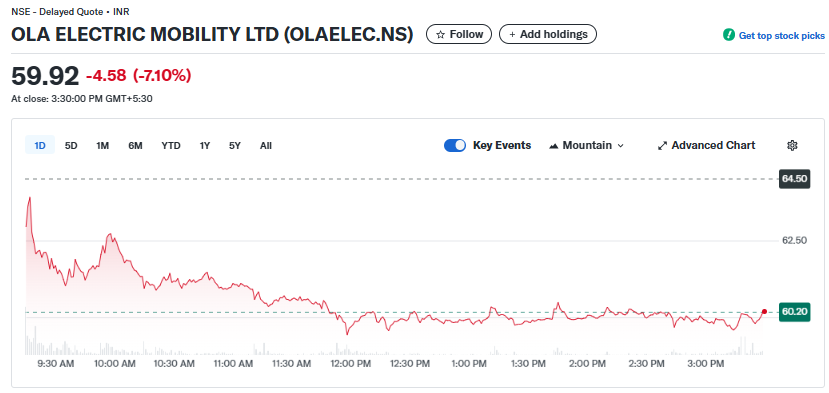
OLA ELECTRIC MOBILITY LTD (OLAELEC.NS)

Other Investors Join the Sell-Off

SoftBank was not the only investor to reduce holdings in Ola Electric. Early-stage investors, including Tiger Global and Alpha Wave, along with automobile giants Hyundai and Kia, also trimmed their stakes over the past few months.

The combined effect of these sales created downward pressure on the stock, despite recent positive developments in the company’s operations.

The market capitalization of Ola Electric currently stands at ₹26,998.69 crore (approximately $3.2 billion). The 52-week high for the stock was ₹123.90 per share, while the low was ₹39.58, highlighting the volatility in the EV segment and investor sentiment around new-age Indian mobility companies.

Financials Show Revenue Dip, Loss Expansion

Ola Electric’s latest quarterly results added to investor caution. For Q1 FY26 (April–June), the company reported a consolidated net loss of ₹428 crore (approximately $51 million), up 23% from ₹347 crore in the same quarter last year. Revenue from operations nearly halved to ₹828 crore (approximately $99 million) from ₹1,644 crore in the year-ago period.

Although the company undertook aggressive cost-cutting measures, bringing total expenses down by 42% to ₹1,065 crore (approximately $128 million), the steep decline in revenue outweighed these savings.

Analysts note that while the company’s fundamentals remain under pressure in the near term, its long-term growth prospects hinge on EV adoption and regulatory incentives.

PLI Approval to Support Future Growth

Despite the short-term sell-off, Ola Electric has received regulatory approval for its Gen 3 scooter portfolio under the government’s Production Linked Incentive (PLI) scheme. This approval allows the company to access incentives worth 13–18% of sales value until 2028, a critical step towards improving profitability from FY26 onwards.

The Gen 3 scooters, which contribute the majority of the company’s sales, have been central to investor optimism in recent months. Even with the current decline, Ola Electric shares surged over 55% in the past month on the back of strong trading volumes and positive technical indicators.

Promoters continue to maintain significant control, with a combined stake of 36.78%, while other investors such as Ani Technologies and Indus Trust hold smaller stakes. Market watchers are now closely monitoring quarterly performance and production ramp-up under the PLI scheme for signs of a sustained recovery.

The post OLA ELECTRIC MOBILITY LTD (OLAELEC.NS): Shares Fall 7.1% After SoftBank Cuts Stake appeared first on CoinCentral.

Piyasa Fırsatı
SuiNS Logosu
SuiNS Fiyatı(NS)
$0.02971
$0.02971$0.02971
-1.03%
USD
SuiNS (NS) Canlı Fiyat Grafiği
Sorumluluk Reddi: Bu sitede yeniden yayınlanan makaleler, halka açık platformlardan alınmıştır ve yalnızca bilgilendirme amaçlıdır. MEXC'nin görüşlerini yansıtmayabilir. Tüm hakları telif sahiplerine aittir. Herhangi bir içeriğin üçüncü taraf haklarını ihlal ettiğini düşünüyorsanız, kaldırılması için lütfen [email protected] ile iletişime geçin. MEXC, içeriğin doğruluğu, eksiksizliği veya güncelliği konusunda hiçbir garanti vermez ve sağlanan bilgilere dayalı olarak alınan herhangi bir eylemden sorumlu değildir. İçerik, finansal, yasal veya diğer profesyonel tavsiye niteliğinde değildir ve MEXC tarafından bir tavsiye veya onay olarak değerlendirilmemelidir.

Ayrıca Şunları da Beğenebilirsiniz

Trump-Backed WLFI Plunges 58% – Buyback Plan Announced to Halt Freefall

Trump-Backed WLFI Plunges 58% – Buyback Plan Announced to Halt Freefall

World Liberty Financial (WLFI), the Trump-linked DeFi project, is scrambling to stop a market collapse after its token lost over 50% of its value in September. On Friday, the project unveiled a full buyback-and-burn program, directing all treasury liquidity fees to absorb selling pressure. According to a governance post on X, the community approved the plan overwhelmingly, with WLFI pledging full transparency for every burn. The urgency of the move reflects WLFI’s steep losses in recent weeks. WLFI is trading Friday at $0.19, down from its September 1 peak of $0.46, according to CoinMarketCap, a 58% drop in less than a month. Weekly losses stand at 12.85%, with a 15.45% decline for the month. This isn’t the project’s first attempt at intervention. Just days after launch, WLFI burned 47 million tokens on September 3 to counter a 31% sell-off, sending the supply to a verified burn address. For World Liberty Financial, the buyback-and-burn program represents both a damage-control measure and a test of community faith. While tokenomics adjustments can provide short-term relief, the project will need to convince investors that WLFI has staying power beyond interventions. WLFI Launches Buyback-and-Burn Plan, Linking Token Scarcity to Platform Growth According to the governance proposal, WLFI will use fees generated from its protocol-owned liquidity (POL) pools on Ethereum, BNB Chain, and Solana to repurchase tokens from the open market. Once bought back, the tokens will be sent to a burn address, permanently removing them from circulation.WLFI Proposal Source: WLFI The project stressed that this system ties supply reduction directly to platform growth. As trading activity rises, more liquidity fees are generated, fueling larger buybacks and burns. This seeks to create a feedback loop where adoption drives scarcity, and scarcity strengthens token value. Importantly, the plan applies only to WLFI’s protocol-controlled liquidity pools. Community and third-party liquidity pools remain unaffected, ensuring the mechanism doesn’t interfere with external ecosystem contributions. In its proposal, the WLFI team argued that the strategy aligns long-term holders with the project’s future by systematically reducing supply and discouraging short-term speculation. Each burn increases the relative stake of committed investors, reinforcing confidence in WLFI’s tokenomics. To bolster credibility, WLFI has pledged full transparency: every buyback and burn will be verifiable on-chain and reported to the community in real time. WLFI Joins Hyperliquid, Jupiter, and Sky as Buyback Craze Spills Into Wall Street WLFI’s decision to adopt a full buyback-and-burn strategy places it among the most ambitious tokenomic models in crypto. While partly a response to its sharp September price decline, the move also reflects a trend of DeFi protocols leveraging revenue streams to cut supply, align incentives, and strengthen token value. Hyperliquid illustrates the model at scale. Nearly all of its platform fees are funneled into automated $HYPE buybacks via its Assistance Fund, creating sustained demand. By mid-2025, more than 20 million tokens had been repurchased, with nearly 30 million held by Q3, worth over $1.5 billion. This consistency both increased scarcity and cemented Hyperliquid’s dominance in decentralized derivatives. Other protocols have adopted variations. Jupiter directs half its fees into $JUP repurchases, locking tokens for three years. Raydium earmarks 12% of fees for $RAY buybacks, already removing 71 million tokens, roughly a quarter of the circulating supply. Burn-based models push further, as seen with Sky, which has spent $75 million since February 2025 to permanently erase $SKY tokens, boosting scarcity and governance influence. But the buyback phenomenon isn’t limited to DeFi. Increasingly, listed companies with crypto treasuries are adopting aggressive repurchase programs, sometimes to offset losses as their digital assets decline. According to a report, at least seven firms, ranging from gaming to biotech, have turned to buybacks, often funded by debt, to prop up falling stock prices. One of the latest is Thumzup Media, a digital advertising company with a growing Web3 footprint. On Thursday, it launched a $10 million share repurchase plan, extending its capital return strategy through 2026, after completing a $1 million program that saw 212,432 shares bought at an average of $4.71. DeFi Development Corp, the first public company built around a Solana-based treasury strategy, also recently expanded its buyback program to $100 million, up from $1 million, making it one of the largest stock repurchase initiatives in the digital asset sector. Together, these cases show how buybacks, whether in tokenomics or equities, are emerging as a key mechanism for stabilizing value and signaling confidence, even as motivations and execution vary widely
Paylaş
CryptoNews2025/09/26 19:12
Son of filmmaker Rob Reiner charged with homicide for death of his parents
Son of filmmaker Rob Reiner charged with homicide for death of his parents

FILE PHOTO: Rob Reiner, director of "The Princess Bride," arrives for a special 25th anniversary viewing of the film during the New York Film Festival in New York
Paylaş
Rappler2025/12/16 09:59
Bitcoin Peak Coming in 45 Days? BTC Price To Reach $150K

Bitcoin Peak Coming in 45 Days? BTC Price To Reach $150K

The post Bitcoin Peak Coming in 45 Days? BTC Price To Reach $150K appeared first on Coinpedia Fintech News Bitcoin has delivered one of its strongest performances in recent months, jumping from September lows of $108K to over $117K today. But while excitement is high, market watchers warn the clock is ticking.  History shows Bitcoin peaks don’t last forever, and analysts now believe the next major top could arrive within just 45 days, with …
Paylaş
CoinPedia2025/09/18 15:49