Zama and the Kohaku upgrade enable Shibarium to offer private, quantum-resistant smart contracts. The TokenPlay AI deal turns SHIB into a real in-app currency. According to Zama’s updated roadmap, the public testnet is now live on Sepolia, and the team is aiming to launch on Ethereum in the fourth quarter. After that, they’re looking to [...]]]>Zama and the Kohaku upgrade enable Shibarium to offer private, quantum-resistant smart contracts. The TokenPlay AI deal turns SHIB into a real in-app currency. According to Zama’s updated roadmap, the public testnet is now live on Sepolia, and the team is aiming to launch on Ethereum in the fourth quarter. After that, they’re looking to [...]]]>

Shiba Inu Team Unveils Transformative Privacy Upgrade for Shibarium & BONE

2025/11/28 18:40
  • Zama and the Kohaku upgrade enable Shibarium to offer private, quantum-resistant smart contracts.
  • The TokenPlay AI deal turns SHIB into a real in-app currency.

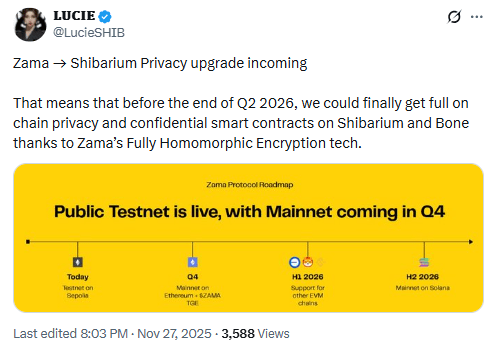
According to Zama’s updated roadmap, the public testnet is now live on Sepolia, and the team is aiming to launch on Ethereum in the fourth quarter. After that, they’re looking to roll out support for other EVM chains in the first half of 2026, followed by an expansion to Solana’s mainnet in the second half of the year.
Source: X

Against this backdrop, Shiba Inu ecosystem team member Lucie wrote on X that Zama’s technology will power a Shibarium privacy upgrade. She said that before the end of the second quarter of 2026, Shibarium and Bone could gain full on-chain privacy and confidential smart contracts through Zama’s fully homomorphic encryption stack. If the timeline holds, Shibarium would align its privacy rollout with Zama’s broader multi-chain expansion.

Kohaku Upgrade Lays the Crypto Foundations for Shibarium

Meanwhile, the Kohaku upgrade, unveiled by Vitalik Buterin at Devcon 2025, as noted in our earlier post, introduces a modular privacy framework for Ethereum that Shibarium can inherit. It brings quantum-resistant signatures based on Dilithium schemes and a new stealth-address standard so wallets can receive funds without exposing public identity. Ethereum researchers argue this shift is needed before quantum computers can break today’s ECDSA signatures, which they tentatively place around 2028.

Kohaku also changes Shibarium’s economics once it plugs into the framework. Privacy transactions that rely on zero-knowledge proofs use far more gas than standard transfers, with benchmarks suggesting workloads equivalent to roughly 15–20 normal token moves. On Shibarium, that extra computation is paid in BONE, which turns the token into fuel for heavy cryptographic processing instead of only serving as a basic gas asset.

The higher gas load then feeds into Shibarium’s burn contracts, where accumulated BONE is swapped for SHIB and permanently removed from circulation, potentially accelerating the burn cycle if private volume grows.

Regulatory design is part of Kohaku as well. The framework bundles “Privacy Pools”, which let users prove their funds are not tied to sanctioned or hacked wallets without disclosing full transaction histories. For Shibarium, adopting these tools would offer what the Shib team calls “clean privacy,” aimed at institutions that need confidentiality but must follow anti-money-laundering rules.

Shibarium’s sidechain architecture cannot rely on automatic inheritance. Developers must manually adapt the privacy SDK to Heimdall and Bor nodes and optimize wallets and validators for data-heavy private blocks.

Shiba Token’s TokenPlay AI Deal Adds Utility for SHIB

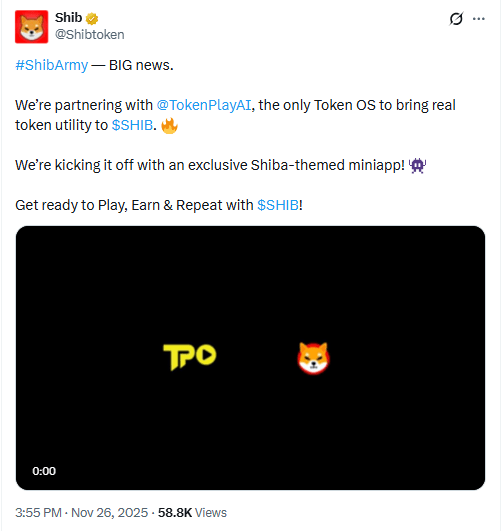
Moreover, Shiba Token announced a new partnership with TokenPlay AI. The deal, as highlighted in our previous article, connects SHIB to a “token OS” that can run Shiba-themed apps inside chat, gaming, and interactive dashboards.
Source: X

Through this integration, SHIB can move from passive holding to active in-app use. Users will be able to earn and spend SHIB inside the first Shiba-branded miniapp and then cycle it through repeat gameplay and rewards.

]]>
Piyasa Fırsatı
BitShiba Logosu
BitShiba Fiyatı(SHIBA)
$0,00000000043
$0,00000000043$0,00000000043
+3,11%
USD
BitShiba (SHIBA) Canlı Fiyat Grafiği
Sorumluluk Reddi: Bu sitede yeniden yayınlanan makaleler, halka açık platformlardan alınmıştır ve yalnızca bilgilendirme amaçlıdır. MEXC'nin görüşlerini yansıtmayabilir. Tüm hakları telif sahiplerine aittir. Herhangi bir içeriğin üçüncü taraf haklarını ihlal ettiğini düşünüyorsanız, kaldırılması için lütfen [email protected] ile iletişime geçin. MEXC, içeriğin doğruluğu, eksiksizliği veya güncelliği konusunda hiçbir garanti vermez ve sağlanan bilgilere dayalı olarak alınan herhangi bir eylemden sorumlu değildir. İçerik, finansal, yasal veya diğer profesyonel tavsiye niteliğinde değildir ve MEXC tarafından bir tavsiye veya onay olarak değerlendirilmemelidir.

Ayrıca Şunları da Beğenebilirsiniz

Son of filmmaker Rob Reiner charged with homicide for death of his parents

Son of filmmaker Rob Reiner charged with homicide for death of his parents

FILE PHOTO: Rob Reiner, director of "The Princess Bride," arrives for a special 25th anniversary viewing of the film during the New York Film Festival in New York
Paylaş
Rappler2025/12/16 09:59
Addressing the sustainability question: The Web3 energy narrative

Addressing the sustainability question: The Web3 energy narrative

The post Addressing the sustainability question: The Web3 energy narrative appeared on BitcoinEthereumNews.com. contributor Posted: September 22, 2025 The environmental impact of blockchain technology remains a significant public concern in September 2025. For Web3 to achieve widespread legitimacy, it must present a credible narrative and technological path towards sustainability. The models pioneered by Oraichain, Pinlink, and RSS3 showcase how decentralized networks can be designed for efficiency and can contribute to a more sustainable digital economy. Oraichain, as a sovereign Layer 1, is built on a Delegated Proof-of-Stake (DPoS) consensus mechanism. This is inherently more energy-efficient than the Proof-of-Work systems that drew early criticism. By design, its security model relies on economic staking rather than raw computational power, allowing the network to process complex AI computations with a minimal energy footprint compared to its predecessors, aligning its operations with a greener Web3. Pinlink’s DePIN model promotes a more efficient use of existing hardware resources. The relentless construction of massive, power-hungry data centers by tech giants is a major source of energy consumption. Pinlink’s approach is to unlock the value in dormant or underutilized GPUs already in circulation around the world. This “recycling” of computing capacity reduces the need for new hardware manufacturing and makes the overall digital infrastructure ecosystem more resource-efficient. RSS3 contributes to sustainability through its distributed and lightweight design. Unlike a centralized data indexer that requires massive, concentrated server farms, the RSS3 network is run by a global collection of independent nodes. These nodes can be operated on low-power, consumer-grade hardware, distributing the energy load and avoiding the inefficiencies of large-scale, centralized data centers. This architectural choice makes its information layer inherently more sustainable and resilient. Disclaimer: This is a paid post and should not be treated as news/advice. Next: As Bitcoin’s sell pressure grows, are investors seeking safety in altcoins? Source: https://ambcrypto.com/addressing-the-sustainability-question-the-web3-energy-narrative/
Paylaş
BitcoinEthereumNews2025/09/23 09:02
Alcohol Still Leads Restaurant Beverage Orders, According To Harris Poll

Alcohol Still Leads Restaurant Beverage Orders, According To Harris Poll

The post Alcohol Still Leads Restaurant Beverage Orders, According To Harris Poll appeared on BitcoinEthereumNews.com. A new Harris Poll reveals millennials and Gen X still drive alcohol sales in restaurants, while Gen Z mixes drinks, formats, and expectations. Alcohol may still be the default for many American diners, but the latest Harris Poll suggests drinking habits are shifting. While older generations continue to reach for beer, wine, and cocktails, Gen Z is redefining what it means to drink out, focusing more on flexibility, aesthetics, and mood than tradition. Millennials are still loyal alcohol buyers when dining out, but Gen Z’s beverage habits are harder to pin down, according to new Harris Poll data. getty What the new Harris Poll reveals about U.S. beverage behavior In a nationally representative survey conducted by Harris in partnership with eMarketer, 36 percent of Americans reported that alcohol is their preferred restaurant beverage, slightly ahead of soda at 29 percent and water at 21 percent. But in practice, the most commonly ordered items are still non-alcoholic: 89 percent said they ordered water in the past 30 days, and 78 percent ordered soda. Alcohol remains a strong presence, with 69 percent of diners saying they ordered at least one alcoholic drink recently. Cocktails topped the alcohol category, followed by beer, spirits, and wine. While the overall preference is clear, the details begin to diverge once you look at generational breakdowns. Millennials still drive alcohol sales, especially with repeat orders Millennials continue to be the most reliable customers for restaurants selling alcohol. Fifty percent say alcohol is their default drink when dining out, compared to just 25 percent of Gen Z. They also reported significantly more repeat orders over the past month—especially for beer, spirits, and wine. This makes millennials a priority for alcohol brands and on-premise sales strategies. Libby Rodney, the Chief Strategy Officer at The Harris Poll, explained it this…
Paylaş
BitcoinEthereumNews2025/09/24 02:21