TLDR Apple stock plunged at $254.43on Sept. 24 down by 1.26% YTD but behind Big Tech peers. UBS data shows strong wait times for iPhone 17 Base but muted demand for higher-end models. ASP growth may be limited by pricing strategy favoring entry-level buyers. The iPhone 17 Air’s $999 redesign and China subsidies boost near-term [...] The post Apple Inc. ($AAPL) Stock: Turns Positive in 2025 After iPhone 17 Launch appeared first on CoinCentral.TLDR Apple stock plunged at $254.43on Sept. 24 down by 1.26% YTD but behind Big Tech peers. UBS data shows strong wait times for iPhone 17 Base but muted demand for higher-end models. ASP growth may be limited by pricing strategy favoring entry-level buyers. The iPhone 17 Air’s $999 redesign and China subsidies boost near-term [...] The post Apple Inc. ($AAPL) Stock: Turns Positive in 2025 After iPhone 17 Launch appeared first on CoinCentral.

Apple Inc. ($AAPL) Stock: Turns Positive in 2025 After iPhone 17 Launch

2025/09/25 00:24

TLDR

  • Apple stock plunged at $254.43on Sept. 24 down by 1.26% YTD but behind Big Tech peers.

  • UBS data shows strong wait times for iPhone 17 Base but muted demand for higher-end models.

  • ASP growth may be limited by pricing strategy favoring entry-level buyers.

  • The iPhone 17 Air’s $999 redesign and China subsidies boost near-term demand.

  • Apple still lags Microsoft and Google in AI, with major Siri updates delayed until 2026.

Apple Inc. (AAPL) shares were down 1.21% as of 12:46 PM EDT, dropping from around $254.43 to $251.36.
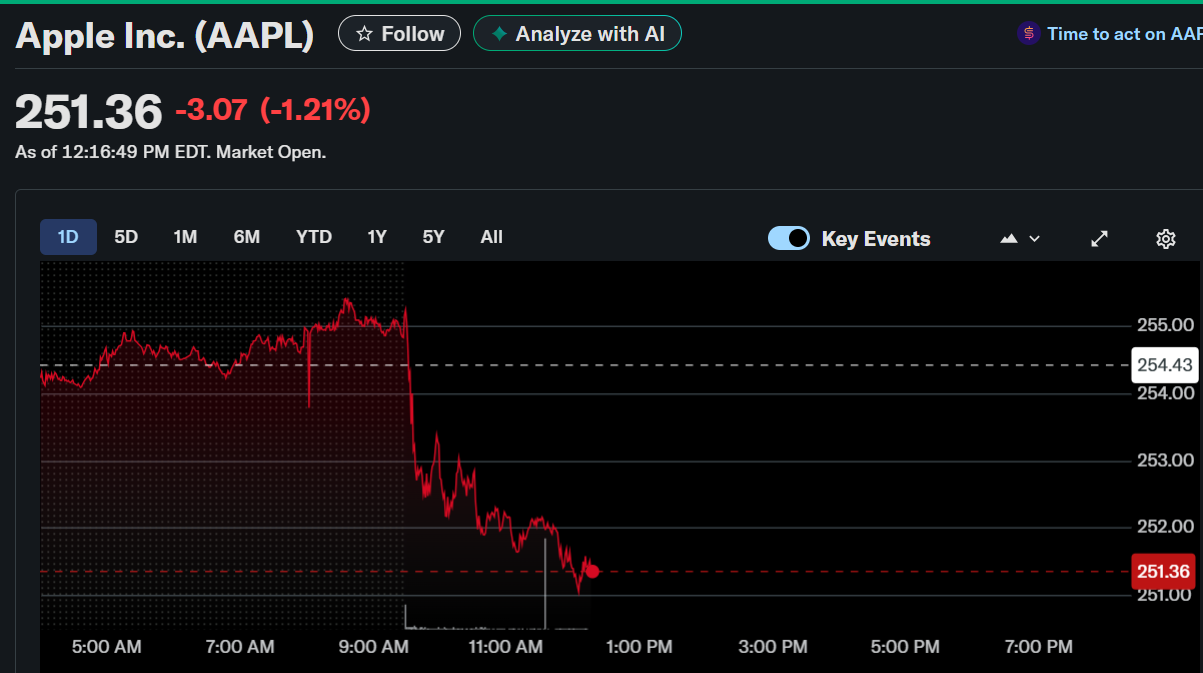
Apple Inc. (AAPL)

With these gains, Apple has erased its 2025 losses, now up 1.96% year-to-date, though still trailing the S&P 500’s 13.18% rise. The September 25 earnings report will give further clarity on Apple’s momentum.

The rally followed strong initial demand for Apple’s newly launched iPhone 17 lineup. Shares climbed 4% earlier this week as shipping times lengthened for the redesigned iPhone Air, signaling healthy interest heading into the holiday quarter.

UBS warns of ASP pressure

Despite the positive stock reaction, UBS analysts flagged potential risks for Apple’s average selling price. Evidence Lab data showed “elevated year-over-year wait times” for the iPhone 17 Base model across 30 tracked markets, while demand for higher-end models like the Pro Max looked flatter.

In the U.S., wait times for the iPhone 17 Base stretched to 18 days versus 11 days for the iPhone 16 Base. In China, wait times jumped to 25 days compared with 9 days for last year’s model, which UBS partly attributed to subsidies. However, the analysts noted that heavy mixing toward entry-level models may dampen ASP upside this quarter.

Apple’s pricing strategy

UBS pointed to Apple’s strategic pricing adjustments. The Base model now starts with 256GB storage, effectively lowering its price per gigabyte, while the Air and Pro models saw implied price increases. This mix could weigh on revenue per unit even if total shipments grow.

The $999 iPhone Air is proving a strong draw, being Apple’s first major redesign in years. Bank of America analysts reported longer delivery windows of 18 days for the Air compared with just 10 days for last year’s iPhone 16.

Broader product ecosystem and AI lag

Apple’s fall lineup also included new AirPods Pro 3 and the latest Apple Watch, which introduced AI-driven health features such as blood pressure risk alerts. Still, the company lags competitors in AI innovation. A major Siri update isn’t expected until 2026, leaving Apple behind Microsoft and Google, both of which have heavily invested in AI this year.

Performance overview

Looking beyond 2025, Apple remains a long-term outperformer. The company has returned 12.87% over the past year and 144.18% over five years, compared with the S&P 500’s 16.41% and 105.66% gains, respectively. Yet the near-term focus rests squarely on the iPhone 17’s holiday season performance and whether Apple can sustain momentum despite ASP concerns and AI challenges.

The post Apple Inc. ($AAPL) Stock: Turns Positive in 2025 After iPhone 17 Launch appeared first on CoinCentral.

Piyasa Fırsatı
NEAR Logosu
NEAR Fiyatı(NEAR)
$1.54
$1.54$1.54
+0.39%
USD
NEAR (NEAR) Canlı Fiyat Grafiği
Sorumluluk Reddi: Bu sitede yeniden yayınlanan makaleler, halka açık platformlardan alınmıştır ve yalnızca bilgilendirme amaçlıdır. MEXC'nin görüşlerini yansıtmayabilir. Tüm hakları telif sahiplerine aittir. Herhangi bir içeriğin üçüncü taraf haklarını ihlal ettiğini düşünüyorsanız, kaldırılması için lütfen [email protected] ile iletişime geçin. MEXC, içeriğin doğruluğu, eksiksizliği veya güncelliği konusunda hiçbir garanti vermez ve sağlanan bilgilere dayalı olarak alınan herhangi bir eylemden sorumlu değildir. İçerik, finansal, yasal veya diğer profesyonel tavsiye niteliğinde değildir ve MEXC tarafından bir tavsiye veya onay olarak değerlendirilmemelidir.

Ayrıca Şunları da Beğenebilirsiniz

Trump-Backed WLFI Plunges 58% – Buyback Plan Announced to Halt Freefall

Trump-Backed WLFI Plunges 58% – Buyback Plan Announced to Halt Freefall

World Liberty Financial (WLFI), the Trump-linked DeFi project, is scrambling to stop a market collapse after its token lost over 50% of its value in September. On Friday, the project unveiled a full buyback-and-burn program, directing all treasury liquidity fees to absorb selling pressure. According to a governance post on X, the community approved the plan overwhelmingly, with WLFI pledging full transparency for every burn. The urgency of the move reflects WLFI’s steep losses in recent weeks. WLFI is trading Friday at $0.19, down from its September 1 peak of $0.46, according to CoinMarketCap, a 58% drop in less than a month. Weekly losses stand at 12.85%, with a 15.45% decline for the month. This isn’t the project’s first attempt at intervention. Just days after launch, WLFI burned 47 million tokens on September 3 to counter a 31% sell-off, sending the supply to a verified burn address. For World Liberty Financial, the buyback-and-burn program represents both a damage-control measure and a test of community faith. While tokenomics adjustments can provide short-term relief, the project will need to convince investors that WLFI has staying power beyond interventions. WLFI Launches Buyback-and-Burn Plan, Linking Token Scarcity to Platform Growth According to the governance proposal, WLFI will use fees generated from its protocol-owned liquidity (POL) pools on Ethereum, BNB Chain, and Solana to repurchase tokens from the open market. Once bought back, the tokens will be sent to a burn address, permanently removing them from circulation.WLFI Proposal Source: WLFI The project stressed that this system ties supply reduction directly to platform growth. As trading activity rises, more liquidity fees are generated, fueling larger buybacks and burns. This seeks to create a feedback loop where adoption drives scarcity, and scarcity strengthens token value. Importantly, the plan applies only to WLFI’s protocol-controlled liquidity pools. Community and third-party liquidity pools remain unaffected, ensuring the mechanism doesn’t interfere with external ecosystem contributions. In its proposal, the WLFI team argued that the strategy aligns long-term holders with the project’s future by systematically reducing supply and discouraging short-term speculation. Each burn increases the relative stake of committed investors, reinforcing confidence in WLFI’s tokenomics. To bolster credibility, WLFI has pledged full transparency: every buyback and burn will be verifiable on-chain and reported to the community in real time. WLFI Joins Hyperliquid, Jupiter, and Sky as Buyback Craze Spills Into Wall Street WLFI’s decision to adopt a full buyback-and-burn strategy places it among the most ambitious tokenomic models in crypto. While partly a response to its sharp September price decline, the move also reflects a trend of DeFi protocols leveraging revenue streams to cut supply, align incentives, and strengthen token value. Hyperliquid illustrates the model at scale. Nearly all of its platform fees are funneled into automated $HYPE buybacks via its Assistance Fund, creating sustained demand. By mid-2025, more than 20 million tokens had been repurchased, with nearly 30 million held by Q3, worth over $1.5 billion. This consistency both increased scarcity and cemented Hyperliquid’s dominance in decentralized derivatives. Other protocols have adopted variations. Jupiter directs half its fees into $JUP repurchases, locking tokens for three years. Raydium earmarks 12% of fees for $RAY buybacks, already removing 71 million tokens, roughly a quarter of the circulating supply. Burn-based models push further, as seen with Sky, which has spent $75 million since February 2025 to permanently erase $SKY tokens, boosting scarcity and governance influence. But the buyback phenomenon isn’t limited to DeFi. Increasingly, listed companies with crypto treasuries are adopting aggressive repurchase programs, sometimes to offset losses as their digital assets decline. According to a report, at least seven firms, ranging from gaming to biotech, have turned to buybacks, often funded by debt, to prop up falling stock prices. One of the latest is Thumzup Media, a digital advertising company with a growing Web3 footprint. On Thursday, it launched a $10 million share repurchase plan, extending its capital return strategy through 2026, after completing a $1 million program that saw 212,432 shares bought at an average of $4.71. DeFi Development Corp, the first public company built around a Solana-based treasury strategy, also recently expanded its buyback program to $100 million, up from $1 million, making it one of the largest stock repurchase initiatives in the digital asset sector. Together, these cases show how buybacks, whether in tokenomics or equities, are emerging as a key mechanism for stabilizing value and signaling confidence, even as motivations and execution vary widely
Paylaş
CryptoNews2025/09/26 19:12
Son of filmmaker Rob Reiner charged with homicide for death of his parents
Son of filmmaker Rob Reiner charged with homicide for death of his parents

FILE PHOTO: Rob Reiner, director of "The Princess Bride," arrives for a special 25th anniversary viewing of the film during the New York Film Festival in New York
Paylaş
Rappler2025/12/16 09:59
Bitcoin Peak Coming in 45 Days? BTC Price To Reach $150K

Bitcoin Peak Coming in 45 Days? BTC Price To Reach $150K

The post Bitcoin Peak Coming in 45 Days? BTC Price To Reach $150K appeared first on Coinpedia Fintech News Bitcoin has delivered one of its strongest performances in recent months, jumping from September lows of $108K to over $117K today. But while excitement is high, market watchers warn the clock is ticking.  History shows Bitcoin peaks don’t last forever, and analysts now believe the next major top could arrive within just 45 days, with …
Paylaş
CoinPedia2025/09/18 15:49