The Grass network captures more than 100TB of data every day. Grass nodes are now spread across 190 countries and regions, with more than 2.5 million nodes.The Grass network captures more than 100TB of data every day. Grass nodes are now spread across 190 countries and regions, with more than 2.5 million nodes.

After the airdrop, the price fluctuated upward. What are the characteristics of Grass, a web crawler project that combines AI and DePIN?

2024/11/05 08:30
3 min read

Author: Research institution ASXN

Compiled by: Felix, PANews

Recently, Grass, a web crawler project combining AI and DePIN, has once again launched an airdrop "feast". On October 28, the Grass Foundation announced that the first round of GRASS token airdrops were open for collection. Due to too many people claiming, the Phantom wallet was once down. As of November 4, Dune data showed that 82.75% of the GRASS airdrop tokens (about 64,781,717 tokens) had been claimed by users, involving 1,830,287 addresses for airdrop claims.

The airdrop craze also once "boosted" the GRASS token. Since the announcement of the airdrop, GRASS has shown a soaring trend, from around $0.65 to $1.86, and is now trading at $1.63. This article aims to analyze the technical characteristics of the Grass project from a technical perspective.

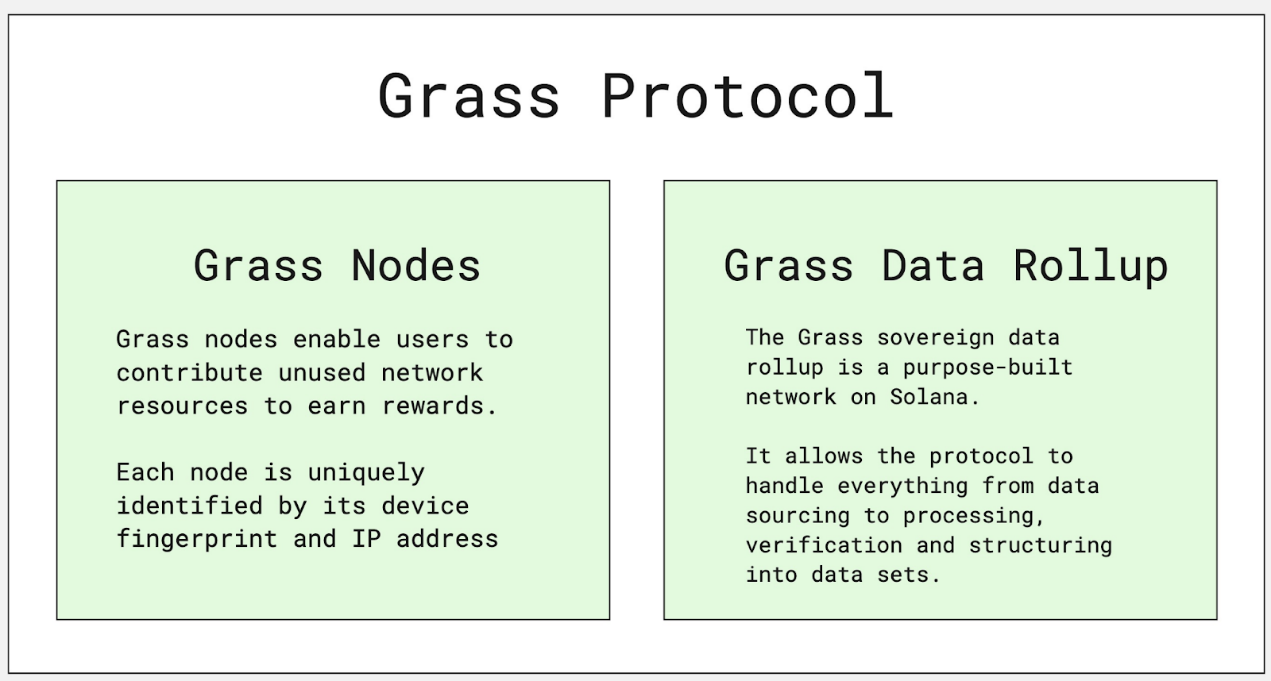
Grass is a decentralized data layer and network focused on web scraping, real-time contextual retrieval, and AI data collection. Its main goal is to decentralize and democratize web data collection through incentive mechanisms while compensating users for contributing resources.
After the airdrop, the price fluctuated upward. What are the characteristics of Grass, a web crawler project that combines AI and DePIN?

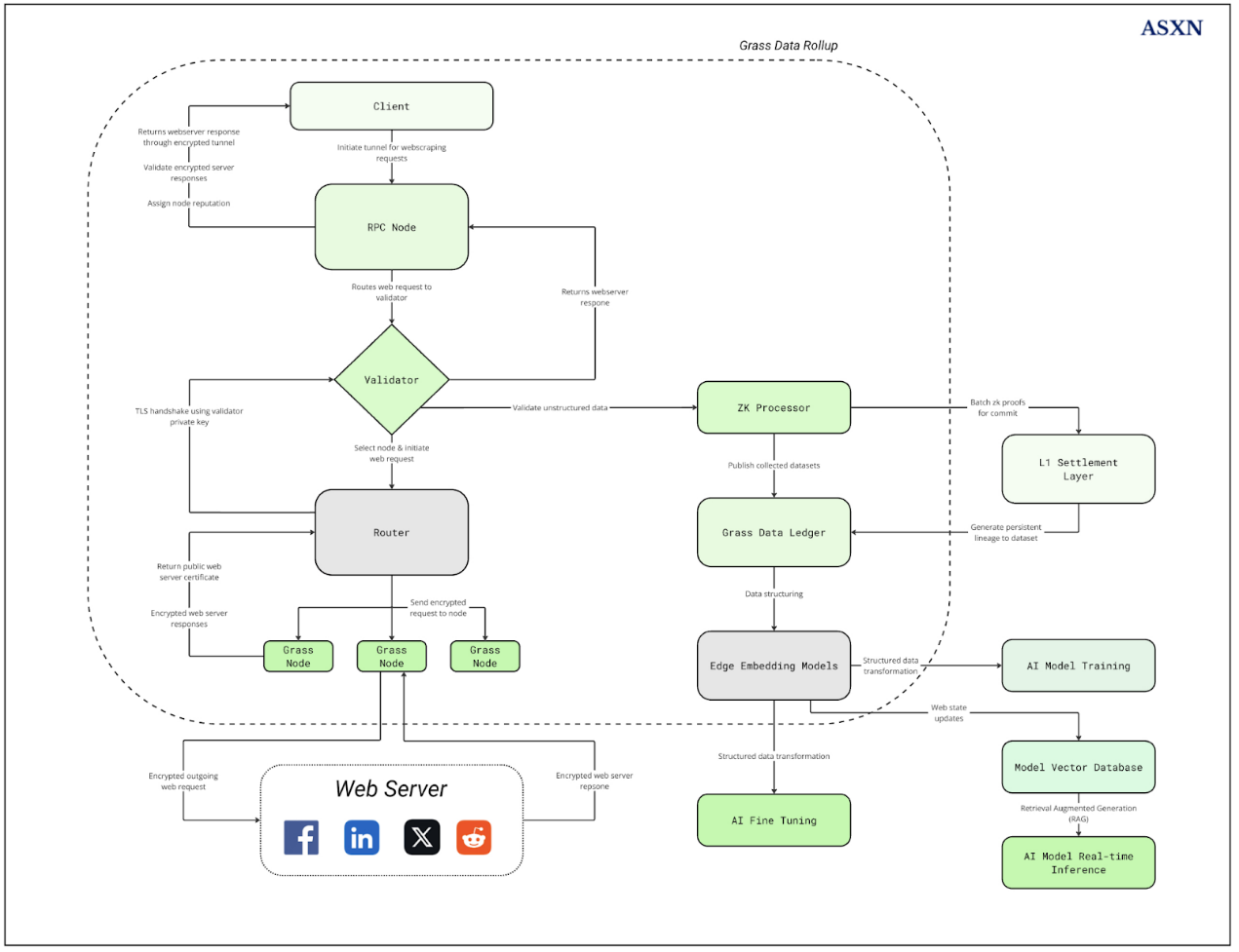
The Grass network currently captures more than 100TB of data every day. As of now, Grass nodes are spread across 190 countries and have more than 2.5 million nodes.

It manages all processes from initial data collection to processing and validation, while compensating and incentivizing participants.

The Grass Agreement consists of the following parts:

  • Grass Node
  • Sovereign Data Rollup

After the airdrop, the price fluctuated upward. What are the characteristics of Grass, a web crawler project that combines AI and DePIN?

Grass nodes allow users to contribute idle network resources to earn rewards. Each node is uniquely identified by its device fingerprint and IP address.

The GRASS Sovereign Data Rollup is a purpose-built network on Solana that enables the protocol to handle all transactions from data source to processing, validating, and structuring datasets.

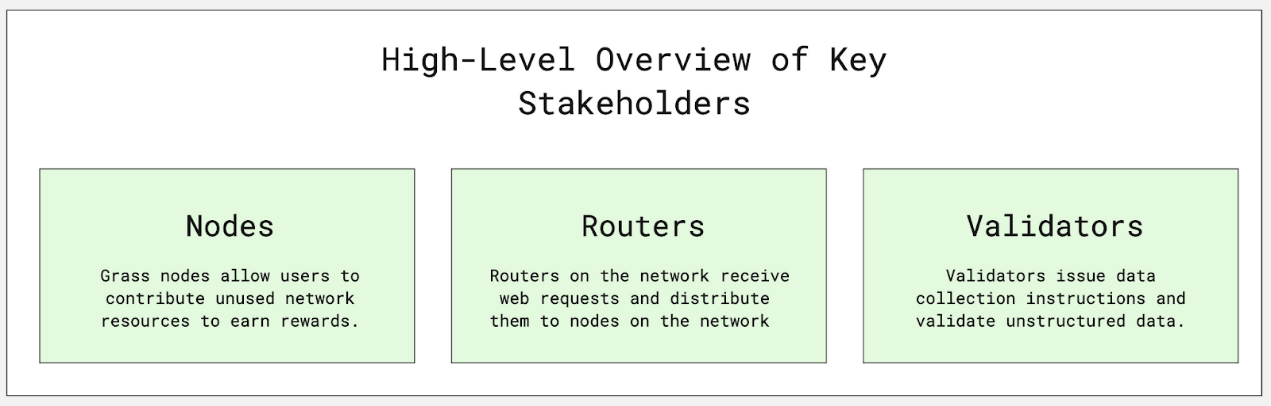
The network is built around validators that issue data collection instructions, routers that manage the distribution of web requests, and nodes that users use to contribute their idle network resources.

GRASS uses a data ledger for hash storage, a Merkle tree bundling system, and on-chain root data publishing.
After the airdrop, the price fluctuated upward. What are the characteristics of Grass, a web crawler project that combines AI and DePIN?

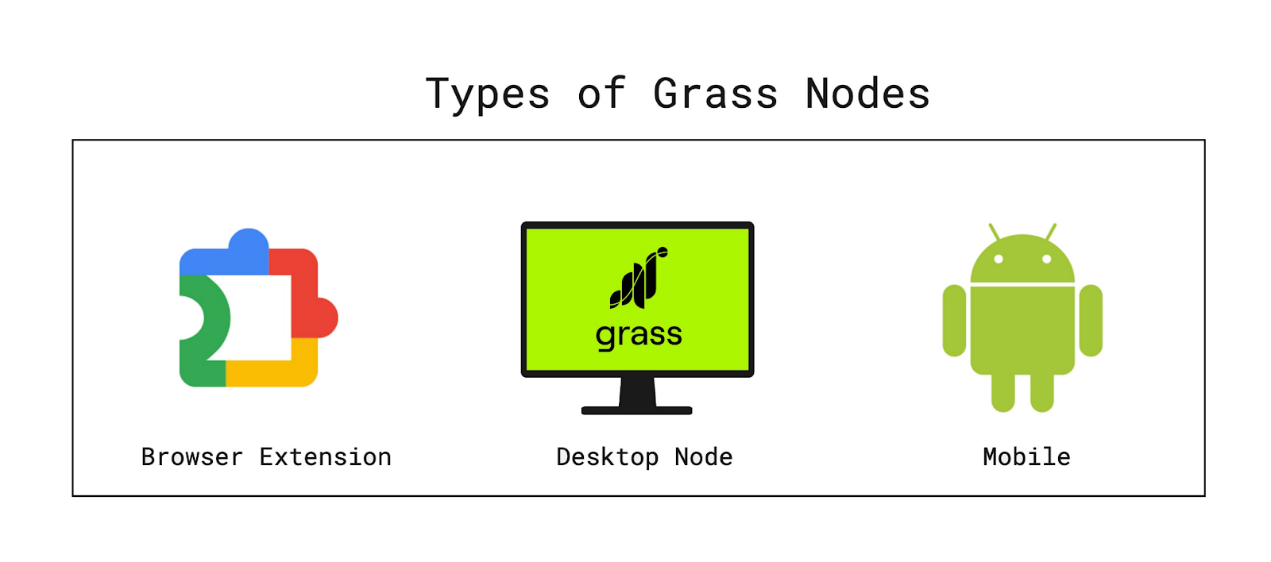
GRASS nodes can be deployed via a browser extension, desktop application, or Android-based mobile application.
After the airdrop, the price fluctuated upward. What are the characteristics of Grass, a web crawler project that combines AI and DePIN?

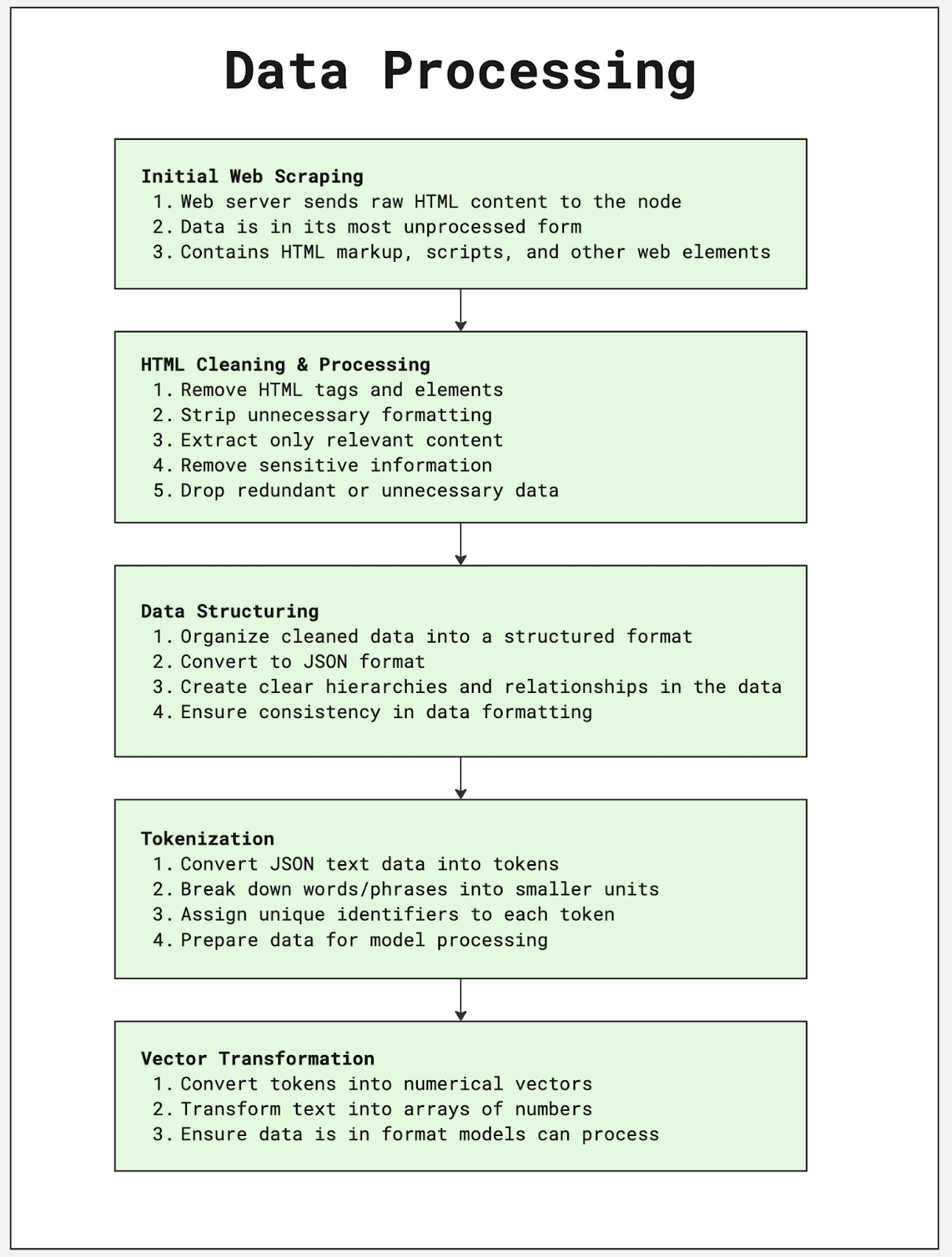
For data processing, the protocol uses an HTML to JSON conversion system, custom Python cleanup scripts, data structure tools, and vectorization processes, while developing embedded models for edge processing.
After the airdrop, the price fluctuated upward. What are the characteristics of Grass, a web crawler project that combines AI and DePIN?

Security and authentication are maintained through Zero-Knowledge Transport Layer Security (ZK TLS), proof generation for web requests, web session logging, a decentralized database for hash storage, and anti-data poisoning measures.

GRASS also ensures the integrity and quality of the data through various means, including a contributor ranking system, a consensus mechanism for quality control, a distributed work system, and a reputation scoring system.

Data management is handled through multiple storage solutions, including Hugging Face (which supports up to 10TB/day of free storage), self-hosted MongoDB for proprietary datasets, and partnerships with decentralized data providers.

Recently, the team opened up their dataset UpVoteWeb, which contains 600 million Reddit posts and comments on HuggingFace: https://huggingface.co/datasets/OpenCo7/UpVoteWeb

Related reading: Decentralized Data Layer: New Infrastructure for the AI Era

Market Opportunity
Moonveil Logo
Moonveil Price(MORE)
$0,0007806
$0,0007806$0,0007806
-1,83%
USD
Moonveil (MORE) Live Price Chart
Disclaimer: The articles reposted on this site are sourced from public platforms and are provided for informational purposes only. They do not necessarily reflect the views of MEXC. All rights remain with the original authors. If you believe any content infringes on third-party rights, please contact [email protected] for removal. MEXC makes no guarantees regarding the accuracy, completeness, or timeliness of the content and is not responsible for any actions taken based on the information provided. The content does not constitute financial, legal, or other professional advice, nor should it be considered a recommendation or endorsement by MEXC.

You May Also Like

Cashing In On University Patents Means Giving Up On Our Innovation Future
Cashing In On University Patents Means Giving Up On Our Innovation Future

The post Cashing In On University Patents Means Giving Up On Our Innovation Future appeared on BitcoinEthereumNews.com. “It’s a raid on American innovation that would deliver pennies to the Treasury while kneecapping the very engine of our economic and medical progress,” writes Pipes. Getty Images Washington is addicted to taxing success. Now, Commerce Secretary Howard Lutnick is floating a plan to skim half the patent earnings from inventions developed at universities with federal funding. It’s being sold as a way to shore up programs like Social Security. In reality, it’s a raid on American innovation that would deliver pennies to the Treasury while kneecapping the very engine of our economic and medical progress. Yes, taxpayer dollars support early-stage research. But the real payoff comes later—in the jobs created, cures discovered, and industries launched when universities and private industry turn those discoveries into real products. By comparison, the sums at stake in patent licensing are trivial. Universities collectively earn only about $3.6 billion annually in patent income—less than the federal government spends on Social Security in a single day. Even confiscating half would barely register against a $6 trillion federal budget. And yet the damage from such a policy would be anything but trivial. The true return on taxpayer investment isn’t in licensing checks sent to Washington, but in the downstream economic activity that federally supported research unleashes. Thanks to the bipartisan Bayh-Dole Act of 1980, universities and private industry have powerful incentives to translate early-stage discoveries into real-world products. Before Bayh-Dole, the government hoarded patents from federally funded research, and fewer than 5% were ever licensed. Once universities could own and license their own inventions, innovation exploded. The result has been one of the best returns on investment in government history. Since 1996, university research has added nearly $2 trillion to U.S. industrial output, supported 6.5 million jobs, and launched more than 19,000 startups. Those companies pay…
Share
BitcoinEthereumNews2025/09/18 03:26
Trump foe devises plan to starve him of what he 'craves' most

Trump foe devises plan to starve him of what he 'craves' most

A longtime adversary of President Donald Trump has a plan for a key group to take away what Trump craves the most — attention. EX-CNN journalist Jim Acosta, who
Share
Rawstory2026/02/04 01:19
Why Bitcoin Is Struggling: 8 Factors Impacting Crypto Markets

Why Bitcoin Is Struggling: 8 Factors Impacting Crypto Markets

Failed blockchain adoption narratives and weak fee capture have undercut confidence in major crypto projects.
Share
CryptoPotato2026/02/04 01:05