Bitcoin (BTC) Price: How BTC Has Outperformed Gold and the S&P 500 Since the War Began
TLDR
- Bitcoin dropped 8.5% when the U.S.-Iran war started but has since risen ~11% from its lowest point.
- Each new conflict escalation has triggered a sell-off, but Bitcoin keeps finding buyers at higher price levels.
- BTC has outperformed gold and the S&P 500 over the same two-week period.
- Large Bitcoin wallet holders (whales) are accumulating again near $71,000, now controlling 68.17% of total supply.
- On-chain data suggests little resistance between current prices and ~$82,000.
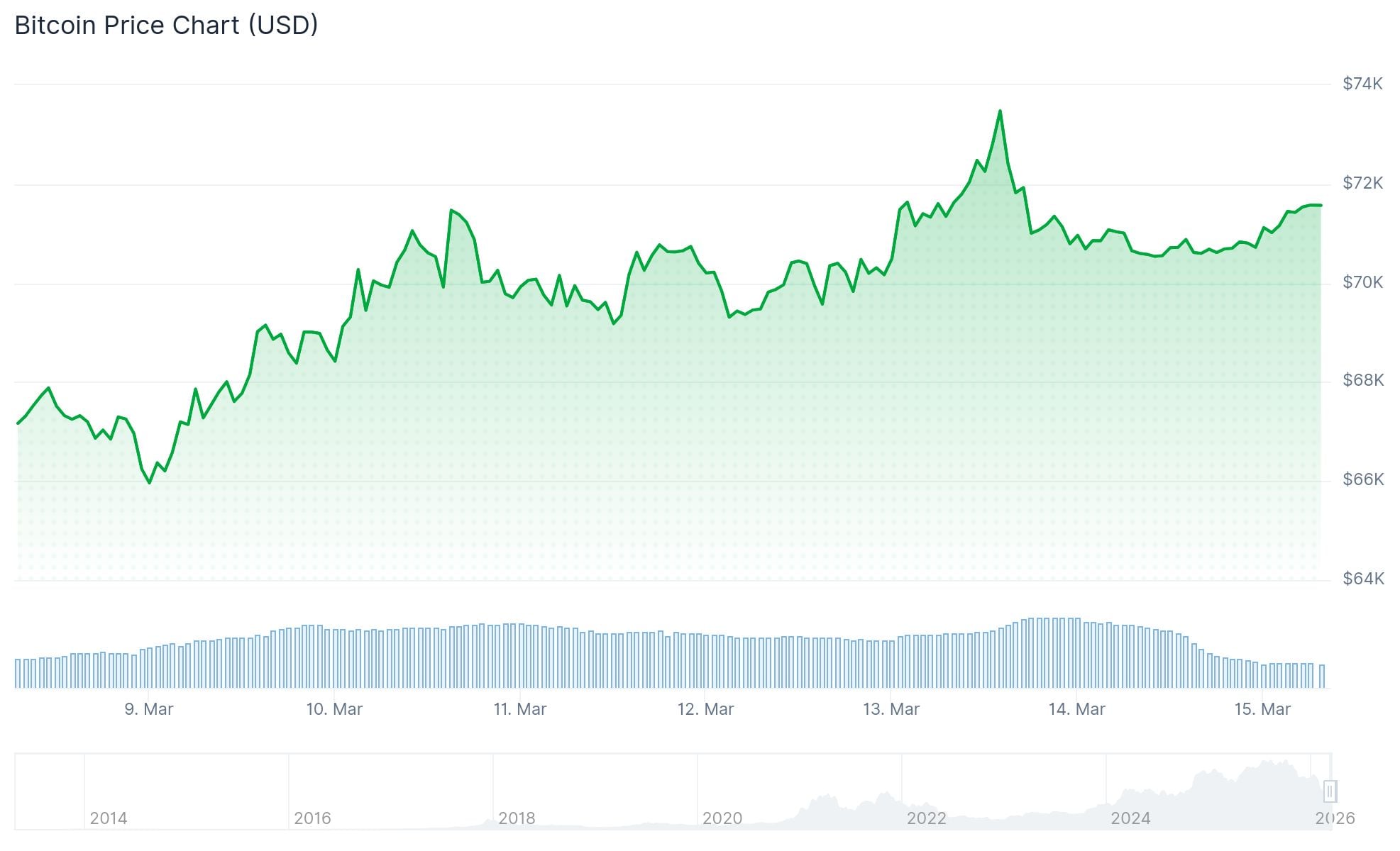
Bitcoin is currently trading at $71,500.
 Bitcoin (BTC) Price
The U.S.-Iran war began on a Saturday, Feb. 28. Bitcoin was the only major market open that day. It dropped 8.5% to $64,000. That was its lowest point.
Two weeks later, the picture looks different.
Bitcoin has climbed roughly 11% from that low. It now trades around $71,500. Over the same stretch, gold has been volatile, the S&P 500 is down, and Asian equity markets had their worst week since 2020. Only oil — up over 40% — and the U.S. dollar have outperformed Bitcoin. Both are direct beneficiaries of the war.
A Rising Floor After Every Sell-Off
Every escalation since Feb. 28 has triggered a Bitcoin sell-off. But each time, buyers have stepped in at a higher level.
After Iran’s retaliatory missile strikes on March 2, the price bottomed at $66,000. After a week of sustained conflict on March 7, the floor was $68,000. Following tanker attacks on March 12, BTC held $69,400. After the Kharg Island strike on March 14, the low was $70,596.
That’s a rising support line of roughly $1,000–$2,000 per event.
At the same time, Bitcoin has been rejected four times near $73,000–$74,000. That ceiling has held firm. Something has to give — either Bitcoin breaks above $74,000, or a bigger escalation finally overwhelms buyers.
Earlier this year, a sudden liquidation event wiped $2.5 billion in leveraged positions over a single weekend, dragging Bitcoin to $77,000. That episode appears to have cleared out overleveraged positions, leaving a market that has since absorbed repeated war headlines without a similar collapse.
Whales Accumulating, On-Chain Data Points to $82K
Data from crypto analytics platform Santiment shows large Bitcoin wallets — those holding between 10 and 10,000 BTC — have started accumulating again near $71,000.
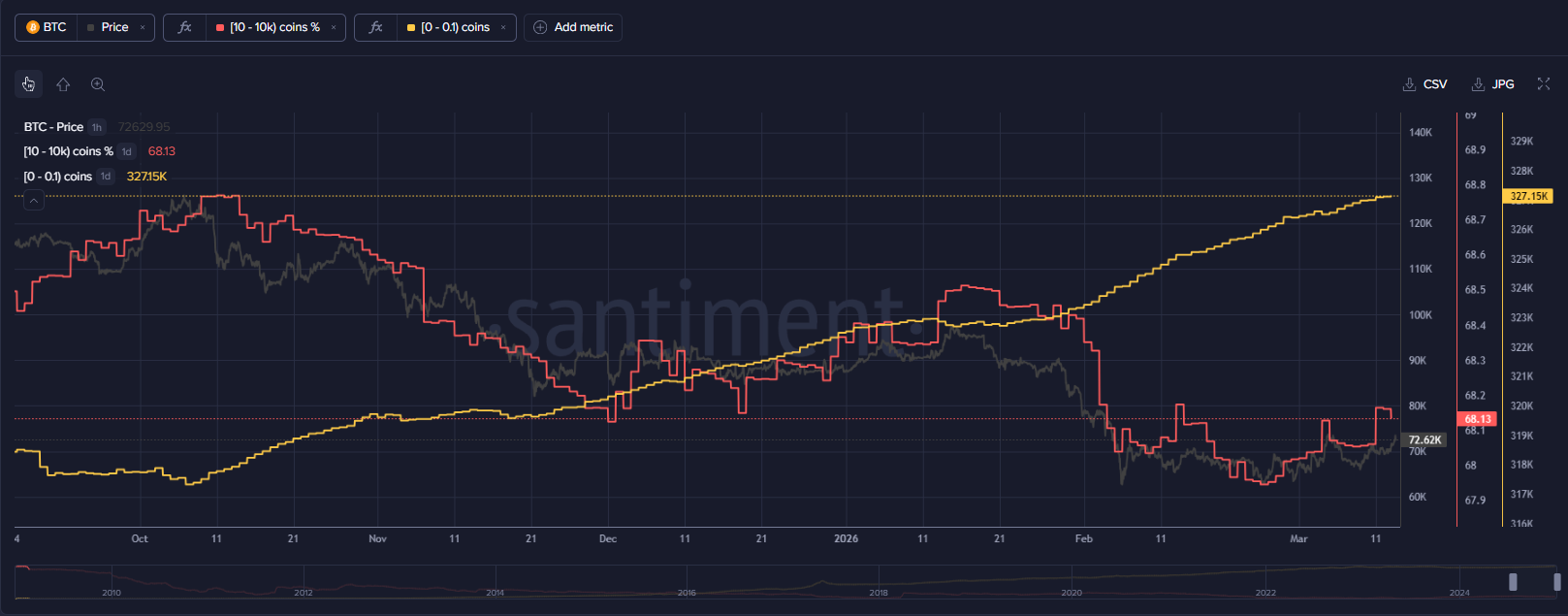 Source: Santiment
These wallets now control 68.17% of Bitcoin’s total supply, up from 68.07% a week ago. Santiment called the shift a “positive reversal.” The platform is watching to see if retail investors begin selling, which would historically signal a market bottom forming.
The Crypto Fear & Greed Index sat at 16 on Sunday — firmly in “Extreme Fear.”
U.S. spot Bitcoin ETFs logged their first five-day inflow streak of 2026 this week, pulling in approximately $767 million.
On-chain analyst Ali Martinez, citing the UTXO Realized Price Distribution metric, noted that Bitcoin currently faces very little resistance between current prices and roughly $82,045. The $74,000 rejection zone, he noted, has low investor cost-basis activity, suggesting it may not be as strong a barrier as it appears.
The next major support below current prices sits around $66,898.
Bitcoin is up 7.55% over the past 30 days. BTC is currently trading at $71,500.
The post Bitcoin (BTC) Price: How BTC Has Outperformed Gold and the S&P 500 Since the War Began appeared first on CoinCentral.
You May Also Like

Sonic jumps 11% as Binance stakes 76mln tokens – Can S flip $0.05?

PHL seeking $280-million ADB loan for semiconductor development