Pump.fun has officially generated over $1 billion in cumulative revenue, becoming the first application in Solana history to cross the ten-figure milestone. ThePump.fun has officially generated over $1 billion in cumulative revenue, becoming the first application in Solana history to cross the ten-figure milestone. The

Pump.fun Is Solana First $1B Revenue App: Expansion to Ethereum Incoming

2026/03/12 21:02
3 min read
For feedback or concerns regarding this content, please contact us at [email protected]

Pump.fun has officially generated over $1 billion in cumulative revenue, becoming the first application in Solana history to cross the ten-figure milestone.

The viral memecoin launchpad, which pioneered the bonding curve model to deter rug pulls, has now outpaced nearly every DeFi protocol in crypto by fee generation.

But the revenue record is already secondary to a potentially larger shift. Subdomain registrations for ethereum.pump.fun, base.pump.fun, and monad.pump.fun have been identified on-chain, signaling that an aggressive cross-chain expansion is imminent.
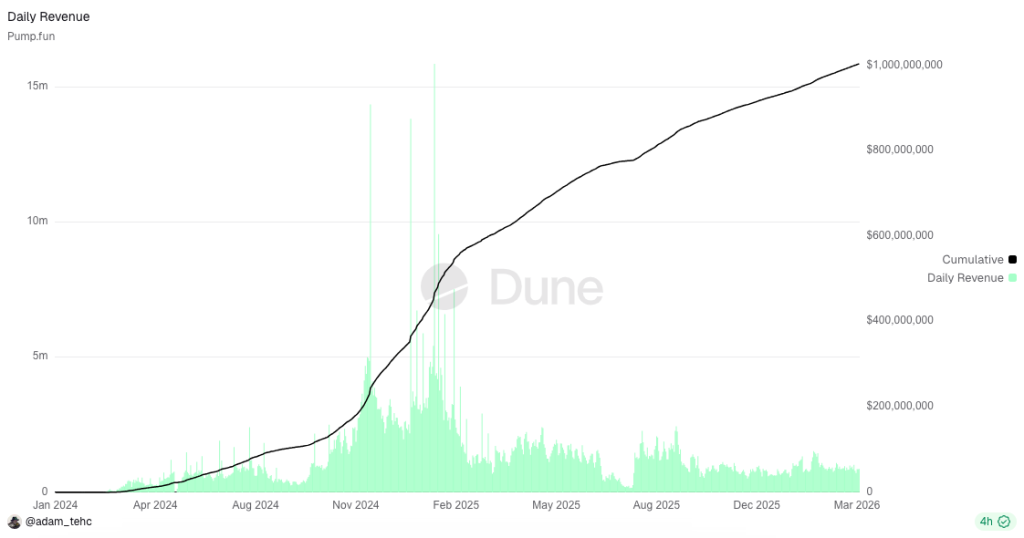
Source: Dune

Since its launch on January 19, 2024, Pump.fun has facilitated the creation of around 12 million tokens. At the height of the memecoin frenzy in late 2024, the platform accounted for approximately 62% of all daily transactions on the Solana network.

The platform’s revenue engine is relentless. By April 2025, total fees hit 1.52 million SOL. Daily revenue consistently hovers around $1 million. This volume has made Pump.fun the de facto ‘Solana revenue’ driver, overshadowing legacy DeFi applications.

However, the metrics also reveal the extreme volatility of the product. Data suggests 98.5% of tokens launched on the platform fail to complete their bonding curve, effectively going to zero. Despite this, user retention remains high, with lifetime unique users exceeding 22 million.

Discover: The next crypto to explode

What the Subdomain Registrations Actually Reveal About Pump.fun’s Next Move

The discovery of formatted subdomains for Ethereum, Base, and Monad is not a definitive roadmap, but it is a strong signal of intent.

Expansion to the Base network represents the most logical immediate step. Base has cultivated a thriving retail user base similar to Solana’s, but currently lacks a single dominant launchpad with Pump.fun’s brand recognition.

A successful deployment here would unify the fractured memecoin liquidity currently spread across smaller forks.

The Ethereum subdomain points to a different strategy. While high gas fees historically deterred memecoin trading on mainnet, Wall Street is choosing Ethereum as the backbone of institutional DeFi, which could allow Pump.fun to tap into deeper capital markets.

How Pump.fun Expanding From Solana to Ethereum and Base Changes the Launchpad Wars

If Pump.fun successfully ports its UI and bonding curve mechanics to EVM chains, it instantly threatens native competitors.

On Base, protocols like Clanker have gained traction, but they lack the massive war chest, fueled by $1.3 billion in ICO and private funding, that Pump.fun now commands.

Security remains the primary wildcard in this expansion. The memecoin launchpad sector is notoriously fragile.

Recently, the Bonk.fun website was hijacked by a malicious actor, draining user wallets and highlighting the risks inherent in these high-velocity platforms. Expanding to new chains multiplies these attack vectors significantly.

If Pump.fun can maintain security while deploying on multiple chains, it effectively universalizes the ‘launchpad’ experience, turning it into a chain-agnostic utility rather than a feature exclusive to Solana.

Discover: The best crypto to buy now

Market Opportunity
pump.fun Logo
pump.fun Price(PUMP)
$0.00187
$0.00187$0.00187
+0.05%
USD
pump.fun (PUMP) Live Price Chart
Disclaimer: The articles reposted on this site are sourced from public platforms and are provided for informational purposes only. They do not necessarily reflect the views of MEXC. All rights remain with the original authors. If you believe any content infringes on third-party rights, please contact [email protected] for removal. MEXC makes no guarantees regarding the accuracy, completeness, or timeliness of the content and is not responsible for any actions taken based on the information provided. The content does not constitute financial, legal, or other professional advice, nor should it be considered a recommendation or endorsement by MEXC.

You May Also Like

The Channel Factories We’ve Been Waiting For

The Channel Factories We’ve Been Waiting For

The post The Channel Factories We’ve Been Waiting For appeared on BitcoinEthereumNews.com. Visions of future technology are often prescient about the broad strokes while flubbing the details. The tablets in “2001: A Space Odyssey” do indeed look like iPads, but you never see the astronauts paying for subscriptions or wasting hours on Candy Crush.  Channel factories are one vision that arose early in the history of the Lightning Network to address some challenges that Lightning has faced from the beginning. Despite having grown to become Bitcoin’s most successful layer-2 scaling solution, with instant and low-fee payments, Lightning’s scale is limited by its reliance on payment channels. Although Lightning shifts most transactions off-chain, each payment channel still requires an on-chain transaction to open and (usually) another to close. As adoption grows, pressure on the blockchain grows with it. The need for a more scalable approach to managing channels is clear. Channel factories were supposed to meet this need, but where are they? In 2025, subnetworks are emerging that revive the impetus of channel factories with some new details that vastly increase their potential. They are natively interoperable with Lightning and achieve greater scale by allowing a group of participants to open a shared multisig UTXO and create multiple bilateral channels, which reduces the number of on-chain transactions and improves capital efficiency. Achieving greater scale by reducing complexity, Ark and Spark perform the same function as traditional channel factories with new designs and additional capabilities based on shared UTXOs.  Channel Factories 101 Channel factories have been around since the inception of Lightning. A factory is a multiparty contract where multiple users (not just two, as in a Dryja-Poon channel) cooperatively lock funds in a single multisig UTXO. They can open, close and update channels off-chain without updating the blockchain for each operation. Only when participants leave or the factory dissolves is an on-chain transaction…
Share
BitcoinEthereumNews2025/09/18 00:09
Gold continues to hit new highs. How to invest in gold in the crypto market?

Gold continues to hit new highs. How to invest in gold in the crypto market?

As Bitcoin encounters a "value winter", real-world gold is recasting the iron curtain of value on the blockchain.
Share
PANews2025/04/14 17:12
XRP Multi-Year Accumulation Signals Potential 1000% Breakout

XRP Multi-Year Accumulation Signals Potential 1000% Breakout

The post XRP Multi-Year Accumulation Signals Potential 1000% Breakout appeared on BitcoinEthereumNews.com. XRP Builds Multi-Year Base as Whales Accumulate and Volume
Share
BitcoinEthereumNews2026/03/21 00:04







