World’s Largest Art Auction House Is Shutting Down Its NFT Division
Christie’s the world’s largest art auction house, its shuttering its digital art division, home to many NFTs. The institution hosted a $69 million NFT auction in 2021, helping kickstart the sector’s fame.
Theoretically, the firm may continue selling NFTs in the “21st Century Art” category, but this seems unlikely.
The Art World Ditches NFTs
The NFT sector took the world by storm in 2022, but the broader Web3 sector has largely moved on. Although there was a brief revival earlier this year, and the space is still exploring use cases, this is unrelated to their purported use as an art form. Christie’s, the world’s largest art auction house, is shuttering all its NFT services:
This may seem like a minor development, but the art auction house is very key to NFT history. In 2021, Christie’s made history by selling an NFT collection for $69 million.
This largely helped trigger the technology’s rise to fame, powering the gains of 2022. Christie’s even launched an on-chain auction platform as a show of confidence.
It may be difficult to see why that confidence is gone today. Objectively, NFTs aren’t performing much worse than they have been in 2023 or 2024. For one, the top NFT collections’ trading volume increased by nearly 90% in the last 24 hours. The sector’s most recent peak is smaller than in 2024, but it’s not a significant drop.
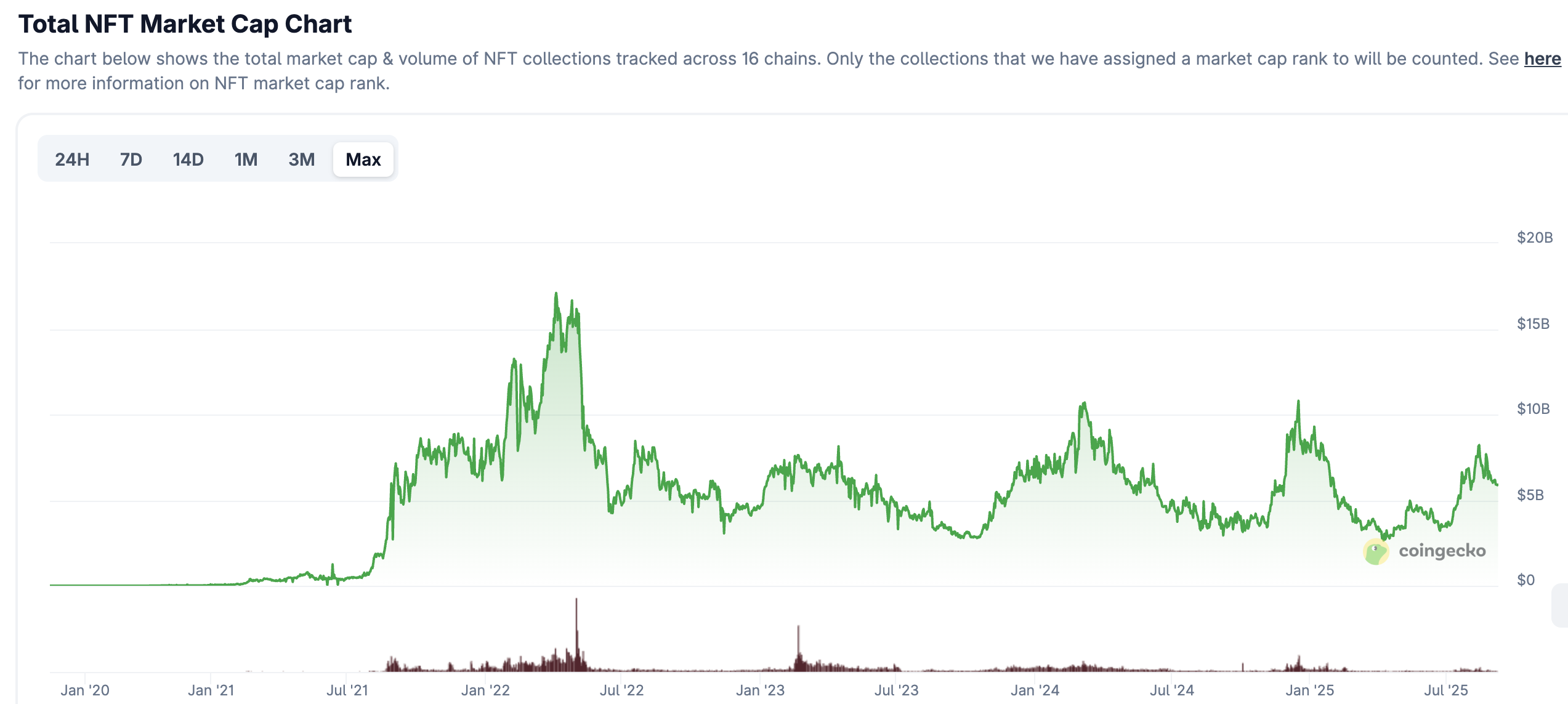 NFT Market Caps. Source: CoinGecko
More Than Volumes and Market Caps
Unfortunately, though, stats like that are irrelevant to NFTs’ place in the art world. Years ago, serious artists heralded them as an important future for digital art, and famous creators have launched their own collections on many occasions.
In 2025, though, this use case has apparently fallen out of favor. Simply put, the art world has moved on.
Decisions like this are key “intangibles” in the market, and investors shouldn’t take them lightly. Would NFTs have ever taken off if major institutions like Christie’s didn’t think they were legitimate art? If the exact same organizations have lost their faith in NFTs, who will keep it alive?
This development may serve as a canary in the coal mine. The NFT sector isn’t dead yet, but its oldest friends are abandoning it. Although it may linger on for quite some time, a full return to the limelight seems unlikely.
You May Also Like

YZi Labs Binance Deposit: A $6.63M Signal That Could Shake the ID Token Market

BitGo wins BaFIN nod to offer regulated crypto trading in Europe
BitGo’s move creates further competition in a burgeoning European crypto market that is expected to generate $26 billion revenue this year, according to one estimate. BitGo, a digital asset infrastructure company with more than $100 billion in assets under custody, has received an extension of its license from Germany’s Federal Financial Supervisory Authority (BaFin), enabling it to offer crypto services to European investors. The company said its local subsidiary, BitGo Europe, can now provide custody, staking, transfer, and trading services. Institutional clients will also have access to an over-the-counter (OTC) trading desk and multiple liquidity venues.The extension builds on BitGo’s previous Markets-in-Crypto-Assets (MiCA) license, also issued by BaFIN, and adds trading to the existing custody, transfer and staking services. BitGo acquired its initial MiCA license in May 2025, which allowed it to offer certain services to traditional institutions and crypto native companies in the European Union.Read more