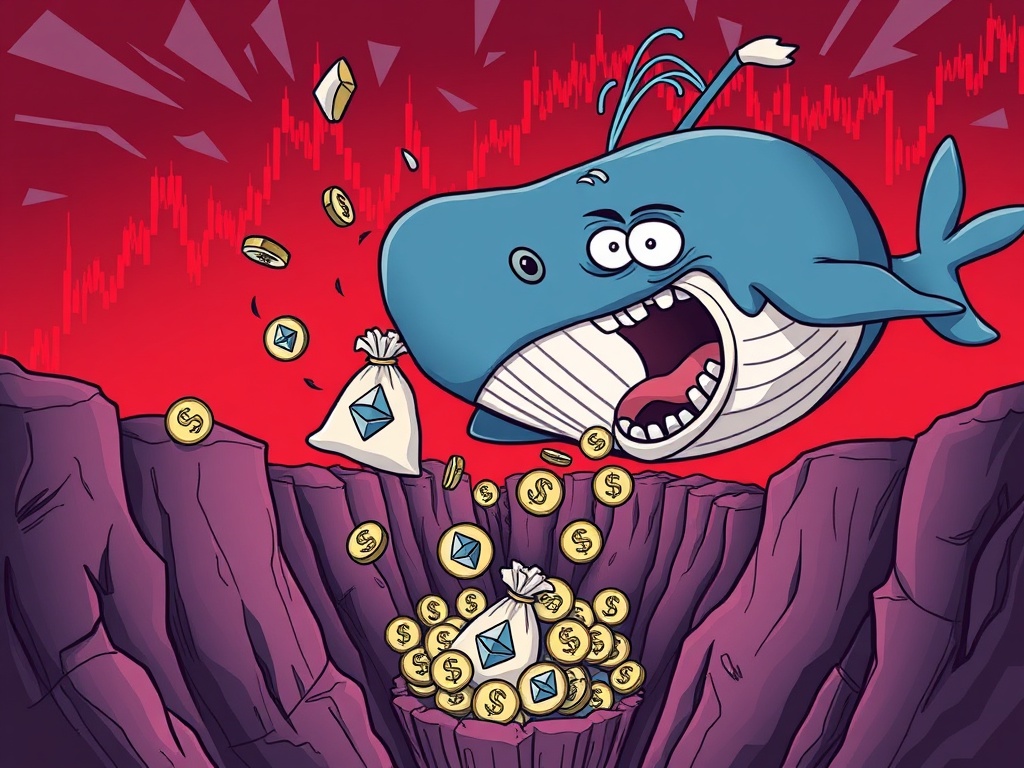
BitcoinWorld Shocking Ethereum Whale Sell-Off: $944,000 Loss in a Day The cryptocurrency market, a realm of rapid changes, recently saw a significant Ethereum whale sell-off. A major investor experienced a nearly million-dollar loss in just one day, sending a clear message about market volatility. Such dramatic, high-stakes moves are not uncommon in digital assets. What exactly transpired, and what critical lessons can we draw from this rapid turn of events? What Sparked This Sudden Ethereum Whale Sell-Off? Blockchain analytics firm Lookonchain reported a striking transaction. A prominent crypto holder, often called a ‘whale,’ purchased 3,690 ETH, valued at an estimated $15.6 million. This acquisition occurred just one day before a dramatic reversal. The very next day, in an apparent panic, the same whale liquidated all their Ethereum. This swift sell-off resulted in a significant loss of $944,000. Why would such a large investor make such an immediate and costly decision? While motives are speculative, rapid reversals like this often stem from: Sudden Market Downturns: A sharp price drop or negative news can trigger fear. Margin Call Pressure: Leverage positions might force quick sales to avoid liquidation. Unforeseen Circumstances: Personal or external factors requiring immediate liquidity. This incident highlights that even seasoned, well-funded participants are susceptible to market pressures and emotional trading. Understanding a Crypto Whale’s Panic A ‘whale’ is an individual or entity holding a vast amount of cryptocurrency, enough to potentially sway market prices. When such a holder executes an Ethereum whale sell-off, it can create a noticeable impact, especially in a sensitive market. This particular whale’s rapid decision to sell within 24 hours suggests a strong reaction to perceived risk or an urgent need to exit the position. This behavior, while dramatic, is not uncommon in highly volatile crypto markets. It shows that even investors with deep pockets can be influenced by the same emotional biases as smaller traders. The speed, magnitude, and the incurred loss all point to a reactive, rather than strategic, decision. The Market Impact of an Ethereum Whale Sell-Off While a single Ethereum whale sell-off is notable, its broader market implications require context. Large sales can increase selling pressure, potentially causing a short-term dip in ETH’s price. Other traders might react, amplifying the effect. However, the Ethereum market is vast and highly liquid. It often absorbs substantial sell orders without long-term damage. The market’s resilience comes from its depth and diverse participants. While immediate impacts might include slight price fluctuations or momentary sentiment dips, established cryptocurrencies like Ethereum typically recover. Investors often consider broader economic indicators, technological advancements, and overall market sentiment over isolated whale movements. Lessons from Volatile ETH Trades This incident offers crucial lessons for all cryptocurrency investors. The dramatic Ethereum whale sell-off underscores the importance of strategic planning and emotional discipline in volatile markets. Consider these actionable insights: Avoid Impulsive Decisions: Reacting out of fear or greed often leads to losses. Stick to your predefined investment strategy. Prioritize Risk Management: Never invest more than you can afford to lose. Utilize tools like stop-loss orders to manage potential downsides. Conduct Thorough Research (DYOR): Understand your assets’ long-term potential, rather than chasing quick gains. Maintain a Long-Term View: Focus on fundamental value over daily price swings. Even large investors can make costly mistakes when panic sets in. This reinforces the idea that emotional trading is often detrimental in any financial market. The recent Ethereum whale sell-off serves as a powerful reminder of the crypto market’s dynamic nature. While such transactions can cause temporary jitters, they also highlight the importance of disciplined investing and sound risk management. For investors, the key is to remain calm, conduct thorough research, and adhere to a well-defined strategy, avoiding impulsive reactions. The crypto journey rewards patience and informed decisions. Frequently Asked Questions (FAQs) Q1: What defines a crypto whale? A crypto whale is an individual or entity holding a substantial amount of cryptocurrency, capable of influencing market prices through large trades. Q2: How do whale activities typically affect crypto prices? Large whale trades, especially sell-offs, can temporarily increase selling pressure and volatility. However, the overall market’s liquidity and broader trends usually dictate long-term impact. Q3: Is panic selling a common occurrence in crypto markets? Yes, due to high volatility and strong emotions, panic selling can occur during significant price drops or negative news. Even large investors are not immune. Q4: What’s the best approach during a major market sell-off? It’s generally wise to avoid impulsive reactions. Revisit your investment strategy, analyze the underlying causes, and consider your long-term objectives. Effective risk management, like stop-loss orders, is also crucial. If you found this analysis insightful, consider sharing it with your network! Stay informed and make smart decisions in the ever-evolving world of cryptocurrency. To learn more about the latest crypto market trends, explore our article on key developments shaping Ethereum price action. This post Shocking Ethereum Whale Sell-Off: $944,000 Loss in a Day first appeared on BitcoinWorld and is written by Editorial TeamBitcoinWorld Shocking Ethereum Whale Sell-Off: $944,000 Loss in a Day The cryptocurrency market, a realm of rapid changes, recently saw a significant Ethereum whale sell-off. A major investor experienced a nearly million-dollar loss in just one day, sending a clear message about market volatility. Such dramatic, high-stakes moves are not uncommon in digital assets. What exactly transpired, and what critical lessons can we draw from this rapid turn of events? What Sparked This Sudden Ethereum Whale Sell-Off? Blockchain analytics firm Lookonchain reported a striking transaction. A prominent crypto holder, often called a ‘whale,’ purchased 3,690 ETH, valued at an estimated $15.6 million. This acquisition occurred just one day before a dramatic reversal. The very next day, in an apparent panic, the same whale liquidated all their Ethereum. This swift sell-off resulted in a significant loss of $944,000. Why would such a large investor make such an immediate and costly decision? While motives are speculative, rapid reversals like this often stem from: Sudden Market Downturns: A sharp price drop or negative news can trigger fear. Margin Call Pressure: Leverage positions might force quick sales to avoid liquidation. Unforeseen Circumstances: Personal or external factors requiring immediate liquidity. This incident highlights that even seasoned, well-funded participants are susceptible to market pressures and emotional trading. Understanding a Crypto Whale’s Panic A ‘whale’ is an individual or entity holding a vast amount of cryptocurrency, enough to potentially sway market prices. When such a holder executes an Ethereum whale sell-off, it can create a noticeable impact, especially in a sensitive market. This particular whale’s rapid decision to sell within 24 hours suggests a strong reaction to perceived risk or an urgent need to exit the position. This behavior, while dramatic, is not uncommon in highly volatile crypto markets. It shows that even investors with deep pockets can be influenced by the same emotional biases as smaller traders. The speed, magnitude, and the incurred loss all point to a reactive, rather than strategic, decision. The Market Impact of an Ethereum Whale Sell-Off While a single Ethereum whale sell-off is notable, its broader market implications require context. Large sales can increase selling pressure, potentially causing a short-term dip in ETH’s price. Other traders might react, amplifying the effect. However, the Ethereum market is vast and highly liquid. It often absorbs substantial sell orders without long-term damage. The market’s resilience comes from its depth and diverse participants. While immediate impacts might include slight price fluctuations or momentary sentiment dips, established cryptocurrencies like Ethereum typically recover. Investors often consider broader economic indicators, technological advancements, and overall market sentiment over isolated whale movements. Lessons from Volatile ETH Trades This incident offers crucial lessons for all cryptocurrency investors. The dramatic Ethereum whale sell-off underscores the importance of strategic planning and emotional discipline in volatile markets. Consider these actionable insights: Avoid Impulsive Decisions: Reacting out of fear or greed often leads to losses. Stick to your predefined investment strategy. Prioritize Risk Management: Never invest more than you can afford to lose. Utilize tools like stop-loss orders to manage potential downsides. Conduct Thorough Research (DYOR): Understand your assets’ long-term potential, rather than chasing quick gains. Maintain a Long-Term View: Focus on fundamental value over daily price swings. Even large investors can make costly mistakes when panic sets in. This reinforces the idea that emotional trading is often detrimental in any financial market. The recent Ethereum whale sell-off serves as a powerful reminder of the crypto market’s dynamic nature. While such transactions can cause temporary jitters, they also highlight the importance of disciplined investing and sound risk management. For investors, the key is to remain calm, conduct thorough research, and adhere to a well-defined strategy, avoiding impulsive reactions. The crypto journey rewards patience and informed decisions. Frequently Asked Questions (FAQs) Q1: What defines a crypto whale? A crypto whale is an individual or entity holding a substantial amount of cryptocurrency, capable of influencing market prices through large trades. Q2: How do whale activities typically affect crypto prices? Large whale trades, especially sell-offs, can temporarily increase selling pressure and volatility. However, the overall market’s liquidity and broader trends usually dictate long-term impact. Q3: Is panic selling a common occurrence in crypto markets? Yes, due to high volatility and strong emotions, panic selling can occur during significant price drops or negative news. Even large investors are not immune. Q4: What’s the best approach during a major market sell-off? It’s generally wise to avoid impulsive reactions. Revisit your investment strategy, analyze the underlying causes, and consider your long-term objectives. Effective risk management, like stop-loss orders, is also crucial. If you found this analysis insightful, consider sharing it with your network! Stay informed and make smart decisions in the ever-evolving world of cryptocurrency. To learn more about the latest crypto market trends, explore our article on key developments shaping Ethereum price action. This post Shocking Ethereum Whale Sell-Off: $944,000 Loss in a Day first appeared on BitcoinWorld and is written by Editorial Team

Shocking Ethereum Whale Sell-Off: $944,000 Loss in a Day

5 min read

BitcoinWorld

Shocking Ethereum Whale Sell-Off: $944,000 Loss in a Day

The cryptocurrency market, a realm of rapid changes, recently saw a significant Ethereum whale sell-off. A major investor experienced a nearly million-dollar loss in just one day, sending a clear message about market volatility. Such dramatic, high-stakes moves are not uncommon in digital assets. What exactly transpired, and what critical lessons can we draw from this rapid turn of events?

What Sparked This Sudden Ethereum Whale Sell-Off?

Blockchain analytics firm Lookonchain reported a striking transaction. A prominent crypto holder, often called a ‘whale,’ purchased 3,690 ETH, valued at an estimated $15.6 million. This acquisition occurred just one day before a dramatic reversal. The very next day, in an apparent panic, the same whale liquidated all their Ethereum. This swift sell-off resulted in a significant loss of $944,000.

Why would such a large investor make such an immediate and costly decision? While motives are speculative, rapid reversals like this often stem from:

  • Sudden Market Downturns: A sharp price drop or negative news can trigger fear.
  • Margin Call Pressure: Leverage positions might force quick sales to avoid liquidation.
  • Unforeseen Circumstances: Personal or external factors requiring immediate liquidity.

This incident highlights that even seasoned, well-funded participants are susceptible to market pressures and emotional trading.

Understanding a Crypto Whale’s Panic

A ‘whale’ is an individual or entity holding a vast amount of cryptocurrency, enough to potentially sway market prices. When such a holder executes an Ethereum whale sell-off, it can create a noticeable impact, especially in a sensitive market. This particular whale’s rapid decision to sell within 24 hours suggests a strong reaction to perceived risk or an urgent need to exit the position.

This behavior, while dramatic, is not uncommon in highly volatile crypto markets. It shows that even investors with deep pockets can be influenced by the same emotional biases as smaller traders. The speed, magnitude, and the incurred loss all point to a reactive, rather than strategic, decision.

The Market Impact of an Ethereum Whale Sell-Off

While a single Ethereum whale sell-off is notable, its broader market implications require context. Large sales can increase selling pressure, potentially causing a short-term dip in ETH’s price. Other traders might react, amplifying the effect. However, the Ethereum market is vast and highly liquid. It often absorbs substantial sell orders without long-term damage.

The market’s resilience comes from its depth and diverse participants. While immediate impacts might include slight price fluctuations or momentary sentiment dips, established cryptocurrencies like Ethereum typically recover. Investors often consider broader economic indicators, technological advancements, and overall market sentiment over isolated whale movements.

Lessons from Volatile ETH Trades

This incident offers crucial lessons for all cryptocurrency investors. The dramatic Ethereum whale sell-off underscores the importance of strategic planning and emotional discipline in volatile markets.

Consider these actionable insights:

  • Avoid Impulsive Decisions: Reacting out of fear or greed often leads to losses. Stick to your predefined investment strategy.
  • Prioritize Risk Management: Never invest more than you can afford to lose. Utilize tools like stop-loss orders to manage potential downsides.
  • Conduct Thorough Research (DYOR): Understand your assets’ long-term potential, rather than chasing quick gains.
  • Maintain a Long-Term View: Focus on fundamental value over daily price swings.

Even large investors can make costly mistakes when panic sets in. This reinforces the idea that emotional trading is often detrimental in any financial market.

The recent Ethereum whale sell-off serves as a powerful reminder of the crypto market’s dynamic nature. While such transactions can cause temporary jitters, they also highlight the importance of disciplined investing and sound risk management. For investors, the key is to remain calm, conduct thorough research, and adhere to a well-defined strategy, avoiding impulsive reactions. The crypto journey rewards patience and informed decisions.

Frequently Asked Questions (FAQs)

Q1: What defines a crypto whale?
A crypto whale is an individual or entity holding a substantial amount of cryptocurrency, capable of influencing market prices through large trades.

Q2: How do whale activities typically affect crypto prices?
Large whale trades, especially sell-offs, can temporarily increase selling pressure and volatility. However, the overall market’s liquidity and broader trends usually dictate long-term impact.

Q3: Is panic selling a common occurrence in crypto markets?
Yes, due to high volatility and strong emotions, panic selling can occur during significant price drops or negative news. Even large investors are not immune.

Q4: What’s the best approach during a major market sell-off?
It’s generally wise to avoid impulsive reactions. Revisit your investment strategy, analyze the underlying causes, and consider your long-term objectives. Effective risk management, like stop-loss orders, is also crucial.

If you found this analysis insightful, consider sharing it with your network! Stay informed and make smart decisions in the ever-evolving world of cryptocurrency.

To learn more about the latest crypto market trends, explore our article on key developments shaping Ethereum price action.

This post Shocking Ethereum Whale Sell-Off: $944,000 Loss in a Day first appeared on BitcoinWorld and is written by Editorial Team

Market Opportunity
LETSTOP Logo
LETSTOP Price(STOP)
$0.01774
$0.01774$0.01774
-2.15%
USD
LETSTOP (STOP) Live Price Chart
Disclaimer: The articles reposted on this site are sourced from public platforms and are provided for informational purposes only. They do not necessarily reflect the views of MEXC. All rights remain with the original authors. If you believe any content infringes on third-party rights, please contact [email protected] for removal. MEXC makes no guarantees regarding the accuracy, completeness, or timeliness of the content and is not responsible for any actions taken based on the information provided. The content does not constitute financial, legal, or other professional advice, nor should it be considered a recommendation or endorsement by MEXC.

You May Also Like

‘Big Short’ Michael Burry flags key levels on the Bitcoin chart

‘Big Short’ Michael Burry flags key levels on the Bitcoin chart

The post ‘Big Short’ Michael Burry flags key levels on the Bitcoin chart appeared on BitcoinEthereumNews.com. The famous ‘Big Short’ investor Michael Burry made
Share
BitcoinEthereumNews2026/02/05 21:54
Solana Price Prediction: SOL Tipped for 3x Boom While Little Pepe (LILPEPE) Gains 100x Speculation

Solana Price Prediction: SOL Tipped for 3x Boom While Little Pepe (LILPEPE) Gains 100x Speculation

Right now, the crypto community is buzzing with excitement as Solana (SOL) keeps gaining steam. Little Pepe (LILPEPE), a Layer 2 meme coin, is also on the rise in the market due to speculation about 100x returns. It’s clear that investors are watching a wide range of opportunities, given Solana’s impressive price hike over the
Share
Coinstats2025/09/19 04:30
New Zealand Dollar declines to near 0.5650 as dovish RBNZ overshadows US tariff relief

New Zealand Dollar declines to near 0.5650 as dovish RBNZ overshadows US tariff relief

The post New Zealand Dollar declines to near 0.5650 as dovish RBNZ overshadows US tariff relief appeared on BitcoinEthereumNews.com. The NZD/USD pair drifts lower to around 0.5655 during the Asian trading hours on Tuesday. The New Zealand Dollar (NZD) softens against the US Dollar (USD) amid an imminent rate cut from the Reserve Bank of New Zealand (RBNZ). Traders await the release of the US September Nonfarm Payrolls (NFP) report later on Thursday.  The RBNZ cut the Official Cash Rate (OCR) to 2.5% at its October meeting after a larger-than-expected 0.9% contraction in Gross Domestic Product (GDP) for the second quarter of 2025. A further reduction of 25 basis points (bps) to 2.25% is widely anticipated at the next meeting on November 26, 2025. The RBNZ has already delivered a series of rate cuts throughout 2025 in an attempt to stimulate a struggling economy.  The prospect of the RBNZ’s aggressive rate-cutting policy overshadowed the US decision to roll back tariffs on Kiwi exports. This, in turn, could exert some selling pressure on the NZD and acts as a tailwind for the pair. In the near term Meanwhile, US President Donald Trump lifted tariffs on more than 200 food products in response to rising US grocery prices. On Sunday, New Zealand welcomed the announcement that it would remove additional tariffs on a range of New Zealand agricultural products, including beef, offal, and kiwi fruit.  Trump removed tariffs on New Zealand exports on more than 200 food products, including beef, amid consumer concerns about rising US grocery prices. It is worth about NZ$2.21 billion ($1.25 billion) annually.  Hawkish remarks from Fed policymakers ahead of a deluge of US economic data spooked traders and could weigh on the USD. Kansas City Fed President Jeffery Schmid said on Friday that monetary policy should lean against demand growth, adding that current Fed policy is “modestly restrictive,” which he believes is appropriate.  New Zealand Dollar FAQs The New…
Share
BitcoinEthereumNews2025/11/18 10:59