

Bitcoin Price Forecast: BTC falls slightly as Trump calls security advisors to deal with Iran-Israel war
- Bitcoin price declines slightly to around $106,000 on Tuesday following a mild recovery the previous day.
- Donald Trump leaves the G7 summit early to return to Washington and meet with his national security team.
- Institutional accumulation continues to support BTC prices, but any further escalation could hit global risk assets.
Bitcoin (BTC) price falls to around $106,000 at the time of writing on Tuesday following a mild recovery the previous day. The decline comes as investors continue to digest the escalation of the Iran-Israel conflict and after US President Donald Trump highlighted concerns and asked his security advisors to meet in the situation room. While institutional interest in Bitcoin remains robust, any further escalation in the Middle East could impact global risk assets.
The US enters to resolve the Iran-Israel war
Bitcoin price action remained broadly resilient on Monday despite escalating tensions in the Middle East. The four-day-old war between Israel and Iran that started on Friday had failed to trigger a sharp correction. The largest cryptocurrency by market capitalization held above its key psychological threshold of 100,000 despite the initial shock, compared to April last year, when BTC fell more than 8% amid similar Iran-Israel turmoil.
The New York Times reported on Monday that US President Donald Trump has encouraged Vice President JD Vance and his Middle East envoy, Steve Witkoff, to offer to meet with the Iranians this week.
Moreover, President Donald Trump has instructed his national security team to be ready in the White House's situation room as he travels back to Washington on Monday evening after cutting short his trip to the G7 summit, according to ABC News.
The White House stated that Trump was departing the summit early, citing the situation in the Middle East. In a post in Truth.Social on Tuesday, Trump said that he hasn't reached Iran for peace talks "in any way."
The Kobeissi letter reports that the meeting would be a “make or break moment” for whether the US will join the war against Iran.
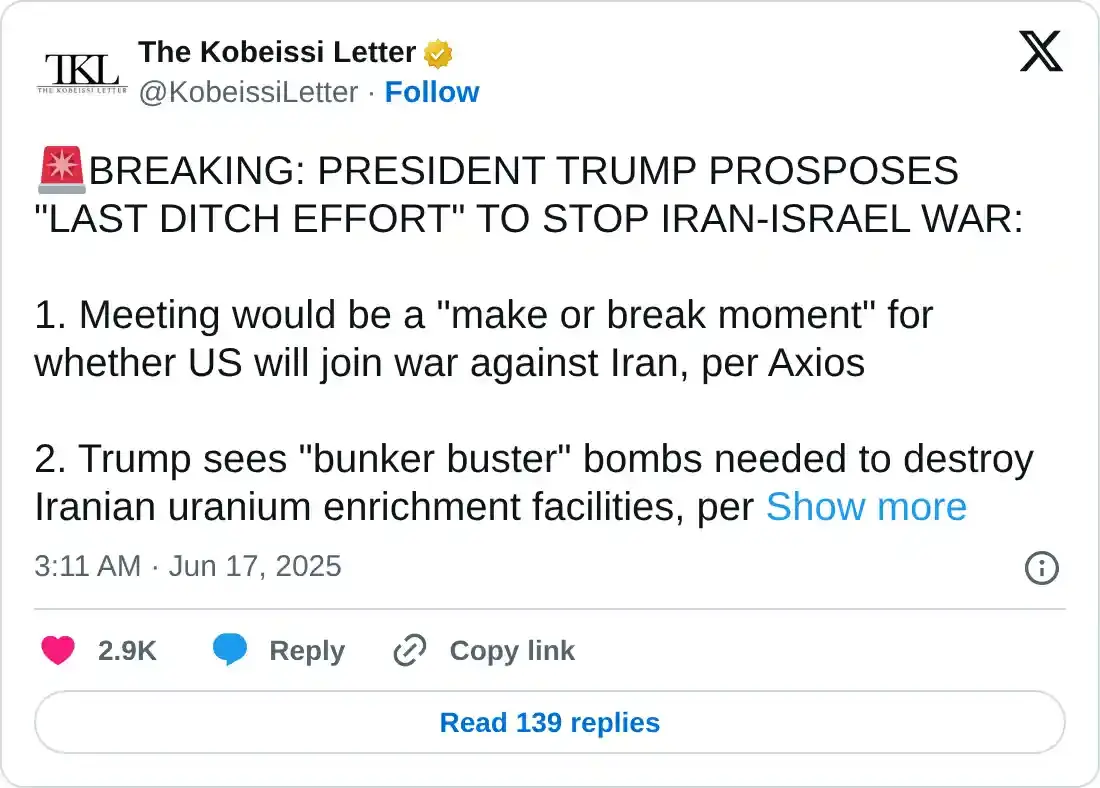
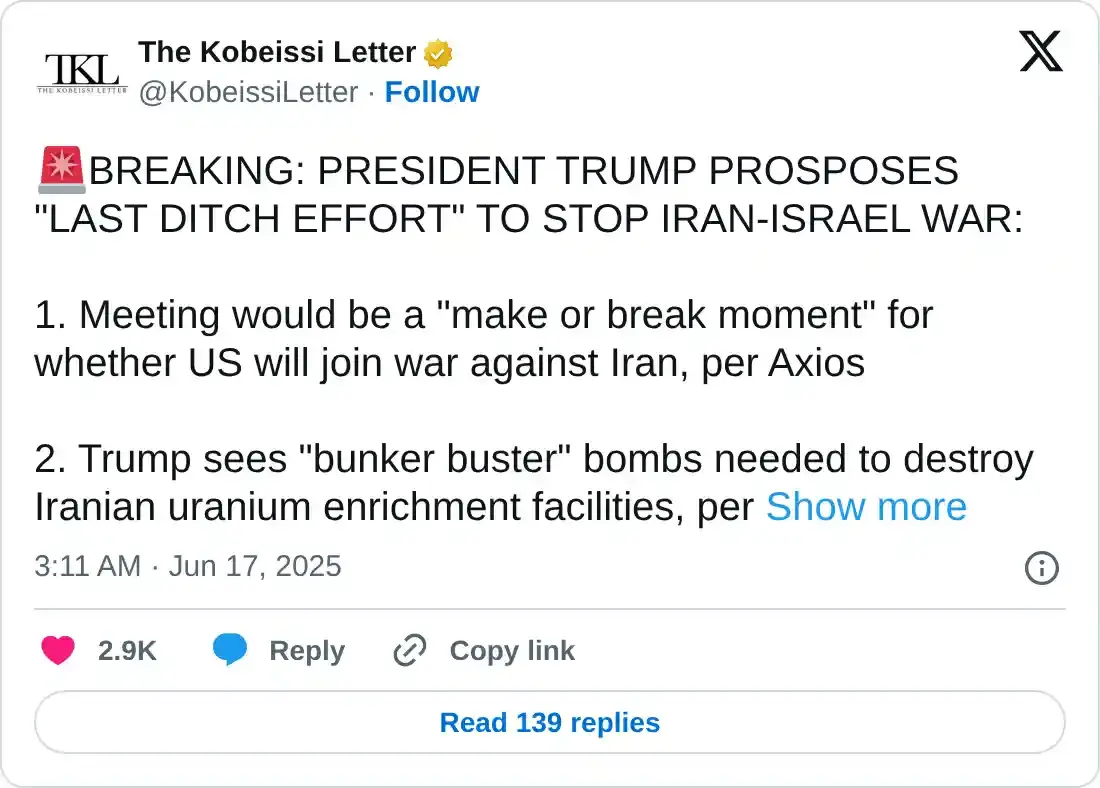
Analysts see the US bunker-buster bombs that could be used to destroy Iranian uranium enrichment facilities could serve as an “inflection point” in this ongoing conflict.
Traders should still remain cautious, as any further escalation of ongoing tensions could disrupt stability in global risk markets. Additionally, the Iranian blockade of the Strait of Hormuz (which is used for global Oil shipments) could also spark a surge in Oil prices, fueling further escalation or direct US military involvement.
Institutional demand supports Bitcoin’s resilient price action
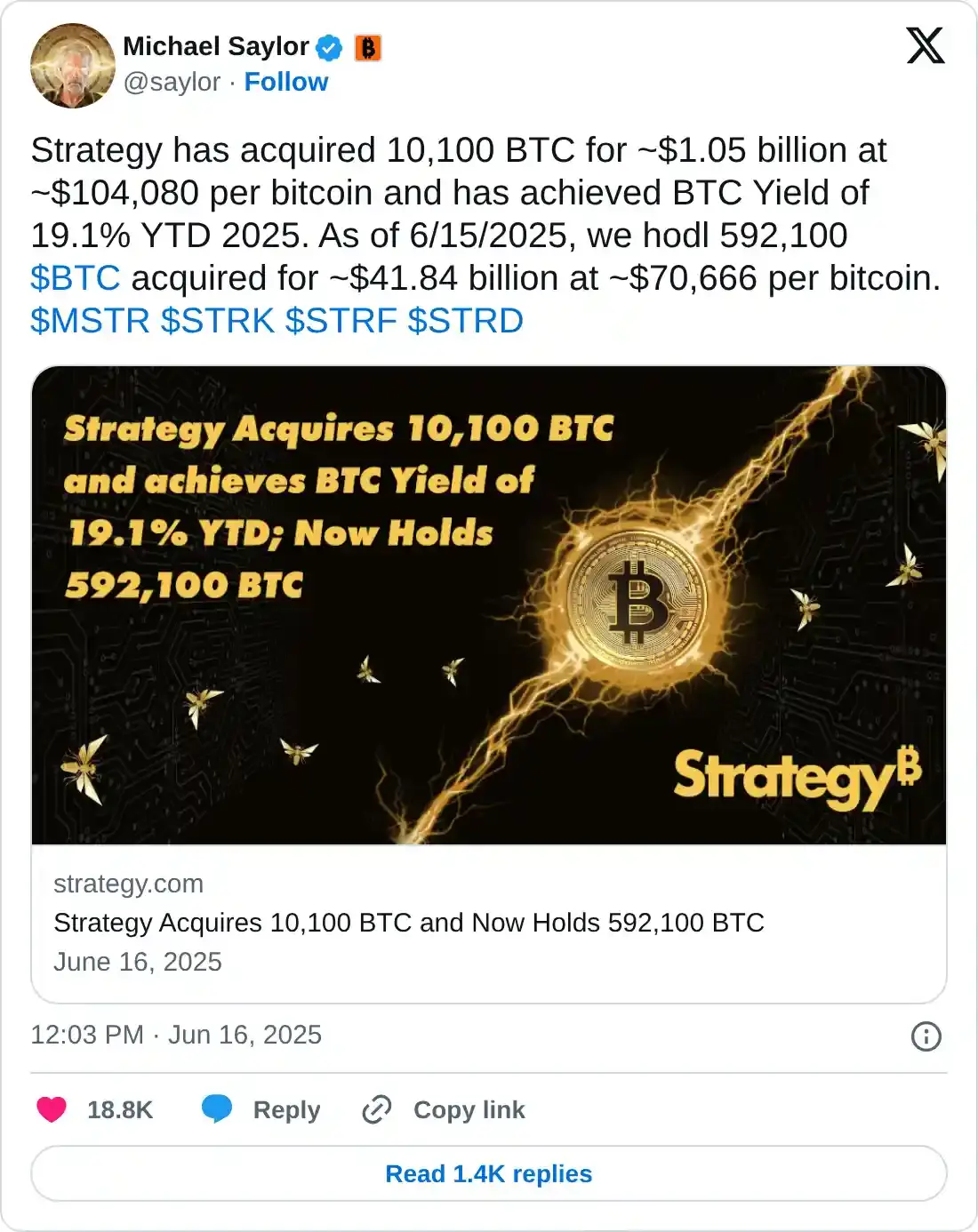
Bitcoin’s institutional demand remains robust, supporting its price at the start of the week. Strategy announced on Monday that it has added 10,100 BTC for $1.05 billion at an average price of $104,080 per BTC. The firm currently holds 592,100 BTC.
Following the footsteps of the Strategy, Japanese investment firm Metaplanet announced on the same day that it had purchased an additional 1,112 BTC, bringing its total holding to 10,000 BTC.
According to Coinglass data, US spot Bitcoin ETFs recorded an inflow of $408.60 million on Monday, continuing its six-day streak of gains since last week.
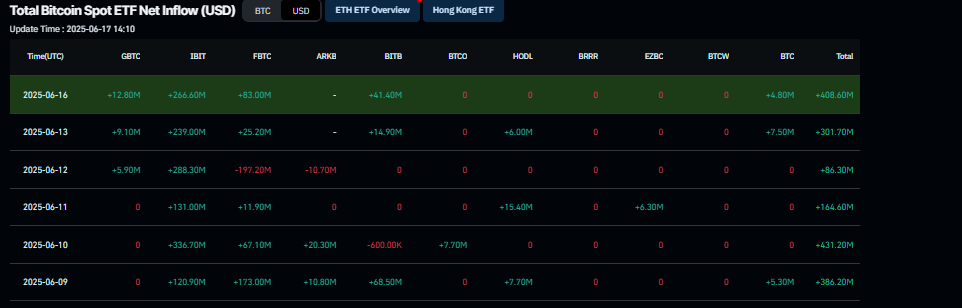
Total Bitcoin Sport ETF net inflow chart. Source: Coinglass
Bitcoin Price Forecast: BTC is poised for a decline as FVG gets triggered
Bitcoin price declined sharply, falling from the June 10 open of $110,274 to the June 11 close of $105,671, creating a Fair Value Gap (FVG) at approximately $108,064. This bearish FVG marks a key resistance zone, meaning that once Bitcoin collects liquidity, it is likely to continue its correction.
On Monday, BTC retested and faced a slight pullback from this FGV zone, closing the day up by 1.14%. At the time of writing on Tuesday, it trades slightly down at around $106,000.
If BTC continues its correction, it could extend the decline to retest its key support at $103,070, the 50-day Exponential Moving Average (EMA). A successful close below this level could extend the decline to retest its key, psychologically important level at $100,000.
The Relative Strength Index (RSI) momentum indicator on the daily chart is hovering around its neutral level of 50, indicating indecision among traders. The Moving Average Convergence Divergence (MACD) indicator on the daily chart displayed a bearish crossover on Thursday, providing a sell signal and giving credence to the downward trend.
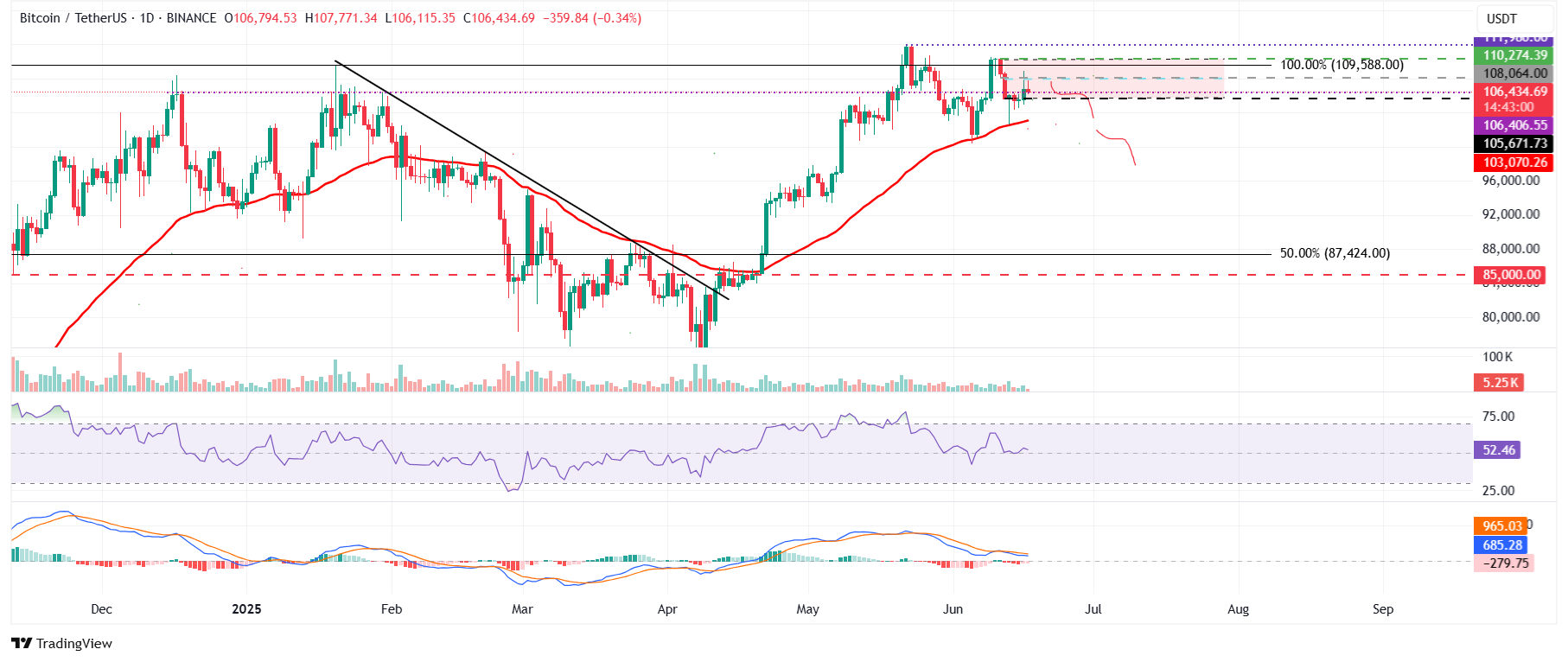
BTC/USDT daily chart
On the contrary, if BTC recovers and closes above its FVG level at $108,064, it could extend the recovery toward retesting its May 22 all-time high of $111,980.
Bitcoin, altcoins, stablecoins FAQs
Bitcoin is the largest cryptocurrency by market capitalization, a virtual currency designed to serve as money. This form of payment cannot be controlled by any one person, group, or entity, which eliminates the need for third-party participation during financial transactions.
Altcoins are any cryptocurrency apart from Bitcoin, but some also regard Ethereum as a non-altcoin because it is from these two cryptocurrencies that forking happens. If this is true, then Litecoin is the first altcoin, forked from the Bitcoin protocol and, therefore, an “improved” version of it.
Stablecoins are cryptocurrencies designed to have a stable price, with their value backed by a reserve of the asset it represents. To achieve this, the value of any one stablecoin is pegged to a commodity or financial instrument, such as the US Dollar (USD), with its supply regulated by an algorithm or demand. The main goal of stablecoins is to provide an on/off-ramp for investors willing to trade and invest in cryptocurrencies. Stablecoins also allow investors to store value since cryptocurrencies, in general, are subject to volatility.
Bitcoin dominance is the ratio of Bitcoin's market capitalization to the total market capitalization of all cryptocurrencies combined. It provides a clear picture of Bitcoin’s interest among investors. A high BTC dominance typically happens before and during a bull run, in which investors resort to investing in relatively stable and high market capitalization cryptocurrency like Bitcoin. A drop in BTC dominance usually means that investors are moving their capital and/or profits to altcoins in a quest for higher returns, which usually triggers an explosion of altcoin rallies.
You May Also Like

The Role of Blockchain in Building Safer Web3 Gaming Ecosystems
- Immutable Ownership of Assets Blockchain records can be manipulated by anyone. If a player owns a sword, skin, or plot of land as an NFT, it is verifiably in their ownership, and it cannot be altered or deleted by the developer or even hacked. This has created a proven track record of ownership, providing control back to the players, unlike any centralised gaming platform where assets can be revoked.
- Decentralized Infrastructure Blockchain networks also have a distributed architecture where game data is stored in a worldwide network of nodes, making them much less susceptible to centralised points of failure and attacks. This decentralised approach makes it exponentially more difficult to hijack systems or even shut off the game’s economy.
- Secure Transactions with Cryptography Whether a player buys an NFT or trades their in-game tokens for other items or tokens, the transactions are enforced by cryptographic algorithms, ensuring secure, verifiable, and irreversible transactions and eliminating the risks of double-spending or fraudulent trades.
- Smart Contract Automation Smart contracts automate the enforcement of game rules and players’ economic exchanges for the developer, eliminating the need for intermediaries or middlemen, and trust for the developer. For example, if a player completes a quest that promises a reward, the smart contract will execute and distribute what was promised.
- Anti-Cheating and Fair Gameplay The naturally transparent nature of blockchain makes it extremely simple for anyone to examine a specific instance of gameplay and verify the economic outcomes from that play. Furthermore, multi-player games that enforce smart contracts on things like loot sharing or win sharing can automate and measure trustlessness and avoid cheating, manipulations, and fraud by developers.
- Cross-Platform Security Many Web3 games feature asset interoperability across platforms. This interoperability is made viable by blockchain, which guarantees ownership is maintained whenever assets transition from one game or marketplace to another, thereby offering protection to players who rely on transfers for security against fraud. Key Security Dangers in Web3 Gaming Although blockchain provides sound first principles of security, the Web3 gaming ecosystem is susceptible to threats. Some of the most serious threats include:

Vitalik Buterin Challenges Ethereum’s Layer 2 Paradigm
