

Must Read
Just remember that despite the hype, nothing is being sold yet, and there is no legitimate ‘early access’ to GCash sharesJust remember that despite the hype, nothing is being sold yet, and there is no legitimate ‘early access’ to GCash shares
[Finterest] GCash, Maya IPOs in 2026? What this means for potential investors
MANILA, Philippines – The IPO rumor has been hanging around both GCash and Maya for years, and in early 2026 the noise is getting louder again, as they begin to look a lot less like startup fintechs and more like proper financial giants.
The clearest signal is that both camps keep talking like they want to be ready when the window opens. Since early 2025, Globe has been saying GCash wants to be “push-button ready” for an IPO, but that “no final decisions have been made.”
And on the Maya side, chairman Manuel V. Pangilinan is hinting that foreign shareholder pressure may push the rival digital bank to do a dual IPO within the year, starting with a US offering.
“It’s what our foreign shareholders want. That’s a deeper market to raise money for this type of business,” Pangilinan said at the sidelines of Meralco’s 2025 financial results briefing, according to an Inquirer report.
Where GCash and Maya stand today
GCash is run by Mynt (also known as Globe Fintech Innovations), which is a joint venture among Globe Telecom, Ant Group, and Ayala Corporation, with Japan’s MUFG investing for an 8% stake. In other words, GCash is far, far past its days as a start-up vying for attention. Today, it has deep-pocketed corporate shareholders who know how to monetize an eventual listing.
The latest infusion of capital by MUFG has already put GCash’s value at $5 billion as of August 2024. That puts the homegrown e-wallet firmly in unicorn territory, meaning a private company valued at $1 billion or more. But an IPO could push its valuation even higher, with an $8 billion figure being floated around.
Profitability is where GCash looks unusually mature for a fintech story. Mynt started to break even as early as the second half of 2021. That matters because it frames the IPO less as a cash lifeline and more as a strategic step-up or expansion play.
Maya is structured differently, and its ownership tells you why its IPO logic might also differ. The PLDT Group and First Pacific own about 39% of Maya and intend to maintain or even increase that stake, while other shareholders include Tencent, KKR, and the International Finance Corporation.
A 2025 Reuters report said that private equity firm KKR owned over 20% of Maya and had hired Goldman Sachs to explore selling its stake, in a deal that could value the company at over $2 billion. That also makes Maya a unicorn by the usual definition, but it is still likely smaller than GCash on headline valuation benchmarks. We’ll get back to KKR in a bit.
On profitability, Maya has been trying to prove it can be more than payments, and on that front, it has largely succeeded as a digital bank. Maya turned profitable in 2025, booking P1.6 billion in earnings in the first nine months as lending expanded.
Why GCash and Maya are exploring IPOs
An IPO, or initial public offering, is when a private company sells shares to the public for the first time and becomes a listed company on a stock exchange. It is usually a mix of primary shares (new shares sold to raise fresh cash for the company) and secondary shares (existing shareholders selling part of their stake so they can cash out). Either way, once listed, the company’s value is judged daily by the market, rather than by private funding rounds and investor presentations.
(READ: [Finterest] What does it really mean when the PSE loses value?)
For GCash, the most consistent narrative has been a domestic listing, likely on the Philippine Stock Exchange, partly because its user base is overwhelmingly local and because it would be politically and reputationally powerful to frame it as a national champion.
But with its valuation now running in the multi-billion-dollar range, it’s easy to see why GCash has been careful about when and where it goes public. Until recently, Securities and Exchange Commission (SEC) regulations required a 20% minimum public float. For a company as big as GCash, a strict 20% public float could translate to an offering so large that it risks overwhelming local demand, which can create price pressure and a rough debut even for an otherwise strong business.
No doubt GCash has been lobbying hard to have this revised, and the policy shift has now materialized in a way that could meaningfully change the IPO equation. The SEC has moved to a tiered framework that lowers the minimum public float for larger companies, which appears tailored to make it more practical for giants like GCash and Maya to pursue a domestic listing without having to flood the market.
Under the new structure, Tier IV firms — those with expected market value above P50 billion up to P150 billion — need to float just 15% or an amount equivalent to at least P10 billion, whichever is higher. That Tier IV bracket is a plausible landing zone for a local GCash or Maya listing.
Still, we have no clear timeline of when GCash could go public.
“Mynt and its shareholders remain open to the various capital solutions, including an IPO. However, there is still no official decision that has been made regarding the timing. We will make the necessary disclosures in accordance with PSE regulations as soon as we get a definitive decision on this front,” Globe Chief Financial Officer Juan Carlo Puno said in a February 2026 briefing, as reported by ABS-CBN.
For Maya, the narrative is rather different given KKR’s stake. When a major shareholder is a private equity (PE) fund, there is a constant pressure to create a clean, credible liquidity event for the PE to cash out. An IPO can do exactly that, offering a high-profile pathway for an eventual exit or partial sell-down. Read in that light, it is plausible that the “foreign shareholders” Pangilinan has referred to in discussing a US-first listing are, at least in part, investors like KKR who typically have tighter timelines for monetizing their stakes than strategic owners do.
Still, this doesn’t mean Maya will be confined to the US markets. Pangilinan said that he’s “insisting on a dual listing,” which means that Maya could debut on the local bourse as early has H2 2026.
What this means for you as a potential investor
Neither company’s IPO story reads like they need funding to survive. Both have credible profitability narratives now, and both have heavyweight shareholders who can fund them privately if needed.
The more plausible motivations are about scale and optionality — funding bigger lending books, building out adjacent products like credit, insurance, and investments, and giving early investors a clean path to partial exit without a private secondary sale every time.
For regular readers, it’s still too early to plan your portfolio around an IPO that does not yet have a prospectus, a price range, or even a final exchange. But it’s not too early to treat this as a space to watch, because a GCash or Maya listing would likely be one of the biggest retail investing stories the Philippines has seen in years, and it will influence how future local tech and fintech companies try to go public.
Just remember that despite the hype, nothing is being sold yet, and there is no legitimate “early access” to GCash shares. Mynt, GCash’s parent, has explicitly warned the public about this. In a recent advisory, the company said it “has not authorized any public offering of its shares” and that any social media posts or communications offering “early access” or a “pre-sale” are “unauthorized and fraudulent.” Mynt also clarified it has not made any official filings with the SEC or the PSE.
And while you watch the space, you can bet that GCash and Maya are absolutely watching each other too. If one of them lists first, it creates the benchmark everyone will use to judge the other, be that valuation multiples, growth expectations, and even the “right” narrative for Philippine fintech in public markets. First-to-list also shapes investor psychology. It can become the default proxy for Philippine fintech in overseas markets the way certain names become shorthand for their sectors once they’re public. — Rappler.com
Lance Spencer Yu is a former business journalist for Rappler. He later worked as a private capital analyst at MSCI, working directly with sovereign wealth funds, pension funds, and family offices across the Asia-Pacific region. He now serves as an investment and strategy analyst at Dedale Intelligence, producing in-depth, actionable research for private equity funds and institutional investors.
Finterest is Rappler’s series that demystifies the world of money and gives practical advice on managing your personal finances.
Market Opportunity
The Voter Dog Price(MAYA)
$0.00003676
$0.00003676$0.00003676
USD
The Voter Dog (MAYA) Live Price Chart
Disclaimer: The articles reposted on this site are sourced from public platforms and are provided for informational purposes only. They do not necessarily reflect the views of MEXC. All rights remain with the original authors. If you believe any content infringes on third-party rights, please contact [email protected] for removal. MEXC makes no guarantees regarding the accuracy, completeness, or timeliness of the content and is not responsible for any actions taken based on the information provided. The content does not constitute financial, legal, or other professional advice, nor should it be considered a recommendation or endorsement by MEXC.
You May Also Like

A Netflix ‘KPop Demon Hunters’ Short Film Has Been Rated For Release
The post A Netflix ‘KPop Demon Hunters’ Short Film Has Been Rated For Release appeared on BitcoinEthereumNews.com. KPop Demon Hunters Netflix Everyone has wondered what may be the next step for KPop Demon Hunters as an IP, given its record-breaking success on Netflix. Now, the answer may be something exactly no one predicted. According to a new filing with the MPA, something called Debut: A KPop Demon Hunters Story has been rated PG by the ratings body. It’s listed alongside some other films, and this is obviously something that has not been publicly announced. A short film could be well, very short, a few minutes, and likely no more than ten. Even that might be pushing it. Using say, Pixar shorts as a reference, most are between 4 and 8 minutes. The original movie is an hour and 36 minutes. The “Debut” in the title indicates some sort of flashback, perhaps to when HUNTR/X first arrived on the scene before they blew up. Previously, director Maggie Kang has commented about how there were more backstory components that were supposed to be in the film that were cut, but hinted those could be explored in a sequel. But perhaps some may be put into a short here. I very much doubt those scenes were fully produced and simply cut, but perhaps they were finished up for this short film here. When would Debut: KPop Demon Hunters theoretically arrive? I’m not sure the other films on the list are much help. Dead of Winter is out in less than two weeks. Mother Mary does not have a release date. Ne Zha 2 came out earlier this year. I’ve only seen news stories saying The Perfect Gamble was supposed to come out in Q1 2025, but I’ve seen no evidence that it actually has. KPop Demon Hunters Netflix It could be sooner rather than later as Netflix looks to capitalize…
Share
BitcoinEthereumNews2025/09/18 02:23
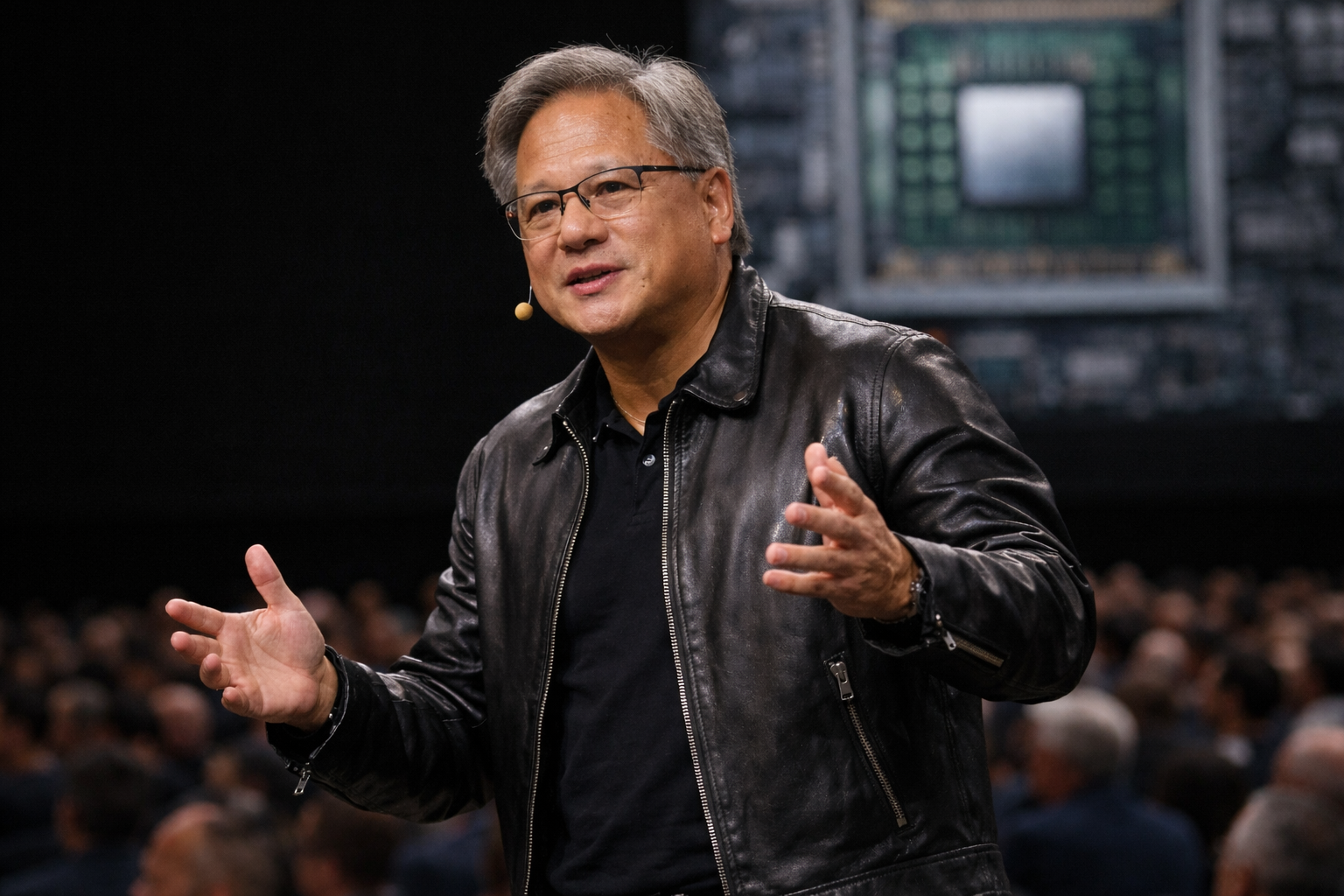
Nvidia’s Jensen Huang believes markets are wrong on software selloff
Following a week that saw enterprise software giants like IBM and a bunch of cybersecurity firms endure their steepest declines in years, Nvidia’s chief executive
Share
Coinstats2026/02/26 13:41

BetFury is at SBC Summit Lisbon 2025: Affiliate Growth in Focus
The post BetFury is at SBC Summit Lisbon 2025: Affiliate Growth in Focus appeared on BitcoinEthereumNews.com. Press Releases are sponsored content and not a part of Finbold’s editorial content. For a full disclaimer, please . Crypto assets/products can be highly risky. Never invest unless you’re prepared to lose all the money you invest. Curacao, Curacao, September 17th, 2025, Chainwire BetFury steps onto the stage of SBC Summit Lisbon 2025 — one of the key gatherings in the iGaming calendar. From 16 to 18 September, the platform showcases its brand strength, deepens affiliate connections, and outlines its plans for global expansion. BetFury continues to play a role in the evolving crypto and iGaming partnership landscape. BetFury’s Participation at SBC Summit The SBC Summit gathers over 25,000 delegates, including 6,000+ affiliates — the largest concentration of affiliate professionals in iGaming. For BetFury, this isn’t just visibility, it’s a strategic chance to present its Affiliate Program to the right audience. Face-to-face meetings, dedicated networking zones, and affiliate-focused sessions make Lisbon the ideal ground to build new partnerships and strengthen existing ones. BetFury Meets Affiliate Leaders at its Massive Stand BetFury arrives at the summit with a massive stand placed right in the center of the Affiliate zone. Designed as a true meeting hub, the stand combines large LED screens, a sleek interior, and the best coffee at the event — but its core mission goes far beyond style. Here, BetFury’s team welcomes partners and affiliates to discuss tailored collaborations, explore growth opportunities across multiple GEOs, and expand its global Affiliate Program. To make the experience even more engaging, the stand also hosts: Affiliate Lottery — a branded drum filled with exclusive offers and personalized deals for affiliates. Merch Kits — premium giveaways to boost brand recognition and leave visitors with a lasting conference memory. Besides, at SBC Summit Lisbon, attendees have a chance to meet the BetFury team along…
Share
BitcoinEthereumNews2025/09/18 01:20