

Silver Price to $1,000? These Two Historic Ratios Say It’s Not as Crazy as It Sounds
Silver price is down from its January all-time high of $121. The price looks weak in the near term and could move lower before stability appears. Long-range expectations still remain strong, and that contrast between short-term pressure and future potential sits at the center of a bold forecast shared by Karel Mercx (@KarelMercx on X).
His thesis does not rely on hype or emotion. The argument rests on two historic ratios that have guided precious metals cycles for more than a century.
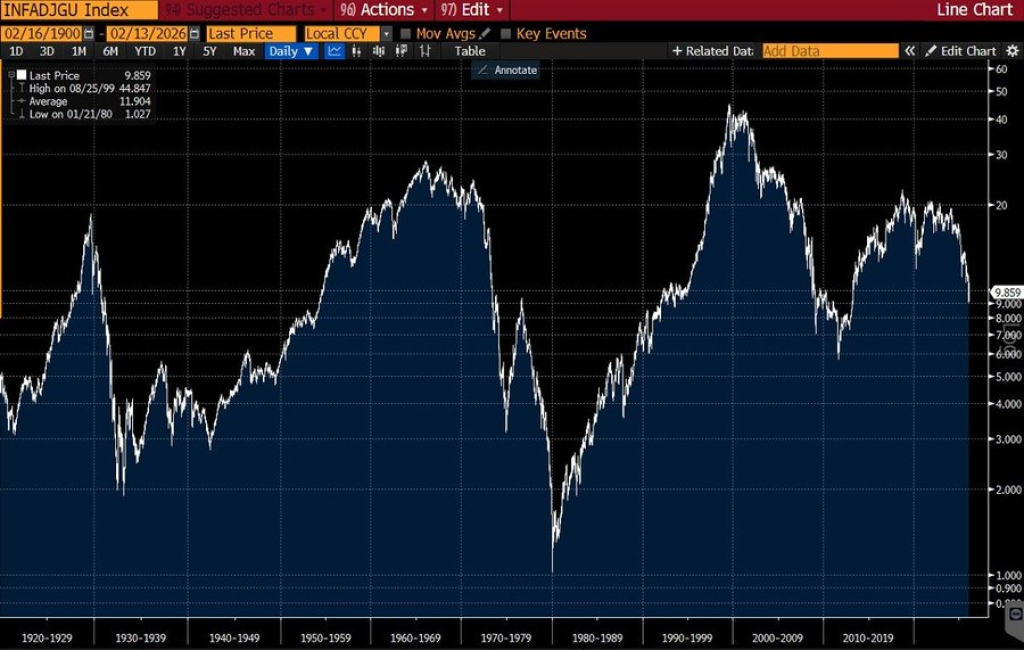
Karel Mercx explains that the Dow priced in gold compresses long periods of market psychology into a single measure. Peaks in optimism appeared in 1929, 1966, and 1999.
 @KarelMercx / X
Deep pessimism followed in 1933 and 1980. Present levels now resemble zones that historically preceded another downward move in the ratio, which means gold strengthened against equities during those phases.
Mercx does not accept the idea that the real bottom formed in 2011. Global debt expanded sharply after that year, and past cycles only reached completion once debt pressure eased through either deflation or inflation.
Historical precedent from the 1930s and the 1970s supports that framework. His midpoint target for the Dow-to-gold ratio sits near 2.5. Current readings near 9.82 imply a decline of almost four times if the cycle completes in a similar fashion.
Gold would need to rise toward about $19,800 if the Dow remains close to present territory near 49,501. Mercx notes that equities do not need to collapse for precious metals to reach extreme highs. The 1970s delivered an equity low years before metals peaked, which shows that both trends can unfold on separate timelines.
Gold Silver Ratio Compression Creates The Mathematical Path Toward A Four Digit Silver Price
The second pillar of the forecast comes from the gold-silver ratio. Silver trades in a smaller market than gold, which explains why upside phases often move faster once momentum turns positive. The ratio reached 14 at the 1980 extreme. Mercx selects 19 as a conservative midpoint to avoid reliance on perfect timing.
Gold near $19,800 combined with a ratio of 19 produces a silver price slightly above $1,000. Present conditions show gold near $5,042 and silver near $77, which leaves a wide distance between current valuation and historic extremes.
Movement from one extreme to the opposite side of the cycle forms the core logic behind the projection.
 @KarelMercx / X
Silver Price Outlook Points To A Possible 2030 To 2033 Window Based On Cycle Structure
Time expectations also draw from the 1970s template described by Karel Mercx. Current Dow to gold positioning resembles the mid-cycle zone seen between 1973 and 1976.
Final metals highs arrived in 1980, which places a similar duration of about four to seven years for the present environment. That framework leads to a projected window between 2030 and 2033 for any move above $1,000.
Read Also: Bittensor Subnets Are the Real Cheat Code – TAO Holders Might Be Missing the Biggest Edge
Short term silver price action may continue to fluctuate, yet the long horizon described by Mercx focuses on structural mathematics instead of daily volatility. Cycles in precious metals often unfold slowly before decisive acceleration appears.
Subscribe to our YouTube channel for daily crypto updates, market insights, and expert analysis.
The post Silver Price to $1,000? These Two Historic Ratios Say It’s Not as Crazy as It Sounds appeared first on CaptainAltcoin.
You May Also Like

The Italian banking giant held approximately $96 million worth of Bitcoin spot ETFs last December, hedged with Strategy put options.

US-listed company DDC increased its holdings by 80 bitcoins, bringing its total holdings to 2,068 bitcoins.
