

S&P Rates First Bitcoin-Backed Loan Securitization
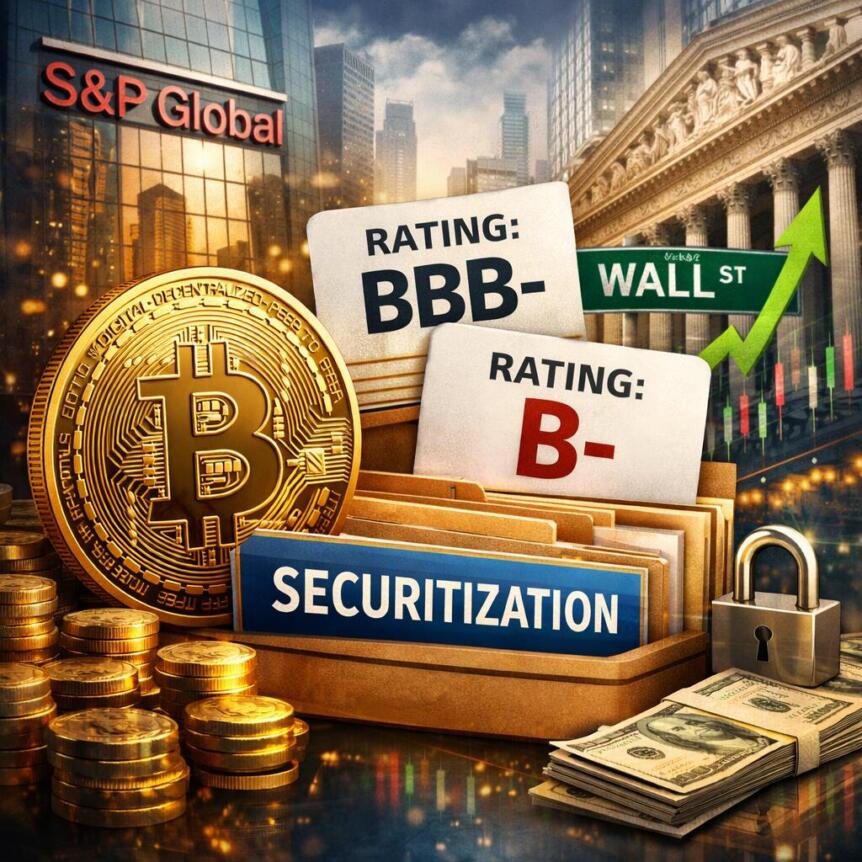
S&P Global Ratings has assigned preliminary credit ratings to Ledn Issuer Trust 2026-1, marking the first rated securitization backed by a portfolio of Bitcoin-collateralized loans. The $200 million transaction bundles 5,441 short-term, fixed-rate loans extended to 2,914 U.S. retail borrowers, all secured by Bitcoin (CRYPTO: BTC) held with a regulated U.S. custodian. As of Dec. 31, 2025, the loans were backed by 4,078.87 BTC valued at roughly $356.9 million. The structure includes overcollateralization, liquidation triggers and a liquidity reserve to mitigate market volatility and repayment risk.
Key takeaways
- S&P assigned preliminary ratings of BBB- (sf) to the $160 million Class A notes and B- (sf) to the $28 million Class B notes.
- The securitization is backed by 5,441 fixed-rate, short-term balloon loans secured by 4,078.87 BTC.
- Aggregate outstanding principal stood at $199.1 million against collateral valued at approximately $356.9 million as of Dec. 31, 2025.
- Each loan has a tenor of 12 months or less and requires a single bullet repayment at maturity or upon default.
- A liquidity reserve equal to 5% of the outstanding note balance at closing supports payment stability during the early life of the deal.
Tickers mentioned: $BTC
Sentiment: Neutral
Price impact: Neutral. The development concerns structured credit markets rather than immediate spot demand for Bitcoin.
Market context: Institutional engagement with crypto markets has expanded beyond spot ETFs and custody into structured credit, as traditional capital markets test securitization frameworks for digital asset-backed lending.
Why it matters
This transaction represents a structural milestone for crypto-backed lending. By applying traditional asset-backed securities frameworks to Bitcoin-collateralized loans, the deal introduces standardized credit analysis and transparency into a segment previously dominated by private or offshore platforms.
For institutional investors, rated tranches provide clearer risk segmentation. Senior notes benefit from structural protections and overcollateralization, while junior tranches absorb higher volatility risk. This layered approach may broaden participation among investors that require formal credit ratings.
For borrowers and crypto-native lenders, the transaction signals that regulated securitization channels are becoming accessible. However, it also places greater emphasis on operational rigor, collateral management and liquidity controls.
What to watch next
- Whether final ratings differ from the preliminary BBB- and B- assessments after closing.
- Performance of the collateral during the 12-month loan cycle, particularly under Bitcoin price volatility.
- Potential replication of similar securitizations by other crypto lenders.
- Evolution of eligibility criteria and concentration limits during the revolving period.
Sources & verification
- Preliminary ratings announcement dated Feb. 9, 2026.
- Presale documentation for Ledn Issuer Trust 2026-1.
- Transaction data reflecting 4,078.87 BTC collateral and $199.1 million outstanding principal as of Dec. 31, 2025.
- Published structured finance criteria referenced in the ratings analysis.
Bitcoin-Backed Loans Enter Rated Structured Credit Markets
The assignment of preliminary ratings to Ledn Issuer Trust 2026-1 marks a notable step in the convergence of digital assets and traditional structured finance. The transaction packages a portfolio of short-term Bitcoin (CRYPTO: BTC)-secured consumer loans into asset-backed securities, applying established credit methodologies typically reserved for credit cards, auto loans or mortgage-backed products.
The securitization comprises 5,441 fixed-rate balloon loans extended to 2,914 unique borrowers. Each loan carries a maturity of no more than 12 months and is structured with a single lump-sum repayment of principal and accrued interest at maturity, or earlier if triggered by default. There are no interim amortization payments during the life of the loan, increasing the importance of collateral management and liquidation protocols.
As of the Dec. 31, 2025 statistical cutoff date, the outstanding principal across the initial loan pool totaled $199.1 million. Those obligations were secured by 4,078.87 BTC with an estimated fair market value of approximately $356.9 million. This substantial overcollateralization provides a buffer against adverse price movements in Bitcoin, though it does not eliminate volatility risk.
The deal includes a revolving period during which additional eligible fixed-rate loans may be purchased by the issuer. An initial $0.9 million cash deposit in a funding account supports these acquisitions. Eligibility standards and concentration limits are embedded in the transaction documents to prevent material deterioration in portfolio quality during this period.
Two tranches of notes have received preliminary ratings. The $160 million Class A notes were assigned a BBB- (sf) rating, reflecting investment-grade credit characteristics under structured finance criteria. The $28 million Class B notes were assigned a B- (sf) rating, indicating higher relative risk and subordinated exposure within the capital structure.
The ratings assessment incorporates multiple stress scenarios. Analysts evaluated the issuer’s capacity to meet interest and principal payments by the legal final maturity date under severe market conditions. Particular emphasis was placed on the servicer’s operational ability to liquidate Bitcoin collateral promptly in the event of borrower default. In crypto-backed lending, collateral execution speed can materially influence recovery outcomes.
The transaction also benefits from a liquidity reserve funded at closing with cash equal to 5% of the outstanding note balance, or $9.4 million at issuance. This reserve is designed to cover temporary payment disruptions and remains at a 5% target level for the first 11 months. It then steps down to 4% in month 12, 3% in month 13 and stabilizes at 2% from month 14 onward until full repayment.
Early amortization triggers further protect noteholders. If specified performance thresholds are breached, the revolving period ends and principal collections accelerate to repay investors. These structural safeguards mirror those found in conventional consumer ABS transactions.
Operational considerations also weighed heavily in the ratings analysis. The evaluation referenced counterparty risk frameworks, asset isolation criteria and legal protections typical of U.S. structured finance. The collateral is held with a regulated U.S. custodian, and the transaction is governed by U.S. law, reinforcing enforceability standards familiar to institutional capital markets participants.
While the ratings are preliminary and subject to change upon final documentation and closing conditions, the transaction signals a shift in how crypto-native lending can integrate with regulated capital markets. Rather than relying solely on balance-sheet funding or private capital, lenders are exploring securitization as a channel to distribute risk and expand liquidity.
This development does not necessarily translate into immediate directional pressure on Bitcoin prices. Instead, it represents infrastructure evolution. By transforming crypto-backed loans into rated securities, the transaction introduces standardized credit segmentation and third-party risk evaluation into a sector that historically operated outside traditional ratings frameworks.
For senior noteholders, the combination of overcollateralization, liquidity reserves and structural protections aims to mitigate downside exposure. Junior tranche investors accept greater sensitivity to price swings and default performance in exchange for potentially higher returns.
As crypto-collateralized lending matures, similar transactions could emerge, provided performance data supports the model. The sustainability of such structures will depend on collateral volatility management, operational efficiency in liquidation processes and adherence to eligibility standards during revolving periods.
The assignment of preliminary ratings underscores a broader trend: digital asset markets are increasingly interfacing with established credit systems. Whether this bridge expands will hinge on how these first transactions perform under real-world stress and whether institutional investors find the risk-return profile consistent with their mandates.
This article was originally published as S&P Rates First Bitcoin-Backed Loan Securitization on Crypto Breaking News – your trusted source for crypto news, Bitcoin news, and blockchain updates.
You May Also Like

American Bitcoin’s $5B Nasdaq Debut Puts Trump-Backed Miner in Crypto Spotlight

‘Compromise is in the air’: Ripple CLO signals progress on crypto bill
