The stablecoin market’s total value has surpassed $270 billion, marking a new milestone for the sector, according to stats collected by defillama.com and artemisanalytics.com. Stablecoin Economy Climbs as Activity Broadens Over the last seven days, aggregate stablecoin capitalization rose by $3.051 billion, a 1.14% gain, per defillama’s dashboard. The new total places the asset class […]The stablecoin market’s total value has surpassed $270 billion, marking a new milestone for the sector, according to stats collected by defillama.com and artemisanalytics.com. Stablecoin Economy Climbs as Activity Broadens Over the last seven days, aggregate stablecoin capitalization rose by $3.051 billion, a 1.14% gain, per defillama’s dashboard. The new total places the asset class […]

Stablecoin Float Surpasses $270 Billion, Setting a New High

4 min read

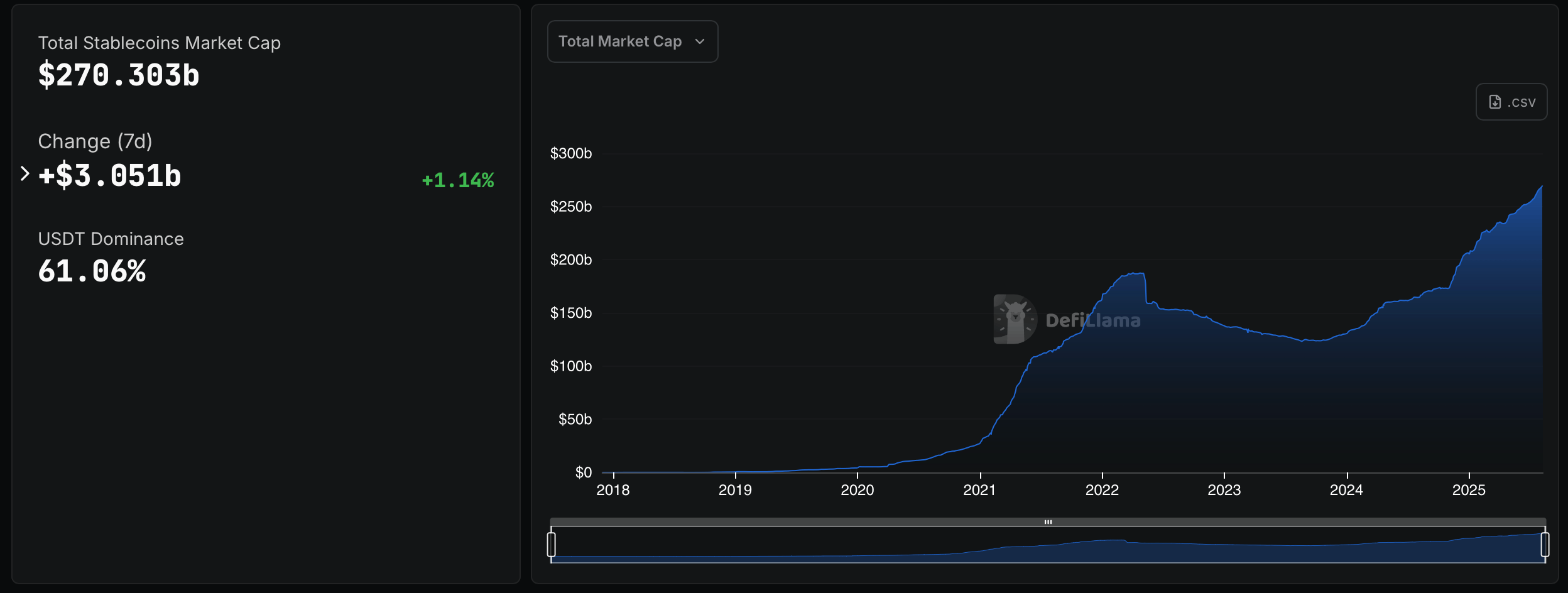
The stablecoin market’s total value has surpassed $270 billion, marking a new milestone for the sector, according to stats collected by defillama.com and artemisanalytics.com.

Stablecoin Economy Climbs as Activity Broadens

Over the last seven days, aggregate stablecoin capitalization rose by $3.051 billion, a 1.14% gain, per defillama’s dashboard. The new total places the asset class within sight of its prior peak and extends a steady climb that carried through 2024 and 2025. The figure reflects circulating supply multiplied by price and focuses on dollar-pegged tokens.

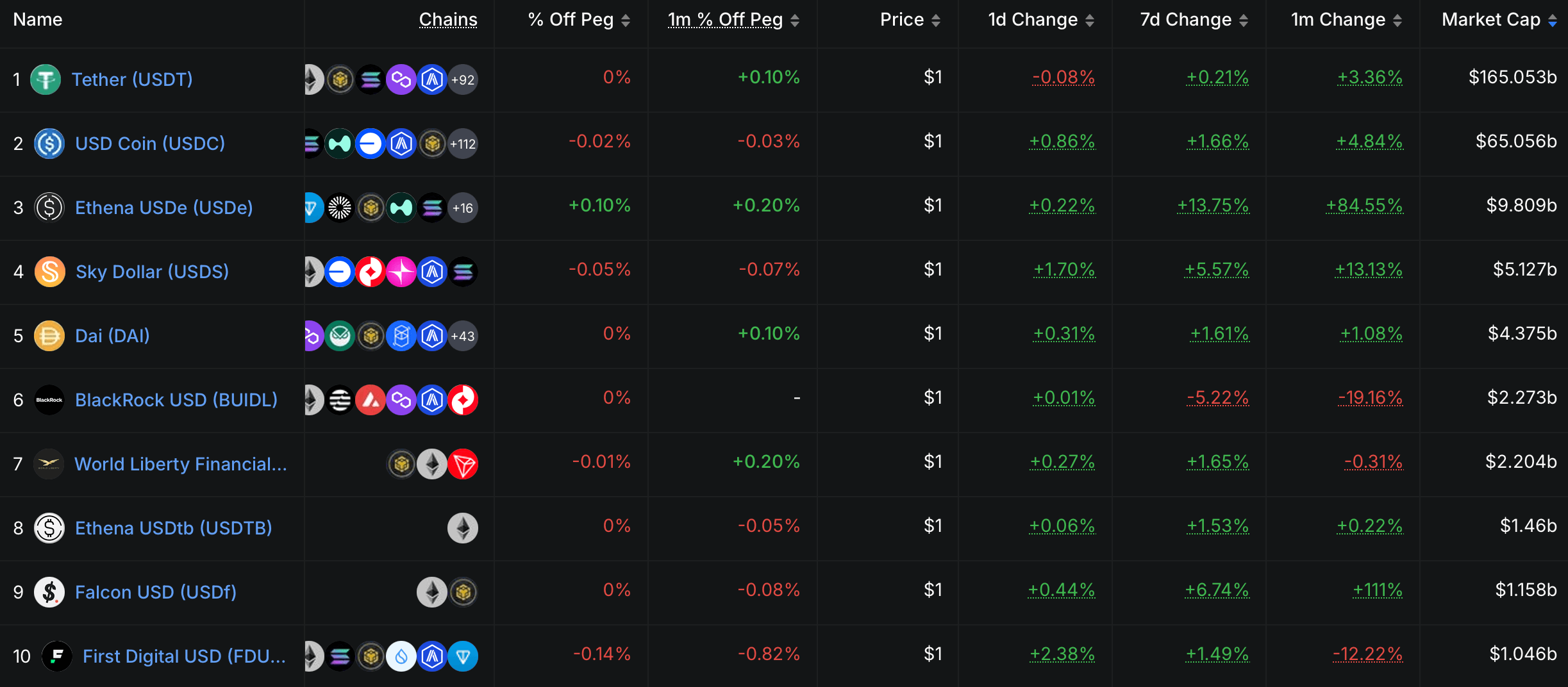
Presently, tether ( USDT) remains the market leader with 61.06% dominance. USDC is the second-largest component, while a mix of competitors, including Ethena’s USDe, Sky’s USDS and DAI, and Blackrock’s BUIDL, account for single-digit shares. Artemis Terminal’s market-share chart shows USDT holding a wide lead in 2025 and USDC’s portion trending higher this year.
Stablecoin Float Surpasses $270 Billion, Setting a New HighSource: Defillama.com

Activity remains broad. Artemis reports 42.8 million addresses interacted with stablecoins over the last month, down 15.2% from the prior 30 days, yet still near the high end of a five-year range. Address activity by chain has widened, with notable participation on BNB Chain, Tron, Base, Arbitrum, Solana, and OP Mainnet alongside Ethereum.

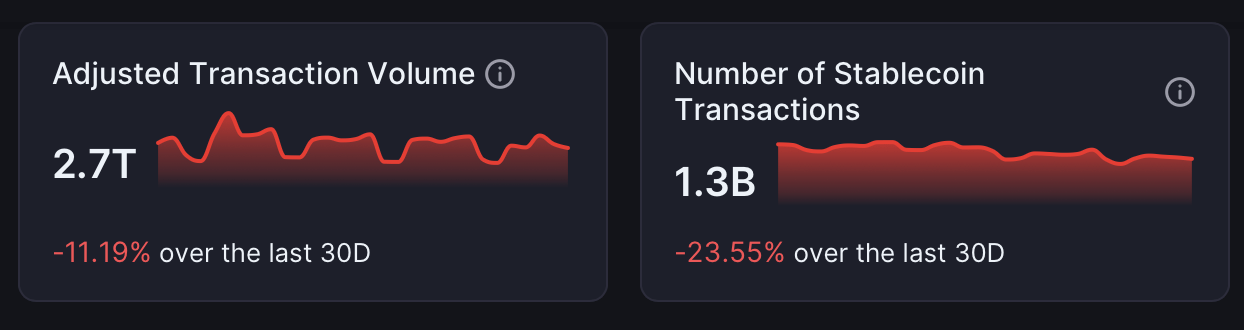
Turnover is heavy. Artemis figures estimate $2.7 trillion in adjusted stablecoin transfer volume over the last 30 days, even after an 11.19% month-over-month decline. The terminal’s multi-year view shows rolling adjusted volume in the $1 trillion range for much of 2024–2025, generally close to Visa’s level and well above Paypal and global remittance totals on a like-for-like basis.
Stablecoin Float Surpasses $270 Billion, Setting a New HighSource: Artemis Terminal

Transaction counts remain elevated at 1.3 billion over the last 30 days, down 23.55% from the previous period. That tally spans major networks and points to repeated use for payments, settlement, trading, and wallet funding across centralized and onchain venues.

Supply composition skews decisively to the U.S. dollar. Artemis’s currency breakdown shows issuance overwhelmingly in USD terms, with euro, pound, and other fiat pegs representing an extremely thin slice of aggregate supply. U.S. dollar tokens continue to anchor crypto pricing and collateral practices across major exchanges and lending platforms.

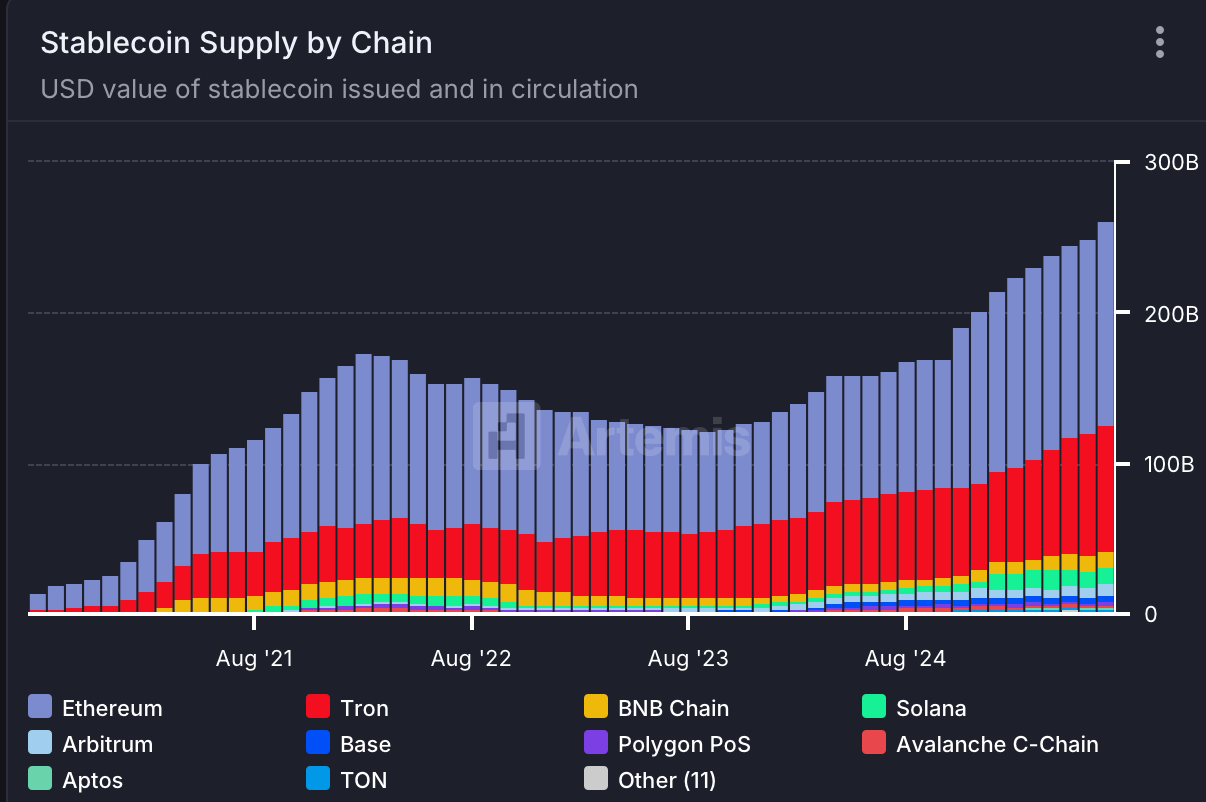
Chains matter. Artemis’s supply-by-chain chart shows Ethereum and Tron holding the largest outstanding balances to date, followed by BNB Chain, Solana, Base, and Arbitrum. A five-year view of net supply change ranks Ethereum first by absolute growth, with Tron second. Rising contributions from Base and Solana highlight additional venues for issuance and circulation.
Stablecoin Float Surpasses $270 Billion, Setting a New HighSource: Artemis Terminal

By token, the five-year net-change table places USDT far ahead in added supply, with USDC next. USDe and USDS contribute smaller but notable increases, while DAI and BUIDL add incremental amounts. The mix suggests incumbents still dominate issuance, even as new instruments target onchain cash management or delta-neutral yield strategies.

Regional flow is diversified. Using a timezone-based method on Ethereum and Solana, Artemis attributes a large share of adjusted transactions to North America and Asia, with Europe’s share lifting since 2024. Latin America, Southeast Asia, and Africa register smaller but very visible portions, signaling adoption by both retail and institutional users.

Active-address charts by token highlight USDT and USDC as primary drivers, with address counts and interactions posting new highs into 2025. Smaller issuers, including PYUSD and other niche pegs, show limited but steady engagement. The breadth of address participation points to stablecoins’ role as a crypto gateway and settlement medium.

The data from defillama.com and Artemis Terminal both point to a system that is larger, highly active, and geographically distributed. The $270.303 billion headline figure caps a period of consistent expansion, while liquidity concentrates in a handful of issuers and blockchains. The asset class functions as a bridge between trading venues, wallets, and traditional finance, including centralized exchanges and onchain protocols.
Stablecoin Float Surpasses $270 Billion, Setting a New HighSource: Defillama.com

As the total float reaches the $270 billion threshold, liquidity conditions on exchanges and in decentralized finance (DeFi) remain closely linked to dollar-pegged assets. Month-to-month rhythms vary, yet the combination of dominant issuers, multi-chain distribution, and deep address activity indicates persistent demand for tokenized dollars across trading, remittances, and settlement.

For context, Defillama lists total stablecoin market cap history climbing from under $10 billion in 2019 to above $250 billion by late 2021, followed by a drawdown and a gradual recovery into 2025. Today’s $270.303 billion reading places the float at a new high for the period.

Market Opportunity
Oasis Logo
Oasis Price(ROSE)
$0.01679
$0.01679$0.01679
-3.67%
USD
Oasis (ROSE) Live Price Chart
Disclaimer: The articles reposted on this site are sourced from public platforms and are provided for informational purposes only. They do not necessarily reflect the views of MEXC. All rights remain with the original authors. If you believe any content infringes on third-party rights, please contact [email protected] for removal. MEXC makes no guarantees regarding the accuracy, completeness, or timeliness of the content and is not responsible for any actions taken based on the information provided. The content does not constitute financial, legal, or other professional advice, nor should it be considered a recommendation or endorsement by MEXC.

You May Also Like

Regulatory Clarity Could Drive 40% of Americans to Adopt DeFi Protocols, Survey Shows

Regulatory Clarity Could Drive 40% of Americans to Adopt DeFi Protocols, Survey Shows

Over 40% of Americans express willingness to use decentralized finance (DeFi) protocols once regulatory clarity on crypto privacy emerges, according to a recent survey from crypto advocacy organization the DeFi Education Fund (DEF). The survey, released on September 18, revealed that many Americans feel frustrated with traditional financial institutions and seek greater control over their financial assets and data. Respondents believe DeFi innovations can deliver this change by providing affordability, equity, and consumer protection. The survey was conducted with Ipsos on KnowledgePanel and included supplementary in-depth interviews in the Bronx and Queens between August 18 and 21, polling 1,321 US adults. Survey Results Show Americans Ready to Adopt DeFi Protocols The findings demonstrate that many Americans are curious about DeFi despite its early stage. 42% of Americans indicated they would likely try DeFi if proposed legislation becomes law (9% extremely/very likely and 33% somewhat likely). 84% said they would use it to “make purchases online,” while 78% would use it to “pay bills.” According to the survey, 77% would use DeFi protocols to “save money,” and 12% of Americans are “extremely” and “very” interested in learning about DeFi. Moreover, nearly 4 in 10 Americans believe that DeFi can address high transaction and service fees found in traditional finance (39%). Consistent with other probability-based sample surveys, the Ipsos x DEF research shows that almost 1 in 5 Americans (18%) have owned or used crypto at some point in their lifetime. Nearly a quarter of Americans (22%) said they’re interested in learning more about nontraditional forms of finance, such as blockchain, crypto, or decentralized finance.Source: DEF The research shows that more than half (56%) of Americans want to reclaim control of their finances. Americans are interested in having control over their money at all times, and many seek ways to send or receive money without intermediaries. One Bronx, NY resident shared his experience of needing to transfer money between accounts, but the bank required him to certify the transfer and visit in person because he couldn’t move the amount he needed remotely. He expressed frustration about the situation because “it was my money… I didn’t understand why I was given a hard time.“ More than half of surveyed Americans agree there should be a way to digitally send money to people without third-party involvement, and this number rises notably for foreign-born Americans (66%). The researchers concluded that Americans are interested in DeFi and believe DeFi can reduce friction points in today’s financial system. Regulatory Developments on DeFi Adoption in the U.S Last month, DeFi Education Fund called on the US Senate Banking Committee to rethink how it plans to regulate the decentralized finance industry after reviewing its recently published discussion draft on a key crypto market-structure bill. The response, signed on behalf of DeFi Education Fund (DEF) members including a16z Crypto, Uniswap Labs, and Paradigm, argued the Responsible Financial Innovation Act of 2025 (RFA) bill should be crafted in a more tech-neutral manner. The group also emphasized that crypto developers should be protected from “inappropriate regulation meant for intermediaries,” and that self-custody rights for all Americans are “essential.” The banking committee is now working on the discussion draft to help ensure it builds on the Digital Asset Market Clarity Act of 2025. The goal is to promote innovation in the $162 billion DeFi industry without compromising consumer protections or financial stability. On September 5, US Federal Reserve Governor Christopher Waller said there was “nothing to be afraid of” about crypto payments operating outside the traditional banking system. This statement has raised hopes among many that DeFi would soon become the new financial infrastructure for Americans and the world
Share
CryptoNews2025/09/18 21:29
Michael Burry’s Bitcoin Warning: Crypto Crash Could Drag Down Gold and Silver Markets

Michael Burry’s Bitcoin Warning: Crypto Crash Could Drag Down Gold and Silver Markets

TLDR Michael Burry warned that bitcoin’s drop below $73,000 may have forced institutions to sell up to $1 billion in gold and silver to cover crypto losses Burry
Share
Coincentral2026/02/04 15:28
Michelin-starred dimsum chain Tim Ho Wan doubles HK footprint with 10th store

Michelin-starred dimsum chain Tim Ho Wan doubles HK footprint with 10th store

For Tim Ho Wan’s chief executive officer Young Sheng Lee, the brand’s aggressive expansion in its home turf helped create a proven growth model that can be replicated
Share
Rappler2026/02/04 15:27
