Virtuals Protocol has introduced a 60-day trial framework that changes how early crypto projects launch while VIRTUAL token is up almost 3%. The post Virtuals ProtocolVirtuals Protocol has introduced a 60-day trial framework that changes how early crypto projects launch while VIRTUAL token is up almost 3%. The post Virtuals Protocol

Virtuals Protocol Debuts 60-Day Trial for Founders, VIRTUAL Shows Signs of Life

3 min read

Virtuals Protocol VIRTUAL $0.64 24h volatility: 2.2% Market cap: $421.06 M Vol. 24h: $79.67 M has introduced a new launch framework called “60 Days,” giving early-stage founders a reversible way to test products, tokens, and market demand.

Instead of forcing immediate and permanent commitment, founders build publicly for 60 days while capital forms through trading activity and optional growth pools.

At the end of the window, founders choose whether to commit. If they commit, funds unlock over time and the project continues.

If they don’t, the token winds down and all eligible funds are returned to holders. The framework removes the usual one-way risk tied to early token launches.

How the 60 Days Mechanism Works

Each project launches a token on the Base network using a standard bonding curve. Tokens trade during the 60-day trial while founders ship updates, engage users, publish metrics, and collect feedback.

Projects begin in private pools. Once cumulative volume reaches 42,000 VIRTUAL, liquidity migrates to a Uniswap V2 pool for open trading.

All trades carry a 1% fee and 30% goes to the protocol while 70% is allocated to the founder but remains locked during the trial.

If the founder commits, those funds unlock. If not, they are redirected into the refund pool.

Capital Formation and Founder Support

Virtuals uses Automated Capital Formation (ACF) to allocate funds to founders based on trading activity.

Released ACF funds support operations and early scaling. Unreleased allocations stay locked and are excluded from refunds until formally released.

Founders may also open a Growth Allocation pool by selling up to 5% of team tokens at a fixed valuation.

These funds are held in escrow and fully refunded if the founder does not commit. If the founder commits, Growth Allocation tokens vest linearly over six months.

To cover living and operating costs, founders receive stipends every 30 days. The stipend equals 10% of collected funds from founder trading fees and released ACF, capped at $5,000 USDC per payout.

It is important to note founders can commit early or wait until Day 60. A commitment unlocks founder trading fees, releases ACF funds, and starts Growth Allocation vesting.

If the founder does not commit, liquidity is drained, token issuance stops, and refunds trigger automatically.

VIRTUAL Attempts a Comeback

VIRTUAL token is up almost 3% in the past 24 hours, currently trading at $0.6374. However, the token has dropped more than 20% in the last 30 days alone.

The chart below shows prices below a descending trendline and the main demand zone sits near the $0.60 area.
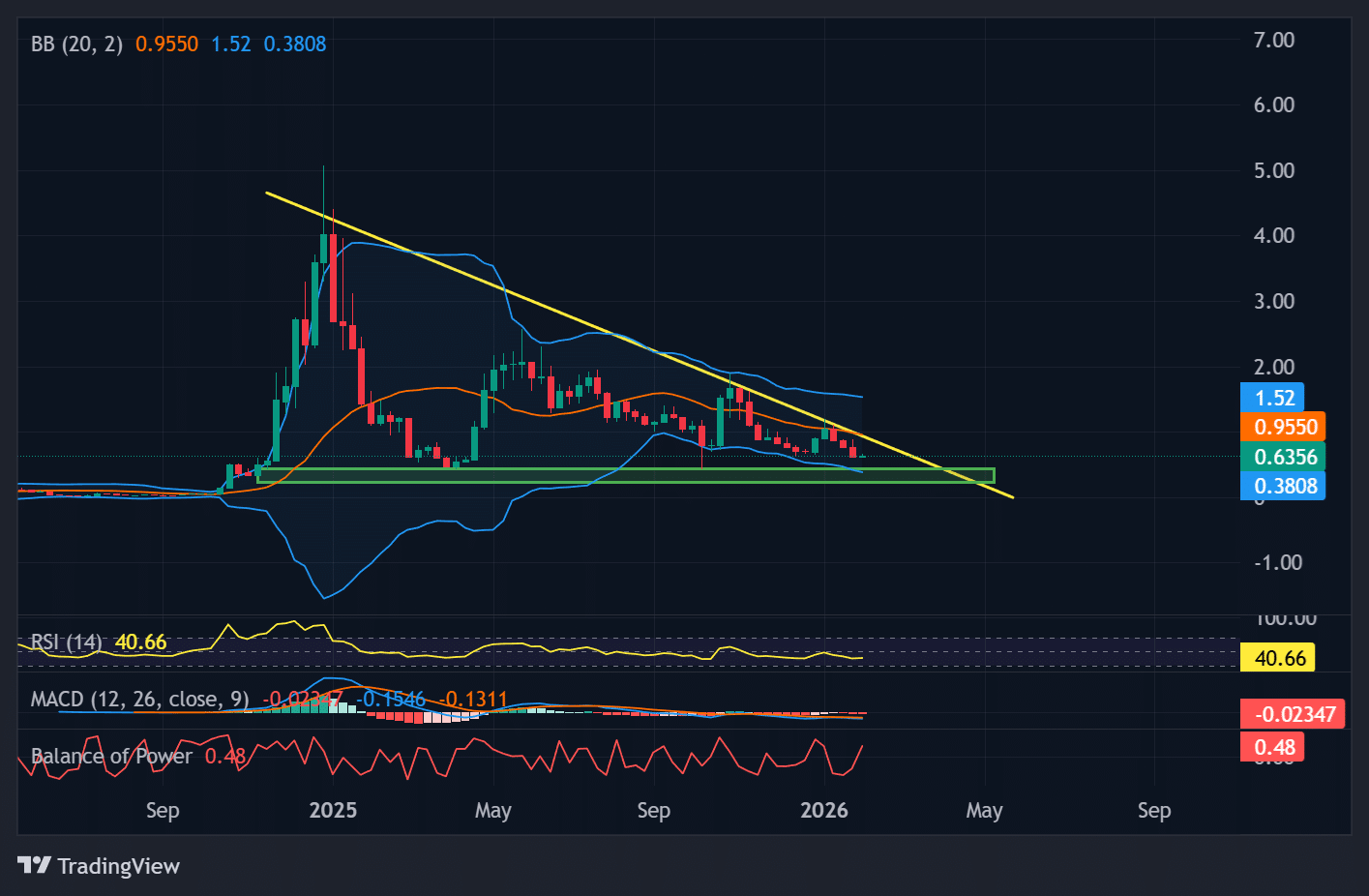
VIRTUAL price chart with momentum indicators. | Source: TradingView

VIRTUAL price chart with momentum indicators. | Source: TradingView

If VIRTUAL holds the current support and breaks the descending trendline, a test of the $0.95 to $1.50 range is possible. However, A clean break below support would expose the $0.38 area.

next

The post Virtuals Protocol Debuts 60-Day Trial for Founders, VIRTUAL Shows Signs of Life appeared first on Coinspeaker.

Disclaimer: The articles reposted on this site are sourced from public platforms and are provided for informational purposes only. They do not necessarily reflect the views of MEXC. All rights remain with the original authors. If you believe any content infringes on third-party rights, please contact [email protected] for removal. MEXC makes no guarantees regarding the accuracy, completeness, or timeliness of the content and is not responsible for any actions taken based on the information provided. The content does not constitute financial, legal, or other professional advice, nor should it be considered a recommendation or endorsement by MEXC.

You May Also Like

The Next “Big Story” in Crypto: Crypto Credit and Borrowing, Says Bitwise CEO

The Next “Big Story” in Crypto: Crypto Credit and Borrowing, Says Bitwise CEO

Bitwise CEO has recently predicted a major growth for the crypto borrowing and credit sector, calling it the next “big story.” The post The Next “Big Story” in Crypto: Crypto Credit and Borrowing, Says Bitwise CEO appeared first on Coinspeaker.
Share
Coinspeaker2025/09/18 22:16
SEC New Standards to Simplify Crypto ETF Listings

SEC New Standards to Simplify Crypto ETF Listings

The post SEC New Standards to Simplify Crypto ETF Listings appeared on BitcoinEthereumNews.com. The United States Securities and Exchange Commission (SEC) approved a new standard for crypto ETF listings on Wednesday. The standard is created to simplify the working of exchanges in terms of the process followed for crypto ETP listings. This makes it possible to to avoid the cumbersome route of case-by-case approval being followed so far. With this change, exchanges can bypass the 19(b) rule filing process. It is a review that can stretch up to 240 days and demands direct SEC approval before an ETF can launch. Instead of going through the tedious and lengthy review process, the SEC has set up a system that allows exchanges to act more quickly. Now, when an ETF issuer presents a product idea to exchanges like Nasdaq, NYSE, or CBOE, the exchange can move ahead as long as the proposal meets the generic listing standard. This means that strategies based on a single token or a basket of tokens can be listed without waiting for individual approval. New Standards Will Ease Crypto ETF Listings: SEC Chairman According to the Chairman of the SEC, Paul Atkins, this move is aimed at making it easier for investors to access digital asset products through regulated U.S. markets. He noted that by approving generic listing standards, the agency is helping U.S. capital markets remain a global leader in digital asset innovation. At the same time, the SEC approved the Grayscale Digital Large Cap Fund, a fund made up of Bitcoin, Ethereum, XRP, Cardano and Solana. Furthermore, the SEC also approved a new type of options linked to the Cboe Bitcoin U.S. ETF Index and its mini version. This step further expands the range of crypto-linked derivatives available in regulated U.S. markets. How Will SEC General Listing Standard Impact Altcoin Crypto ETF Market? The SEC’s updated listing standards could clear…
Share
BitcoinEthereumNews2025/09/18 21:38
Victra Named 2025 Recipient of Verizon’s Best Build Compliance Award

Victra Named 2025 Recipient of Verizon’s Best Build Compliance Award

Verizon Recognizes Victra for Industry-Leading Excellence in Store Design and Brand Compliance. RALEIGH, N.C., Feb. 3, 2026 /PRNewswire/ — Verizon has named Victra
Share
AI Journal2026/02/03 20:49