Ethereum price slid out of its recent consolidation range near $2,800 on as renewed exchange-trade fund outflows and weak trader positioning weighed on short-termEthereum price slid out of its recent consolidation range near $2,800 on as renewed exchange-trade fund outflows and weak trader positioning weighed on short-term

Ethereum price breaks down from consolidation near $2,800 as spot ETH ETFs shed $155M

2026/01/30 15:51
3 min read

Ethereum price slid out of its recent consolidation range near $2,800 on as renewed exchange-trade fund outflows and weak trader positioning weighed on short-term sentiment.

Summary
  • Ethereum broke below a key consolidation zone as ETF outflows returned.
  • Derivatives data pointed to traders cutting risk rather than adding leverage.
  • Technical signals show growing downside pressure below key resistance.

Ethereum was trading at $2,739 at press time, down 8% over the past 24 hours. The second-largest cryptocurrency is now down 8% over the past week and nearly 10% over the past month, even as 24-hour trading volume jumped 81% to $42.8 billion, pointing to rising activity during the sell-off.

Derivatives show traders cutting risk rather than adding leverage. According to CoinGlass data, Ethereum (ETH) futures volume climbed 55% to $90.55 billion, while open interest fell 11% to $34.29 billion.

This combination reflects heavy position turnover and long liquidations, with traders closing or being forced out of existing bets instead of building fresh exposure.

ETF outflows weigh on near-term demand

U.S. spot ETH ETFs returned to net outflows on Jan. 29, with $155 million leaving the products in a single session, as per SoSoValue data. Fidelity’s FETH saw $59.19 million in redemptions, while BlackRock’s ETHA lost $54.88 million. Weekly outflows now stand at $74 million.

ETF flows now play a major role in shaping Ethereum’s short-term price action because they reflect how large, traditional investors are positioning. Steady spot demand is reduced when money leaves these funds, and issuers may have to sell ETH to cover redemptions, further pressuring already fragile sessions.

In addition to ETF outflows, a recent decline in the Coinbase Premium Index also points to limited interest from U.S. traders, which has caused ETH to drift in narrow ranges.

Market sentiment has been further strained by network-related headlines. While talks about quantum-resistant upgrades have brought attention to longer-term security issues, reports of a potential large-scale poisoning attack have sparked new concerns about user safety.

None of these issues poses an immediate threat to Ethereum’s operations, but together they have reinforced a cautious mood at a time when trader confidence is already weak.

Ethereum price technical analysis

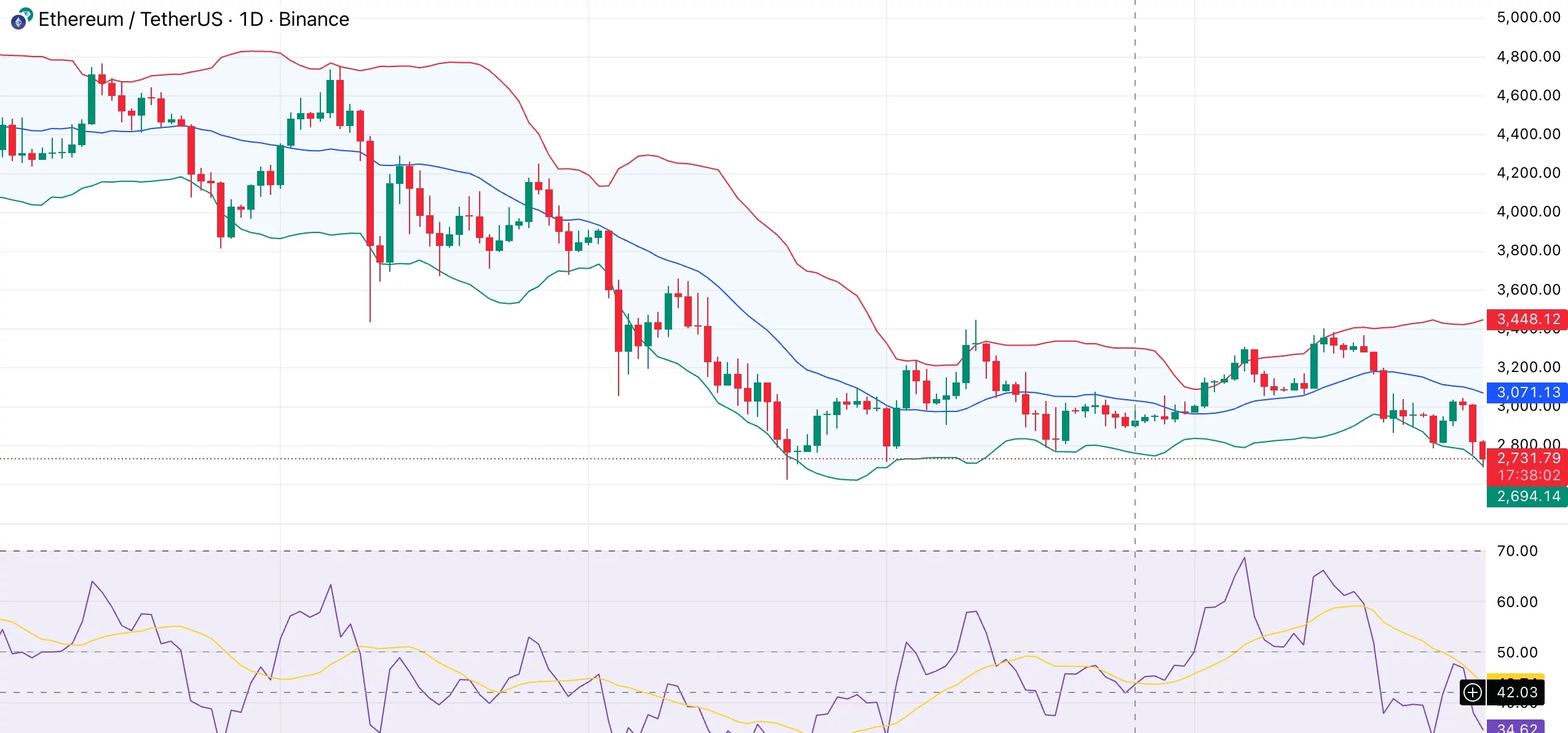
Ethereum’s move below the $2,800–$2,900 area confirms that the recent consolidation has broken down. This zone had contained price for weeks, and losing it shows that sellers have taken back control.

The short-term structure is still pointing lower. ETH continues to form lower highs, and recent rebound attempts faded near the $3,050–$3,100 region, where selling pressure remains heavy.
Ethereum price breaks down from consolidation near $2,800 as spot ETH ETFs shed $155M - 1

Price is now sitting below its short-term moving averages, with the middle Bollinger band near $3,070 acting as a ceiling. As long as ETH stays under this level, rallies are likely to run into resistance.

After a long period of tight trading, volatility is picking up. The Bollinger Bands have started to open to the downside, confirming the recent break from range. The relative strength index is now in the low 40s, indicating a weakening of momentum.

This suggests that there is bearish pressure but not yet severe selling, allowing for more drops before buyers intervene. The $2,700 area, which corresponds with the lower Bollinger Band and recent lows, is the first notable support on the downside.

For the outlook to improve, ETH would need to climb back above $2,950–$3,000 and hold that area on a daily close. A move through this zone would invalidate the breakdown and bring $3,100 back into focus.

Until that happens, the trend favors the downside, with most rebounds likely to be short-lived rather than begin a new uptrend.

Disclaimer: The articles reposted on this site are sourced from public platforms and are provided for informational purposes only. They do not necessarily reflect the views of MEXC. All rights remain with the original authors. If you believe any content infringes on third-party rights, please contact [email protected] for removal. MEXC makes no guarantees regarding the accuracy, completeness, or timeliness of the content and is not responsible for any actions taken based on the information provided. The content does not constitute financial, legal, or other professional advice, nor should it be considered a recommendation or endorsement by MEXC.

You May Also Like

American Bitcoin’s $5B Nasdaq Debut Puts Trump-Backed Miner in Crypto Spotlight

American Bitcoin’s $5B Nasdaq Debut Puts Trump-Backed Miner in Crypto Spotlight

The post American Bitcoin’s $5B Nasdaq Debut Puts Trump-Backed Miner in Crypto Spotlight appeared on BitcoinEthereumNews.com. Key Takeaways: American Bitcoin (ABTC) surged nearly 85% on its Nasdaq debut, briefly reaching a $5B valuation. The Trump family, alongside Hut 8 Mining, controls 98% of the newly merged crypto-mining entity. Eric Trump called Bitcoin “modern-day gold,” predicting it could reach $1 million per coin. American Bitcoin, a fast-rising crypto mining firm with strong political and institutional backing, has officially entered Wall Street. After merging with Gryphon Digital Mining, the company made its Nasdaq debut under the ticker ABTC, instantly drawing global attention to both its stock performance and its bold vision for Bitcoin’s future. Read More: Trump-Backed Crypto Firm Eyes Asia for Bold Bitcoin Expansion Nasdaq Debut: An Explosive First Day ABTC’s first day of trading proved as dramatic as expected. Shares surged almost 85% at the open, touching a peak of $14 before settling at lower levels by the close. That initial spike valued the company around $5 billion, positioning it as one of 2025’s most-watched listings. At the last session, ABTC has been trading at $7.28 per share, which is a small positive 2.97% per day. Although the price has decelerated since opening highs, analysts note that the company has been off to a strong start and early investor activity is a hard-to-find feat in a newly-launched crypto mining business. According to market watchers, the listing comes at a time of new momentum in the digital asset markets. With Bitcoin trading above $110,000 this quarter, American Bitcoin’s entry comes at a time when both institutional investors and retail traders are showing heightened interest in exposure to Bitcoin-linked equities. Ownership Structure: Trump Family and Hut 8 at the Helm Its management and ownership set up has increased the visibility of the company. The Trump family and the Canadian mining giant Hut 8 Mining jointly own 98 percent…
Share
BitcoinEthereumNews2025/09/18 01:33
‘Compromise is in the air’: Ripple CLO signals progress on crypto bill

‘Compromise is in the air’: Ripple CLO signals progress on crypto bill

The post ‘Compromise is in the air’: Ripple CLO signals progress on crypto bill appeared on BitcoinEthereumNews.com. The White House made a second attempt to broker
Share
BitcoinEthereumNews2026/02/11 19:31
The GENIUS Act Is Already Law. Banks Shouldn’t Try to Rewrite It Now

The GENIUS Act Is Already Law. Banks Shouldn’t Try to Rewrite It Now

The post The GENIUS Act Is Already Law. Banks Shouldn’t Try to Rewrite It Now appeared on BitcoinEthereumNews.com. Healthy competition drives innovation and better products for consumers; it is at the center of American economic leadership. Unfortunately, now that the bipartisan GENIUS Act has been signed into law, major legacy financial institutions seem to be having second thoughts about the innovations that stablecoins can bring to financial markets. Bank lobbying groups and public affairs teams have been peppering Congress with complaints about the law, urging members to reopen debate and introduce changes to the legislation that will ensure the stablecoin market doesn’t grow too quickly, protecting banks’ profits and stifling consumer choice. This reactionary response is both overblown and unnecessary. What legacy financial firms should do instead is embrace competition and offer exciting new products and services that consumers want, not try to kneecap emerging players through anti-innovation rules and regulations. The GENIUS Act was carefully designed with a thorough bipartisan process to strengthen consumer safeguards, ensure regulatory oversight, and preserve financial stability. Efforts to roll back its provisions are less about protecting families and more about protecting entrenched banking interests from the competition that helps ensure the U.S. banking system stays the strongest and most innovative in the world. Critics warn that allowing stablecoins to provide rewards could lead to massive deposit outflows from community banks, with figures as high as $6.6 trillion cited. But closer examination shows this fear is unfounded. A July 2025 analysis by consulting firm Charles River Associates found no statistically significant relationship between stablecoin adoption and community bank deposit outflows. In fact, the overwhelming majority of stablecoin reserves remain in the traditional financial system — either in commercial bank accounts or in short-term Treasuries — where they continue to support liquidity and credit in the broader U.S. economy. The dire estimates rely on unrealistic assumptions that every dollar of stablecoin issuance permanently…
Share
BitcoinEthereumNews2025/09/18 09:39
