Gold pushing above $5,600 per ounce feels dramatic, especially with social media packed with crash narratives. But the chart shared by analyst Reflection tells Gold pushing above $5,600 per ounce feels dramatic, especially with social media packed with crash narratives. But the chart shared by analyst Reflection tells

Gold at $5,600 Doesn’t Mean a Crash Is Coming—History Says the Opposite

3 min read

Gold pushing above $5,600 per ounce feels dramatic, especially with social media packed with crash narratives. But the chart shared by analyst Reflection tells a much less emotional story, and a far more consistent one.

The key point in Reflection’s analysis is timing. Gold does not lead market crashes. It follows them.

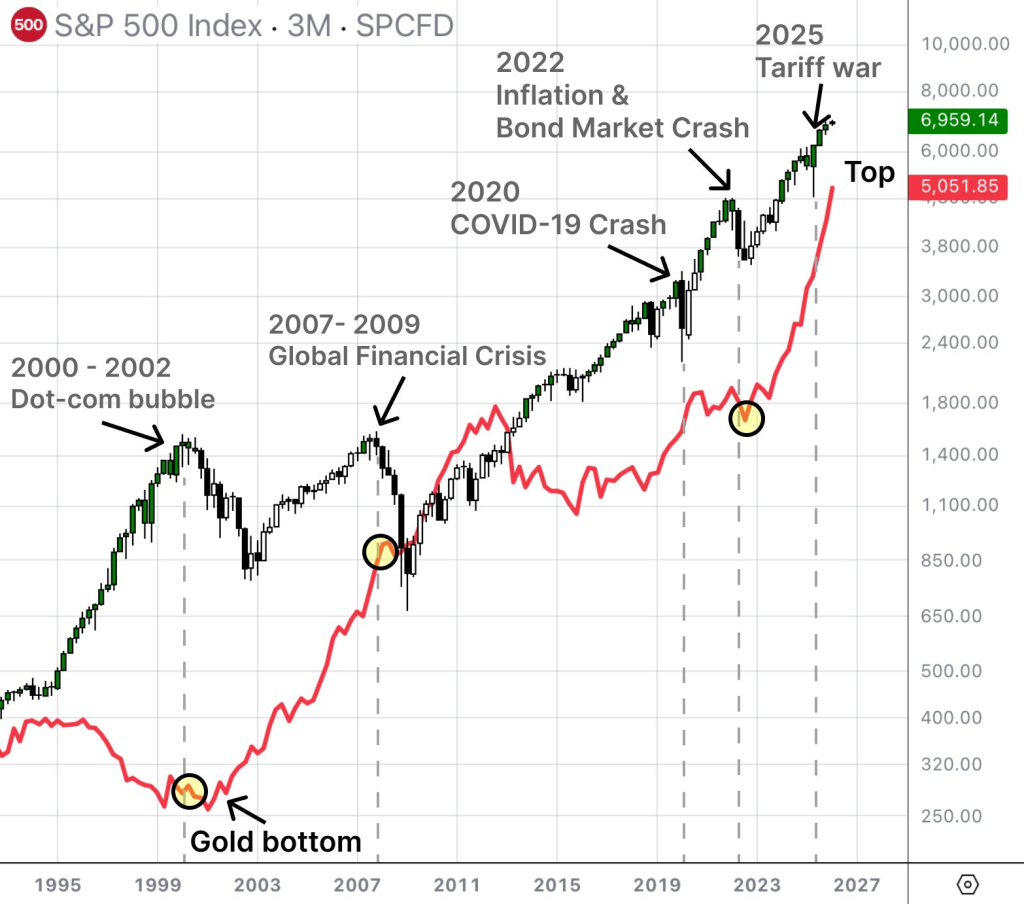
Looking at the S&P 500 plotted against gold across multiple cycles, the same structure repeats.

During the dot-com bubble (2000–2002), equities peaked first. The S&P 500 lost roughly 50%, while gold barely moved at the start. Only after stocks had already collapsed did gold begin its multi-year advance. The gold rally was a reaction to damage already done, not a warning signal.

The same pattern appears in the 2007–2009 Global Financial Crisis. Equities rolled over, credit broke, and fear entered the system. Gold rose during the crisis, but the larger move came after the bottom, once investors were traumatized and avoided risk. That post-crisis gold trade turned into a trap: from 2009 to 2019, gold went sideways while equities compounded aggressively.
Source: X/@0xReflection

Reflection highlights this clearly on the chart. The red gold line keeps rising long after the crash marker, while equities quietly rebuild and then outperform.

The COVID-19 crash follows the same logic. Gold dipped slightly during the initial liquidation. The real move higher came only after markets had already collapsed and panic had set in. Again, gold responded to fear—it didn’t predict it.

Why Today Looks Similar to Post-2009, Not Pre-Crash

Right now, gold is moving while equities are still holding up. That matters.

The chart labels this phase clearly: after crises, not before them, capital rotates into gold as a psychological hedge. Investors remember pain and choose safety—even when risk assets are already recovering.

That’s exactly what Reflection is warning about.

The current environment is saturated with fear narratives:
U.S. debt headlines, deficit panic, AI bubble talk, tariff wars, geopolitical noise. Gold benefits from that mood. But historically, this mood tends to appear after crashes, not right before them.

On the chart, every time gold became a consensus safety trade without an actual equity collapse, it underperformed for years afterward.

Read also: Robert Kiyosaki Admits Regret Over Bitcoin and Gold as Silver Becomes His Safety Net

The Core Risk Reflection Is Pointing Out

The danger isn’t owning gold. The danger is crowding.

When gold becomes the default response to headlines instead of actual market damage, capital gets parked in an asset that can range for a decade. That happened after 2011. It took almost ten years for gold buyers to see real gains again, while stocks and risk assets compounded relentlessly.

Reflection’s chart doesn’t argue that gold must crash from $5,600. It argues something more uncomfortable:
gold rising does not automatically mean a broader market collapse is coming.

In fact, history suggests the opposite.

Subscribe to our YouTube channel for daily crypto updates, market insights, and expert analysis.

The post Gold at $5,600 Doesn’t Mean a Crash Is Coming—History Says the Opposite appeared first on CaptainAltcoin.

Disclaimer: The articles reposted on this site are sourced from public platforms and are provided for informational purposes only. They do not necessarily reflect the views of MEXC. All rights remain with the original authors. If you believe any content infringes on third-party rights, please contact [email protected] for removal. MEXC makes no guarantees regarding the accuracy, completeness, or timeliness of the content and is not responsible for any actions taken based on the information provided. The content does not constitute financial, legal, or other professional advice, nor should it be considered a recommendation or endorsement by MEXC.

You May Also Like

Wormhole launches reserve tying protocol revenue to token

Wormhole launches reserve tying protocol revenue to token

The post Wormhole launches reserve tying protocol revenue to token appeared on BitcoinEthereumNews.com. Wormhole is changing how its W token works by creating a new reserve designed to hold value for the long term. Announced on Wednesday, the Wormhole Reserve will collect onchain and offchain revenues and other value generated across the protocol and its applications (including Portal) and accumulate them into W, locking the tokens within the reserve. The reserve is part of a broader update called W 2.0. Other changes include a 4% targeted base yield for tokenholders who stake and take part in governance. While staking rewards will vary, Wormhole said active users of ecosystem apps can earn boosted yields through features like Portal Earn. The team stressed that no new tokens are being minted; rewards come from existing supply and protocol revenues, keeping the cap fixed at 10 billion. Wormhole is also overhauling its token release schedule. Instead of releasing large amounts of W at once under the old “cliff” model, the network will shift to steady, bi-weekly unlocks starting October 3, 2025. The aim is to avoid sharp periods of selling pressure and create a more predictable environment for investors. Lockups for some groups, including validators and investors, will extend an additional six months, until October 2028. Core contributor tokens remain under longer contractual time locks. Wormhole launched in 2020 as a cross-chain bridge and now connects more than 40 blockchains. The W token powers governance and staking, with a capped supply of 10 billion. By redirecting fees and revenues into the new reserve, Wormhole is betting that its token can maintain value as demand for moving assets and data between chains grows. This is a developing story. This article was generated with the assistance of AI and reviewed by editor Jeffrey Albus before publication. Get the news in your inbox. Explore Blockworks newsletters: Source: https://blockworks.co/news/wormhole-launches-reserve
Share
BitcoinEthereumNews2025/09/18 01:55
Kalshi debuts ecosystem hub with Solana and Base

Kalshi debuts ecosystem hub with Solana and Base

The post Kalshi debuts ecosystem hub with Solana and Base appeared on BitcoinEthereumNews.com. Kalshi, the US-regulated prediction market exchange, rolled out a new program on Wednesday called KalshiEco Hub. The initiative, developed in partnership with Solana and Coinbase-backed Base, is designed to attract builders, traders, and content creators to a growing ecosystem around prediction markets. By combining its regulatory footing with crypto-native infrastructure, Kalshi said it is aiming to become a bridge between traditional finance and onchain innovation. The hub offers grants, technical assistance, and marketing support to selected projects. Kalshi also announced that it will support native deposits of Solana’s SOL token and USDC stablecoin, making it easier for users already active in crypto to participate directly. Early collaborators include Kalshinomics, a dashboard for market analytics, and Verso, which is building professional-grade tools for market discovery and execution. Other partners, such as Caddy, are exploring ways to expand retail-facing trading experiences. Kalshi’s move to embrace blockchain partnerships comes at a time when prediction markets are drawing fresh attention for their ability to capture sentiment around elections, economic policy, and cultural events. Competitor Polymarket recently acquired QCEX — a derivatives exchange with a CFTC license — to pave its way back into US operations under regulatory compliance. At the same time, platforms like PredictIt continue to push for a clearer regulatory footing. The legal terrain remains complex, with some states issuing cease-and-desist orders over whether these event contracts count as gambling, not finance. This is a developing story. This article was generated with the assistance of AI and reviewed by editor Jeffrey Albus before publication. Get the news in your inbox. Explore Blockworks newsletters: Source: https://blockworks.co/news/kalshi-ecosystem-hub-solana-base
Share
BitcoinEthereumNews2025/09/18 04:40
Optimizely Named a Leader in the 2026 Gartner® Magic Quadrant™ for Personalization Engines

Optimizely Named a Leader in the 2026 Gartner® Magic Quadrant™ for Personalization Engines

Company recognized as a Leader for the second consecutive year NEW YORK, Feb. 5, 2026 /PRNewswire/ — Optimizely, the leading digital experience platform (DXP) provider
Share
AI Journal2026/02/06 00:47