A decline in ERC-20 stablecoin supply is often interpreted as liquidity exiting the cryptocurrency market. However, on-chain data from CryptoQuant shows a differentA decline in ERC-20 stablecoin supply is often interpreted as liquidity exiting the cryptocurrency market. However, on-chain data from CryptoQuant shows a different

Stablecoin Liquidity Is Shifting Networks, Not Leaving Crypto

2026/01/29 07:23

A decline in ERC-20 stablecoin supply is often interpreted as liquidity exiting the cryptocurrency market.

However, on-chain data from CryptoQuant shows a different dynamic unfolding in January 2026. Rather than leaving the system, stablecoin liquidity appears to be rotating across blockchain networks.

Stablecoin Supply Moves: January 19–20, 2026

On January 19 and 20, a clear divergence emerged between Ethereum and Tron stablecoin supplies.
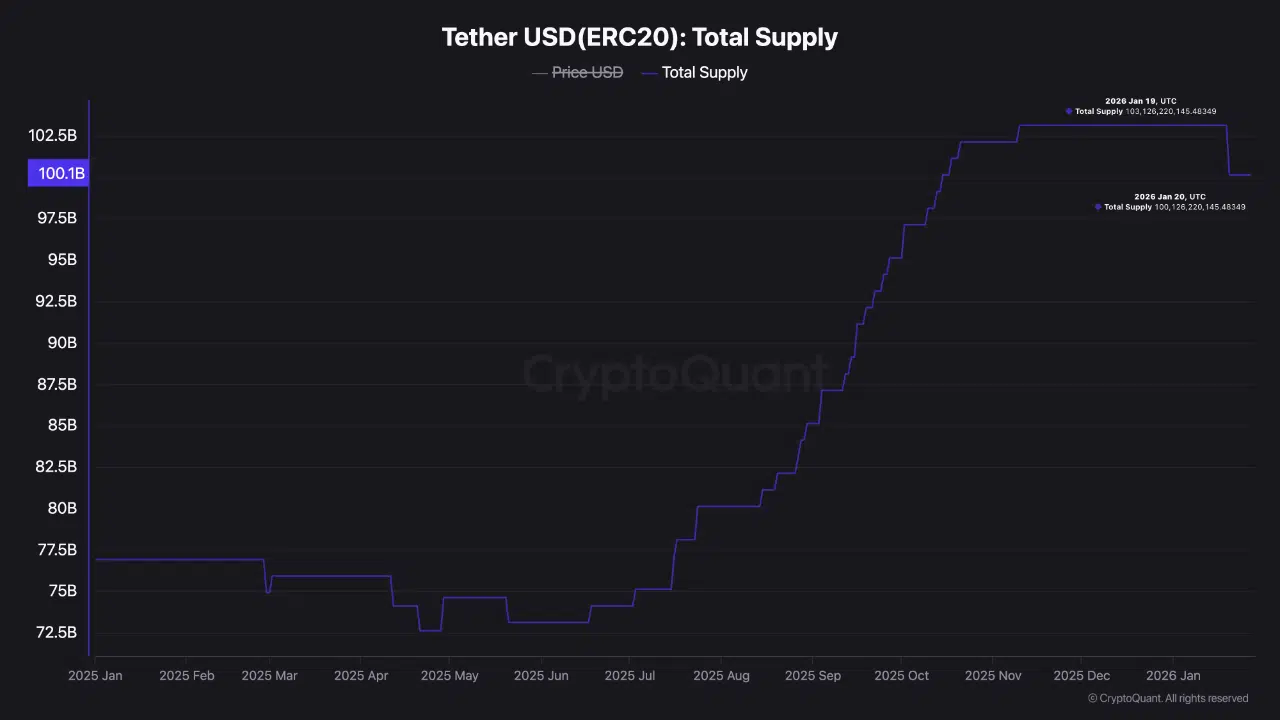
On the Tron network, USDT supply increased sharply. Total TRC-20 USDT rose from 82,434,679,540 on January 19 to 83,434,679,540 on January 20, marking a net increase of $1 billion in a single day. This expansion was driven by a direct mint on Tron.

At the same time, Ethereum experienced a notable contraction in stablecoin balances. ERC-20 USDT supply declined by approximately $3.0 billion, while ERC-20 USDC fell by around $3.55 billion. Combined, this represents roughly $6.5 billion in stablecoins removed from Ethereum-based circulation.

The timing is critical. The increase in TRC-20 USDT followed immediately after the contraction on Ethereum, suggesting a coordinated liquidity shift rather than an isolated redemption event.

What the Flow Data Indicates

This pattern does not resemble a broad exit from crypto into fiat. Instead, it reflects a redistribution of liquidity across networks and use cases.

USDT is primarily used for derivatives trading, OTC settlement, and short-term tactical positioning. Because of this role, it frequently migrates to lower-cost networks where transaction efficiency is higher. Tron has increasingly served as a preferred rail for these functions.

USDC, by contrast, is more closely tied to spot market activity and on-chain settlement. As a result, changes in ERC-20 USDC supply tend to act as a clearer signal for spot demand conditions, particularly on Ethereum.

When both USDT and USDC decline on Ethereum while USDT simultaneously expands on Tron, the most straightforward interpretation is that liquidity is changing rails, not disappearing.

OKX Launches Stablecoin Card in Europe as MiCA Takes Effect

Market Implications

The data suggests that liquidity remains inside the crypto ecosystem, but its positioning has become more defensive. Demand for Ethereum-based settlement appears to be softening, while capital preference shifts toward derivatives-oriented and parked liquidity environments.

From a market perspective, falling ERC-20 stablecoin supply carries specific implications. It is bearish for Ethereum on-chain activity, neutral to bearish for spot-driven risk appetite, and not evidence of capital exiting crypto entirely.

Rather than signaling capitulation, the stablecoin flows point to structural reallocation, a rotation within crypto infrastructure driven by cost efficiency and evolving use cases.

The post Stablecoin Liquidity Is Shifting Networks, Not Leaving Crypto appeared first on ETHNews.

Disclaimer: The articles reposted on this site are sourced from public platforms and are provided for informational purposes only. They do not necessarily reflect the views of MEXC. All rights remain with the original authors. If you believe any content infringes on third-party rights, please contact [email protected] for removal. MEXC makes no guarantees regarding the accuracy, completeness, or timeliness of the content and is not responsible for any actions taken based on the information provided. The content does not constitute financial, legal, or other professional advice, nor should it be considered a recommendation or endorsement by MEXC.

You May Also Like

Markets await Fed’s first 2025 cut, experts bet “this bull market is not even close to over”

Markets await Fed’s first 2025 cut, experts bet “this bull market is not even close to over”

Will the Fed’s first rate cut of 2025 fuel another leg higher for Bitcoin and equities, or does September’s history point to caution? First rate cut of 2025 set against a fragile backdrop The Federal Reserve is widely expected to…
Share
Crypto.news2025/09/18 00:27
Best Crypto to Buy as Saylor & Crypto Execs Meet in US Treasury Council

Best Crypto to Buy as Saylor & Crypto Execs Meet in US Treasury Council

The post Best Crypto to Buy as Saylor & Crypto Execs Meet in US Treasury Council appeared on BitcoinEthereumNews.com. Michael Saylor and a group of crypto executives met in Washington, D.C. yesterday to push for the Strategic Bitcoin Reserve Bill (the BITCOIN Act), which would see the U.S. acquire up to 1M $BTC over five years. With Bitcoin being positioned yet again as a cornerstone of national monetary policy, many investors are turning their eyes to projects that lean into this narrative – altcoins, meme coins, and presales that could ride on the same wave. Read on for three of the best crypto projects that seem especially well‐suited to benefit from this macro shift:  Bitcoin Hyper, Best Wallet Token, and Remittix. These projects stand out for having a strong use case and high adoption potential, especially given the push for a U.S. Bitcoin reserve.   Why the Bitcoin Reserve Bill Matters for Crypto Markets The strategic Bitcoin Reserve Bill could mark a turning point for the U.S. approach to digital assets. The proposal would see America build a long-term Bitcoin reserve by acquiring up to one million $BTC over five years. To make this happen, lawmakers are exploring creative funding methods such as revaluing old gold certificates. The plan also leans on confiscated Bitcoin already held by the government, worth an estimated $15–20B. This isn’t just a headline for policy wonks. It signals that Bitcoin is moving from the margins into the core of financial strategy. Industry figures like Michael Saylor, Senator Cynthia Lummis, and Marathon Digital’s Fred Thiel are all backing the bill. They see Bitcoin not just as an investment, but as a hedge against systemic risks. For the wider crypto market, this opens the door for projects tied to Bitcoin and the infrastructure that supports it. 1. Bitcoin Hyper ($HYPER) – Turning Bitcoin Into More Than Just Digital Gold The U.S. may soon treat Bitcoin as…
Share
BitcoinEthereumNews2025/09/18 00:27
UK Treasury spokesperson: Hopes banks will stop blocking crypto companies

UK Treasury spokesperson: Hopes banks will stop blocking crypto companies

PANews reported on January 29th, citing CoinDesk, that British officials stated they expect banks to treat all businesses, including crypto service providers, fairly
Share
PANews2026/01/29 09:56
