

How to Index Monad Data and Build Blazing-Fast dApps with OnFinality
The Monad Blockchain is engineered for extreme performance: high throughput, ultra-low latency, and full EVM compatibility. But to truly unlock its power, developers need a reliable way to access Monad data efficiently - especially for real-time apps, analytics, bots, gaming, and DeFi protocols.
This post shows you how to index Monad data using OnFinality's hosted The Graph (Subgraph) or SubQuery service, why that matters, and what kinds of dApps benefit most.
Table of Contents
- What is the Monad Blockchain?
- Why Index Monad Data?
- The Benefits of OnFinality for Monad Indexing
- How to Deploy a Monad Indexer on OnFinality
- Common Questions about Monad Indexing
- Final Thoughts
What is the Monad Blockchain?
Monad is a next-generation EVM-compatible Layer 1 designed for extreme performance. Its architecture focuses on speed, determinism, and efficient execution.
Core attributes:
- High throughput through parallel transaction execution
- Sub-second block times
- Full Ethereum tooling compatibility
- Decentralised validator set with modest hardware requirements
Thanks to its design Monad is ideal for:
- High-frequency trading & DeFi
- Real-time games
- AI-driven agents and automation
- Consumer social apps
But none of these apps function without clean and fast access to on-chain state. That's why indexing matters.
Why Index Monad Data?
Indexing transforms the raw, unstructured blockchain into fast, queryable databases - containing only the information your dApp needs.
When you Index Monad Data, you gain:
- Structured tables of events, transactions, and contract calls
- Ability to run complex, multi-parameter queries instantly
- Reduced load on Monad RPC endpoints
- Power for real-time UIs, dashboards, bots, agents, and analytics
Apps that rely solely on RPC quickly hit performance and cost limitations.Indexing solves that.
The Benefits of OnFinality for Monad Indexing
OnFinality provides the most developer-friendly and scalable way to deploy a Monad Indexer, with infrastructure trusted across multiple major ecosystems,
By publishing your Monad SubQuery or The Graph indexer project on OnFinality, you benefit from:
- One-click deployment - No need to run your own infrastructure
- Flexible - Hosting of both SubQuery and The Graph projects
- Expert support & assistance setting up your indexer
- Auto-scaling resources
- Global CDN - Fast data delivery anywhere in the world
- Integrated Monad RPC - ensuring fast and consistent data ingestion
This gives you production-grade reliability with almost zero DevOps overhead.
How to Deploy a Monad Indexer on OnFinality
🛠 Prerequisites
Before getting started, ensure you have:
- A working SubQuery or The Graph project for the Monad blockchain. Check out their quick start guide first
- An IPFS-hosted version of your project.
- An account on OnFinality’s Indexing Service
Step 1: Prepare and Host Your SubQuery or Subgraph Project
OnFinality requires your project to be publicly accessible on IPFS. Learn how to publish your SubQuery project to IPFS.
Today, we will be using a demo Monad project deployment with IPFS CID:
QmT3pUm6RFE87gmSdibn4p9uCbhHdDgxu1pxo8w5nmjeRD
Step 2: Log In to OnFinality’s Indexing Service
To create your first project, head to OnFinality Indexing Service. You'll need to authenticate with your GitHub account to login.
On first login, you will be asked to authorise OnFinality’s Indexing Service. We only need your email address to identify your account, and we don't use any other data from your GitHub account for any other reasons. In this step, you can also request or grant access to your GitHub Organisation account so you can post SubQuery projects under your GitHub Organisation instead of your personal account.
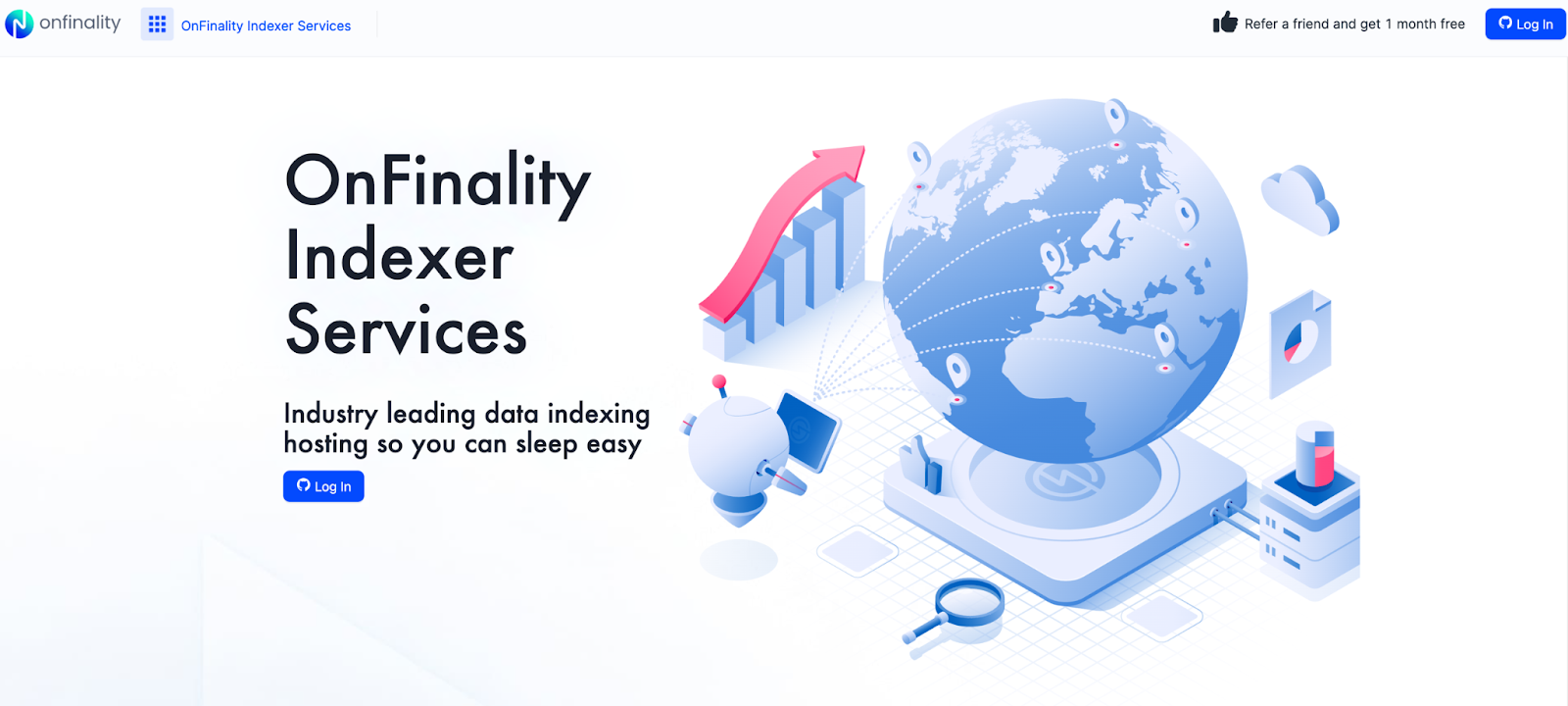
OnFinality Indexing Service is where you manage all your hosted projects uploaded to the OnFinality Indexing Service platform. You can create, delete, and even upgrade projects all from this application.
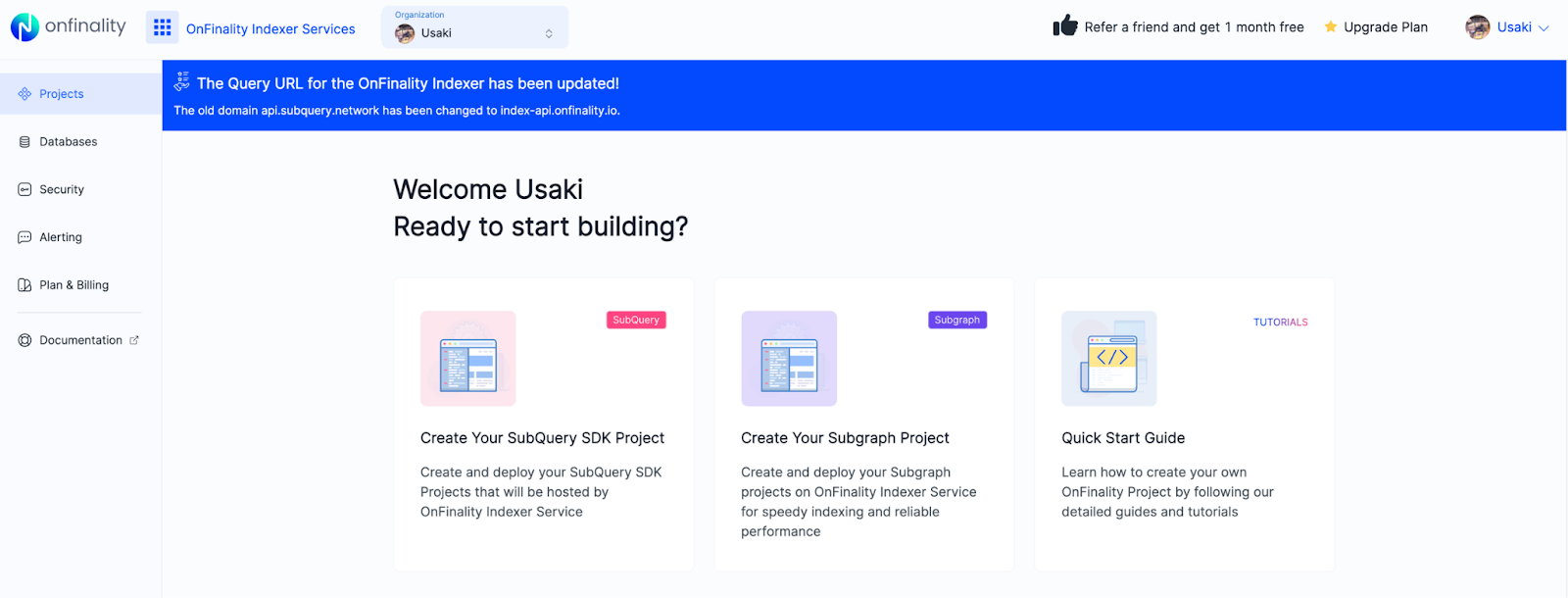
Step 3: Create Your Monad Indexing Project
There are two methods to create a project in the OnFinality Indexing Service: you can use the UI or directly via the subql cli tool
Using the UI
Start by clicking on "Create Project". You'll be taken to the new project form. Start by selecting what project type you would like to deploy (SubQuery), and then follow the steps and enter the following (you can change this in the future):
- Project Name: Name your project.
- Description: Provide a description of your project.
- Database: Premium customers can access dedicated databases to host production SubQuery projects from. If this interests you, you can contact [email protected] to have this setting enabled.
- Visible in Explorer: If selected, this will show the project from the public explorer to share with the community.
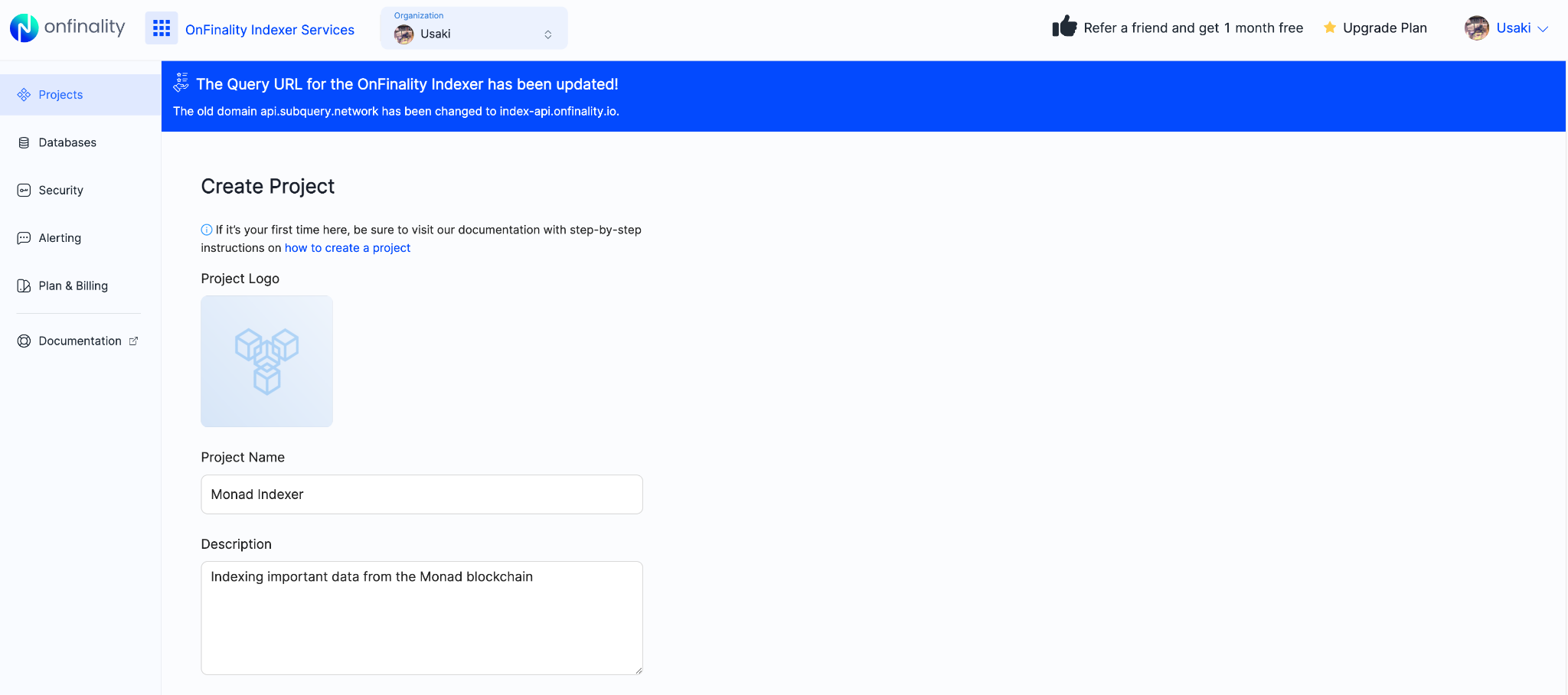
Create your project and you'll see it on your OnFinality’s Indexing Project's list. Next, we just need to deploy the first version of it.
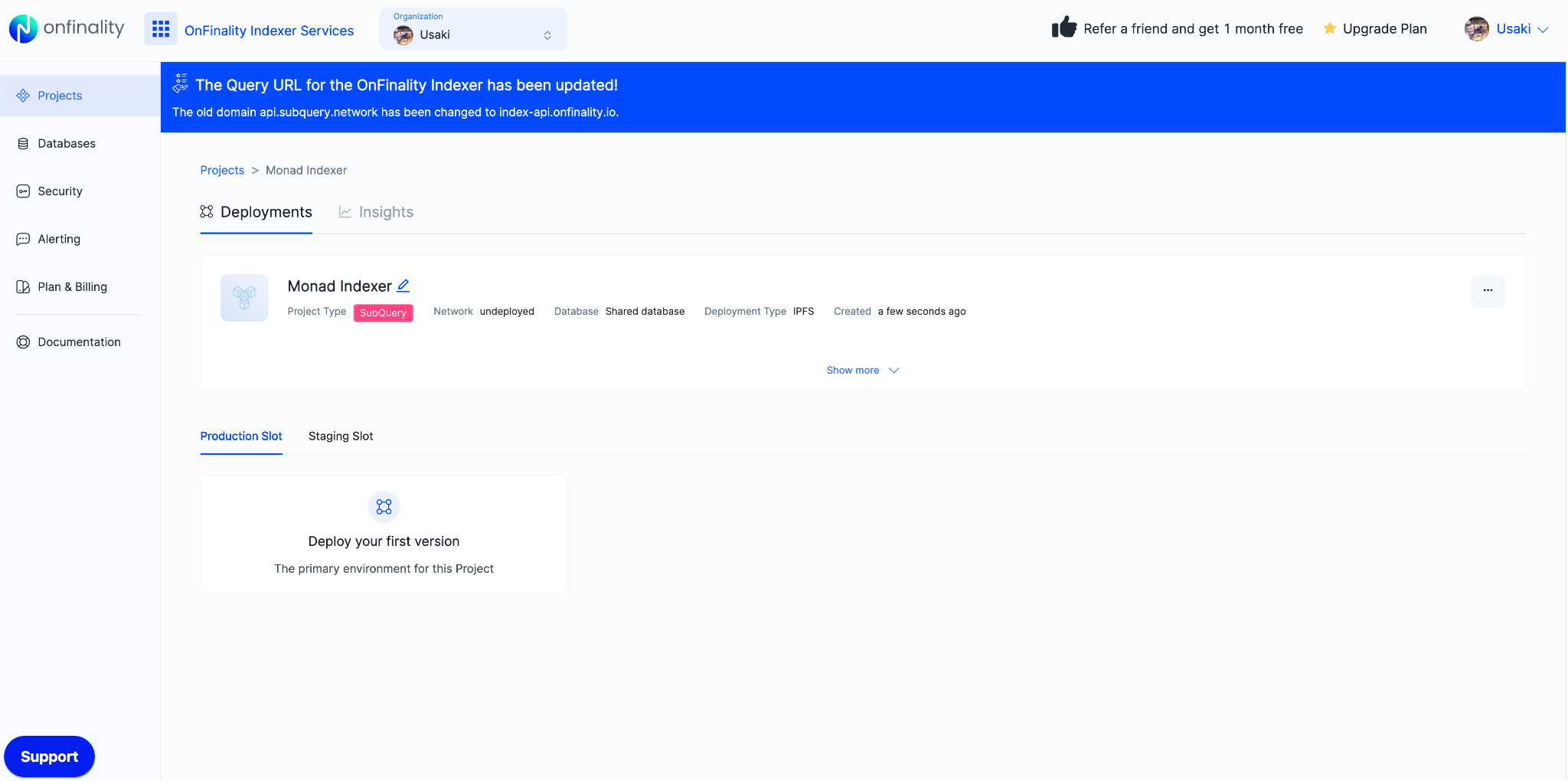
Using the CLI
You can also use @subql/cli to create a new deployment of your project to our Indexing Service. Please follow the guide on how to create a new project on the OnFinality’s Indexing Service in the CLI documentation.
Step 4: Deploy your First Version
While creating a project will setup the display details of the project, you must deploy a version of it before it becomes operational. Deploying a version triggers an indexing operation to start, and sets up the required query service to start accepting GraphQL requests. You can also deploy new versions to existing projects here.
With your new project, you'll see a "Deploy your first version" button. Click this, and fill in the required information about the deployment:
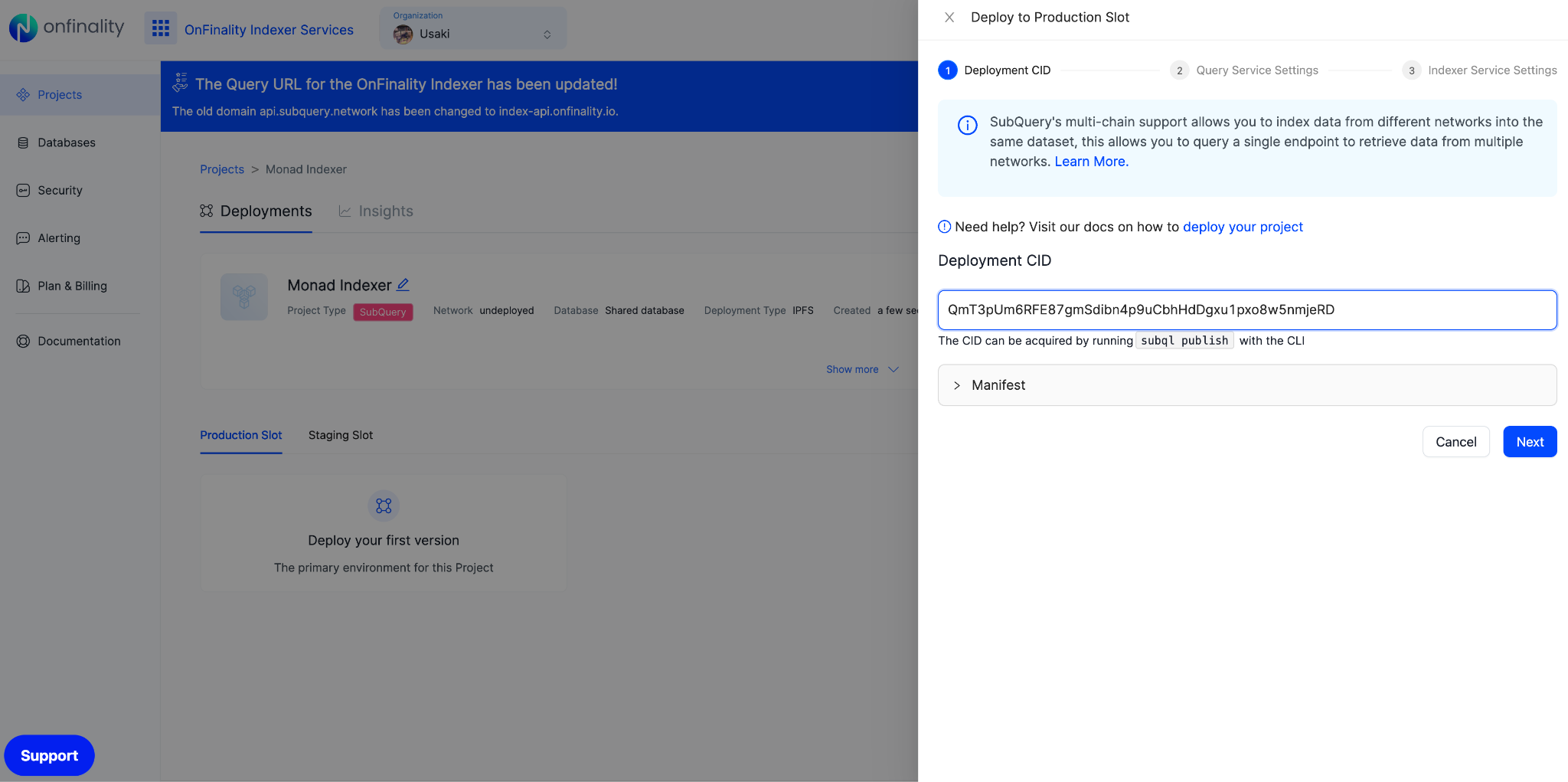
- CID: Provide your IPFS deployment CID from Step 1
- Manifest: The details are obtained from the contents of the provided CID, used to confirm that you have the correct deployment
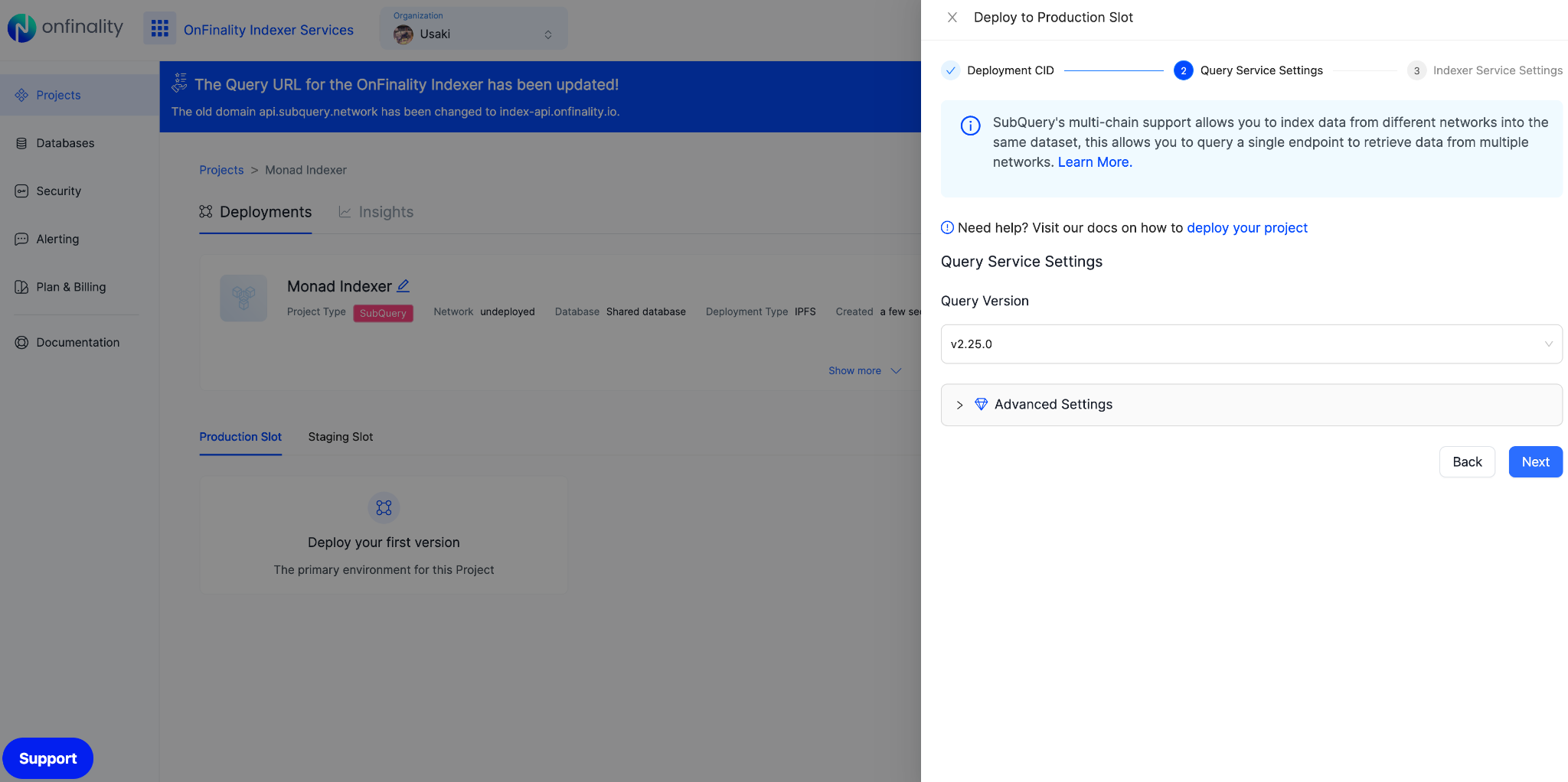
- Query Version: This is the version of SubQuery's query service that you want to run this project on. We suggest using the latest version
- Advanced Settings: There are numerous advanced settings which are explained via the in built help feature.
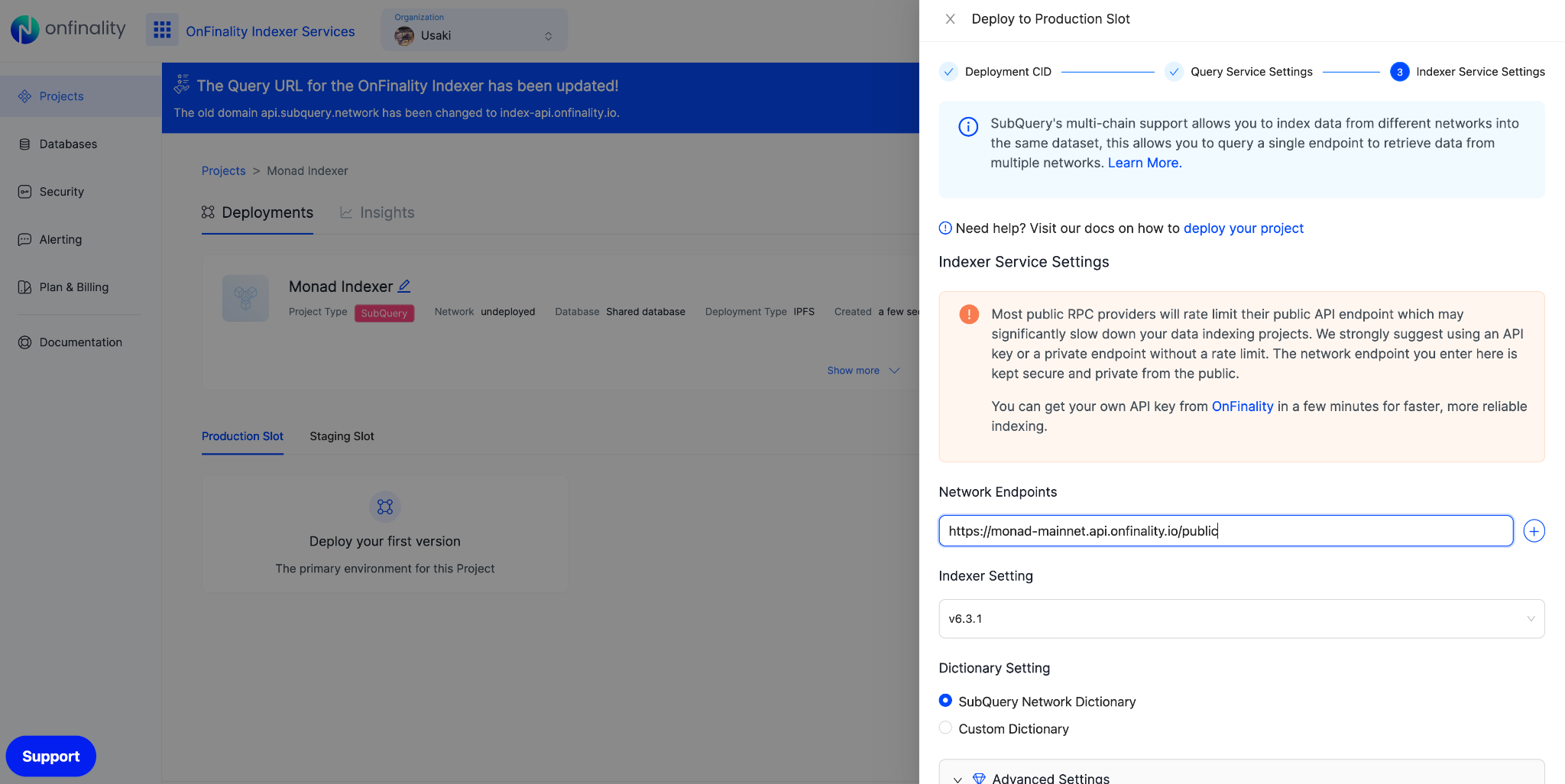
Network Endpoints: You can use OnFinality’s limited public Ethereum endpoint to get started:https://monad-mainnet.api.onfinality.io/public
For best results, sign up at https://app.onfinality.io/signup to retrieve an endpoint with higher rate limits
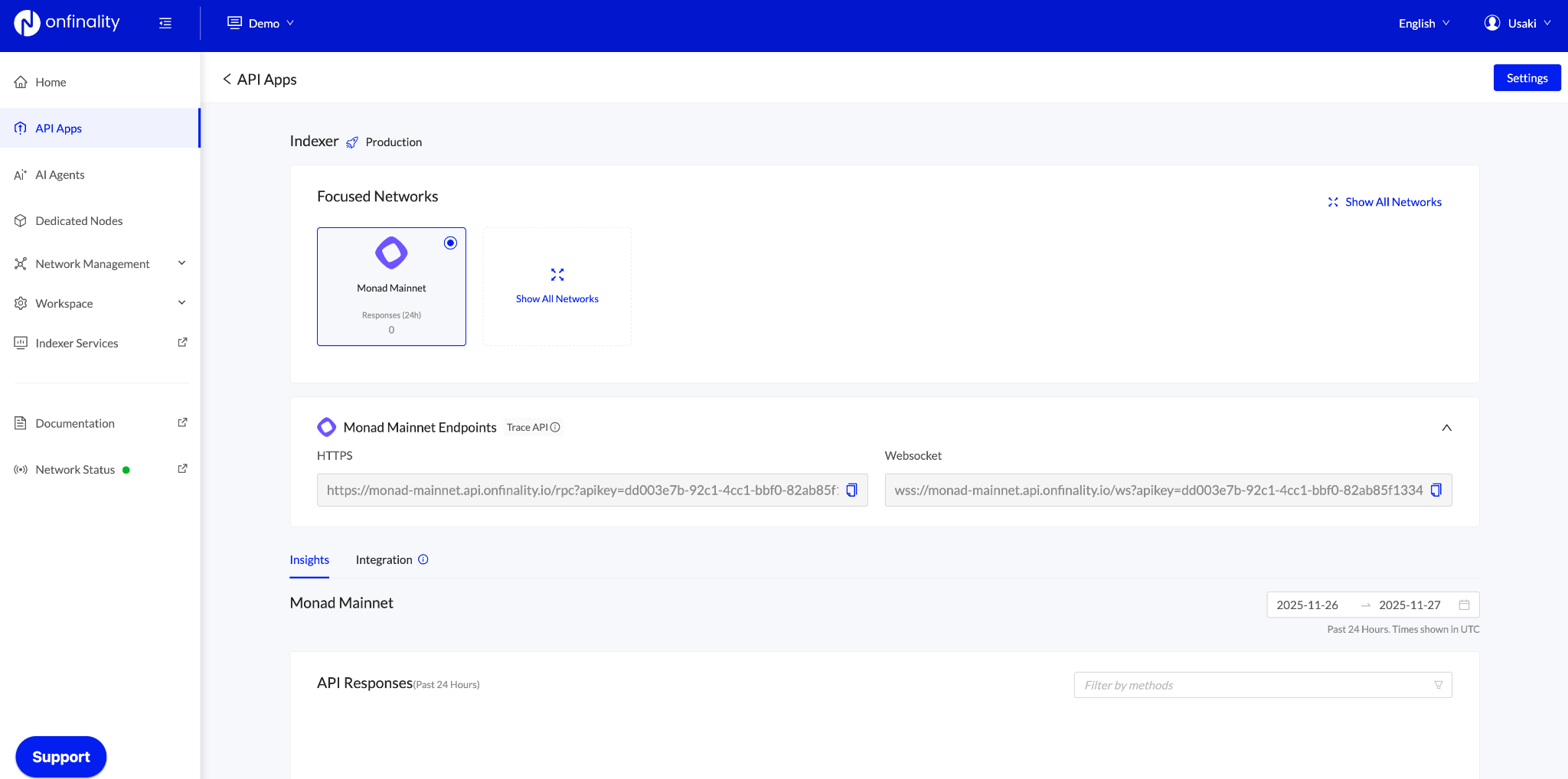
Once submitted, OnFinality will begin indexing your project. Depending on Ethereum's chain state and your query configuration, this may take a few minutes to fully sync.
Step 5: Connect to your Project
Once your deployment has successfully completed and our nodes have indexed your data from the chain, you'll be able to connect to your project via the displayed GraphQL Query endpoint.
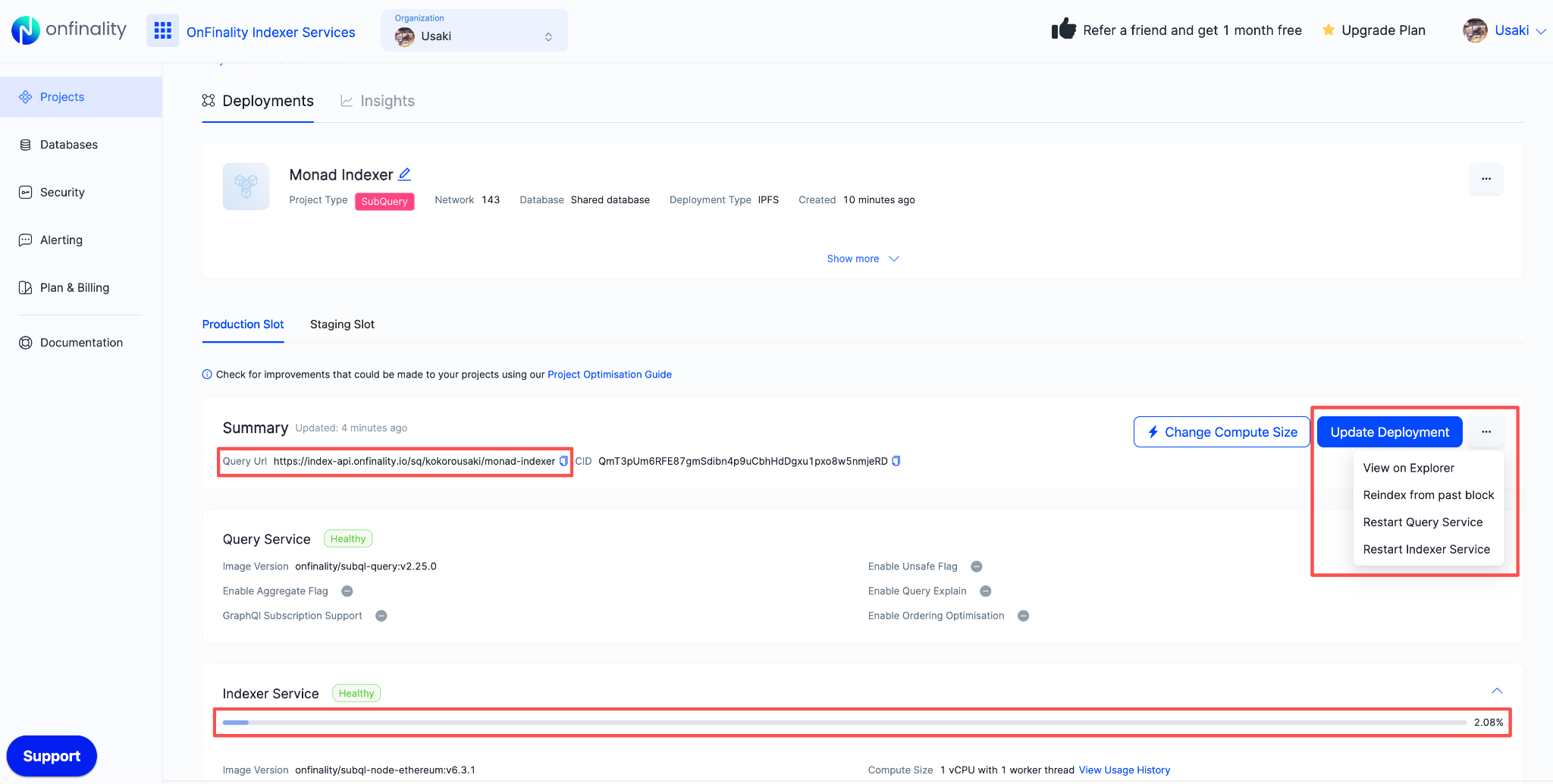
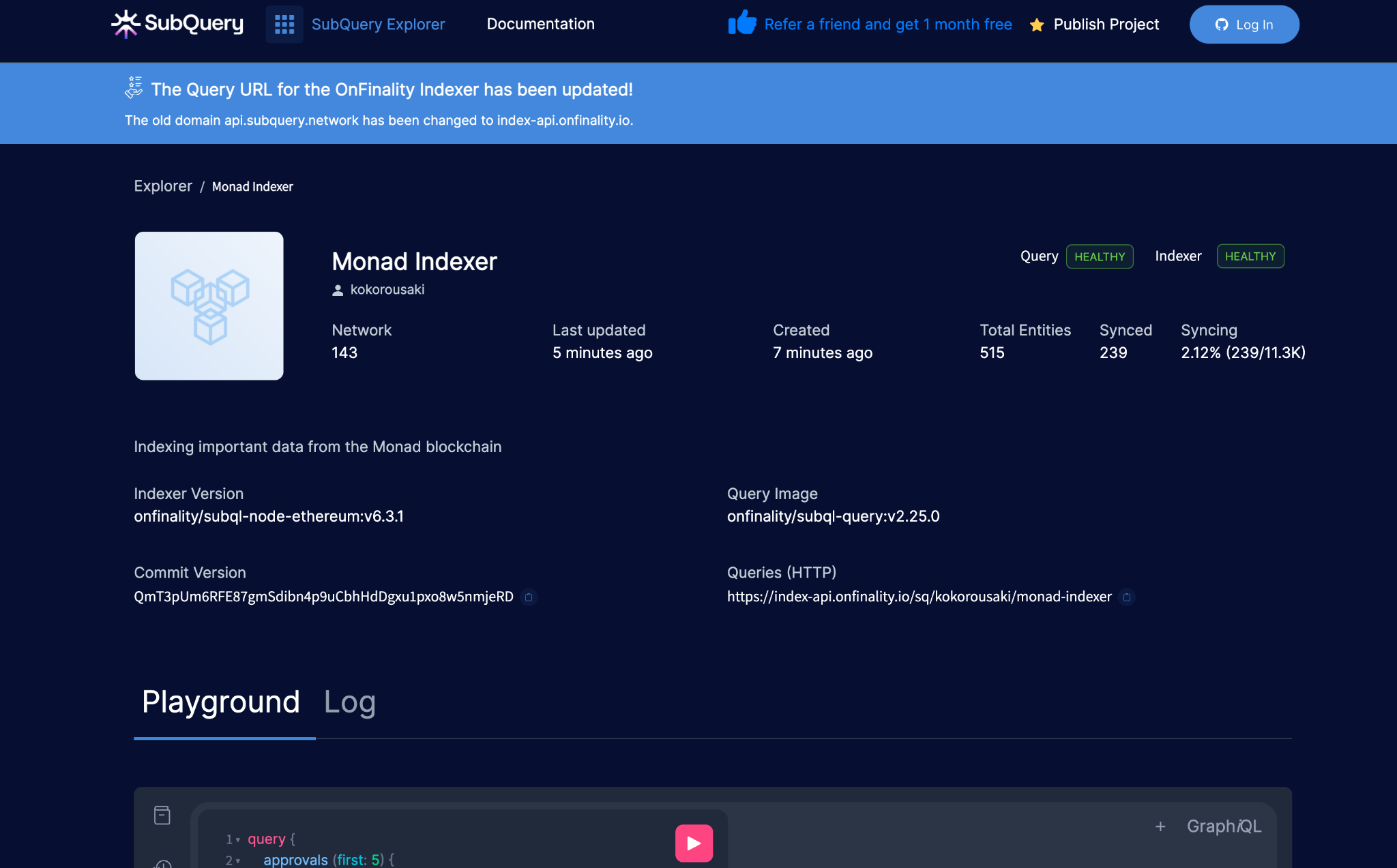
Alternatively, you can click on the three dots next to the title of your project, and view it on SubQuery Explorer. There you can use the in browser playground to get started.
Additional Resources
Getting started with Ethereum indexing is easier when you have the right tools and trusted infrastructure. For deeper insights, check out these resources:
- Monad Documentation – Official guides for Ethereum developers.
- SubQuery Academy – Tutorials on building indexers with SubQuery.
- OnFinality Docs – How to use OnFinality’s RPC and indexer services.
Common Questions about Monad Indexing
Who needs to index Monad data?
Any team building dApps, NFT platforms, or DeFi protocols on monad needs to index blockchain data to deliver fast, reliable, and structured queries for their users.
How do I build my first Monad Indexer?
The easiest way to build a Monad Indexer is with OnFinality. Start a project, define your Monad data sources, and deploy to OnFinality Indexing. Follow the official SubQuery docs for step-by-step guidance.
What is the best data indexer for Monad?
The best data indexer for Monad is SubQuery, offering flexible, high-performance indexing that integrates seamlessly with OnFinality’s enterprise-grade infrastructure.
How do I choose the right Monad RPC provider?
When selecting a Monad RPC provider, prioritize reliability, scalability, and global performance. OnFinality delivers high-performance Monad RPC nodes with worldwide coverage to support developers and enterprises alike.
Final Thoughts
Deploying a Monad Indexer doesn’t have to be complex. With OnFinality’s managed infrastructure and the power of SubQuery and The Graph, you can focus on innovating your dApp instead of dealing with indexing challenges.Whether you’re building a new DeFi protocol or scaling an enterprise-grade Web3 platform, using a trusted RPC provider and a robust SubQuery or Subgraph Indexer ensures your application is fast, resilient, and built to grow.
About OnFinality
OnFinality is a blockchain infrastructure platform that serves hundreds of billions of API requests monthly across more than 130 networks, including Avalanche, BNB Chain, Cosmos, Polkadot, Ethereum, and Polygon. It provides scalable APIs, RPC endpoints, node hosting, and indexing tools to help developers launch and grow blockchain networks efficiently. OnFinality’s mission is to make Web3 infrastructure effortless so developers can focus on building the future of decentralised applications.
App | Website | Twitter | Telegram | LinkedIn | YouTube
You May Also Like

Cathie Wood's Ark Bets Big On Solana Treasury Play: Makes $162M Investment In Brera Holdings As Stock Explodes 225%

A Reality Check Pi Holders Might Not Want to Hear
