Polymarket Teams Up With Major US Soccer League
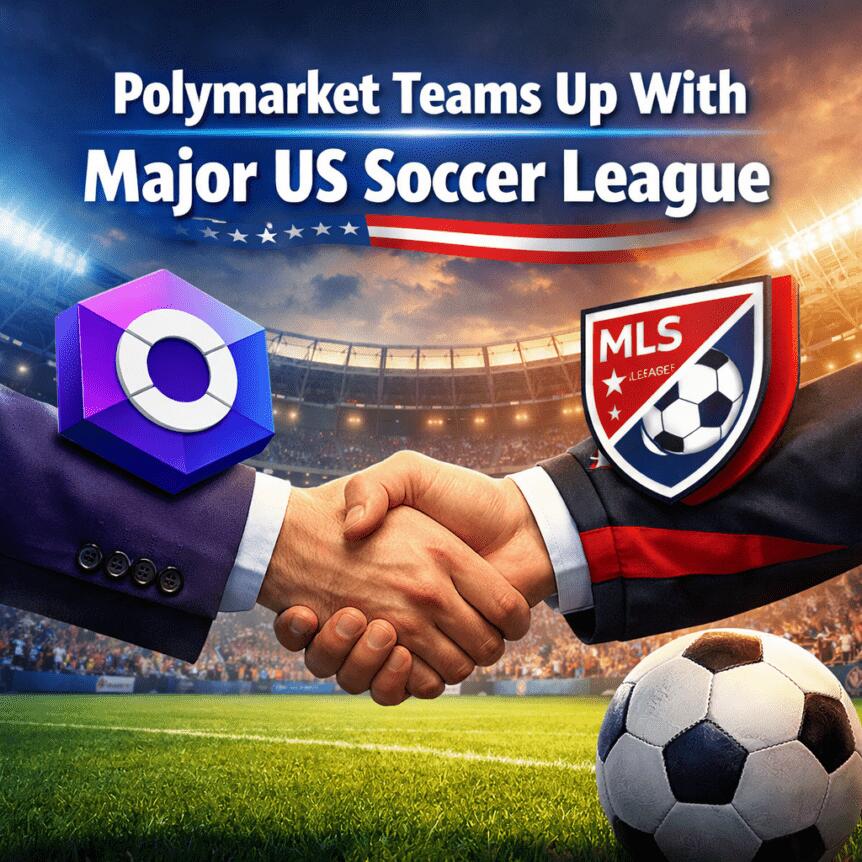
Polymarket has sealed a multi-year agreement with Major League Soccer (MLS) to serve as the league’s exclusive prediction market partner for MLS and the Leagues Cup, the league’s marquee midseason competition. The collaboration aims to blend live data, statistics, and sentiment analytics into fan experiences, delivering second-screen engagement that goes beyond traditional viewing. The deal represents a significant step in the ongoing effort to merge sports entertainment with data-driven betting features, signaling a broader push to turn match moments into interactive, real-time narratives for fans.
Key takeaways
- MLS and the Leagues Cup designate Polymarket as their exclusive prediction market partner for a multi-year period, integrating the platform into flagship league events.
- The partnership focuses on new fan experiences, including second-screen engagement that weaves data, statistics, and sentiment into live matches and season-long storylines.
- Safeguards are planned to protect match integrity, with independent monitoring of trading activities to prevent manipulation or misconduct.
- The deal comes as soccer in the United States continues to gain momentum ahead of the 2026 FIFA World Cup set to be hosted across North America and Mexico.
- Within the broader prediction-market ecosystem, the sector has seen rising volumes and regulatory activity, with notable developments around platforms such as Kalshi and Bitnomial in recent weeks.
Sentiment: Neutral
Market context: The MLS-Polymarket collaboration sits at the crossroads of live sports, data analytics, and regulated prediction markets. As soccer’s American footprint expands with events like the Leagues Cup and a forthcoming World Cup on the horizon, leagues are exploring data-rich fan experiences that can coexist with regulatory oversight and safeguards around betting markets.
Why it matters
The MLS-Polymarket deal underscores a broader trend in professional sports: the integration of prediction markets as a tool for fan engagement, sponsorship activation, and data-driven storytelling. By positioning Polymarket as the exclusive partner for MLS and Leagues Cup, the league is signaling that live events can be augmented with real-time sentiment and probability-based narratives without sacrificing the integrity of competition. For Polymarket, the partnership expands its footprint beyond apolitical markets and into a slate of high-profile league properties, aligning the platform with one of the sport’s most widely watched ecosystems in the United States.
From a consumer standpoint, the arrangement promises more interactive experiences during matches. Fans could see second-screen features that translate in-game events—such as goals, penalties, or pivotal moments—into probability shifts, consensus sentiment, and data-driven insights. The idea is to offer a more immersive way to track season-long arcs, player form, and tactical shifts, potentially turning matchdays into dynamic, narrative-driven experiences rather than discrete, isolated events.
Regulators, meanwhile, continue to weigh the expansion of prediction markets in the United States. The CFTC has signaled a willingness to enable certain market structures, as evidenced by recent no-action letters to select platforms. At the same time, several states have pursued litigation or regulatory actions related to sports-event contracts, highlighting the ongoing tension between innovation and licensing regimes. The MLS-Polymarket partnership is therefore not only a business development but also a test case for how leagues and operators can collaborate under a framework designed to preserve fairness and reduce risk.
Industry observers have noted that this moment is part of a wave of mainstream sports partnerships with data- and betting-related platforms. Earlier reporting has highlighted a broader surge in partnerships and distribution deals, with prediction-market operators exploring placements in content, search results, and other fan-facing channels. The combination of a front-office endorsement from a major league and a trusted platform in the prediction-space may help normalize these tools for a broader audience, while still requiring robust controls to ensure compliance and integrity.
Beyond soccer, the landscape for prediction markets has seen notable activity around platform volumes and regulatory signals. For example, Kalshi recently posted a record weekly volume, underscoring persistent interest in event-based contracts, even as states challenge or restrict certain kinds of wagering. Meanwhile, Bitnomial has received a no-action letter from the CFTC, indicating an avenue for crypto-derivative exchanges to operate event contracts under certain conditions. These developments, viewed in aggregate, illustrate both the opportunity and the risk embedded in expanding prediction markets within major sporting ecosystems.
The deal also coincides with a period when MLS and the Leagues Cup are leveraging data-driven approaches to deepen fan participation. As the World Cup in North America and Mexico approaches, leagues are keen to showcase how technology and data can enhance viewer engagement without compromising the integrity of the competition. The collaboration with Polymarket is a concrete example of how sports properties are experimenting with new formats that blend entertainment, statistics, and real-time probabilities into the fan experience.
What to watch next
- How MLS and Leagues Cup implement second-screen features during matches and tournament play, including the types of data dashboards and sentiment analytics that will be visible to fans.
- The evolution of Polymarket’s participation in MLS assets—whether the platform expands to additional MLS events, teams, or ancillary content beyond the Leagues Cup.
- Regulatory developments around prediction markets in key U.S. states, and how independent monitoring will be structured to safeguard competition integrity.
- The trajectory of World Cup-related fan engagement initiatives as 2026 approaches and more leagues explore data-driven experiences tied to global tournaments.
Sources & verification
- MLS press release announcing the multi-year partnership with Polymarket: https://www.mlssoccer.com/news/mls-enters-multi-year-partnership-with-polymarket
- Cointelegraph coverage of Polymarket’s ecosystem and partners, including Chainlink integrations and prediction-market dynamics: https://cointelegraph.com/news/polymarket-chainlink-partner-prediction-market-resolution-accuracy
- Token Terminal data on Kalshi’s weekly volume performance: https://tokenterminal.com/explorer/projects/kalshi?interval=365d
- CFTC no-action letter to Bitnomial enabling event contracts: https://cointelegraph.com/news/cftc-issues-no-action-letter-to-bitnomial-clearing-way-for-event-contracts
What the deal signals for the market
The MLS-Polymarket agreement adds a high-visibility case study to a growing roster of sports-business collaborations aimed at monetizing data and fan participation. For MLS, the arrangement could translate into new sponsorship opportunities, richer broadcast experiences, and the ability to capture audience sentiment metrics across leagues—assets that can be packaged for advertisers and partners. For Polymarket, aligning with a premier American sport property offers a path to broaden use cases, integrate with official content, and demonstrate use cases for predictive insights within live sports contexts.
From a market perspective, the tension between innovation and regulation remains central. While no-action letters and court actions illustrate a path for some platforms to operate, states have challenged certain sports-event contracts as unlicensed gambling. The balance between expanding consumer choice and maintaining consumer protections will continue to shape how these partnerships evolve, including the role of independent monitoring and governance to preserve integrity around prediction markets tied to major league events.
Looking ahead, investors, fans, and builders will watch how the collaboration translates into tangible fan experiences, measurable engagement, and broader adoption across sports leagues. If the model proves compelling—combining real-time data, sentiment, and interactive content with a trusted betting-context—it could catalyze further cross-sport collaborations and contribute to a more data-rich, interactive ecosystem around live sports.
https://platform.twitter.com/widgets.js
This article was originally published as Polymarket Teams Up With Major US Soccer League on Crypto Breaking News – your trusted source for crypto news, Bitcoin news, and blockchain updates.
You May Also Like

Cashing In On University Patents Means Giving Up On Our Innovation Future
Trump foe devises plan to starve him of what he 'craves' most