

Ukraine Blocks Polymarket Over ‘War Bets’ as Global Crackdown Widens
Ukraine has gone ahead to restrict entry into Polymarket, which is further escalating an expanding global crackdown on prediction markets that regulators are increasingly considering to be illegal gambling or derivatives trading.
The ruling has drawn fresh scrutiny to the fast-growing crypto platform, raising questions about whether markets tied to real-world events can operate alongside national gambling, financial, and public policy rules, especially on matters involving war and geopolitics.
The ban was issued on Dec. 10, 2025, by Ukraine’s National Commission for the Regulation of Electronic Communications under Resolution No. 695.
The order requires internet service providers to restrict access to online resources that organize, conduct, or facilitate gambling activities without a valid domestic license.
War-Linked Bets Push Ukraine to Ban Polymarket
As part of the enforcement, the domain polymarket.com was added to Ukraine’s public register of blocked websites, effectively cutting off access for users inside the country.
Local media reported the enforcement on Monday, confirming that the block is now active.
Ukrainian officials have pointed to Polymarket’s role in facilitating wagers on geopolitical outcomes linked to Russia’s invasion as a key factor behind the move.
While Polymarket does not offer fixed odds like traditional sportsbooks, regulators argue that the distinction is largely technical.
The platform allows users to buy and sell shares linked to specific outcomes, with prices reflecting the market’s implied probability.
In Ukraine’s view, this structure still constitutes gambling when offered without authorization, especially when the underlying events involve an active military conflict.
Polymarket, founded in 2020 by Shane Coplan, has grown into one of the most prominent prediction platforms globally, with an estimated valuation of around $8 billion.
All activity on the platform is conducted using the USDC stablecoin on the Polygon blockchain, making transactions and settlements publicly visible.
Supporters often point to this transparency as a key difference from offshore betting sites, but regulators across multiple jurisdictions have remained unconvinced.
Ukraine’s action places it among a growing list of jurisdictions that have restricted or fully blocked Polymarket.
The platform is currently inaccessible in at least 33 countries, including the United States, the United Kingdom, France, Germany, Italy, Poland, Singapore, Australia, Iran, and Russia.
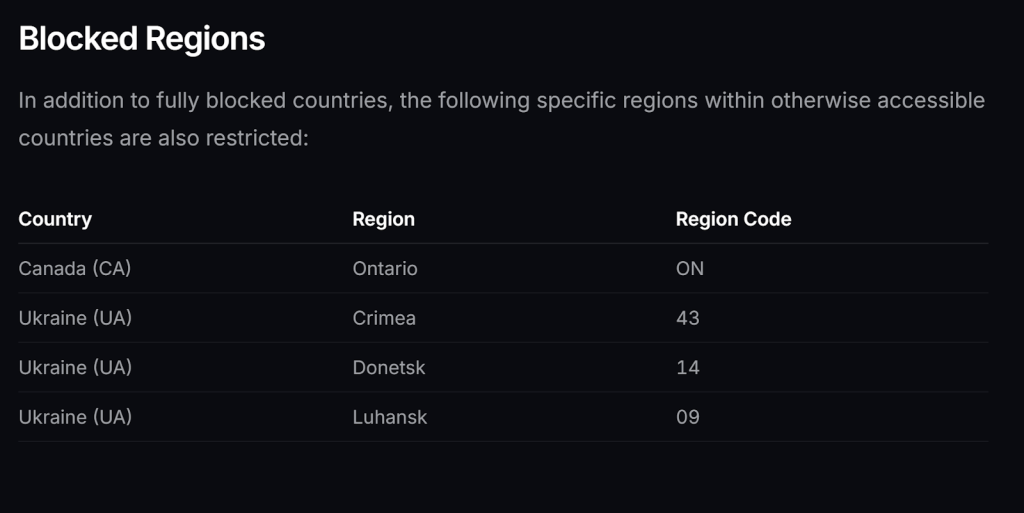 Source: Polymarket
In some regions, access is partially restricted, allowing users only to close existing positions while barring new trades.
Polymarket’s own documentation attributes these limits to a mix of international sanctions, local gambling laws, financial regulations, and anti-money laundering requirements.
Prediction Markets Face Growing Global Crackdown
The Ukrainian block also reflects a broader global push to rein in prediction markets as their reach and influence expand. In the United States, scrutiny has intensified in recent weeks.
On Jan. 9, the Tennessee Sports Wagering Council issued cease-and-desist letters to Polymarket, Kalshi, and Crypto.com.
Regulators accused the platforms of operating unlicensed sports wagering products in violation of state law, despite their registration with the Commodity Futures Trading Commission as designated contract markets.
At the federal level, concerns have extended beyond licensing into questions of public integrity. On Jan. 6, New York Representative Ritchie Torres announced plans to introduce the Public Integrity in Financial Prediction Markets Act of 2026.
The enforcement actions come at a time when Polymarket is attempting to reestablish a foothold in the U.S. market.
After exiting the country in 2022 and paying a $1.4 million penalty to settle CFTC allegations, the platform has been testing a limited U.S. exchange following its acquisition of QCX LLC and the securing of a designated contract market license.
You May Also Like

Polygon: Bulls defend $0.10 demand zone – Can POL rally 15%?

Headwind Helps Best Wallet Token
