World Liberty Financial, a decentralized finance project linked to the family of U.S. President Donald Trump, has entered the crypto lending market as its USD1 World Liberty Financial, a decentralized finance project linked to the family of U.S. President Donald Trump, has entered the crypto lending market as its USD1

Trump’s World Liberty Financial Debuts Crypto Lending as USD1 Stablecoin Hits $3.5B

2026/01/13 06:05
3 min read

World Liberty Financial, a decentralized finance project linked to the family of U.S. President Donald Trump, has entered the crypto lending market as its USD1 stablecoin climbs past $3.5 billion in circulating supply.

The project launched its lending and borrowing product, World Liberty Markets, on Monday, as stated by the company announcement.

The new web-based application allows users to lend and borrow digital assets within a single on-chain marketplace built around USD1, the platform’s U.S. dollar–backed stablecoin, and its governance token, WLFI.

Users can post collateral, including Ether, a tokenized version of Bitcoin, and major stablecoins such as USDC and USDT, with the underlying infrastructure powered by Dolomite.

On-chain Lending Rebounds as World Liberty Financial Builds on USD1 Momentum

World Liberty Financial said the launch represents the second major product rollout for the project, following the introduction of USD1 last year.

The stablecoin has grown rapidly, reaching approximately $3.48 billion in market capitalization, with the entire issued supply already in circulation.
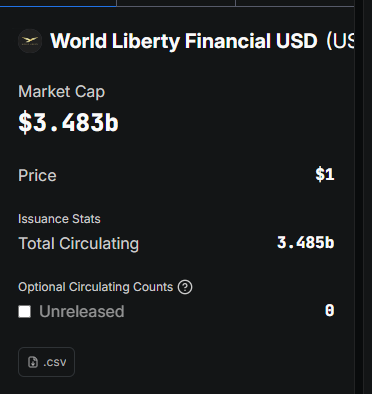
Source: defillama

USD1 maintains a $1 peg and is deployed across multiple blockchains, with the largest share on BNB Smart Chain at roughly 1.92 billion tokens, followed by Ethereum with about 1.31 billion.

Smaller but growing allocations exist on Solana, Aptos, Plume, Tron, and several newer networks.

The lending launch comes as on-chain credit has regained momentum after the collapses of several centralized lenders in the previous cycle.

Galaxy Research reported that crypto-collateralized lending reached an all-time high of $73.59 billion at the end of the third quarter of 2025, surpassing the 2021 peak.

Source: Galaxy Research

DeFi lending applications accounted for $40.99 billion of that total, capturing 55.7% of the overall lending market and growing nearly 55% quarter over quarter.

Unlike the last cycle, growth has been driven by fully collateralized loans, transparent liquidation mechanisms, and on-chain risk management.

USD1’s Role Expands Across Banking and Crypto Markets

World Liberty Financial’s move places it directly into this evolving sector, where demand for borrowing against digital assets is increasing as investors seek liquidity without selling holdings.

The company said World Liberty Markets is designed to expand the utility of USD1, allowing holders to deploy the stablecoin while accessing borrowing opportunities.

Users who supply USD1 are eligible for the project’s existing points program, which distributes rewards subject to specific terms.

The company has also launched an early-user rewards campaign, offering WLFI incentives for USD1 deposits.

The timing of the launch aligns with growing institutional and regulatory engagement around stablecoins.

Earlier this month, World Liberty Financial confirmed that its trust entity filed an application for a U.S. national banking charter with the Office of the Comptroller of the Currency.

USD1 has also gained visibility through high-profile market activity. In December, Binance rolled out a limited-time “USD1 Boost Program,” offering enhanced yields of up to 20% APR on the stablecoin through its Simple Earn products.

The promotion coincided with a sharp increase in USD1’s market capitalization and followed Binance’s decision to expand fee-free USD1 trading pairs and replace BUSD with USD1 as a primary collateral asset on the exchange.

Binance has positioned USD1 as an integral part of its collateral framework, further embedding the token into the centralized trading infrastructure.

The broader lending market has continued to evolve alongside these developments.

While centralized lenders still account for a large share of outstanding loans, Galaxy Research data shows that on-chain platforms now dominate new growth.

Source: Galaxy Research

CeFi lending reached $24.37 billion by the end of September, with Tether holding nearly 60% of the tracked market, but surviving centralized lenders have shifted to fully collateralized models and public reporting.

Market Opportunity
OFFICIAL TRUMP Logo
OFFICIAL TRUMP Price(TRUMP)
$3.528
$3.528$3.528
-1.12%
USD
OFFICIAL TRUMP (TRUMP) Live Price Chart
Disclaimer: The articles reposted on this site are sourced from public platforms and are provided for informational purposes only. They do not necessarily reflect the views of MEXC. All rights remain with the original authors. If you believe any content infringes on third-party rights, please contact [email protected] for removal. MEXC makes no guarantees regarding the accuracy, completeness, or timeliness of the content and is not responsible for any actions taken based on the information provided. The content does not constitute financial, legal, or other professional advice, nor should it be considered a recommendation or endorsement by MEXC.

You May Also Like

Cashing In On University Patents Means Giving Up On Our Innovation Future

Cashing In On University Patents Means Giving Up On Our Innovation Future

The post Cashing In On University Patents Means Giving Up On Our Innovation Future appeared on BitcoinEthereumNews.com. “It’s a raid on American innovation that would deliver pennies to the Treasury while kneecapping the very engine of our economic and medical progress,” writes Pipes. Getty Images Washington is addicted to taxing success. Now, Commerce Secretary Howard Lutnick is floating a plan to skim half the patent earnings from inventions developed at universities with federal funding. It’s being sold as a way to shore up programs like Social Security. In reality, it’s a raid on American innovation that would deliver pennies to the Treasury while kneecapping the very engine of our economic and medical progress. Yes, taxpayer dollars support early-stage research. But the real payoff comes later—in the jobs created, cures discovered, and industries launched when universities and private industry turn those discoveries into real products. By comparison, the sums at stake in patent licensing are trivial. Universities collectively earn only about $3.6 billion annually in patent income—less than the federal government spends on Social Security in a single day. Even confiscating half would barely register against a $6 trillion federal budget. And yet the damage from such a policy would be anything but trivial. The true return on taxpayer investment isn’t in licensing checks sent to Washington, but in the downstream economic activity that federally supported research unleashes. Thanks to the bipartisan Bayh-Dole Act of 1980, universities and private industry have powerful incentives to translate early-stage discoveries into real-world products. Before Bayh-Dole, the government hoarded patents from federally funded research, and fewer than 5% were ever licensed. Once universities could own and license their own inventions, innovation exploded. The result has been one of the best returns on investment in government history. Since 1996, university research has added nearly $2 trillion to U.S. industrial output, supported 6.5 million jobs, and launched more than 19,000 startups. Those companies pay…
Share
BitcoinEthereumNews2025/09/18 03:26
Here’s How Consumers May Benefit From Lower Interest Rates

Here’s How Consumers May Benefit From Lower Interest Rates

The post Here’s How Consumers May Benefit From Lower Interest Rates appeared on BitcoinEthereumNews.com. Topline The Federal Reserve on Wednesday opted to ease interest rates for the first time in months, leading the way for potentially lower mortgage rates, bond yields and a likely boost to cryptocurrency over the coming weeks. Average long-term mortgage rates dropped to their lowest levels in months ahead of the central bank’s policy shift. Copyright{2018} The Associated Press. All rights reserved. Key Facts The central bank’s policymaking panel voted this week to lower interest rates, which have sat between 4.25% and 4.5% since December, to a new range of 4% and 4.25%. How Will Lower Interest Rates Impact Mortgage Rates? Mortgage rates tend to fall before and during a period of interest rate cuts: The average 30-year fixed-rate mortgage dropped to 6.35% from 6.5% last week, the lowest level since October 2024, mortgage buyer Freddie Mac reported. Borrowing costs on 15-year fixed-rate mortgages also dropped to 5.5% from 5.6% as they neared the year-ago rate of 5.27%. When the Federal Reserve lowered the funds rate to between 0% and 0.25% during the pandemic, 30-year mortgage rates hit record lows between 2.7% and 3% by the end of 2020, according to data published by Freddie Mac. Consumers who refinanced their mortgages in 2020 saved about $5.3 billion annually as rates dropped, according to the Consumer Financial Protection Bureau. Similarly, mortgage rates spiked around 7% as interest rates were hiked in 2022 and 2023, though mortgage rates appeared to react within weeks of the Fed opting to cut or raise rates. How Do Treasury Bonds Respond To Lower Interest Rates? Long-term Treasury yields are more directly influenced by interest rates, as lower rates tend to result in lower yields. When the Fed pushed rates to near zero during the pandemic, 10-year Treasury yields fell to an all-time low of 0.5%. As…
Share
BitcoinEthereumNews2025/09/18 05:59
Spur Protocol Daily Quiz 21 February 2026: Claim Free Tokens and Boost Your Crypto Wallet

Spur Protocol Daily Quiz 21 February 2026: Claim Free Tokens and Boost Your Crypto Wallet

Spur Protocol Daily Quiz February 21 2026: Today’s Correct Answer and How to Earn Free In-App Tokens The Spur Protocol Daily Quiz for February 21, 2026, is
Share
Hokanews2026/02/21 17:10