

Data Signals Bitcoin Has Traded in Bear Territory Since Late 2025
This article was first published on The Bit Journal.
Bitcoin bear market signals are reshaping crypto debate in a quieter way than past cycles. There is no panic or sudden collapse. Instead, long-term data is raising concerns that Bitcoin may already be in a corrective phase much earlier than many investors expected.
Several on-chain and technical indicators turned bearish late last year and have yet to recover. According to CryptoQuant’s head of research, Julio Moreno, multiple metrics shifted into bearish territory in early November, suggesting Bitcoin may already be about two months into a bear market despite relatively stable price action.
This view challenges the idea that Bitcoin remains firmly in a growth phase and highlights how modern market cycles are unfolding differently from earlier ones.
Long-Term Metrics Are Flashing Early Warnings
The clearest evidence for a Bitcoin bear market is coming from long-term indicators rather than short-term price moves. Analysts often look to the one-year moving average to filter out market noise. When Bitcoin trades below this level for extended periods, momentum has historically weakened instead of recovering.
CryptoQuant’s head of research, Julio Moreno, sees this sustained move below the one-year average as the final technical confirmation of a bear market. His view is supported by CryptoQuant’s Bull Score Index, which tracks market health through activity, investor behavior, demand, and liquidity. The index turned bearish in early November and has remained weak, pointing to a prolonged cooling phase rather than a temporary dip.
Another key signal is realized price, which reflects the average cost at which Bitcoin was acquired. In past downturns, price has often drifted back toward this level before forming a more stable base. Together, these indicators suggest the market is consolidating, not simply pulling back.
Bitcoin Price Action Adds Context
The latest price action continues to validate the bearish narrative on Bitcoin. Verified market data indicates that Bitcoin price started 2025 at around $93,000, passed above $126,000 in October and ended the year lower than it had begun. Such reversals more often than not mark the end of expansion waves in history.
As of early January, live market data shows the Bitcoin price trading near $88,000. Based on historical drawdowns and realized price models, analysts estimate a possible bottom between $56,000 and $60,000 within the following year.
If reached, this would represent a 55 percent decline from the all-time high, notably smaller than in past bear markets.
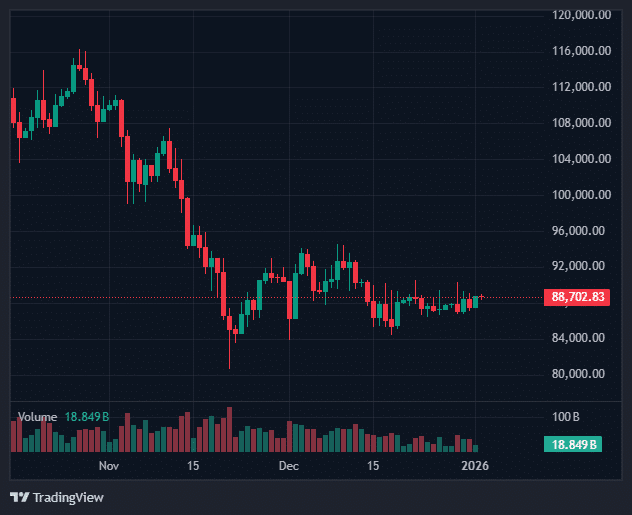 Source: CoinMarketCap
Why This Bitcoin Bear Market Looks Different
This Bitcoin bear market lacks the chaos seen in earlier downturns. Major industry failures and forced liquidations amplified previous cycles. In contrast, the current phase shows no comparable systemic collapses.
One reason is the evolving demand structure. Institutional investors now hold a larger share of circulating supply and tend to accumulate periodically rather than react emotionally. This behavior has helped keep the Bitcoin price more stable despite weakening momentum.
What This Means For 2026 Expectations
Many forecasts still frame 2026 as a strong growth year. The Bitcoin bear market thesis complicates that view. Historically, recoveries begin only after prolonged consolidation near realized price levels.
For financial students, analysts, and developers, this phase offers a clear lesson in how market structure reshapes familiar cycles. Patience, not timing, may matter most.
Conclusion
The current Bitcoin bear market is unfolding quietly, guided by data rather than drama. Long-term indicators point to ongoing consolidation, while the Bitcoin price reflects growing restraint.
With stronger foundations and steadier demand, this cycle may be less destructive, but no less critical. Understanding it now can shape smarter decisions later.
Glossary of Key Terms
Bitcoin Bear Market: A sustained period of declining or stagnant Bitcoin prices.
Realized Price: The average acquisition price of all existing Bitcoin.
One-Year Moving Average: A long-term indicator used to identify trend direction.
Market Cycle: Repeating phases of growth, peak, decline, and recovery.
FAQs About Bitcoin Bear Market
Is Bitcoin currently in a bear market?
Several long-term indicators suggest conditions consistent with a Bitcoin bear market.
At what point can Bitcoin expect to find a base?
Analysts consensually predict a range between $56,000 and $60,000.
In what way is that the difference between this bear market and previous bear markets?
Institutional demand and fewer systemic failures help smooth out the wild gyrations.
Does this change the ultimate outlook for Bitcoin?
The answer is no. Over time, bear markets frequently clear the air, paving the way for future growth.
Sources
FinanceYahoo
CryptoQuant
CoinMarketCap
Read More: Data Signals Bitcoin Has Traded in Bear Territory Since Late 2025">Data Signals Bitcoin Has Traded in Bear Territory Since Late 2025
You May Also Like

Thank you for your trust, let’s embark on a new journey together

Vitalik Buterin Reveals Ethereum’s Long-Term Focus on Quantum Resistance
