What Could Be the Federal Reserve’s Impact on the Crypto Market in 2026?
The crypto market has entered a cautious consolidation phase just as the Federal Reserve prepares for one of its most politically charged transitions in decades. Jerome Powell’s term as Fed Chair ends in May 2026, and President Donald Trump is already positioning allies for key board seats. This shift could redefine the monetary tone of the next cycle — and with it, the trajectory of risk assets like crypto.
Reading the Chart: Calm Before the Policy Storm
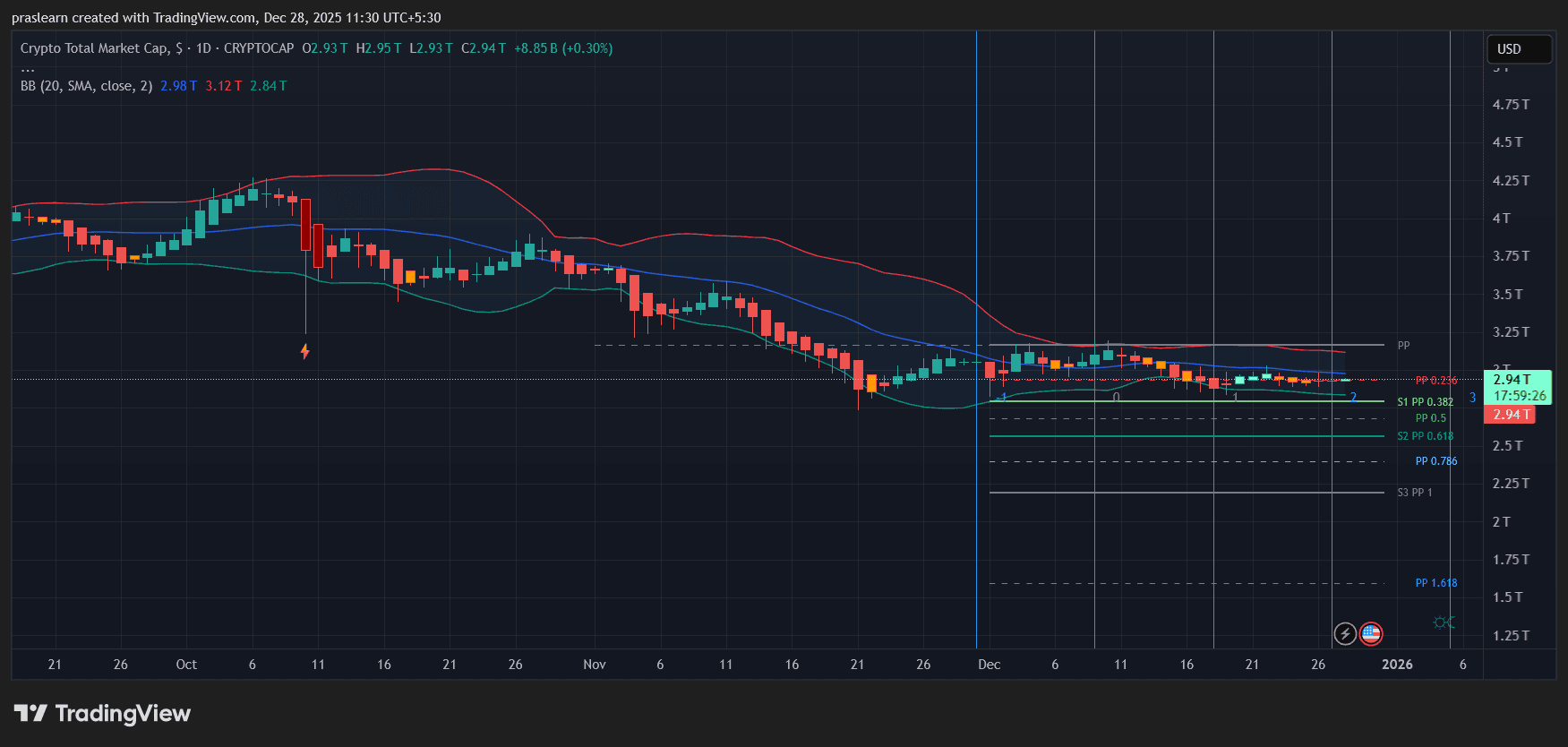 Total Crypto Market: TradingView
Historically, crypto market thrives in liquidity-rich environments. Bitcoin’s bull runs in 2017, 2021, and mid-2024 were all underpinned by dovish Fed conditions or balance sheet expansion. As the chart shows, the total crypto market cap is now hovering around $2.94 trillion, with volatility squeezed inside the Bollinger Bands and price action sliding just below the 20-day moving average (blue line). Traders appear to be in a wait-and-see mode, reflecting macro uncertainty more than sector-specific weakness.
The Bollinger Bands have tightened considerably — a classic sign of impending volatility. The upper band sits around $3.12T, while the lower support hovers near $2.84T, creating a narrow trading corridor. This compression suggests that markets are anticipating a breakout but lack a clear catalyst in the short term.
Momentum indicators point to declining selling pressure but no confirmed reversal yet. The market’s failed attempts to reclaim the mid-band resistance since early December indicate fading confidence. If the Fed signals early rate cuts or a more accommodative tone, a move above $3.0T–$3.1T could trigger a renewed bull leg targeting $3.25T–$3.5T. Conversely, if hawkish rhetoric resurfaces, we may see a retest of $2.8T, followed by deeper liquidity sweeps toward $2.5T (the 0.618 Fibonacci zone).
Political Influence Meets Monetary Policy
While Trump’s new Fed appointments might lean toward rate cuts, the institutional inertia of the central bank remains strong. Economists from Morgan Stanley and Wells Fargo expect the Fed’s policy framework to remain largely intact through 2026–2027, even with leadership turnover. That means no abrupt U-turn in rate policy — just a gradual easing, likely tied to inflation cooling and employment stability.
Still, markets trade on expectations, not realities. If investors believe Trump’s new appointees will prioritize growth over inflation control, risk appetite could surge prematurely — igniting a speculative wave across crypto assets, especially Bitcoin and Ethereum, as traders price in cheaper capital and weaker USD outlooks.
The Macro-Crypto Connection in 2026
Crypto’s correlation with U.S. monetary policy has tightened since 2022. The chart’s muted price action since November aligns with broader dollar resilience and real yields staying positive. As yields begin to compress in mid-2026 — a probable outcome under a more dovish Fed — capital could rotate back into risk assets. In such a case, stablecoins, DeFi tokens, and large-cap altcoins might see inflows similar to the 2020–2021 liquidity cycle.
Meanwhile, the psychological barrier at $3 trillion remains crucial. A confirmed close above that mark, with expanding volume, would signal market readiness for another leg higher. Below $2.8T, however, sentiment could flip, pushing total market capitalization toward the $2.5T–$2.6T support cluster, where long-term buyers may re-enter.
What This Means for Traders and Investors
The 2026 Fed transition introduces both policy risk and opportunity. If Jerome Powell’s successor prioritizes growth and lowers rates faster than expected, crypto could front-run traditional markets, sparking an early rally. But if the Fed’s continuity narrative holds, expect sideways accumulation well into Q2 2026.
For now, traders should watch for a volatility breakout from the current Bollinger squeeze. Positioning ahead of the February–May policy window could be key. The broader takeaway? The crypto market is coiling for a macro-driven move, and the next Fed chair may decide its direction more than any halving or ETF approval.
Forecast: Crypto Market Scenarios for 2026
- Bullish Case: Dovish Fed transition triggers liquidity rebound → Total market cap breaks $3.2T, targets $3.8T by late 2026.
- Base Case: Gradual easing with steady inflation → Range-bound between $2.7T and $3.2T until Q3 2026.
- Bearish Case: Inflation resurgence or policy conflict → Retest of $2.5T before recovery in 2027.
The chart’s compression and muted volatility mirror investor hesitation ahead of a potentially seismic shift in Fed leadership. Whether Trump’s influence accelerates rate cuts or not, the next twelve months will determine whether crypto’s consolidation morphs into expansion — or deeper correction. The market’s next breakout won’t be technical alone; it’ll be political.
You May Also Like

Michael Burry bets billions that AI bubble will burst
Ripple Gears Up for Public Debut as 2026 IPO Speculation Surges