Brian Armstrong, the co-founder and chief executive of Coinbase, has drawn a firm line against any attempt to reopen the GENIUS Act. The law set the first federalBrian Armstrong, the co-founder and chief executive of Coinbase, has drawn a firm line against any attempt to reopen the GENIUS Act. The law set the first federal

Coinbase CEO Pushes Back as Banks Seek to Reopen the GENIUS Act

Brian Armstrong, the co-founder and chief executive of Coinbase, has drawn a firm line against any attempt to reopen the GENIUS Act. The law set the first federal framework for stablecoins after months of negotiation. Armstrong has framed the renewed push to revise it as a direct challenge to competition in U.S. financial markets. 

He has argued that the debate no longer centers on safety. Instead, it reflects a struggle over who controls access to yield in a modern payments system. Consequently, the next phase of the fight could shape how innovation survives inside U.S. regulation.

Coinbase Pushes Back on Renewed Lobbying

Armstrong has said Coinbase will oppose any effort to reopen the GENIUS Act. He views the law as settled policy. Besides that, he has stressed that reopening compromises legislative credibility. 

Lawmakers already agreed that stablecoin issuers cannot pay interest directly. However, platforms and third parties can still offer rewards. That compromise balanced innovation with oversight. Hence, changing it now risks tilting the field toward entrenched players.

He has also warned that repeated lobbying campaigns weaken trust in rulemaking. According to Armstrong, reopening settled frameworks invites incumbents to delay competition through political pressure. 

Moreover, he has linked this pattern to broader fintech concerns. Other technology firms watch closely to see whether U.S. legislation holds after passage.

Banking Economics Under Scrutiny

Max Avery, a board member at Digital Ascension Group, has added economic context to the debate. He has pointed out that banks currently earn about 4.4% on reserves held at the Federal Reserve. In contrast, many savings accounts still pay roughly 0.01%. Additionally, he has argued that this spread explains resistance to stablecoin rewards.

Banks typically take deposits and place them at the Federal Reserve. They earn more than 4% in interest. Consequently, customers receive minimal returns. Avery has noted that stablecoin platforms attempt to share part of this yield with users. 

That effort now faces political resistance. Significantly, independent research has shown no evidence of unusual deposit losses at community banks.

What Lawmakers and Markets May Watch

Armstrong and Avery have both urged attention to how amendments take shape. Broad bans on rewards could restrict competition without improving safety. Moreover, scrutiny may fall on who funds campaigns framed as community bank protection. In many cases, large institutions benefit most.

The debate also raises questions about consistency in policymaking. Few lawmakers have pressed banks on stagnant savings rates over the past 15 years. 

Meanwhile, stablecoins face heightened concern over modest rewards. Consequently, the outcome may signal whether U.S. policy favors competitive payments infrastructure or protected banking margins.

Over the next six months, the GENIUS Act could become a test case. Its fate may influence how innovation, yield, and consumer choice evolve in the United States.

Market Opportunity
Talisman Logo
Talisman Price(SEEK)
$0.09145
$0.09145$0.09145
+0.46%
USD
Talisman (SEEK) Live Price Chart
Disclaimer: The articles reposted on this site are sourced from public platforms and are provided for informational purposes only. They do not necessarily reflect the views of MEXC. All rights remain with the original authors. If you believe any content infringes on third-party rights, please contact [email protected] for removal. MEXC makes no guarantees regarding the accuracy, completeness, or timeliness of the content and is not responsible for any actions taken based on the information provided. The content does not constitute financial, legal, or other professional advice, nor should it be considered a recommendation or endorsement by MEXC.

You May Also Like

IP Hits $11.75, HYPE Climbs to $55, BlockDAG Surpasses Both with $407M Presale Surge!

IP Hits $11.75, HYPE Climbs to $55, BlockDAG Surpasses Both with $407M Presale Surge!

The post IP Hits $11.75, HYPE Climbs to $55, BlockDAG Surpasses Both with $407M Presale Surge! appeared on BitcoinEthereumNews.com. Crypto News 17 September 2025 | 18:00 Discover why BlockDAG’s upcoming Awakening Testnet launch makes it the best crypto to buy today as Story (IP) price jumps to $11.75 and Hyperliquid hits new highs. Recent crypto market numbers show strength but also some limits. The Story (IP) price jump has been sharp, fueled by big buybacks and speculation, yet critics point out that revenue still lags far behind its valuation. The Hyperliquid (HYPE) price looks solid around the mid-$50s after a new all-time high, but questions remain about sustainability once the hype around USDH proposals cools down. So the obvious question is: why chase coins that are either stretched thin or at risk of retracing when you could back a network that’s already proving itself on the ground? That’s where BlockDAG comes in. While other chains are stuck dealing with validator congestion or outages, BlockDAG’s upcoming Awakening Testnet will be stress-testing its EVM-compatible smart chain with real miners before listing. For anyone looking for the best crypto coin to buy, the choice between waiting on fixes or joining live progress feels like an easy one. BlockDAG: Smart Chain Running Before Launch Ethereum continues to wrestle with gas congestion, and Solana is still known for network freezes, yet BlockDAG is already showing a different picture. Its upcoming Awakening Testnet, set to launch on September 25, isn’t just a demo; it’s a live rollout where the chain’s base protocols are being stress-tested with miners connected globally. EVM compatibility is active, account abstraction is built in, and tools like updated vesting contracts and Stratum integration are already functional. Instead of waiting for fixes like other networks, BlockDAG is proving its infrastructure in real time. What makes this even more important is that the technology is operational before the coin even hits exchanges. That…
Share
BitcoinEthereumNews2025/09/18 00:32
Landmark Crypto Bills Drive 2025 Regulatory Shift as Congress Signals Commitment to Digital Asset Growth
Landmark Crypto Bills Drive 2025 Regulatory Shift as Congress Signals Commitment to Digital Asset Growth

The post Landmark Crypto Bills Drive 2025 Regulatory Shift as Congress Signals Commitment to Digital Asset Growth appeared on BitcoinEthereumNews.com. U.S. crypto
Share
BitcoinEthereumNews2025/12/28 08:34
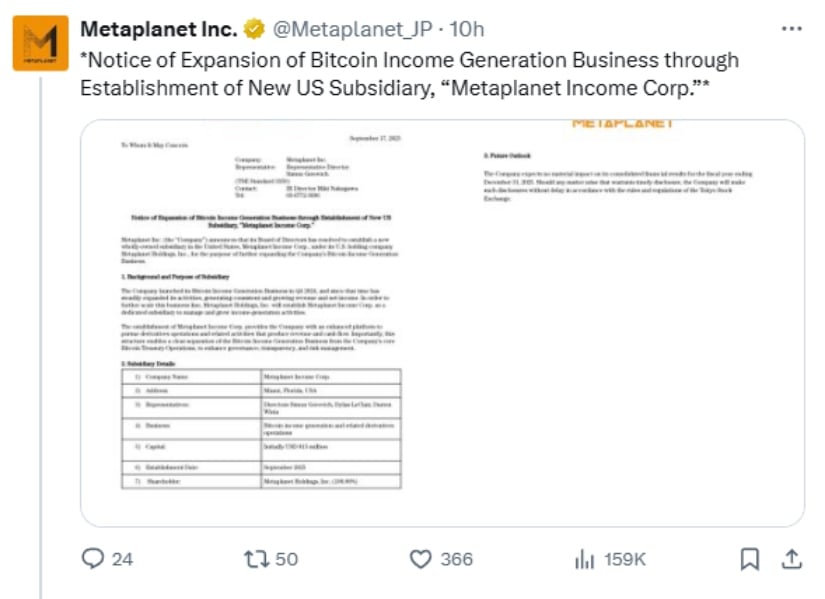
Japanese Bitcoin Giant Metaplanet Raises $1.4 Billion to Enter U.S. Market

Japanese Bitcoin Giant Metaplanet Raises $1.4 Billion to Enter U.S. Market

Metaplanet, Japan's largest corporate Bitcoin holder, has completed a massive $1.4 billion fundraising round and launched new subsidiaries in Miami and Tokyo. The Tokyo-listed company more than doubled its initial fundraising target, attracting major institutional investors including sovereign wealth funds.
Share
Brave Newcoin2025/09/18 05:15