Governing and Scaling AI Agents: Operational Excellence and the Road Ahead
:::info This is the fifth and final article in our series on agentic AI in the enterprise. In the earlier parts, we covered what agentic AI is (Part 1), the maturity phases of adoption (Part 2), the seven pillars of agent architecture (Part 3), and deployment patterns vs. pitfalls (Part 4). Now, we turn to how you operationalise and scale these AI agents in a responsible way. This part discusses establishing the right metrics and “AgentOps” practices, managing tools and platforms, adapting organisational culture and roles, and preparing for what’s next - from emerging regulations to future competitive dynamics. We’ll wrap up by summarising the journey and offering a call-to-action for enterprise leaders venturing into agentic AI.
:::
\ 
\ By the time you’re putting AI agents into production and expanding their use, success becomes less about building the agent (you’ve done that) and more about governing and managing it over its lifecycle. It’s similar to how DevOps emerged once software deployment scaled: here we need “AgentOps” or “MLOps” disciplines to ensure our AI agents keep delivering value day in, day out. Let’s break down a few key aspects: metrics to measure an agent’s impact, the evolving tooling/vendor landscape that can support you, the cultural and organisational shifts needed, and some thoughts on future-proofing your strategy as agentic AI continues to evolve.
\
Metrics for Measuring Impact
“When introducing AI agents, defining metrics is crucial, otherwise how do you know if it’s actually working?”
\ This was a hard lesson I learned early on. It’s easy to get wowed by a demo, but enterprises run on results, not cool tech. We found it useful to track metrics across several dimensions to paint a holistic picture of an agent’s impact: operational performance, business impact, compliance/risk, and user adoption. Here are some key metrics (by category) that we recommend:
-
Operational Metrics: These tell you how well the agent is performing its task on a technical and service level. Examples include accuracy or success rate (what percentage of tasks does the agent complete correctly without human intervention?), average handling time (how fast does the agent resolve an issue vs. a human), and throughput (tasks completed per hour). If the agent interacts with end users, measure user satisfaction (e.g. CSAT scores or feedback ratings for those interactions). Also track utilisation: how often is the agent being triggered or used? For instance, after deploying an agent for software testing, we measured that it automatically caught and fixed about 30% of bugs, which was a clear operational win, tracked release-over-release. Operational metrics often form the early success criteria in pilot phases (e.g. “achieve at least X% accuracy within Y months”).
-
Economic Metrics (ROI): Ultimately, you need to justify the project in business terms. Track how the agent is affecting the bottom line or key business KPIs. This can include direct cost savings (e.g. reduction in support labour hours: “the agent saved 200 hours of Tier-1 support work this month”), revenue impact (e.g. the agent’s upsell suggestions added £50k in sales last quarter), or efficiency gains in process metrics (like a higher conversion rate, or reduced downtime due to faster incident response). Also account for the cost of the agent itself, including ongoing cloud compute costs, maintenance effort, etc. One project of ours calculated that an AI agent reduced average QA cycle time by 30%, translating to an estimated £250k per year in saved engineering hours. But we also monitored that as usage grew, the agent’s API costs were climbing; this went into an ROI dashboard to ensure the value far outpaced the spend. Many organisations set up an “AI ROI” dashboard for leadership, showing running totals of benefits versus costs. Nothing quiets sceptics like hard numbers showing a positive payoff.
-
Compliance & Risk Metrics: Especially in regulated industries, you should measure things related to safety, compliance, and risk reduction. This might include the number of incidents or errors the agent prevented (“the agent caught 5 potential fraud cases that slipped past manual checks”), or conversely any compliance issues caused by the agent (hopefully zero, but if an agent made a decision that violated a policy, you need to log that and investigate). If you have human review steps, track how often humans override or correct the agent. A high override rate might indicate the agent is doing things people aren’t comfortable with - a risk signal that either the agent is making dubious choices or users don’t trust it yet. Another useful metric is time to detect and resolve agent issues (analogous to MTTR in incident management): if something goes wrong with the agent, how quickly do you notice and fix it? Some companies even conduct regular compliance audits of their AI systems; the findings can be distilled into metrics. For example, “Last quarter’s audit found 0 instances of personal data leakage by the agent” or “100% of high-value transactions handled by the agent were logged and reviewed with no discrepancies found.” These reassure management (and regulators) that the AI is under control.
-
Organisational (Adoption) Metrics: Finally, gauge the human side: are people actually using the agent and integrating it into their work? Metrics here could include adoption rates (e.g. what percentage of customer inquiries are now handled by the agent vs. humans - and is that trending up or flat?), or user sentiment surveys (do employees find the agent helpful? do customers feel their issue was well-handled by the AI?). You might measure the number of new ideas or requests for AI agents coming from the business, e.g. “after our pilot, 5 other departments requested their own AI agent within 3 months,” which is a nice indicator of organisational buy-in. Another angle: how roles are changing. If the agent takes over task X, are the employees who used to do X now moving to higher-value work? That can be captured via qualitative manager feedback or time-allocation studies. The ultimate adoption metric is a bit fuzzy but revealing: when people start saying things like “Let’s have the agent handle this,” as a normal part of conversation, you know it’s become a trusted part of operations.
\
By monitoring a balanced scorecard of these metrics, you can ensure the AI agent initiative stays on track and delivers sustainable value. Metrics help you catch issues early (for example, a drop in accuracy or a spike in human overrides might signal model drift or a new type of query the agent can’t handle well). Metrics also provide the evidence needed to secure continued support and budget - nothing builds confidence like a steadily improving dashboard. As a practitioner, I recommend defining a handful of metrics in each category before you deploy the agent (so you have a baseline), and then iterating on them as you learn what really matters. This discipline not only demonstrates value; it often guides you to improve the agent itself. For instance, we noticed from metrics that a certain type of query always led to a human fallback, that pointed us to a capability the agent lacked, which we then added. In sum: measure, measure, measure. Agentic AI should ultimately drive measurable improvement; if it’s not, you need to regroup and find out why.
\
Tooling and Vendor Landscape
The rise of agentic AI hasn’t gone unnoticed by the tech industry. In fact, it’s spurred a boom in tools and platforms to help build and manage these systems. A year or two ago, many of us were cobbling together open-source libraries and custom code; now, every major cloud provider and a swarm of startups are offering solutions for enterprise AI agents. It’s both a blessing (more choice, faster development) and a curse (lots of hype, risk of lock-in). Let’s sketch a neutral overview of the landscape so you know what’s out there and what trade-offs to consider:
Cloud AI Platforms (Hyperscalers): The big cloud providers (AWS, Microsoft, Google, IBM, Oracle, etc.) have all thrown their hats in the ring with enterprise AI agent offerings. For example, AWS has expanded its Amazon Bedrock service to include Bedrock Agents, which provide templates for building multi-step agents with tool integrations and an orchestration layer, all running on AWS’s managed infrastructure (https://aws.amazon.com/bedrock/agents/). Microsoft has built out the Copilot ecosystem across its products and introduced Copilot Studio, effectively a platform for businesses to create and manage their own AI copilots or agents that plug into Microsoft 365 and other systems (https://www.microsoft.com/en-us/microsoft-365-copilot/microsoft-copilot-studio). Google added an Agent Builder in its Vertex AI platform, complete with pre-built connectors and an Agent API, and even introduced open frameworks like A2A (described above) to foster multi-agent interoperability. IBM launched watsonx Orchestrate, geared towards automating business workflows by orchestrating multiple AI and RPA components - IBM’s spin on agentic AI for enterprise processes (https://www.ibm.com/products/watsonx-orchestrate). Other players like Oracle and SAP are embedding agent-like automation features in their cloud apps as well.
· Pros: Faster time-to-market (since you can leverage pre-built components), and a lot of heavy lifting (scaling, security, model hosting) is handled for you. It can be easier to integrate with other services in that cloud’s ecosystem (e.g. using AWS Lambda, Azure Functions, etc. alongside the agent).
· Cons: Potential vendor lock-in or limitations - you often have to work within their ecosystem and accept their guardrails and pricing. Also, not all features may meet your specific needs, so assess carefully. Many savvy teams use these as accelerators for prototypes or initial deployments, but also plan for how to remain flexible.
\ Open-Source Frameworks: The open-source community has been very active in agentic AI, and these frameworks often set the pace of innovation. LangChain is a popular library that provides a modular way to chain LLM calls, integrate tools, and manage conversational agent state - a lot of early agent experiments were built on LangChain. We also saw the likes of AutoGPT (one of the first autonomous GPT-based agent demos) spawn many variants and inspire features in more robust tools. Haystack (from deepset) focuses on question-answering agents with knowledge bases, but it includes components useful for building agents that do retrieval and take actions. There are visual builder tools like Flowise, Dust, etc., for constructing agent workflows with minimal coding.
· Pros: Flexibility and community-driven improvements. You can see the code, customise it to fit your needs, and avoid license costs. There’s a rich ecosystem of plugins and integrations contributed by developers worldwide.
· Cons: You’re on the hook for maintaining it, ensuring security, and scaling it in production. Many enterprises mitigate this by pairing open-source components with their own internal tooling or cloud infrastructure to harden them. In practice, a hybrid approach is common: e.g. using LangChain within an Azure OpenAI deployment, or using AWS’s orchestration while still writing custom logic with open libraries.
\ Startups and Niche Players: Alongside the giants, a wave of startups is pushing the boundaries with specialised solutions. These range from developer-focused platforms to domain-specific AI agents. For example, a startup has been working on a general-purpose agent that can perform software actions by observing and imitating how humans use applications (essentially training an agent to use software via the UI). Another startup might focus on agents that learn business processes by observing human workers, aiming for easy automation of tasks. We’re also seeing companies building agent ops and evaluation tools, essentially the “DevOps for AI” toolkits that help test, monitor, and manage AI agents in production. Others specialise in AI security - offering products that provide additional guardrails for LLMs to prevent things like prompt injection or data leakage.
· Pros: These smaller players often innovate faster and target specific pain points - you might find a solution that exactly fits your need (say, an agent specialised in financial compliance workflows). They can also be more flexible in integration.
· Cons: Not all will survive long-term, and some might not scale to enterprise requirements. There’s a due diligence burden: you have to vet them for security, reliability, and support. A pragmatic approach some take is to pilot with a startup’s solution to see if it solves the problem, but architect things in a way that you could swap it out if needed (avoiding deep coupling).
\ In summary, the vendor/tool landscape is rich and evolving rapidly. There’s no one-size-fits-all answer - the right choice depends on factors like your existing tech stack, the importance of on-premise or data locality, your team’s expertise, and how cutting-edge (versus risk-averse) your organisation is. My advice is to be strategically eclectic: don’t blindly commit to a single vendor’s full stack if you can avoid it. Instead, evaluate best-of-breed components for each of the architecture pillars. Insist on interoperability - favour tools that support open standards or at least export/import options for data and models, so you’re not boxed in if you need to change direction later. The good news is that competition is driving the big providers to keep adding features and improving (for example, in mid-2025 we saw Microsoft, AWS, and Google all roll out new agent management consoles and integration hubs within months of each other). Use that to your advantage in negotiations and planning.
\ Finally, remember: the fanciest platform won’t rescue a project with a poor problem definition or weak execution. Technology is an enabler, not a saviour. The fundamentals we discussed: clear objectives, strong architecture, governance, etc. - still determine success more than any specific tool. Choose tools that align with those fundamentals and that fit your constraints.
\
Cultural and Organisational Shifts
Deploying autonomous agents isn’t just a technical endeavour, it’s an organisational transformation. To truly harness agentic AI, companies often need to adapt roles, develop new skills, and instil new ways of working. This human side of the equation can be the hardest, but it’s absolutely crucial for long-term success. Here are some key people-and-process shifts we’ve observed as agentic AI takes hold:
New Roles and Skills: Just as the DevOps movement created roles like Site Reliability Engineer (SRE), the rise of AI agents is spawning its own roles. We’re already seeing job titles such as Prompt Engineer, AI Ethicist, AI Ops Specialist, or Knowledge Engineer popping up. In my teams, we upskilled some of our business analysts to become what I call “AI co-pilots” - people who deeply understand the workflow and can work with the agent, tuning its prompts or providing feedback on its output. We also found it valuable to have a Product Manager for the AI agent, someone responsible for the agent’s performance, user experience, and improvement roadmap, akin to a product owner.
\ Organisations might consider forming an AI Centre of Excellence (CoE) or similar, which brings together these skills and serves as a hub of expertise. The CoE can set standards, share best practices, and help business units deploy agents more consistently. Importantly, IT teams will need training on the specific platforms and frameworks chosen, e.g. if you use Azure OpenAI, ensure your engineers know how to deploy and secure models; if you use an open-source library, share tips and gotchas for using it properly. By investing in talent (training existing staff, hiring specialists, or partnering with consultants where needed), you build an internal competency that will pay dividends as AI adoption grows. As one CIO told me, “We want AI owners, not just AI users, in our organisation”, meaning people who deeply understand how the AI works and can continuously adapt and improve it, rather than treating it as a black box.
\ Leadership and Culture: Leadership has to set the tone that AI is a strategic priority, and also manage the anxieties that come with it. Successful organisations have top executives openly champion AI initiatives, not just by funding them, but by communicating their importance and framing them positively to the workforce. For example, the CEO of an insurance company we worked with sent a company-wide note about their new underwriting AI agent, emphasising that it’s there to assist underwriters, not replace them, and committing to reskill employees to work alongside AI. That kind of top-down reassurance and clarity is crucial to prevent rumours and resistance on the ground.
\ Culturally, teams must shift to a mindset of human-AI collaboration. This means training employees to see the agent as part of the team. We updated standard operating procedures (SOPs) to include how to interact with the AI agent or what to do if the agent flags an issue. We encouraged a “trust, but verify” approach - treat the AI like a junior colleague whose work you double-check, rather than either blindly trusting it or rejecting it outright. Also, it’s important to celebrate human+AI wins. When an employee using the agent achieves something great (like resolving a problem much faster), call that out and give credit to both the person and the technology. It reinforces that working with AI is an asset, not a threat.
\ We also created feedback loops from users back to the AI development team, for instance, a Slack channel where anyone could post “The agent gave a weird answer on this case” or “Wish the agent could also do X.” This gave users a voice in improving the agent and made them feel part of its evolution, rather than having a tool imposed on them. The more you can involve people and make the AI project a collaborative effort, the more goodwill you build.
\ Trust and Accountability: Trust is the currency of adoption. Users need to trust the agent to actually use it, and management needs to trust it to allow it to scale to more critical tasks. Building trust starts with transparency. As we discussed under governance, having logs and the ability to explain an agent’s actions helps demystify it. In one case, we provided department heads a simple weekly report: “Here’s what the agent did this week, here were the outcomes, here’s where it needed help.” Over time, as that report consistently showed positive results and honest accounting of any hiccups, trust grew.
\ Another tactic: gradual autonomy. Don’t give an agent full control overnight: start it in advisory mode, then partial automation, then full automation in a limited domain. By the time it’s fully autonomous, people have seen it perform and are comfortable. It’s analogous to onboarding a new employee: you wouldn’t let a new hire make major decisions on day one without oversight; an AI agent shouldn’t be different.
\ Also establish clear accountability frameworks: decide ahead of time how you’ll handle it if the agent makes a mistake. For instance, if an AI agent sends a wrong email to a client or makes a bad call in a process, who takes responsibility? Usually it will be the business owner or team that deployed the agent, but spelling this out avoids panic and finger-pointing when something does go wrong. We found that having a defined fallback or incident response plan actually boosted confidence too, e.g. knowing that “if the agent is unsure, it automatically flags a human, and if it ever crashes, it pages the on-call engineer” reassured everyone that we weren’t leaving things purely to chance.
\ Interestingly, sometimes showing the limitations of the agent can build trust. We made it a point to clearly state what the AI will not do or is not allowed to do. By setting those boundaries (for example: “The agent will never approve a payment over £1000; that will always go to a manager”), people felt more comfortable because they knew the AI’s scope and that critical stuff was safeguarded.
\ In summary, preparing your people and processes is as important as preparing the technology. The organisations that get the most out of agentic AI are usually those that evolve their operating model alongside the tech deployment. New tech + old org model = limited value; new tech + new org mindset = transformation.
\ We’ve seen companies create internal “AI Guilds” or working groups for employees interested in AI to share experiences and tips. Others have updated job descriptions to include working with AI tools as a competency. Some have redesigned teams, for example, appointing an “AI Controller” in a department who is responsible for monitoring the agents day-to-day. These changes can sound minor, but they add up to an enterprise that’s AI-ready, not just AI-curious.
\
Future Predictions and Next Steps
\ Looking forward, what does the future hold for agentic AI in the enterprise? Based on current trends, here are a few predictions and insights about where things are headed, and what that means for those of us implementing these technologies:
Agent Sprawl (and the Need to Tame It): As adoption expands, there’s a real possibility of “agent sprawl”: dozens or even hundreds of AI agents popping up across different teams and functions. On one hand, that could be a sign of healthy uptake and innovation; on the other, it raises management headaches. How do you ensure all these agents are following governance rules? How do you avoid duplicate efforts (two teams building similar agents because they didn’t coordinate)? We might see the emergence of internal AI “app stores” or registries where approved agents are catalogued for reuse, and management consoles to monitor all agents centrally. Enterprises will likely need to establish guardrails to prevent everyone from just spinning up their own rogue agents (the AI equivalent of shadow IT). I suspect that within a year or two, companies with heavy AI use will introduce formal policies around agent development and deployment: not to stifle innovation, but to ensure security, compliance, and efficiency. Scaling from 5 agents to 50 might be technically easy with cloud infrastructure, but managing that sprawl will require process and oversight. The winners will be those who get ahead of this with good internal governance, avoiding a chaotic Wild West of AI in their org.
\ Regulation on the Horizon: Governments and regulators are waking up to AI’s implications, especially for autonomous decision systems. We should expect increasing regulation of AI systems that operate with a degree of autonomy. The EU’s forthcoming AI Act, for example, is poised to classify certain AI applications, likely including autonomous decision-making systems in areas like finance, HR, or customer service, as “high-risk.” This will impose requirements like transparency, human oversight, record-keeping, and accountability measures for those systems (https://commission.europa.eu/news-and-media/news/ai-act-enters-force-2024-08-01_en). Other regions and industries will have their own rules: for instance, the US FTC has been warning against “unfair or deceptive” AI practices, and sector-specific regulators (in healthcare, banking, etc.) are issuing AI governance guidelines. For enterprise teams, this means we’ll need to build compliance into our AI projects. Features we might have considered optional could become mandatory: think explainability modules, audit logs, bias testing, opt-out mechanisms for users, and so on. My prediction: within 2-3 years, any company deploying AI agents in a core business process will need some form of “AI accountability report” on file. This would document how the agent works, what data it uses, how you mitigate risks, and what results it’s getting (very much like how you’d validate a human-driven process but with extra emphasis on algorithmic fairness and safety). We might even see requirements to notify authorities or get certification for certain AI systems (for example, an autonomous credit underwriting agent might need regulatory approval). While it’s hard to know exactly how laws will shape up, it’s wise to design with the assumption that you’ll need to prove your agent is safe and fair. Getting ahead by implementing the governance practices we discussed will put you in a good position to meet compliance when the time comes.
\ Competitive Advantage: AI Haves vs Have-Nots: We’re likely to witness a growing gap between organisations that leverage agentic AI effectively and those that don’t. Just as with past tech waves (think e-commerce in the 2000s, or cloud computing in the 2010s), the early adopters who get it right could significantly outperform those who lag behind. An autonomous agent, when used well, can dramatically increase the speed and scale at which a company operates. That can translate to taking market share or delivering services at much lower cost. For example, imagine two logistics companies: one uses AI agents to dynamically reroute shipments, handle delays, and optimise loads in real time without human intervention; the other relies on manual dispatchers. The former will likely have better on-time performance and cost per delivery, giving it an edge that compounds over time. We’re already seeing hints of this competitive divide in sectors like finance (some firms have AI doing trading or compliance checks at speeds and volumes impossible for humans) and customer service (some companies can handle customer queries instantly and around the clock with AI, while others make you wait till Monday 9am for a response). The point is, agentic AI will become a standard part of the enterprise toolkit, and those who master it early will gain an innovation advantage. Conversely, those who ignore it risk being outpaced or disrupted by more AI-native competitors. That said, it’s not about rushing in blindly, the advantage comes from doing it well, not just doing it first. But certainly, every forward-looking enterprise should have autonomous agents on its strategic roadmap, if not in active pilots already.
\ Evolving Technology (Smarter Agents): On a more optimistic note, the technology itself is improving rapidly. Many of today’s limitations (like LLMs sometimes “hallucinating” facts, or agents struggling with long-term memory) are actively being worked on by researchers and companies. We can expect next-generation foundation models with better reasoning abilities, perhaps even some built-in planning or tool-use capabilities. There are also efforts to make AI outputs more controllable (so you can set firm boundaries on what an agent will or won’t do). Tools for interpretability and debugging of AI decisions will get better, which will make it easier to trust and verify what agents are doing. There’s the prospect of agents that can learn continuously on the job: right now, most enterprise agents are fixed once deployed (aside from occasional retraining), but future ones might update themselves from new data and feedback in near-real-time (under proper governance, of course). That could reduce the maintenance burden and improve performance over time automatically.
\ On the flip side, more powerful agents mean bigger consequences if they go wrong, so everything we discussed about governance and oversight becomes even more critical. I also foresee a wave of “AI agent management” products focused on safekeeping - akin to how we have antivirus and firewalls for traditional IT, we might get monitoring tools specifically designed to watch AI agent behaviour and flag or even automatically stop errant actions. The emergence of industry standards (like A2A for interoperability, or maybe auditability standards) will also make it easier to adopt agents widely.
\ If I project, say, 5 years out, I imagine many companies will have a sort of AI agent platform that is as commonplace as their CRM or ERP. This platform would host myriad agents, monitor them, enforce policies, and facilitate continuous improvement - much of it automated. The concept of “AI workers” or “digital colleagues” will be normalised. We might even see them formally accounted for in organisation charts or team meetings (“We have 5 human analysts and 2 AI agents working on this project”). All that paints a picture of huge potential upside: efficiency, new capabilities, maybe even new business models that weren’t possible without AI agents.
\ In the near term, expect a lot of experimentation and learning across industries. There will be big wins, and there will be high-profile failures (which we’ll all learn from, perhaps more from the failures!). I suspect standard practices will start to emerge once enough companies have gone through the cycle. Possibly even industry-specific agent solutions, like pre-trained finance agents or healthcare agents that come with relevant knowledge and compliance guardrails out of the box, will become available. We may also see more collaboration between companies on AI safety and standards (since a disaster for one could spur regulation for all, there’s an incentive to share best practices on the non-competitive aspects like safety).
\
Final Thoughts and Call to Action
Bringing it all together, agentic AI is here to stay, and its footprint in enterprises will only grow. But as we’ve discussed throughout this series, the journey is an iterative one (a marathon, not a sprint) and it requires as much emphasis on people and process as on algorithms and code. Those who combine vision (imagining new ways to leverage autonomous agents) with pragmatism (managing the risks and building stepwise) will shape the next era of business.
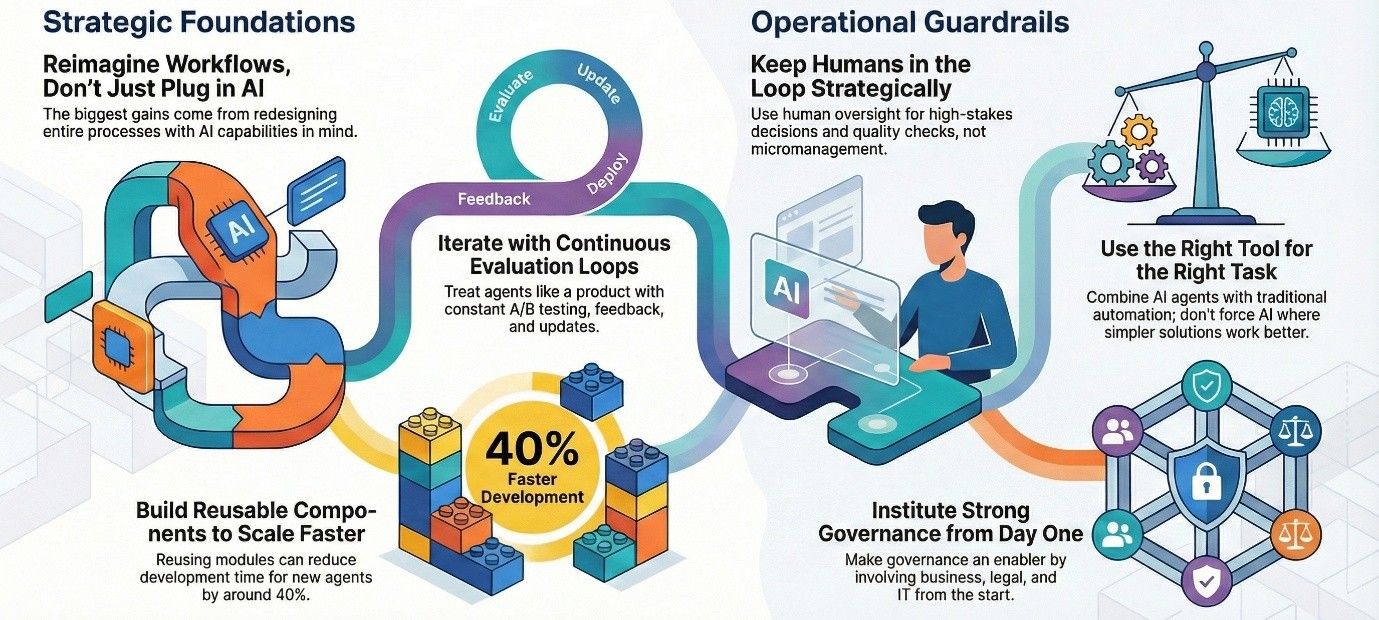
\ If you’re an enterprise leader or practitioner, what should you do Monday morning? Here’s a quick playbook distilled from everything we’ve covered:
-
Redesign Workflows, Not Just Technology: Don’t just drop an AI agent into an existing process and expect magic. The biggest gains come when you reimagine the workflow with the agent in mind. Simplify or change human procedures alongside introducing the AI. Treat it as an opportunity to streamline the whole operation, not just plug in a fancy tool. Agents that look impressive but don’t actually improve how work gets done will fizzle out. Aim for process improvement + AI, not AI slapped onto a broken process.
-
Use the Right Tool for the Right Task: Agentic AI is not a hammer for every nail. Successful solutions often mix approaches. Maybe an AI agent handles the unstructured, complex parts of a task, but a simple deterministic program handles the rest. Don’t force AI into areas where a straightforward software or rules-based solution would do better. Evaluate each step of a workflow: if it requires heavy judgement or pattern recognition, AI might help; if it’s formulaic or mission-critical to get exactly right every time, a conventional system might be safer. Often a hybrid approach: AI for what it does best, traditional automation for the rest - yields the best results.
-
Iterate with Evaluation Loops: Treat your agent as a product that’s never finished. The top performers set up continuous evaluation and improvement cycles. This means A/B testing changes, regularly feeding failure cases back into model training or prompt tweaking, and having a cadence for model updates. Implement the ability to track every decision the agent makes and review it (those logs are gold mines for debugging and improvement). Some firms, as mentioned, even have an “AI audit log” reviewed periodically by QA or audit teams. The mindset should be Agile: frequent iterations, feedback-driven tweaks, and incremental expansion of the agent’s capabilities. This not only improves performance but keeps stakeholders engaged as they see constant progress.
-
Build Modular, Reusable Components: Don’t reinvent the wheel for each new agent or use case. Aim to build modules and a common platform that can be reused. For example, if in Part 3 you developed a robust natural language parsing module or a connector to your SAP system for one agent, package it so other teams can reuse it for their agents. Consider creating a library of “agent skills” (reusable action integrations like sending an email, querying a DB, etc.) that all your agents can call. In practice, companies that adopt a platform mindset see huge efficiency gains. One bank reported that by reusing components, they reduced development time by ~40% for each subsequent agent. Also, maintain shared knowledge bases where possible instead of silos per agent (with proper context separation). Reusability is a force multiplier for scaling AI solutions across the enterprise.
-
Keep Humans in the Loop (Strategically): Autonomy doesn’t mean no human involvement; it means humans focus their involvement where it matters most. Define clearly where human oversight or input is needed for your agents. Is it final approval on high-stakes decisions? Is it periodic quality spot-checks of the agent’s outputs? Plan these checkpoints deliberately. They act as safety nets while the agent earns trust. The trick is to avoid unnecessary micromanagement: humans should supervise, not redo the work. Over time, as the agent consistently proves itself, you can dial back some checkpoints (e.g. move from 100% review to sample audits). Also plan for new roles: you might need an “AI Controller” or agent supervisor as discussed, and you should train users on how to handle exceptions the agent flags. Human-AI partnership tends to yield better outcomes than either alone, and it helps culturally too - people see that the AI isn’t a black box running wild; there’s a human-centric safety net ensuring everything stays on track.
-
Institute Strong Governance from Day One: We’ve hit this point repeatedly because it’s crucial. Set up an AI governance framework at project inception, not as an afterthought. This includes forming a multi-disciplinary team or committee (IT, business, legal, compliance, security) to oversee the project, establishing guidelines for ethical use and risk assessment, and defining escalation paths if something goes wrong. Develop AI use policies, e.g. who can build or deploy an agent, what data can be used, levels of human oversight required for certain tasks, etc. Consider investing in tools for bias monitoring, model validation, and so on as they become available. Governance might sound like bureaucracy, but done well it’s an enabler of innovation, not a roadblock. The key is to make governance a partner in innovation: involve the risk folks early so they help shape a solution that can pass muster, rather than swooping in at the end to block something. A little time spent on guardrails and guidelines up front can save a lot of pain later, and will make scaling to multiple agents much smoother.
\
Following this playbook creates the conditions for agentic AI to flourish in your enterprise. The overarching theme is balance: be ambitious in leveraging AI, but stay grounded in business reality and risk management. If you redesign workflows, pick the right tool for each task, iterate constantly, reuse what you can, keep humans appropriately in the loop, and govern strongly, you are stacking the deck for success.
\ As a practitioner, I’ve learned to approach agentic AI with twin mindsets: optimism that it can solve problems and unlock value we couldn’t before, and pragmatism that it requires discipline, hard work, and sometimes saying “no” to unrealistic ideas. With that balanced approach, the results I’ve seen are truly transformative, not in a sci-fi “AI runs the company” way, but in tangible improvements: projects that used to take months get done in weeks, insights that were buried in data are surfaced daily, employees are freed from drudgery to focus on creative and strategic work, and customers get faster, smarter service. Those wins build on each other and create momentum.
\ The field of agentic AI is evolving fast. The next year will surely bring new breakthroughs and, no doubt, new cautionary tales. But armed with the insights we’ve discussed, from architectural pillars to cultural change, you should be well-equipped to navigate this journey. The companies that get it right will not only avoid the pitfalls; they’ll create new operating models that define the next competitive frontier.
\ Agentic AI is a tool, a very powerful one. Its value ultimately depends on how well we wield it. My hope is that with the lessons from early adopters in hand, you can wield it wisely to truly transform how your organisation works, for the better.
\
\

You May Also Like

Palmeiras Defeats River Plate In Epic Copa Libertadores Clash

Tether Targeting 150 New Hires in Major Expansion Push; LiquidChain Presale Gains Momentum