

Solana price prints failed auction: Could a rally to $144 be next?
Solana price prints a failed auction below $121 and quickly reclaims value, signaling seller exhaustion and opening the door for a potential rotation toward $144 resistance.
- Failed auction forms below $121 with a rapid reclaim.
- Price reclaims the Value Area High, signaling acceptance.
- Upside rotation toward $144 resistance becomes likely.
Solana (SOL) price is showing early bullish signals after printing a failed auction below $121, a development that often marks exhaustion of selling pressure. The swift reclaim above this level suggests that the market was unable to find acceptance at lower prices, indicating a lack of committed sellers.
With price now trading back above key value levels, the structure points to a possible upside continuation toward higher resistance zones.
Solana price key technical points
- Failed auction forms below $121, signaling downside rejection.
- Price reclaims the Value Area High, confirming acceptance back into higher value.
- Upside rotation toward $144 becomes viable, completing a full auction cycle.
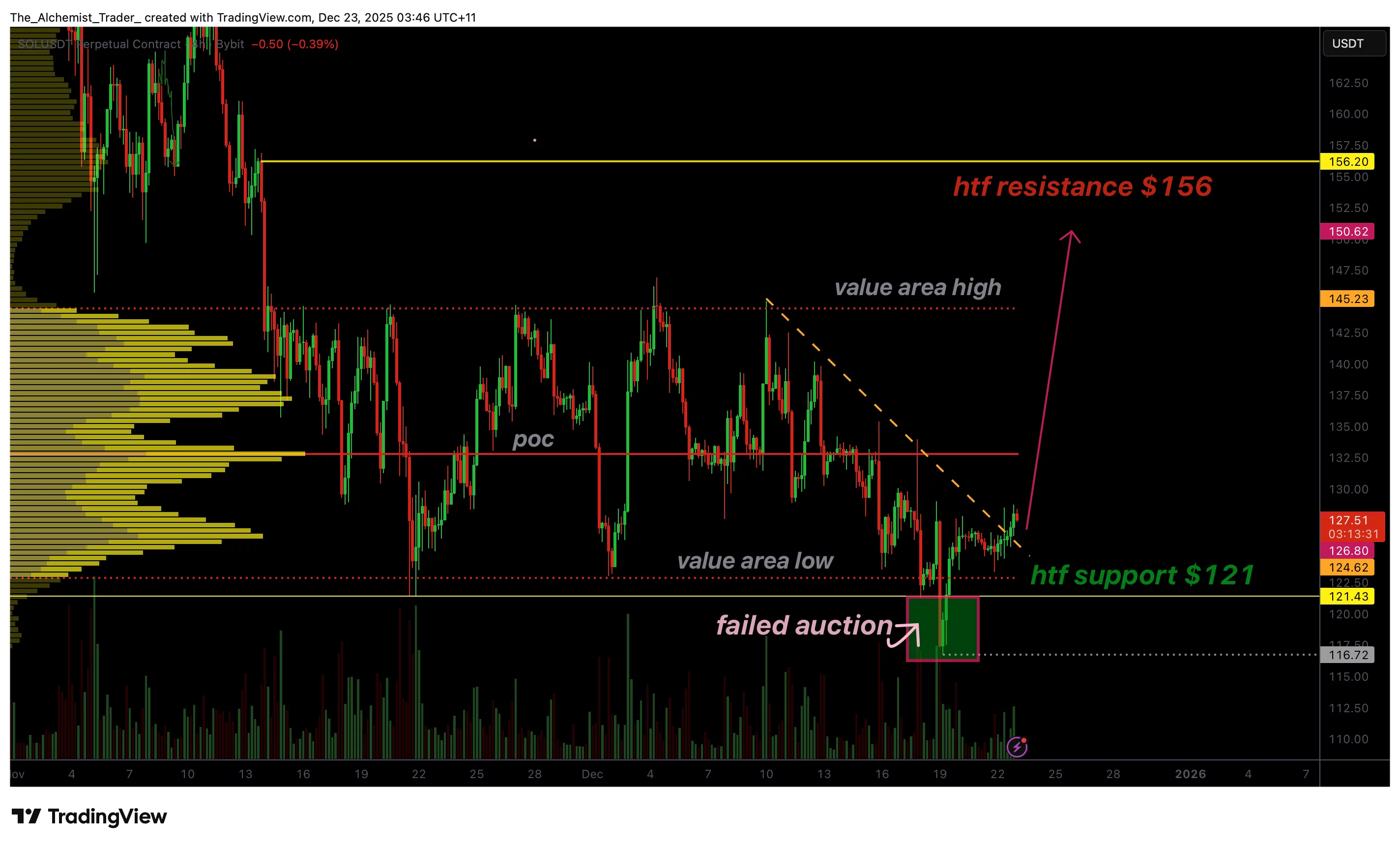
A failed auction occurs when price briefly breaks below a key level, triggers liquidity, and then quickly reclaims that level without follow-through. In Solana’s case, the price dipped below $121 but failed to sustain a trade below it. Instead, buyers stepped in aggressively, forcing prices back higher and invalidating the breakdown.
This behavior suggests that the ability to sell interest at lower prices was limited. When markets attempt to move lower but fail to attract sellers, it often signals downside exhaustion. Rather than discovering new value below support, price is forced to rotate back upward in search of liquidity and balance.
The bullish implications of this failed auction were further reinforced when Solana closed back above the Value Area High (VAH). Acceptance above the VAH is a critical confirmation signal in market auction theory, as it indicates that the price is no longer accepted at a lower value and is instead transitioning back toward a higher value.
From a market-structure perspective, this reclaim shifts short-term control back toward buyers. While Solana remains within a broader range, the failed auction changes the immediate bias from defensive to constructive. Markets that reclaim value after failed breakdowns often continue rotating higher until the next area of supply is tested.
That next major area sits near $144, which represents a high-time-frame resistance and aligns with the upper boundary of the value area. A move toward this level would complete a full market auction rotation from the Value Area Low to the Value Area High, a common outcome following failed auctions.
Importantly, the $144 level is not arbitrary. It has previously served as a rejection zone where selling pressure has emerged, making it a natural upside target. If Solana reaches this region, it would confirm that the market has successfully transitioned from lower-value acceptance back to higher-value exploration.
From a price-action standpoint, the speed of the reclaim is a key factor. Failed auctions that resolve quickly tend to be more reliable than slow, grinding recoveries. The rapid reclaim above $121 and subsequent acceptance above the value suggest buyer urgency rather than passive short-covering.
Volume behavior also supports the bullish thesis. Failed auctions are most effective when followed by expanding participation as price moves back into value. Continued volume support would increase the probability that the rotation toward $144 can play out without premature rejection, a setup that aligns with Bitwise’s view that rising ETF demand could push Bitcoin, Ethereum, and Solana toward new highs by 2026.
What to expect in the coming price action
As long as Solana holds above the reclaimed value area and maintains acceptance above $121, the probability of a rotation toward the $144 resistance remains elevated. A move into this region would complete a full auction cycle, while failure to hold value would signal continued range-bound conditions.
You May Also Like

The Channel Factories We’ve Been Waiting For

Nasdaq-listed iPower reaches $30 million convertible note financing agreement to launch DAT strategy.
