Explores MaGGIe's architecture, featuring mask guidance embeddings, progressive refinement (PRM), and bidirectional matte fusion for consistent video results.Explores MaGGIe's architecture, featuring mask guidance embeddings, progressive refinement (PRM), and bidirectional matte fusion for consistent video results.

MaGGIe Architecture Deep Dive: Mask Guidance and Sparse Refinement

Abstract and 1. Introduction

  1. Related Works

  2. MaGGIe

    3.1. Efficient Masked Guided Instance Matting

    3.2. Feature-Matte Temporal Consistency

  3. Instance Matting Datasets

    4.1. Image Instance Matting and 4.2. Video Instance Matting

  4. Experiments

    5.1. Pre-training on image data

    5.2. Training on video data

  5. Discussion and References

\ Supplementary Material

  1. Architecture details

  2. Image matting

    8.1. Dataset generation and preparation

    8.2. Training details

    8.3. Quantitative details

    8.4. More qualitative results on natural images

  3. Video matting

    9.1. Dataset generation

    9.2. Training details

    9.3. Quantitative details

    9.4. More qualitative results

7. Architecture details

This section delves into the architectural nuances of our framework, providing a more detailed exposition of components briefly mentioned in the main paper. These insights are crucial for a comprehensive understanding of the underlying mechanisms of our approach.

7.1. Mask guidance identity embedding

7.2. Feature extractor

\ Figure 7. Converting Dense-Image to Sparse-Instance Features. We transform the dense image features into sparse, instance-specific features with the help of instance tokens.
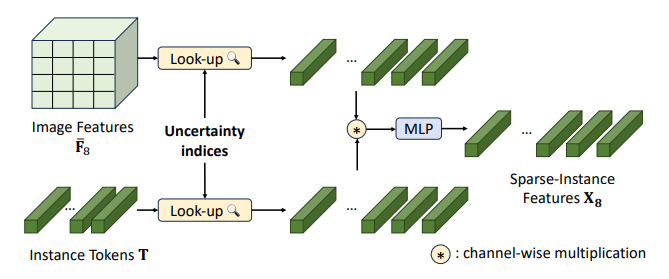
7.3. Dense-image to sparse-instance features

7.4. Detail aggregation

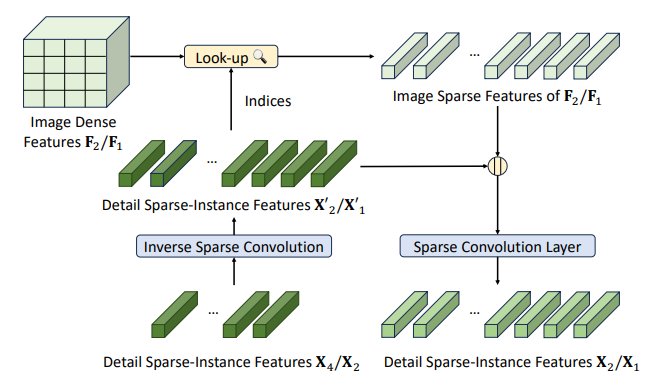
This process, akin to a U-net decoder, aggregates features from different scales, as detailed in Fig. 8. It involves upscaling sparse features and merging them with corresponding higher-scale features. However, this requires precomputed downscale indices from dummy sparse convolutions on the full input image.

7.5. Sparse matte head

Our matte head design, inspired by MGM [56], comprises two sparse convolutions with intermediate normalization and activation (Leaky ReLU) layers. The final output undergoes sigmoid activation for the final prediction. Non-refined locations in the dense prediction are assigned a value of zero.

7.6. Sparse progressive refinement

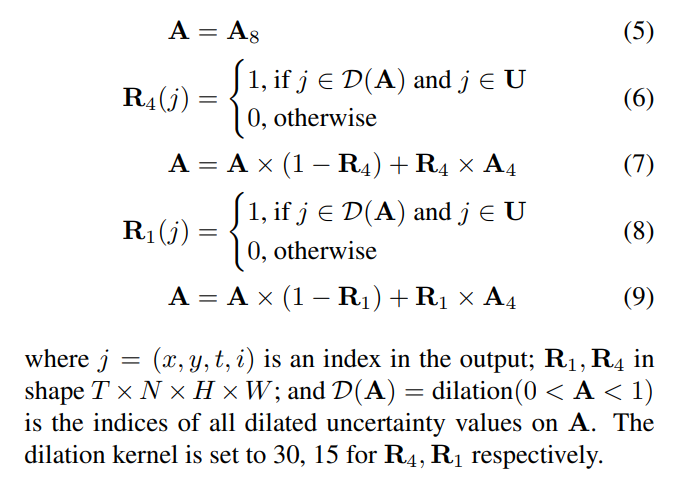
The PRM module progressively refines A8 → A4 → A1 to have A. We assume that all predictions are rescaled to the largest size and perform refinement between intermediate predictions and uncertainty indices U:

\
7.7. Attention loss and loss weight

\ Figure 8. Detail Aggregation Module merges sparse features across scales. This module equalizes spatial scales of sparse features using inverse sparse convolution, facilitating their combination.
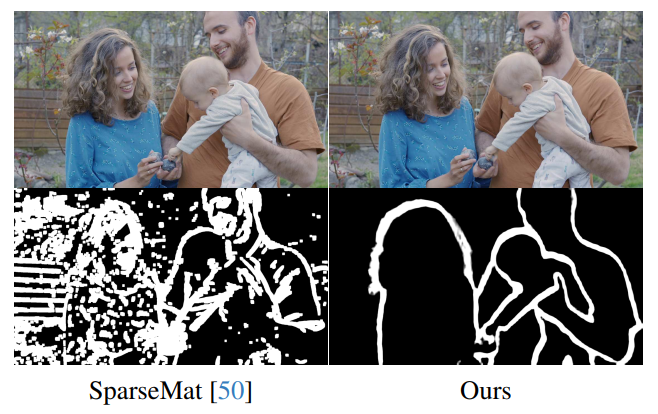
\ Figure 9. Temporal Sparsity Between Two Consecutive Frames. The top row displays a pair of successive frames. Below, the second row illustrates the predicted differences by two distinct frameworks, with areas of discrepancy emphasized in white. In contrast to SparseMat’s output, which appears cluttered and noisy, our module generates a more refined sparsity map. This map effectively accentuates the foreground regions that undergo notable changes between the frames, providing a clearer and more focused representation of temporal sparsity. (Best viewed in color).

7.8. Temporal sparsity prediction

A key aspect of our approach is the prediction of temporal sparsity to maintain consistency between frames. This module contrasts the feature maps of consecutive frames to predict their absolute differences. Comprising three convolution layers with batch normalization and ReLU activation, this module processes the concatenated feature maps from two adjacent frames and predicts the binary differences between them.

\ Unlike SparseMat [50], which relies on manual threshold selection for frame differences, our method offers a more robust and domain-independent approach to determining frame sparsity. This is particularly effective in handling variations in movement, resolution, and domain between frames, as demonstrated in Fig. 9

7.9. Forward and backward matte fusion

\ This fusion enhances temporal consistency and minimizes error propagation.

\

:::info Authors:

(1) Chuong Huynh, University of Maryland, College Park ([email protected]);

(2) Seoung Wug Oh, Adobe Research (seoh,[email protected]);

(3) Abhinav Shrivastava, University of Maryland, College Park ([email protected]);

(4) Joon-Young Lee, Adobe Research ([email protected]).

:::


:::info This paper is available on arxiv under CC by 4.0 Deed (Attribution 4.0 International) license.

:::

\

Market Opportunity
DeepBook Logo
DeepBook Price(DEEP)
$0.034846
$0.034846$0.034846
+1.38%
USD
DeepBook (DEEP) Live Price Chart
Disclaimer: The articles reposted on this site are sourced from public platforms and are provided for informational purposes only. They do not necessarily reflect the views of MEXC. All rights remain with the original authors. If you believe any content infringes on third-party rights, please contact [email protected] for removal. MEXC makes no guarantees regarding the accuracy, completeness, or timeliness of the content and is not responsible for any actions taken based on the information provided. The content does not constitute financial, legal, or other professional advice, nor should it be considered a recommendation or endorsement by MEXC.

You May Also Like

Wormhole launches reserve tying protocol revenue to token

Wormhole launches reserve tying protocol revenue to token

The post Wormhole launches reserve tying protocol revenue to token appeared on BitcoinEthereumNews.com. Wormhole is changing how its W token works by creating a new reserve designed to hold value for the long term. Announced on Wednesday, the Wormhole Reserve will collect onchain and offchain revenues and other value generated across the protocol and its applications (including Portal) and accumulate them into W, locking the tokens within the reserve. The reserve is part of a broader update called W 2.0. Other changes include a 4% targeted base yield for tokenholders who stake and take part in governance. While staking rewards will vary, Wormhole said active users of ecosystem apps can earn boosted yields through features like Portal Earn. The team stressed that no new tokens are being minted; rewards come from existing supply and protocol revenues, keeping the cap fixed at 10 billion. Wormhole is also overhauling its token release schedule. Instead of releasing large amounts of W at once under the old “cliff” model, the network will shift to steady, bi-weekly unlocks starting October 3, 2025. The aim is to avoid sharp periods of selling pressure and create a more predictable environment for investors. Lockups for some groups, including validators and investors, will extend an additional six months, until October 2028. Core contributor tokens remain under longer contractual time locks. Wormhole launched in 2020 as a cross-chain bridge and now connects more than 40 blockchains. The W token powers governance and staking, with a capped supply of 10 billion. By redirecting fees and revenues into the new reserve, Wormhole is betting that its token can maintain value as demand for moving assets and data between chains grows. This is a developing story. This article was generated with the assistance of AI and reviewed by editor Jeffrey Albus before publication. Get the news in your inbox. Explore Blockworks newsletters: Source: https://blockworks.co/news/wormhole-launches-reserve
Share
BitcoinEthereumNews2025/09/18 01:55
Top Altcoins To Hold Before 2026 For Maximum ROI – One Is Under $1!

Top Altcoins To Hold Before 2026 For Maximum ROI – One Is Under $1!

BlockchainFX presale surges past $7.5M at $0.024 per token with 500x ROI potential, staking rewards, and BLOCK30 bonus still live — top altcoin to hold before 2026.
Share
Blockchainreporter2025/09/18 01:16
Best Crypto to Buy as Saylor & Crypto Execs Meet in US Treasury Council

Best Crypto to Buy as Saylor & Crypto Execs Meet in US Treasury Council

The post Best Crypto to Buy as Saylor & Crypto Execs Meet in US Treasury Council appeared on BitcoinEthereumNews.com. Michael Saylor and a group of crypto executives met in Washington, D.C. yesterday to push for the Strategic Bitcoin Reserve Bill (the BITCOIN Act), which would see the U.S. acquire up to 1M $BTC over five years. With Bitcoin being positioned yet again as a cornerstone of national monetary policy, many investors are turning their eyes to projects that lean into this narrative – altcoins, meme coins, and presales that could ride on the same wave. Read on for three of the best crypto projects that seem especially well‐suited to benefit from this macro shift:  Bitcoin Hyper, Best Wallet Token, and Remittix. These projects stand out for having a strong use case and high adoption potential, especially given the push for a U.S. Bitcoin reserve.   Why the Bitcoin Reserve Bill Matters for Crypto Markets The strategic Bitcoin Reserve Bill could mark a turning point for the U.S. approach to digital assets. The proposal would see America build a long-term Bitcoin reserve by acquiring up to one million $BTC over five years. To make this happen, lawmakers are exploring creative funding methods such as revaluing old gold certificates. The plan also leans on confiscated Bitcoin already held by the government, worth an estimated $15–20B. This isn’t just a headline for policy wonks. It signals that Bitcoin is moving from the margins into the core of financial strategy. Industry figures like Michael Saylor, Senator Cynthia Lummis, and Marathon Digital’s Fred Thiel are all backing the bill. They see Bitcoin not just as an investment, but as a hedge against systemic risks. For the wider crypto market, this opens the door for projects tied to Bitcoin and the infrastructure that supports it. 1. Bitcoin Hyper ($HYPER) – Turning Bitcoin Into More Than Just Digital Gold The U.S. may soon treat Bitcoin as…
Share
BitcoinEthereumNews2025/09/18 00:27