In the last few years, casino gaming has started to change faster than anyone expected. Players once lined up at smoky tables; now they tap shiny apps on their In the last few years, casino gaming has started to change faster than anyone expected. Players once lined up at smoky tables; now they tap shiny apps on their

The Future of Casino Gaming on Blockchain

In the last few years, casino gaming has started to change faster than anyone expected. Players once lined up at smoky tables; now they tap shiny apps on their phones. Behind this new scene stands a rising star: blockchain. When mixed with the thrill of slots and cards, the result is the modern crypto casino, a place where code, not people, runs the game. Early adopters cheer the change because they want games that feel fair, fast, and borderless. Yet many still wonder what tomorrow will look like. Will chips turn into tokens? Will dealers be replaced by smart contracts? This article explores the future of casino gaming on blockchain, showing how trust, rewards, speed, and even regulation may shift in ways that make gambling both safer and more exciting for players around the world. From play-to-earn models to virtual reality tables, a new chapter is opening, and the cards are already on the digital felt.

Blockchain’s Greatest Contribution to Casino Gaming Is Trust-Building Within Its Code

Blockchain’s greatest contribution to casino gaming is trust-building within its code. Traditional online houses require players to trust that operators shuffle fairly and deliver as promised, but blockchain gives casino gamers the confidence that trust will always exist between each participant and operator. With a distributed ledger, each spin, shuffle, and payout is recorded publicly, so no one can change them behind closed doors – making cheating significantly harder and auditing much simpler. Furthermore, smart contracts make this possible because rules reside directly on the blockchain instead of sitting behind locked server rooms. When a player wins, the program releases their prize automatically without staff having any chance to delay or change it. Cryptographic proofs such as “provably fair” hashes allow curious players to independently verify each game on their screens. People no longer require a math degree; step-by-step guides demonstrate how to copy a seed number and verify its result. As the network is global, this transparent model works whether users live in Lagos, Lima or London. Trust no longer remains an unproven marketing claim – rather, it becomes an integral technical feature. When faith returns in fairness online betting becomes much safer.
bitcoin-online-crypto-casino.jpg

Play-to-Earn and Token Rewards

One of the most exciting developments associated with blockchain casinos is the rise of play-to-earn models. Under such systems, every hand or spin can deliver small tokens into a player’s wallet even if he or she loses the main bet. Houses set aside part of their revenue to create loyalty pools and convert an evening of entertainment into an income source. Tokens may offer voting rights over game settings, entry to special tournaments, or a share of future profits. Because rewards sit on blockchain, they can move freely between wallets allowing players to trade them for other coins or real-world cash. Some projects even allow gamblers to reinvest the tokens back into the platform in exchange for a share of its rake, turning each gambler into an individual mini-shareholder. This shift blurs the distinction between customer and owner, encouraging longer sessions and stronger community ties. Additionally, this approach opens doors to creative promotions such as limited-edition NFT jackpots that celebrate major events or famous card hands. As these ideas spread further outward, whole ecosystems of tip bots, side games, and community jackpots spring up around core tables in an effort to turn your casino into a vibrant social hub.

Speed, Costs and Global Access

Traditional online casinos often rely on bank wires or card networks with hidden fees and long wait times; blockchain can remove many of these roadblocks quickly; when sending crypto to fund an account it could settle within seconds or minutes instead of taking days to clear out of escrow. Smart contracts can even use stablecoin deposits as deposits, protecting their balance from price swings while still remaining on-chain. Lower fees mean smaller minimum bets and faster micro-payouts which attract casual players who previously felt priced out; as well as global access. Teenagers living in rural Vietnam with smartphones and cheap data plans can join the same blackjack table as retirees from Spain without fear of the chips freezing mid-hand or any central bank intervening to freeze them mid-game; of course, casinos must still abide by local regulations while the tech itself doesn’t care about borders. As a result, they create an international lobby where chat windows incorporate various languages and cultures, creating an energetic experience unattainable in traditional venues. Furthermore, faster rails enable operators to stream live dealer games in high definition to give a player the impression that they are at their table even while traveling across the country on public transit.

Blockchain Casino Challenges and Next Steps

Though blockchain casinos appear promising, they still face hurdles that may hamper their growth. Scalability is one such barrier; popular networks often clog during peak usage periods and turn instant bets into long waits and an increase in gas fees as a result. Layer-two solutions and faster chains such as Solana or Polygon aim to solve this issue, but their race remains ongoing. Regulation presents another complication; governments worry about money laundering and underage gambling so they create complex regulations which vary from one country to the next. Licensed operators are exploring “on-chain KYC,” in which users keep their identity tokens hidden in private wallets and disclose them only to approved auditors. User experience needs improvement as wallet extensions, seed phrases, and gas settings might disorient those more used to simple email logins. Designers have developed one-click sign-up forms that obscure crypto-jargon behind familiar buttons. Looking ahead, experts forecast an amalgamation between virtual reality and chain casinos, where players walk through three-dimensional halls while smart contracts take care of pots and payouts; once these puzzles have been solved, casinos could take on less the form of websites than more like massive multiplayer worlds powered by self-running code.

The post The Future of Casino Gaming on Blockchain appeared first on CryptoNinjas.

Market Opportunity
FUTURECOIN Logo
FUTURECOIN Price(FUTURE)
$0.11856
$0.11856$0.11856
-0.01%
USD
FUTURECOIN (FUTURE) Live Price Chart
Disclaimer: The articles reposted on this site are sourced from public platforms and are provided for informational purposes only. They do not necessarily reflect the views of MEXC. All rights remain with the original authors. If you believe any content infringes on third-party rights, please contact [email protected] for removal. MEXC makes no guarantees regarding the accuracy, completeness, or timeliness of the content and is not responsible for any actions taken based on the information provided. The content does not constitute financial, legal, or other professional advice, nor should it be considered a recommendation or endorsement by MEXC.

You May Also Like

Building a DEXScreener Clone: A Step-by-Step Guide

Building a DEXScreener Clone: A Step-by-Step Guide

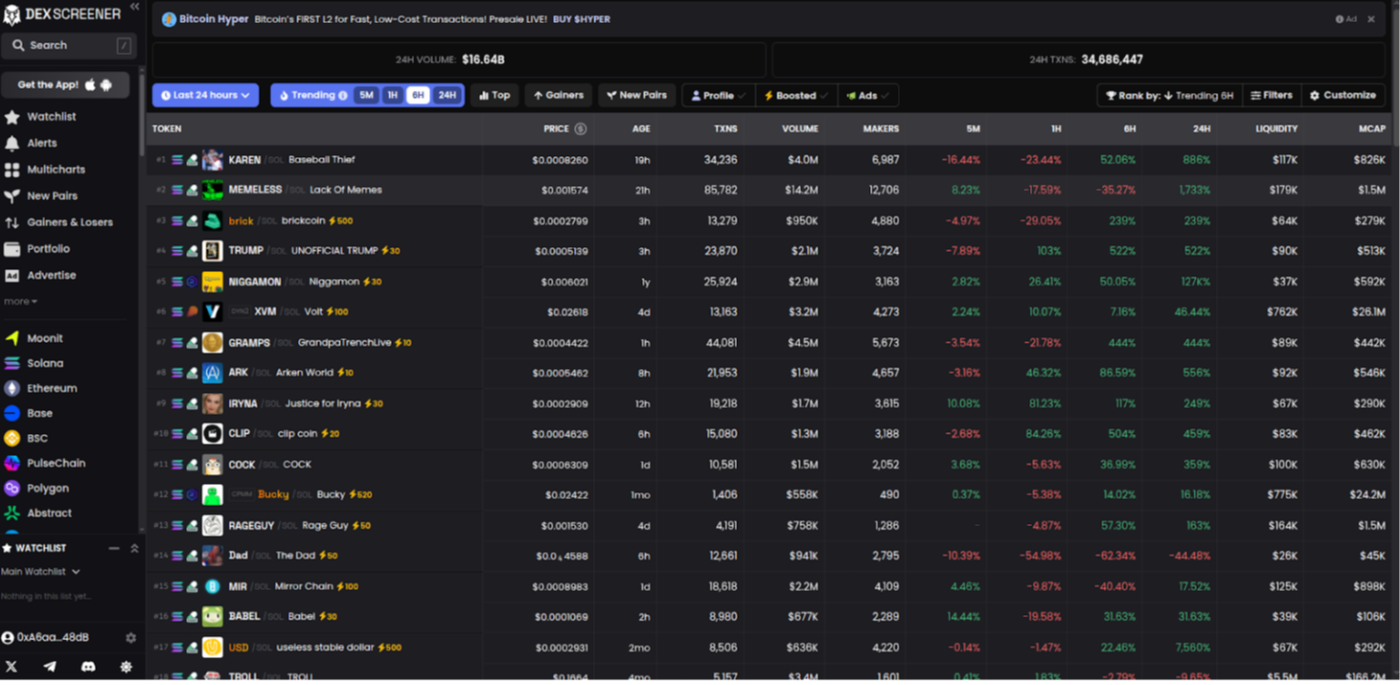
DEX Screener is used by crypto traders who need access to on-chain data like trading volumes, liquidity, and token prices. This information allows them to analyze trends, monitor new listings, and make informed investment decisions. In this tutorial, I will build a DEXScreener clone from scratch, covering everything from the initial design to a functional app. We will use Streamlit, a Python framework for building full-stack apps.
Share
Hackernoon2025/09/18 15:05
Which DOGE? Musk's Cryptic Post Explodes Confusion

Which DOGE? Musk's Cryptic Post Explodes Confusion

A viral chart documenting a sharp decline in U.S. federal employment during President Trump's second term has sparked unexpected confusion in cryptocurrency markets
Share
Coinstats2025/12/20 01:13
Google's AP2 protocol has been released. Does encrypted AI still have a chance?

Google's AP2 protocol has been released. Does encrypted AI still have a chance?

Following the MCP and A2A protocols, the AI Agent market has seen another blockbuster arrival: the Agent Payments Protocol (AP2), developed by Google. This will clearly further enhance AI Agents' autonomous multi-tasking capabilities, but the unfortunate reality is that it has little to do with web3AI. Let's take a closer look: What problem does AP2 solve? Simply put, the MCP protocol is like a universal hook, enabling AI agents to connect to various external tools and data sources; A2A is a team collaboration communication protocol that allows multiple AI agents to cooperate with each other to complete complex tasks; AP2 completes the last piece of the puzzle - payment capability. In other words, MCP opens up connectivity, A2A promotes collaboration efficiency, and AP2 achieves value exchange. The arrival of AP2 truly injects "soul" into the autonomous collaboration and task execution of Multi-Agents. Imagine AI Agents connecting Qunar, Meituan, and Didi to complete the booking of flights, hotels, and car rentals, but then getting stuck at the point of "self-payment." What's the point of all that multitasking? So, remember this: AP2 is an extension of MCP+A2A, solving the last mile problem of AI Agent automated execution. What are the technical highlights of AP2? The core innovation of AP2 is the Mandates mechanism, which is divided into real-time authorization mode and delegated authorization mode. Real-time authorization is easy to understand. The AI Agent finds the product and shows it to you. The operation can only be performed after the user signs. Delegated authorization requires the user to set rules in advance, such as only buying the iPhone 17 when the price drops to 5,000. The AI Agent monitors the trigger conditions and executes automatically. The implementation logic is cryptographically signed using Verifiable Credentials (VCs). Users can set complex commission conditions, including price ranges, time limits, and payment method priorities, forming a tamper-proof digital contract. Once signed, the AI Agent executes according to the conditions, with VCs ensuring auditability and security at every step. Of particular note is the "A2A x402" extension, a technical component developed by Google specifically for crypto payments, developed in collaboration with Coinbase and the Ethereum Foundation. This extension enables AI Agents to seamlessly process stablecoins, ETH, and other blockchain assets, supporting native payment scenarios within the Web3 ecosystem. What kind of imagination space can AP2 bring? After analyzing the technical principles, do you think that's it? Yes, in fact, the AP2 is boring when it is disassembled alone. Its real charm lies in connecting and opening up the "MCP+A2A+AP2" technology stack, completely opening up the complete link of AI Agent's autonomous analysis+execution+payment. From now on, AI Agents can open up many application scenarios. For example, AI Agents for stock investment and financial management can help us monitor the market 24/7 and conduct independent transactions. Enterprise procurement AI Agents can automatically replenish and renew without human intervention. AP2's complementary payment capabilities will further expand the penetration of the Agent-to-Agent economy into more scenarios. Google obviously understands that after the technical framework is established, the ecological implementation must be relied upon, so it has brought in more than 60 partners to develop it, almost covering the entire payment and business ecosystem. Interestingly, it also involves major Crypto players such as Ethereum, Coinbase, MetaMask, and Sui. Combined with the current trend of currency and stock integration, the imagination space has been doubled. Is web3 AI really dead? Not entirely. Google's AP2 looks complete, but it only achieves technical compatibility with Crypto payments. It can only be regarded as an extension of the traditional authorization framework and belongs to the category of automated execution. There is a "paradigm" difference between it and the autonomous asset management pursued by pure Crypto native solutions. The Crypto-native solutions under exploration are taking the "decentralized custody + on-chain verification" route, including AI Agent autonomous asset management, AI Agent autonomous transactions (DeFAI), AI Agent digital identity and on-chain reputation system (ERC-8004...), AI Agent on-chain governance DAO framework, AI Agent NPC and digital avatars, and many other interesting and fun directions. Ultimately, once users get used to AI Agent payments in traditional fields, their acceptance of AI Agents autonomously owning digital assets will also increase. And for those scenarios that AP2 cannot reach, such as anonymous transactions, censorship-resistant payments, and decentralized asset management, there will always be a time for crypto-native solutions to show their strength? The two are more likely to be complementary rather than competitive, but to be honest, the key technological advancements behind AI Agents currently all come from web2AI, and web3AI still needs to keep up the good work!
Share
PANews2025/09/18 07:00