The post JPMorgan reiterates stablecoin market unlikely to hit $1T by 2028 appeared on BitcoinEthereumNews.com. JPMorgan analysts pushed back again on trillion-The post JPMorgan reiterates stablecoin market unlikely to hit $1T by 2028 appeared on BitcoinEthereumNews.com. JPMorgan analysts pushed back again on trillion-

JPMorgan reiterates stablecoin market unlikely to hit $1T by 2028

JPMorgan analysts pushed back again on trillion-dollar projections for stablecoins, arguing that the market’s growth will remain in line with the broader crypto space.

The bank argued that the stablecoin market cannot be viewed independently, as its growth is closely intertwined with the overall performance of the crypto sector, warning that expectations of a $1 trillion market by 2028 are too optimistic.

In its Wednesday report, it revealed that the stablecoin market has swelled by roughly $100 billion this year to over $300 billion, with most of the increase coming from the two largest coins, Tether’s USDT and Circle’s USDC. USDT increased by roughly $48 billion in supply, and USDC by about $34 billion.

JPMorgan said stablecoin demand hinges on trading needs

JPMorgan maintains that the growth of stablecoins is closely tied to broader cryptocurrency activity. It explained that in the past, the market growth surged during BTC and ETH rallies and eased when digital assets slowed. Earlier in the bank’s July report, it had indicated that stablecoin demand is largely driven by trading needs — tokens that are used as cash or collateral in derivatives and DeFi markets, as well as for crypto-native companies to hold unused capital. By then, derivatives exchanges had contributed approximately $20 billion in stablecoins, placing them as the principal contributor to supply growth.

In their then report, it added, “The stablecoin universe is likely to continue to grow over the coming years broadly in line with the overall crypto market cap, perhaps reaching $500 billion–$600 billion by 2028, far lower than the most optimistic expectations of $2 trillion–$4 trillion.”

On the other hand, Citi still expects the stablecoin market to expand to $1.9 trillion by 2030 under normal conditions and potentially reach as high as $4 trillion in an upside scenario, compared with Standard Chartered’s $2 trillion projection for 2028.

JPMorgan just introduced its JPM Coin for institutional clients 

JPMorgan also cautioned that wider use of stablecoins for payments won’t automatically lead to a bigger market cap, as faster circulation reduces the need for higher outstanding balances. Instead, they anticipate that the greater use of payments would increase the frequency of stablecoins transactions. With USDT’s velocity around 50, they estimate that supporting $10 trillion in cross-border payments would require only $200 billion in stablecoins.

Currently, more banks are taking an interest in stablecoins and exploring tokenized deposits. In November, JPMorgan, through its Kinexys unit, even introduced JPM Coin (JPMD) for institutional clients on Base, Ethereum’s layer 2 network incubated by Coinbase. It claimed the move would help both crypto-native and traditional companies transfer funds more quickly and efficiently. Furthermore, it argued that blockchain initiatives such as SWIFT’s experiments could help banks retain their position in international transfers, potentially limiting stablecoins’ use for institutional settlement. 

Its analysts also noted that CBDC initiatives, including the digital euro and digital yuan, could compete with private stablecoins by offering regulated payment options for cross-border and institutional use.

The analysts explained, “In all, we continue to anticipate stablecoin growth broadly in line with the overall crypto market universe over the coming years. Greater usage of stablecoins in payments does not necessarily imply a large increase in the required stock of stablecoins.”

Moreover, it asserted that blockchain projects targeting institutional payments could bolster banks by using non-bearer tokenized deposits, at the expense of privately issued stablecoins.

Want your project in front of crypto’s top minds? Feature it in our next industry report, where data meets impact.

Source: https://www.cryptopolitan.com/jpmorgan-says-stablecoin-unlikely-to-hit-1t/

Market Opportunity
Line Protocol Logo
Line Protocol Price(LINE)
$0.0000051
$0.0000051$0.0000051
0.00%
USD
Line Protocol (LINE) Live Price Chart
Disclaimer: The articles reposted on this site are sourced from public platforms and are provided for informational purposes only. They do not necessarily reflect the views of MEXC. All rights remain with the original authors. If you believe any content infringes on third-party rights, please contact [email protected] for removal. MEXC makes no guarantees regarding the accuracy, completeness, or timeliness of the content and is not responsible for any actions taken based on the information provided. The content does not constitute financial, legal, or other professional advice, nor should it be considered a recommendation or endorsement by MEXC.

You May Also Like

CME Group plans to roll out XRP and Solana futures options in October

CME Group plans to roll out XRP and Solana futures options in October

CME Group will roll out options for XRP and Solana (SOL) futures on October 13, with expiries available daily, monthly and quarterly, adding an extra layer of exposure for investors.
Share
Fxstreet2025/09/18 09:17
DOGE ETF Hype Fades as Whales Sell and Traders Await Decline

DOGE ETF Hype Fades as Whales Sell and Traders Await Decline

The post DOGE ETF Hype Fades as Whales Sell and Traders Await Decline appeared on BitcoinEthereumNews.com. Leading meme coin Dogecoin (DOGE) has struggled to gain momentum despite excitement surrounding the anticipated launch of a US-listed Dogecoin ETF this week. On-chain data reveals a decline in whale participation and a general uptick in coin selloffs across exchanges, hinting at the possibility of a deeper price pullback in the coming days. Sponsored Sponsored DOGE Faces Decline as Whales Hold Back, Traders Sell The market is anticipating the launch of Rex-Osprey’s Dogecoin ETF (DOJE) tomorrow, which is expected to give traditional investors direct exposure to Dogecoin’s price movements.  However, DOGE’s price performance has remained muted ahead of the milestone, signaling a lack of enthusiasm from traders. According to on-chain analytics platform Nansen, whale accumulation has slowed notably over the past week. Large investors, with wallets containing DOGE coins worth more than $1 million, appear unconvinced by the ETF narrative and have reduced their holdings by over 4% in the past week.  For token TA and market updates: Want more token insights like this? Sign up for Editor Harsh Notariya’s Daily Crypto Newsletter here. Dogecoin Whale Activity. Source: Nansen When large holders reduce their accumulation, it signals a bearish shift in market sentiment. This reduced DOGE demand from significant players can lead to decreased buying pressure, potentially resulting in price stagnation or declines in the near term. Sponsored Sponsored Furthermore, DOGE’s exchange reserve has risen steadily in the past week, suggesting that more traders are transferring DOGE to exchanges with the intent to sell. As of this writing, the altcoin’s exchange balance sits at 28 billion DOGE, climbing by 12% in the past seven days. DOGE Balance on Exchanges. Source: Glassnode A rising exchange balance indicates that holders are moving their assets to trading platforms to sell rather than to hold. This influx of coins onto exchanges increases the available supply in…
Share
BitcoinEthereumNews2025/09/18 05:07
The Role of Reference Points in Achieving Equilibrium Efficiency in Fair and Socially Just Economies

The Role of Reference Points in Achieving Equilibrium Efficiency in Fair and Socially Just Economies

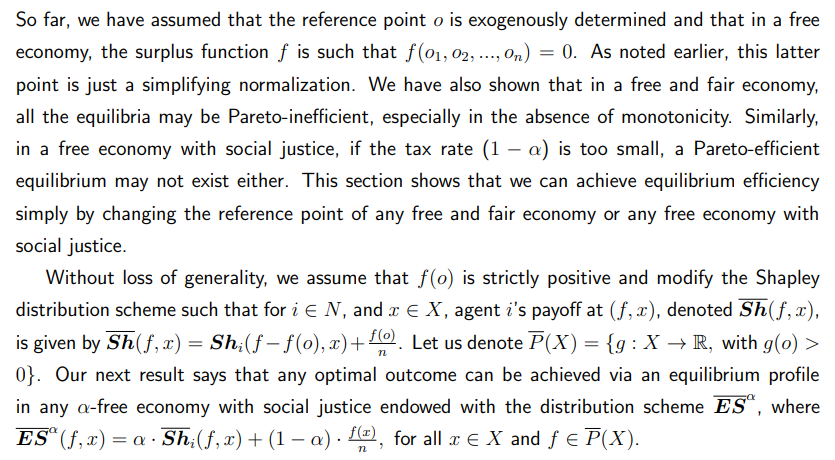
This article explores how a simple change in the reference point can achieve a Pareto-efficient equilibrium in both free and fair economies and those with social justice.
Share
Hackernoon2025/09/17 22:30