On-chain data shows Bitcoin testing a critical investor cost basis near the $81,500 TMMP level, while in total 4K BTC were transferred to Binance. The post 3000On-chain data shows Bitcoin testing a critical investor cost basis near the $81,500 TMMP level, while in total 4K BTC were transferred to Binance. The post 3000

3000 BTC Transferred to Binance, Capriole Warns of Sub-$50K in This Case

Bitcoin BTC $86 384 24h volatility: 0.0% Market cap: $1.72 T Vol. 24h: $44.06 B price continued trading below the key $90,000 level on Dec. 17 when a large Bitcoin transfer of 3,000 BTC from an unknown wallet to Binance was flagged by Whale Alert. The transaction is valued at roughly $260 million.

Meanwhile, a different wallet transferred 1,000 BTC, worth $87.3 million. At the time of writing, Bitcoin is trading around $86,000, down by more than 6% over the past week, according to CoinMarketCap data.

Capriole Founder Issues Warning

Charles Edwards, the founder of the quantitative crypto fund Capriole, has raised alarms about Bitcoin’s preparedness for the rise of quantum computing. He believes that if Bitcoin does not become quantum-resistant within the next few years, the market could face severe consequences.

Quantum computing is widely viewed as a future threat to cryptography. In theory, sufficiently powerful quantum machines could break current encryption standards, expose private keys, and put user funds at risk.

This came soon after Grayscale also acknowledged that quantum computing poses a future risk to blockchain security. It explained that most public blockchains will have to adopt post-quantum cryptography.

However, the financial giant believes that it is unlikely to affect Bitcoin and top altcoins in 2026.

While many consider the quantum computing threat to be far off, Edwards argues that the timeline may be much shorter than most expect.

According to his forecast, 2028 would be a critical deadline. If Bitcoin’s network does not implement a quantum-resistant upgrade by then, he expects the price to fall well below $50,000 and continue declining until the issue is resolved.

He also suggests that fear around quantum risk could eventually be flushed out through a major bear market.

Edwards believes that action needs to happen even sooner. A quantum security patch should be rolled out by 2026 to avoid what he describes as the most severe Bitcoin bear market on record.

Bitcoin could be an early target for quantum attacks because traditional banks are already transitioning toward post-quantum encryption. Legacy systems can often reverse or block fraudulent transactions, explained Edwards.

A Very Important Technical Level

Onchain data from CryptoQuant shows that currently, the Bitcoin True Market Mean Price (TMMP), a key metric, is around $81,500.

When Bitcoin trades above the TMMP, investors tend to feel comfortable holding their positions, and pullbacks often attract buyers. When price drops below it, that same level frequently turns into resistance.

Similarly, the AVIV Ratio is reading levels from past mid-cycle transition phases, where the market neither collapsed nor trended strongly higher. Instead, price tends to move sideways, volatility declines, and investors quietly rebalance.
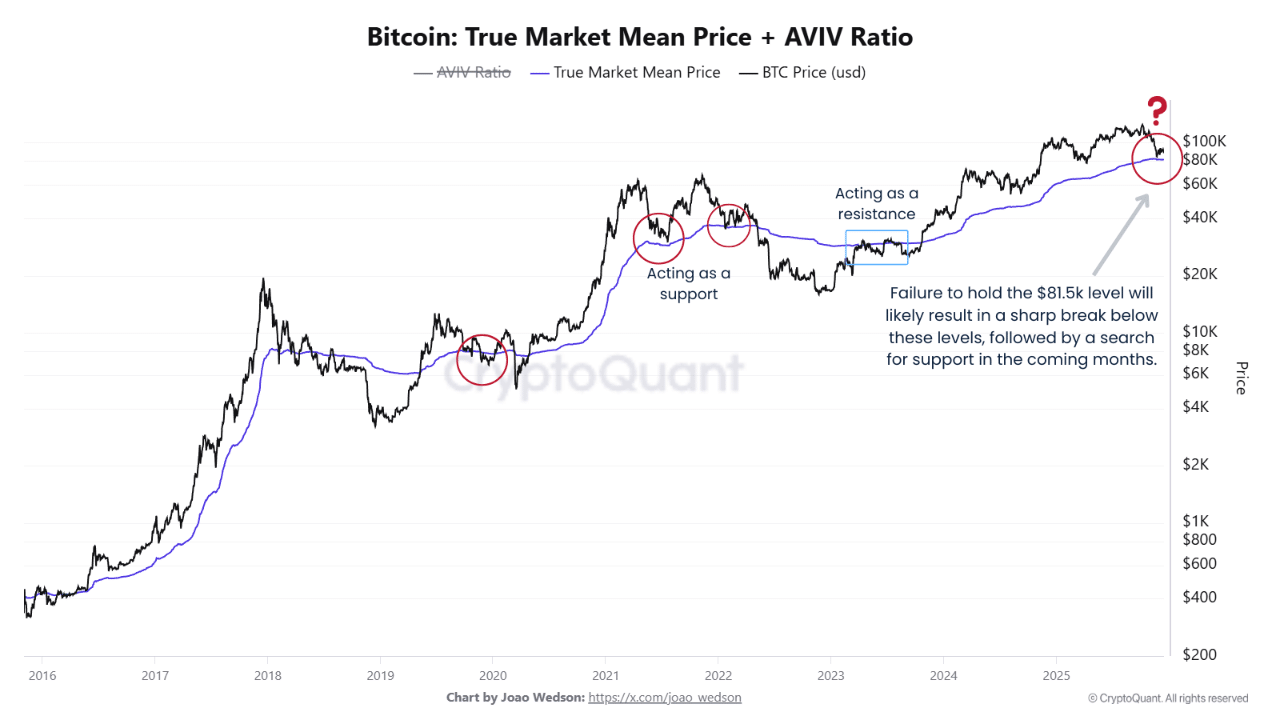
BTC TMMP | Source: CryptoQuant

BTC TMMP | Source: CryptoQuant

If Bitcoin can stay above the TMMP while the AVIV Ratio stabilizes in the 0.8 to 0.9 range, it would suggest that investors are defending their cost basis and absorbing supply. That behavior typically supports longer-term trends.
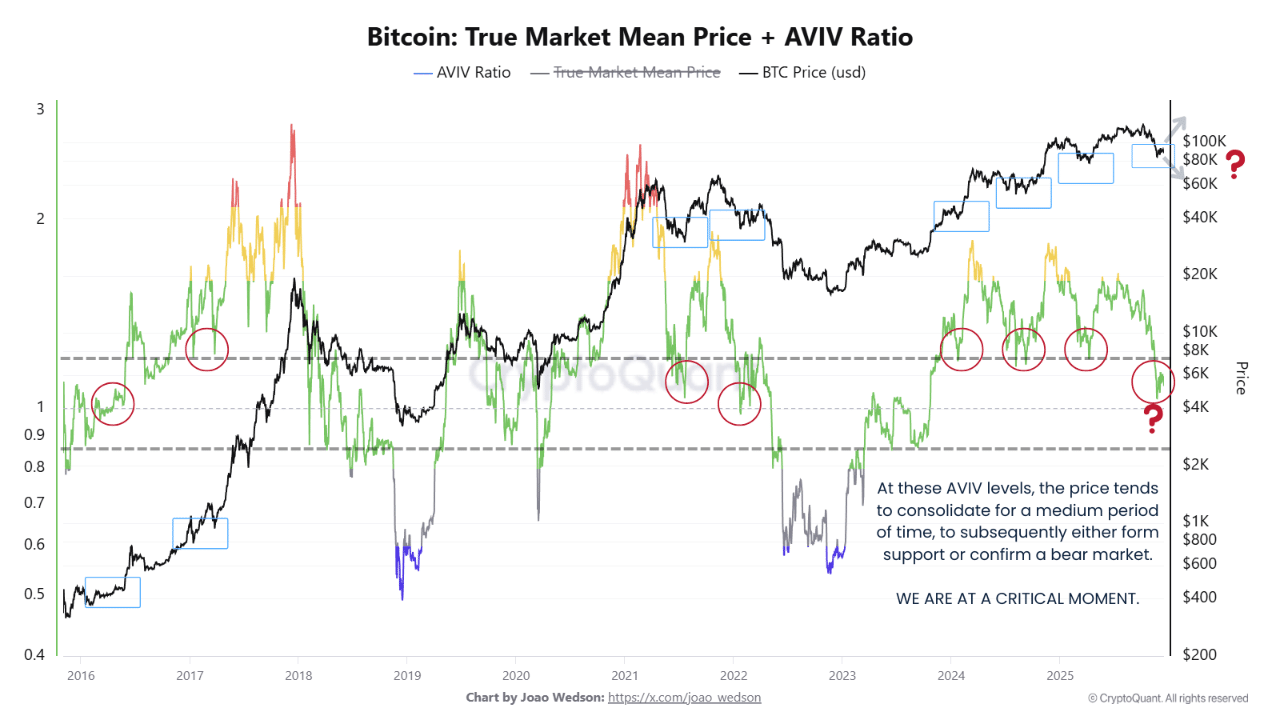
BTC AVIV Ratio | Source: CryptoQuant

BTC AVIV Ratio | Source: CryptoQuant

However, if Bitcoin loses the TMMP and AVIV doesn’t recover, a deeper search for demand could follow for the world’s largest digital asset.

next

The post 3000 BTC Transferred to Binance, Capriole Warns of Sub-$50K in This Case appeared first on Coinspeaker.

Market Opportunity
Bitcoin Logo
Bitcoin Price(BTC)
$86,339.1
$86,339.1$86,339.1
-1.01%
USD
Bitcoin (BTC) Live Price Chart
Disclaimer: The articles reposted on this site are sourced from public platforms and are provided for informational purposes only. They do not necessarily reflect the views of MEXC. All rights remain with the original authors. If you believe any content infringes on third-party rights, please contact [email protected] for removal. MEXC makes no guarantees regarding the accuracy, completeness, or timeliness of the content and is not responsible for any actions taken based on the information provided. The content does not constitute financial, legal, or other professional advice, nor should it be considered a recommendation or endorsement by MEXC.

You May Also Like

The Channel Factories We’ve Been Waiting For

The Channel Factories We’ve Been Waiting For

The post The Channel Factories We’ve Been Waiting For appeared on BitcoinEthereumNews.com. Visions of future technology are often prescient about the broad strokes while flubbing the details. The tablets in “2001: A Space Odyssey” do indeed look like iPads, but you never see the astronauts paying for subscriptions or wasting hours on Candy Crush.  Channel factories are one vision that arose early in the history of the Lightning Network to address some challenges that Lightning has faced from the beginning. Despite having grown to become Bitcoin’s most successful layer-2 scaling solution, with instant and low-fee payments, Lightning’s scale is limited by its reliance on payment channels. Although Lightning shifts most transactions off-chain, each payment channel still requires an on-chain transaction to open and (usually) another to close. As adoption grows, pressure on the blockchain grows with it. The need for a more scalable approach to managing channels is clear. Channel factories were supposed to meet this need, but where are they? In 2025, subnetworks are emerging that revive the impetus of channel factories with some new details that vastly increase their potential. They are natively interoperable with Lightning and achieve greater scale by allowing a group of participants to open a shared multisig UTXO and create multiple bilateral channels, which reduces the number of on-chain transactions and improves capital efficiency. Achieving greater scale by reducing complexity, Ark and Spark perform the same function as traditional channel factories with new designs and additional capabilities based on shared UTXOs.  Channel Factories 101 Channel factories have been around since the inception of Lightning. A factory is a multiparty contract where multiple users (not just two, as in a Dryja-Poon channel) cooperatively lock funds in a single multisig UTXO. They can open, close and update channels off-chain without updating the blockchain for each operation. Only when participants leave or the factory dissolves is an on-chain transaction…
Share
BitcoinEthereumNews2025/09/18 00:09
Singapore Entrepreneur Loses Entire Crypto Portfolio After Downloading Fake Game

Singapore Entrepreneur Loses Entire Crypto Portfolio After Downloading Fake Game

The post Singapore Entrepreneur Loses Entire Crypto Portfolio After Downloading Fake Game appeared on BitcoinEthereumNews.com. In brief A Singapore-based man has
Share
BitcoinEthereumNews2025/12/18 05:17
‘Rich Dad Poor Dad’ Author Kiyosaki Breaks Silence on Fed Rate Cut With Bitcoin Call

‘Rich Dad Poor Dad’ Author Kiyosaki Breaks Silence on Fed Rate Cut With Bitcoin Call

The post ‘Rich Dad Poor Dad’ Author Kiyosaki Breaks Silence on Fed Rate Cut With Bitcoin Call appeared on BitcoinEthereumNews.com. Robert Kiyosaki is back doing
Share
BitcoinEthereumNews2025/12/18 05:25