Legislative postponement triggers risk-off positioning as total market cap slips below $3 trillionLegislative postponement triggers risk-off positioning as total market cap slips below $3 trillion

Bitcoin Falls to $86K as Senate Delays Crypto Market Structure Bill

Bitcoin Falls to $86K as Senate Delays Crypto Market Structure Bill

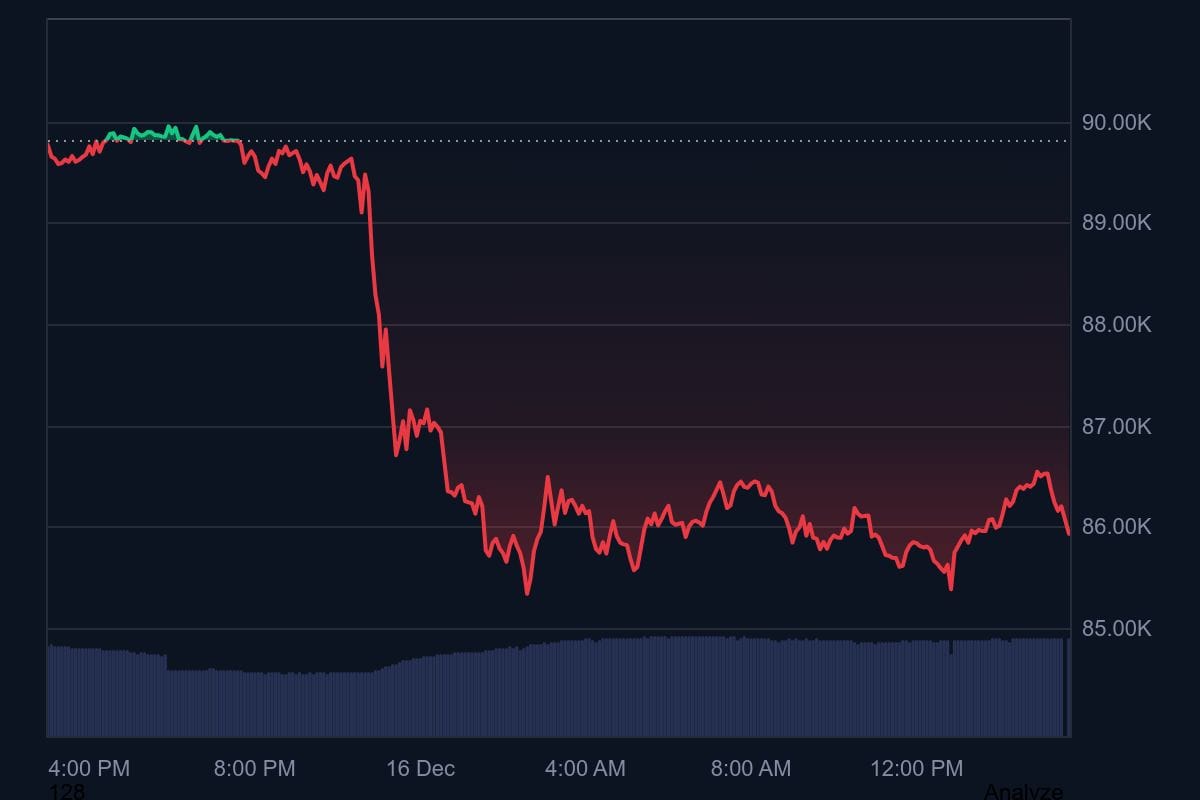
Bitcoin dropped over 4% in the past 24 hours after the U.S. Senate Banking Committee confirmed on Monday that it would delay markup of long-awaited crypto market structure legislation until early 2026, extending regulatory uncertainty that has weighed on institutional sentiment.
Bitcoin Falls to $86K as Senate Delays Crypto Market Structure Bill

The benchmark cryptocurrency briefly touched $84,000 before stabilizing near $85,800 in Asian trading hours, while Ethereum declined over 6% to $2,900. Total cryptocurrency market capitalization fell below $3 trillion to $2.93 trillion as the sell-off rippled across major tokens.

The Senate Banking Committee said it ran out of time to advance the bill before Congress adjourns for the holiday recess, despite nearly two months of active bipartisan negotiations. Chairman Tim Scott's office said discussions would continue, with a markup now targeted for early 2026.

"Chairman Scott and the Senate Banking Committee have made strong progress with Democratic counterparts on bipartisan digital asset market structure legislation," the committee's GOP statement read, adding that Scott "has consistently and patiently engaged in good-faith discussions to produce a strong bipartisan product."

The postponement leaves unresolved how the SEC and CFTC will divide oversight of spot markets and digital asset securities, a jurisdictional question that has created compliance challenges for U.S.-based crypto firms.

Exchange-traded fund flows reflected the defensive shift in positioning. Bitcoin spot ETFs recorded $358 million in outflows, while Ethereum ETFs shed $225 million, according to market data. Combined outflows totaled $582 million across the two largest crypto assets.

In contrast, Solana and XRP ETFs remained positive with inflows of $35 million and $11 million respectively, suggesting selective appetite for specific tokens rather than wholesale risk-off behavior.

The Senate Agriculture Committee, which has jurisdiction over CFTC-related crypto legislation, has not scheduled its own markup, further reducing the likelihood of comprehensive digital asset rules being finalized before mid-2026.

The delay reintroduces policy uncertainty at a time when institutional crypto adoption has accelerated ahead of regulatory clarity. For asset allocators, the gap between market development and legislative frameworks creates friction that translates into higher risk premiums and faster de-risking when sentiment deteriorates.

➢ Stay ahead of the curve. Join Blockhead on Telegram today for all the latest in crypto.
+ Follow Blockhead on Google News
Market Opportunity
Capverse Logo
Capverse Price(CAP)
$0.13467
$0.13467$0.13467
-0.73%
USD
Capverse (CAP) Live Price Chart
Disclaimer: The articles reposted on this site are sourced from public platforms and are provided for informational purposes only. They do not necessarily reflect the views of MEXC. All rights remain with the original authors. If you believe any content infringes on third-party rights, please contact [email protected] for removal. MEXC makes no guarantees regarding the accuracy, completeness, or timeliness of the content and is not responsible for any actions taken based on the information provided. The content does not constitute financial, legal, or other professional advice, nor should it be considered a recommendation or endorsement by MEXC.

You May Also Like

MoneyGram launches stablecoin-powered app in Colombia

MoneyGram launches stablecoin-powered app in Colombia

The post MoneyGram launches stablecoin-powered app in Colombia appeared on BitcoinEthereumNews.com. MoneyGram has launched a new mobile application in Colombia that uses USD-pegged stablecoins to modernize cross-border remittances. According to an announcement on Wednesday, the app allows customers to receive money instantly into a US dollar balance backed by Circle’s USDC stablecoin, which can be stored, spent, or cashed out through MoneyGram’s global retail network. The rollout is designed to address the volatility of local currencies, particularly the Colombian peso. Built on the Stellar blockchain and supported by wallet infrastructure provider Crossmint, the app marks MoneyGram’s most significant move yet to integrate stablecoins into consumer-facing services. Colombia was selected as the first market due to its heavy reliance on inbound remittances—families in the country receive more than 22 times the amount they send abroad, according to Statista. The announcement said future expansions will target other remittance-heavy markets. MoneyGram, which has nearly 500,000 retail locations globally, has experimented with blockchain rails since partnering with the Stellar Development Foundation in 2021. It has since built cash on and off ramps for stablecoins, developed APIs for crypto integration, and incorporated stablecoins into its internal settlement processes. “This launch is the first step toward a world where every person, everywhere, has access to dollar stablecoins,” CEO Anthony Soohoo stated. The company emphasized compliance, citing decades of regulatory experience, though stablecoin oversight remains fluid. The US Congress passed the GENIUS Act earlier this year, establishing a framework for stablecoin regulation, which MoneyGram has pointed to as providing clearer guardrails. This is a developing story. This article was generated with the assistance of AI and reviewed by editor Jeffrey Albus before publication. Get the news in your inbox. Explore Blockworks newsletters: Source: https://blockworks.co/news/moneygram-stablecoin-app-colombia
Share
BitcoinEthereumNews2025/09/18 07:04
ServicePower Closes Transformative Year with AI-Driven Growth and Market Expansion

ServicePower Closes Transformative Year with AI-Driven Growth and Market Expansion

Double-digit growth, 50% team expansion, and accelerated innovation define 2025 momentum MCLEAN, Va., Dec. 18, 2025 /PRNewswire/ — ServicePower, a leading provider
Share
AI Journal2025/12/18 23:32
XRP Fractal Signals $6–$7 Surge by November Amid DLT Disruption

XRP Fractal Signals $6–$7 Surge by November Amid DLT Disruption

The post XRP Fractal Signals $6–$7 Surge by November Amid DLT Disruption appeared on BitcoinEthereumNews.com. XRP Fractal Analysis Hints at $6–$7 Breakout by Mid-November According to renowned market analyst EGRAG CRYPTO, XRP may be on the verge of a significant price movement. In his latest analysis, he points to a fractal formation pattern that suggests XRP could reach the $6–$7 range by mid-November.  Source: EGRAG CRYPTO This projection has quickly caught the attention of traders and long-term investors, as XRP’s current price remains well below this target. Fractals, often used in technical analysis, are recurring chart patterns that can help predict future price action by identifying historical similarities in market behavior.  Therefore, EGRAG CRYPTO argues that XRP is currently mirroring a previous structure that led to a notable rally. If this fractal setup plays out as expected, it could mark one of the most significant price surges for the digital asset in recent years. If XRP reaches $6–$7 by mid-November, it would mark a major win for investors and a symbolic breakthrough for a token that has endured regulatory battles and market volatility, validating its resilience and cementing its relevance in the evolving digital finance ecosystem. Meanwhile, a recent cup-and-handle pattern signalled that XRP had the potential of soaring to $15 by year-end with the altcoin presently trading at $3.04 per CoinGecko data.  DLT-Based Solutions: How Ripple and Stellar are Redefining Cross-Border Banking According to crypto observer SMQKE, distributed ledger technology (DLT)-based solutions are increasingly challenging the traditional correspondent banking model.  For decades, cross-border payments have relied on a chain of intermediaries, often resulting in slow settlements, high costs, and limited transparency. But with the rise of blockchain networks such as Ripple and Stellar, the industry is experiencing a seismic shift. The correspondent banking model depends on trust and pre-funded accounts, locking up liquidity and exposing banks to counterparty risk.  Transactions often take days to…
Share
BitcoinEthereumNews2025/09/19 16:12