Cryptocurrency Market Faces Sharp Correction Amid Rising Leverage and Macroeconomic Concerns The cryptocurrency market experienced a significant downturn on MondayCryptocurrency Market Faces Sharp Correction Amid Rising Leverage and Macroeconomic Concerns The cryptocurrency market experienced a significant downturn on Monday

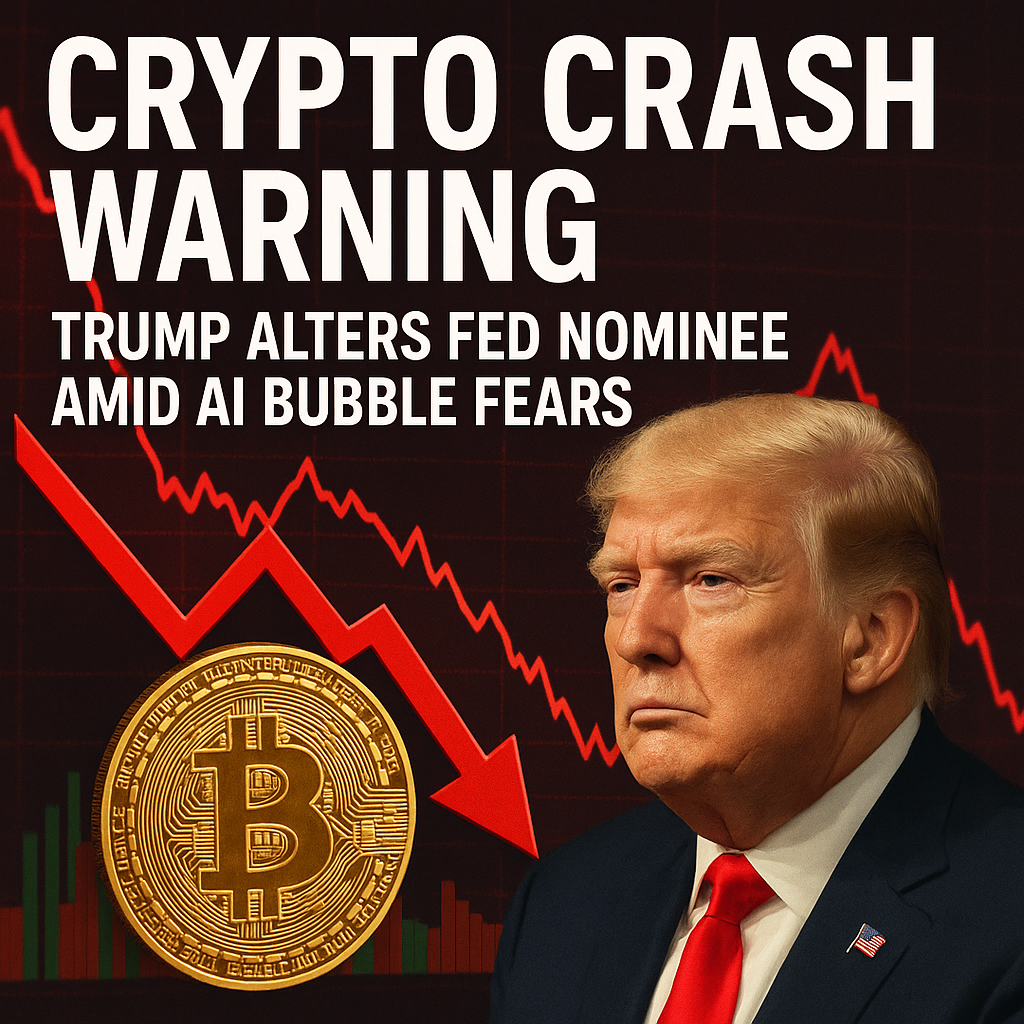
Crypto Crash Warning: Trump Alters Fed Nominee Amid AI Bubble Fears
2025/12/16 08:56
Crypto Crash Warning: Trump Alters Fed Nominee Amid Ai Bubble Fears

Cryptocurrency Market Faces Sharp Correction Amid Rising Leverage and Macroeconomic Concerns

The cryptocurrency market experienced a significant downturn on Monday, with major digital assets retreating as traders reassessed risk amid macroeconomic uncertainties. Bitcoin retested the $85,000 mark, while Ether declined to approximately $2,900, reflecting increased investor caution following disappointing economic indicators and evolving policy expectations in the United States.

Key Takeaways

  • Leverage in the crypto market surged, resulting in over $527 million in liquidations within 24 hours, signaling heightened caution among traders.
  • Growing debt risks related to artificial intelligence investments and tighter liquidity conditions prompted traders to exit riskier assets, triggering a market correction.
  • Indicators show traders seek safety amid rising inflation fears, with US 5-year Treasury yields remaining resilient alongside declining crypto capitalization.
  • Market sentiment is influenced by macroeconomic factors, including consumer spending concerns and Federal Reserve policy outlooks.

Tickers mentioned: none specific

Sentiment: Bearish

Price impact: Negative, driven by increased liquidation events and risk aversion among investors.

Market Dynamics and Investor Behavior

The correction was driven by a combination of deteriorating macroeconomic data and rising leverage within the crypto space. Recent data indicates that traders have liquidated over half a billion dollars worth of bullish positions in the past 24 hours, highlighting a shift towards risk-off strategies. The pervasive use of leverage, with futures open interest topping $135 billion, amplifies volatility, as traders unwind positions amid mounting doubts about further price gains.

Meanwhile, the artificial intelligence sector’s dependence on debt funding has drawn scrutiny from hedge funds like Bridgewater Associates (NASDAQ: MSTR). The firm warns of a potential bubble forming due to excessive borrowing by tech giants to finance AI developments, adding to broader macroeconomic pressures.

US 5-year Treasury versus total crypto market capitalization. Source: TradingView

The US Treasury yields rebounded sharply after hitting a low of 98.64, indicating investor demand for inflation protection amid concerns about the Federal Reserve’s future policy moves. Despite this, retail data paints a subdued picture: a CNBC survey revealed that over 40% of Americans plan to cut holiday spending amid stagnant wages and rising costs, further dampening consumer confidence.

Crypto open interestTotal crypto market open interest, USD. Source: CoinGlass

Excess leverage remains a significant concern, with open interest precariously high. Recent liquidation events and the shift in funding rates — with some exchanges experiencing negative rates, paid to short sellers — underscore the market’s fragile state. This environment is compounded by macroeconomic jitters, including potential changes in US leadership and policy, which influence dollar strength and investor confidence.

President Donald Trump’s circle has recently expressed openness to different candidate options for Federal Reserve Chair, which has added to market volatility. The US Dollar Index stabilizing at around 98 after weeks of decline suggests some confidence in the US economy’s resilience, although this feud with crypto assets persists amid broader macro risks.

Overall, the combination of macroeconomic uncertainties, excessive leverage, and institutional shifts points to ongoing volatility, with investors remaining cautious amid mixed signals from traditional and crypto markets.

This article was originally published as Crypto Crash Warning: Trump Alters Fed Nominee Amid AI Bubble Fears on Crypto Breaking News – your trusted source for crypto news, Bitcoin news, and blockchain updates.

Market Opportunity
OFFICIAL TRUMP Logo
OFFICIAL TRUMP Price(TRUMP)
$5.234
$5.234$5.234
-2.13%
USD
OFFICIAL TRUMP (TRUMP) Live Price Chart
Disclaimer: The articles reposted on this site are sourced from public platforms and are provided for informational purposes only. They do not necessarily reflect the views of MEXC. All rights remain with the original authors. If you believe any content infringes on third-party rights, please contact [email protected] for removal. MEXC makes no guarantees regarding the accuracy, completeness, or timeliness of the content and is not responsible for any actions taken based on the information provided. The content does not constitute financial, legal, or other professional advice, nor should it be considered a recommendation or endorsement by MEXC.

You May Also Like

Volante Technologies Customers Successfully Navigate Critical Regulatory Deadlines for EU SEPA Instant and Global SWIFT Cross-Border Payments

Volante Technologies Customers Successfully Navigate Critical Regulatory Deadlines for EU SEPA Instant and Global SWIFT Cross-Border Payments

PaaS leader ensures seamless migrations and uninterrupted payment operations LONDON–(BUSINESS WIRE)–Volante Technologies, the global leader in Payments as a Service
Share
AI Journal2025/12/16 17:16
Fed Acts on Economic Signals with Rate Cut

Fed Acts on Economic Signals with Rate Cut

In a significant pivot, the Federal Reserve reduced its benchmark interest rate following a prolonged ten-month hiatus. This decision, reflecting a strategic response to the current economic climate, has captured attention across financial sectors, with both market participants and policymakers keenly evaluating its potential impact.Continue Reading:Fed Acts on Economic Signals with Rate Cut
Share
Coinstats2025/09/18 02:28
Google's AP2 protocol has been released. Does encrypted AI still have a chance?

Google's AP2 protocol has been released. Does encrypted AI still have a chance?

Following the MCP and A2A protocols, the AI Agent market has seen another blockbuster arrival: the Agent Payments Protocol (AP2), developed by Google. This will clearly further enhance AI Agents' autonomous multi-tasking capabilities, but the unfortunate reality is that it has little to do with web3AI. Let's take a closer look: What problem does AP2 solve? Simply put, the MCP protocol is like a universal hook, enabling AI agents to connect to various external tools and data sources; A2A is a team collaboration communication protocol that allows multiple AI agents to cooperate with each other to complete complex tasks; AP2 completes the last piece of the puzzle - payment capability. In other words, MCP opens up connectivity, A2A promotes collaboration efficiency, and AP2 achieves value exchange. The arrival of AP2 truly injects "soul" into the autonomous collaboration and task execution of Multi-Agents. Imagine AI Agents connecting Qunar, Meituan, and Didi to complete the booking of flights, hotels, and car rentals, but then getting stuck at the point of "self-payment." What's the point of all that multitasking? So, remember this: AP2 is an extension of MCP+A2A, solving the last mile problem of AI Agent automated execution. What are the technical highlights of AP2? The core innovation of AP2 is the Mandates mechanism, which is divided into real-time authorization mode and delegated authorization mode. Real-time authorization is easy to understand. The AI Agent finds the product and shows it to you. The operation can only be performed after the user signs. Delegated authorization requires the user to set rules in advance, such as only buying the iPhone 17 when the price drops to 5,000. The AI Agent monitors the trigger conditions and executes automatically. The implementation logic is cryptographically signed using Verifiable Credentials (VCs). Users can set complex commission conditions, including price ranges, time limits, and payment method priorities, forming a tamper-proof digital contract. Once signed, the AI Agent executes according to the conditions, with VCs ensuring auditability and security at every step. Of particular note is the "A2A x402" extension, a technical component developed by Google specifically for crypto payments, developed in collaboration with Coinbase and the Ethereum Foundation. This extension enables AI Agents to seamlessly process stablecoins, ETH, and other blockchain assets, supporting native payment scenarios within the Web3 ecosystem. What kind of imagination space can AP2 bring? After analyzing the technical principles, do you think that's it? Yes, in fact, the AP2 is boring when it is disassembled alone. Its real charm lies in connecting and opening up the "MCP+A2A+AP2" technology stack, completely opening up the complete link of AI Agent's autonomous analysis+execution+payment. From now on, AI Agents can open up many application scenarios. For example, AI Agents for stock investment and financial management can help us monitor the market 24/7 and conduct independent transactions. Enterprise procurement AI Agents can automatically replenish and renew without human intervention. AP2's complementary payment capabilities will further expand the penetration of the Agent-to-Agent economy into more scenarios. Google obviously understands that after the technical framework is established, the ecological implementation must be relied upon, so it has brought in more than 60 partners to develop it, almost covering the entire payment and business ecosystem. Interestingly, it also involves major Crypto players such as Ethereum, Coinbase, MetaMask, and Sui. Combined with the current trend of currency and stock integration, the imagination space has been doubled. Is web3 AI really dead? Not entirely. Google's AP2 looks complete, but it only achieves technical compatibility with Crypto payments. It can only be regarded as an extension of the traditional authorization framework and belongs to the category of automated execution. There is a "paradigm" difference between it and the autonomous asset management pursued by pure Crypto native solutions. The Crypto-native solutions under exploration are taking the "decentralized custody + on-chain verification" route, including AI Agent autonomous asset management, AI Agent autonomous transactions (DeFAI), AI Agent digital identity and on-chain reputation system (ERC-8004...), AI Agent on-chain governance DAO framework, AI Agent NPC and digital avatars, and many other interesting and fun directions. Ultimately, once users get used to AI Agent payments in traditional fields, their acceptance of AI Agents autonomously owning digital assets will also increase. And for those scenarios that AP2 cannot reach, such as anonymous transactions, censorship-resistant payments, and decentralized asset management, there will always be a time for crypto-native solutions to show their strength? The two are more likely to be complementary rather than competitive, but to be honest, the key technological advancements behind AI Agents currently all come from web2AI, and web3AI still needs to keep up the good work!
Share
PANews2025/09/18 07:00