

Before Bitcoin: The Forgotten P2P Dreams that Sparked Crypto
\ In a time when Bitcoin wasn’t even a word, a bunch of digital dreamers were already asking wild questions: could money live online? Could people on the Internet access services without middlemen peeking over their shoulders? Can we have real privacy? Back in the late 20th century, this wasn’t just tech talk: it was a countercultural mission.
Hackers, math geniuses, and privacy advocates like the cypherpunks were building tools that could give ordinary people control over their own data and transactions. Some of their creations worked for a while, some didn’t, but all of them shared the same rebellious DNA: decentralization.
From David Chaum’s eCash to the file-sharing chaos of Napster, these early inventions set the stage for the crypto movement. So, let’s time-travel a bit and meet some pioneer brands that turned code into a statement of freedom. \n
eCash: The First Digital Money Experiment
Our story begins in the 1980s, when computers were beige and the Internet was barely a thing. That’s when cryptographer David Chaum had a mind-blowing idea: what if cash could go digital without giving up privacy? His creation, eCash, was launched by his company DigiCash in 1989, making it the first real attempt at private, online payments.
Here’s how it worked: Chaum came up with something called “blind signatures,” a cryptographic trick that let banks verify digital coins without knowing who spent them. Users could make payments online, and no one (not even the bank) could trace them. That level of anonymity was revolutionary for its time.
A few banks, like Deutsche Bank and Mark Twain Bank, even tried it out in the 1990s. But the world wasn’t ready yet; online shopping was just starting. DigiCash went bankrupt in 1998, but Chaum’s ideas didn’t die with it. They lived on in Bitcoin’s DNA, proving that privacy and digital money could share the same codebase.
\n
Mojo Nation: File Sharing with Currency
Before torrents ruled the internet, Jim McCoy and Doug Barnes dreamed up Mojo Nation in 2001, a wild experiment where file sharing met digital economics. McCoy, a former Yahoo engineer, wanted a P2P world where people didn’t just trade files for free: they earned “Mojo,” a kind of micropayment that rewarded users who shared bandwidth and storage. No freeloaders allowed. If you wanted to download, you had to give something back.
\ 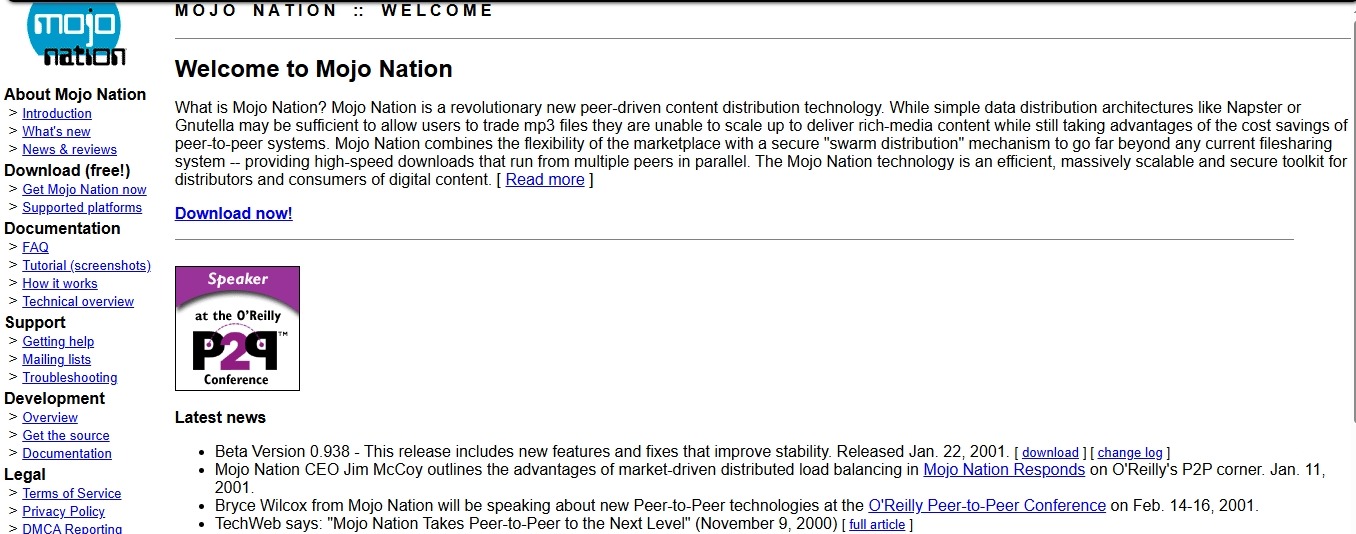
Unlike other platforms, Mojo Nation had an elaborate “swarm distribution” system. Files were split into thousands of fragments scattered across users’ computers, ensuring no single person had a full copy —as in a P2P system. It was part content network, part digital marketplace, and part social experiment. Users built reputation scores, prices were set dynamically, and everything (from bandwidth to hard drive space) was a tradeable asset.
Despite its futuristic design, Mojo Nation never took off. The software was buggy, the interface clunky, and venture capital dried up just as Napster’s legal troubles scared investors away. Yet, its main goal lived on: Bram Cohen, who worked on Mojo Nation, stripped down its ideas and created BitTorrent, the tool that later defined file sharing for an entire generation. Mojo Nation didn’t win, but it passed on its torch brilliantly.
Also, a fun fact here: Len Sassaman, a strong candidate to be Satoshi Nakamoto, and Zooko Wilcox, creator of Zcash, came to work on this platform as well.
\
Napster: Sharing the Soundtrack of Rebellion
If you were around in 1999, you probably remember the chaos that Napster unleashed. Created by Shawn Fanning and Sean Parker, it let anyone share MP3s directly from their computer. Suddenly, people everywhere were trading songs faster than record labels could sue them. Even unreleased songs by Metallica and Madonna were leaked to the public via Napster —which, of course, led to lawsuits.
This platform showed how powerful P2P connections could be. However, the system still worked through central servers that helped users find songs, while the files themselves were passed from one user to another. It wasn’t fully decentralized, but it cracked open the door to a new world where people could exchange information freely. For many, Napster was their first taste of what a decentralized network felt like: wild, open, and uncontrollable.
But yes, the music industry was furious. In 2001, after A&M Records v. Napster, Inc., the platform was forced to shut down. The genie was out of the bottle by then, though. Napster showed the world that direct digital exchange could bypass middlemen: an idea that crypto would later turn into a financial revolution.
\n
Bit Gold: A Direct Ancestor of Bitcoin
In 1998, before “crypto” was short for cryptocurrencies, computer scientist and cypherpunk Nick Szabo proposed something called Bit Gold. It was a digital currency designed to act like gold, but made entirely of code. Users would solve complex cryptographic puzzles, and their successful solutions would create unique, scarce digital “coins.” These records would be timestamped and publicly stored, preventing double-spending without needing a central authority.
Sounds familiar? Well, Szabo never released a working version, but his proposal became a cornerstone of what would later become Bitcoin. It had all the key ingredients: cryptographic proof, decentralized record-keeping, and scarcity based on computation. If you’re squinting at Szabo (who, by the way, shares birthday and initials with Satoshi Nakamoto), you’re not the only one. He’s denied being Nakamoto, though.
Either way, Bit Gold’s design inspired Bitcoin’s very architecture. It proved that digital value could exist without trust in any human institution. We just need math, code, and a network that agrees on common rules. \n
b-Money: The Unfinished Blueprint
That same year, 1998, another cypherpunk, Wei Dai, posted a quiet but powerful proposal for a decentralized economy. It was called b-Money, and it described how a group of people could create money and contracts without banks or governments. There were two versions: one fully decentralized, where everyone kept a copy of the transaction database, and another with trusted servers that maintained consensus.
b-Money imagined a fully anonymous digital economy where people used pseudonyms instead of real names. In its two proposed versions, users or selected “servers” would track who owned what, verify transactions, and even enforce contracts. All without a central authority, relying only on cryptography and collective accountability.
Dai’s system also introduced the concept of rewarding participants who helped verify transactions: an early sketch of what would later become crypto mining. While no one ever built b-Money, its ideas caught Satoshi Nakamoto’s attention. In fact, Satoshi cited Dai’s proposal in the Bitcoin whitepaper as a direct influence.
Wei Dai later said he wrote it more as a thought experiment than a business plan. Yet, that thought helped ignite the very idea of digital money that manages itself. In a sense, b-Money was Bitcoin’s missing rehearsal; a quiet draft before the curtain finally rose. \n
Bitcoin Inspired More
When Bitcoin launched in 2009, it was like the grand remix of everything that came before it. Chaum’s digital cash, Szabo’s decentralization, Dai’s distributed money, and the P2P freedom of Napster and MojoNation all came together in one unstoppable formula. For the first time, a digital currency worked without a central point of control, and the Internet took notice.
Once Bitcoin showed it could survive on its own, innovation exploded. Ethereum arrived with smart contracts that could automate deals without lawyers. DeFi turned financial systems into open playgrounds. NFTs brought art and creativity into the crypto world. And platforms like Obyte went further, ditching blockchains entirely in favor of Directed Acyclic Graphs (DAGs) to make even more decentralized, censorship-resistant transactions.
All these projects share the same rebellious spirit that started decades ago. They’re digital descendants of dreamers who believed that trust could be written in code, not signed on paper. So, the next time someone calls crypto a “passing trend,” we can smile —because this story started long before Bitcoin and it’s still being written today.
\n
Featured Vector Image by Freepik
\n
\ \
You May Also Like

Sport.Fun’s FUN Token Sale Smashes 100% Target In One Day

A Netflix ‘KPop Demon Hunters’ Short Film Has Been Rated For Release
