Aegis is an early-stage project aiming to build a stablecoin that does not rely on fiat currencies, oracles, or permissioned collateral.Aegis is an early-stage project aiming to build a stablecoin that does not rely on fiat currencies, oracles, or permissioned collateral.

A new paradigm for Bitcoin perpetual hedging: How does Aegis use short contracts to create a decentralized stablecoin YUSD?

2025/04/26 10:42
4 min read

By Stacy Muur

Compiled by: Tim, PANews

We’ve seen fiat-backed stablecoins, and we’ve seen crypto-collateralized stablecoins, but Aegis is thinking differently: a Bitcoin-backed stablecoin.

Here’s why its design is bold and why it’s likely to succeed.
A new paradigm for Bitcoin perpetual hedging: How does Aegis use short contracts to create a decentralized stablecoin YUSD?

Most stablecoins today rely on a centralized system that Bitcoin was designed to avoid:

  • Fiat Currency Custody
  • Bank Liquidation
  • Regulatory constraints

Aegis took a different tack, choosing to build its system around Bitcoin rather than a bank.

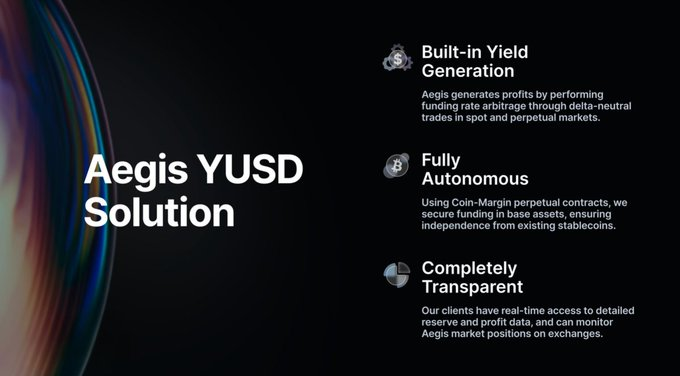
Aegis named its stablecoin YUSD:

  • Anchored to $1
  • Backed by Bitcoin Collateral
  • Maintain stability by shorting perpetual contracts

No oracle required, no currency reserve, no third-party intermediary
A new paradigm for Bitcoin perpetual hedging: How does Aegis use short contracts to create a decentralized stablecoin YUSD?

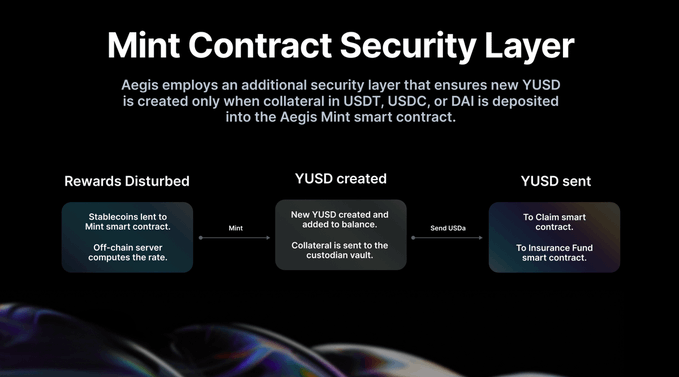
YUSD is only minted when stablecoins such as USDT, USDC or DAI are deposited into the Aegis Mint smart contract.

Once verified, YUSD will be generated and the corresponding collateral will be transferred to a secure custodial vault.

There is no off-chain casting switch, no human intervention, everything is controlled only by smart contract logic.
A new paradigm for Bitcoin perpetual hedging: How does Aegis use short contracts to create a decentralized stablecoin YUSD?

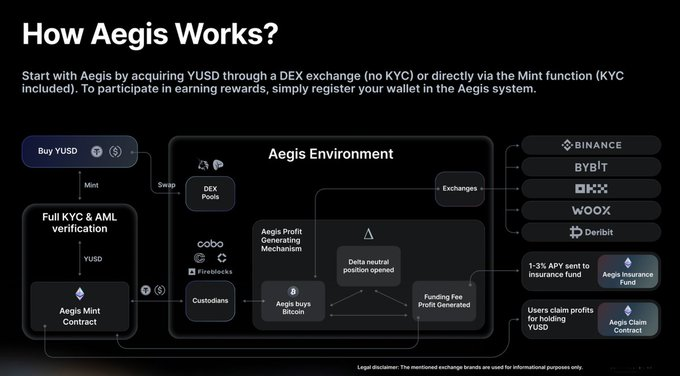
So, how does Aegis work end-to-end?

  1. You can use funds to mint or redeem (on-chain or decentralized exchanges) to obtain YUSD
  2. Aegis uses these funds to buy BTC
  3. Hedge against price volatility risk by opening a short perpetual contract
  4. Short positions earn funding rate income
  5. Profit distribution: part of it will be injected into the insurance pool, and part of it will be distributed to YUSD holders

This is the circulation mechanism of YUSD.
A new paradigm for Bitcoin perpetual hedging: How does Aegis use short contracts to create a decentralized stablecoin YUSD?

But where do these profits come from?

When Aegis shorts a Bitcoin perpetual contract, it profits from the funding rate paid by traders making bullish bets.

These fees will be charged three times per day as long as long demand exists.

This is not staking, and this is not inflation.

This is how opponent pressure is converted into profit.
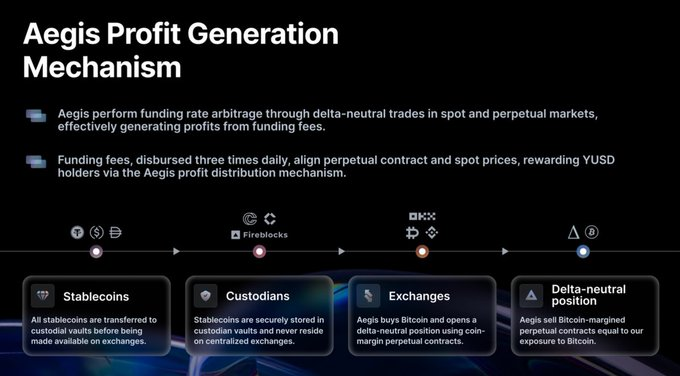
A new paradigm for Bitcoin perpetual hedging: How does Aegis use short contracts to create a decentralized stablecoin YUSD?

Aegis doesn't ask you to do anything extra.

Hold YUSD → Earn fees from Aegis → Snapshot record share → Generate rewards → Receive via APP

See, the profits come from the wind.
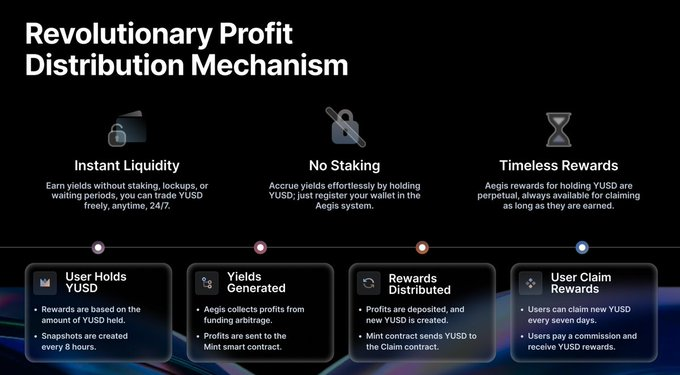
A new paradigm for Bitcoin perpetual hedging: How does Aegis use short contracts to create a decentralized stablecoin YUSD?

Aegis is built to be secure, reliable, independent and free from centralization risks and common single points of failure:

  • No legal currency backing
  • No USDC reserves
  • No oracle dependency

Bitcoin only, collateral hedging processing, over-the-counter holding, real-time monitoring.

No yield model is perfect, especially one tied to the funding rate. So what happens if the funding rate turns negative?

Aegis has established an insurance fund for this purpose.

  • 1-5% of the proceeds will be transferred to the insurance fund
  • This fund is enabled when the funding rate turns negative and the cost of short selling increases.
  • Managed by multi-signature smart contracts
  • Subsequent control will be transferred to Aegis DAO
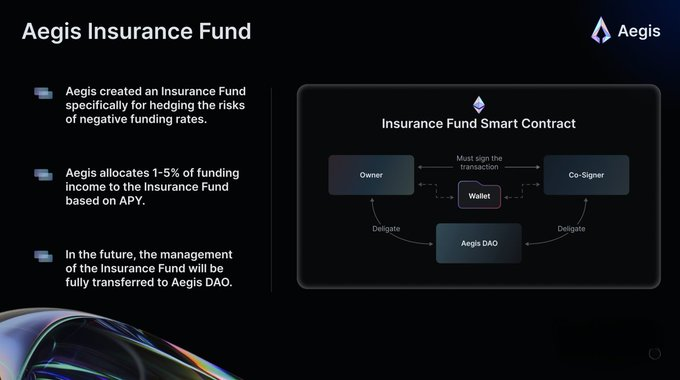
A new paradigm for Bitcoin perpetual hedging: How does Aegis use short contracts to create a decentralized stablecoin YUSD?

Aegis seems to be very focused on transparency:

  • Escrow reserves are verifiable
  • Exchange Position Disclosure
  • Read-only API exposes system status

You don't have to guess at its inner workings, but you can watch the results in real time.
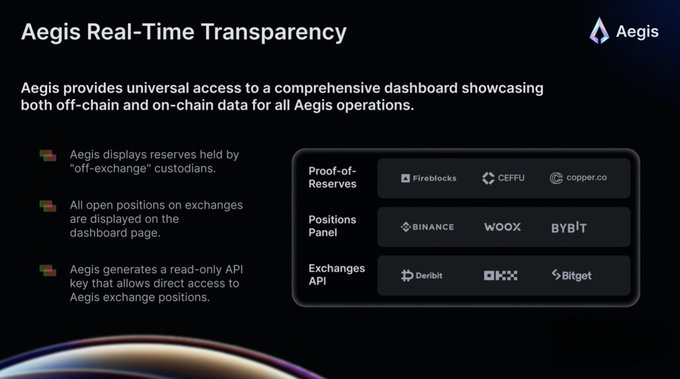
A new paradigm for Bitcoin perpetual hedging: How does Aegis use short contracts to create a decentralized stablecoin YUSD?

The insurance fund is responsible for managing risks, while the Aaegis points system is responsible for driving growth. Users can earn points daily in the following ways:

  • Hold YUSD (earn 15 points per $1 per day)
  • Provide liquidity (30 points per $1 per day, 2x bonus)
  • Borrowing through Euler (45 points per day, 3x bonus)
  • Complete social tasks (50 points per task, 5 times bonus)

The product and service are now fully available on Ethereum and BNB chains.
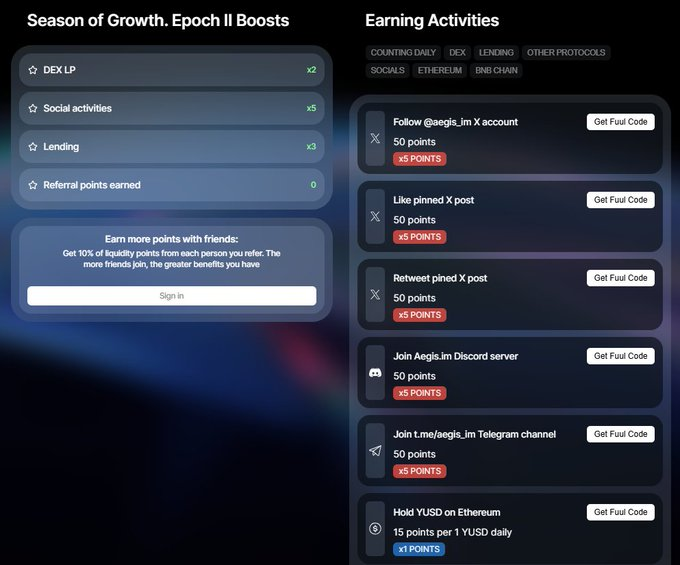
A new paradigm for Bitcoin perpetual hedging: How does Aegis use short contracts to create a decentralized stablecoin YUSD?

In Season 1, all points earnings will receive a 50% bonus, allowing early users to receive a higher proportion of AEG token rewards.

Excess Rewards: Euler integration unlocks a circular strategy - deposit YUSD → earn points → borrow stablecoins → repeat this process.

This maximizes your profits and multiplies your points.

Points are more than just numbers. Every week, 0.2% of the total AEG supply will be distributed based on your share of points.

No need to worry about airdrop delays or guess at distribution rules. ​​

Transparent and open, everything goes according to plan and is directly linked to the use of the protocol.

Aegis is an early-stage project aiming to build a stablecoin that does not rely on fiat currencies, oracles, or permissioned collateral.

It remains uncertain whether the model will remain valid in volatile markets or be scalable in real-world use cases.

But it is one of the clearest experiments yet in the design of a currency based on Bitcoin.

Market Opportunity
Notcoin Logo
Notcoin Price(NOT)
$0.0004571
$0.0004571$0.0004571
+0.74%
USD
Notcoin (NOT) Live Price Chart
Disclaimer: The articles reposted on this site are sourced from public platforms and are provided for informational purposes only. They do not necessarily reflect the views of MEXC. All rights remain with the original authors. If you believe any content infringes on third-party rights, please contact [email protected] for removal. MEXC makes no guarantees regarding the accuracy, completeness, or timeliness of the content and is not responsible for any actions taken based on the information provided. The content does not constitute financial, legal, or other professional advice, nor should it be considered a recommendation or endorsement by MEXC.

You May Also Like

The Next “Big Story” in Crypto: Crypto Credit and Borrowing, Says Bitwise CEO

The Next “Big Story” in Crypto: Crypto Credit and Borrowing, Says Bitwise CEO

Bitwise CEO has recently predicted a major growth for the crypto borrowing and credit sector, calling it the next “big story.” The post The Next “Big Story” in Crypto: Crypto Credit and Borrowing, Says Bitwise CEO appeared first on Coinspeaker.
Share
Coinspeaker2025/09/18 22:16
SEC New Standards to Simplify Crypto ETF Listings

SEC New Standards to Simplify Crypto ETF Listings

The post SEC New Standards to Simplify Crypto ETF Listings appeared on BitcoinEthereumNews.com. The United States Securities and Exchange Commission (SEC) approved a new standard for crypto ETF listings on Wednesday. The standard is created to simplify the working of exchanges in terms of the process followed for crypto ETP listings. This makes it possible to to avoid the cumbersome route of case-by-case approval being followed so far. With this change, exchanges can bypass the 19(b) rule filing process. It is a review that can stretch up to 240 days and demands direct SEC approval before an ETF can launch. Instead of going through the tedious and lengthy review process, the SEC has set up a system that allows exchanges to act more quickly. Now, when an ETF issuer presents a product idea to exchanges like Nasdaq, NYSE, or CBOE, the exchange can move ahead as long as the proposal meets the generic listing standard. This means that strategies based on a single token or a basket of tokens can be listed without waiting for individual approval. New Standards Will Ease Crypto ETF Listings: SEC Chairman According to the Chairman of the SEC, Paul Atkins, this move is aimed at making it easier for investors to access digital asset products through regulated U.S. markets. He noted that by approving generic listing standards, the agency is helping U.S. capital markets remain a global leader in digital asset innovation. At the same time, the SEC approved the Grayscale Digital Large Cap Fund, a fund made up of Bitcoin, Ethereum, XRP, Cardano and Solana. Furthermore, the SEC also approved a new type of options linked to the Cboe Bitcoin U.S. ETF Index and its mini version. This step further expands the range of crypto-linked derivatives available in regulated U.S. markets. How Will SEC General Listing Standard Impact Altcoin Crypto ETF Market? The SEC’s updated listing standards could clear…
Share
BitcoinEthereumNews2025/09/18 21:38
Victra Named 2025 Recipient of Verizon’s Best Build Compliance Award

Victra Named 2025 Recipient of Verizon’s Best Build Compliance Award

Verizon Recognizes Victra for Industry-Leading Excellence in Store Design and Brand Compliance. RALEIGH, N.C., Feb. 3, 2026 /PRNewswire/ — Verizon has named Victra
Share
AI Journal2026/02/03 20:49