The Central Bank of Nigeria (CBN) is rolling out a new framework to tackle rising fraud in the banking sector: customers must now report fraudulent transactions within 72 hours, while banks, including fintechs, are bound by a 16-working-day cycle to investigate and issue refunds.The Central Bank of Nigeria (CBN) is rolling out a new framework to tackle rising fraud in the banking sector: customers must now report fraudulent transactions within 72 hours, while banks, including fintechs, are bound by a 16-working-day cycle to investigate and issue refunds.

Nigerian banks must refund fraud victims within 16 working days under new CBN framework

2025/12/02 22:41
4 min read
For feedback or concerns regarding this content, please contact us at [email protected]

The Central Bank of Nigeria (CBN) is rolling out a new framework to tackle rising fraud in the banking sector: customers must now report fraudulent transactions within 72 hours, while financial institutions, including banks and fintechs, are bound by a 16-working-day cycle to investigate and issue refunds.

The new rules come as fraud in Nigeria’s financial sector continues to surge. Data from the Financial Institutions Training Centre (FITC) shows fraud losses jumped 603% to ₦3.29 billion ($2.27 million) in Q1 2025, with 12,347 cases reported, a 7.63% increase from the previous year.

The CBN released draft guidelines dated November 26, 2025, for handling Authorised Push Payment (APP) fraud, aimed to strengthen preventive measures, tighten bank accountability, and ensure faster reimbursements for victims.

“When finalised, the Guidelines would mandate all financial institutions to institute preventive measures as well as modalities for mitigating and managing APP fraud,” a circular signed by Rita Sike, director, Financial Policy and Regulation Department, read.

This marks the continuation of the CBN’s over a decade-long fight against fraud. In 2011, it established the Nigeria Electronic Fraud Forum (NeFF) to encourage the exchange and the sharing of knowledge on fraud issues among operators.  In 2015, it mandated that financial institutions open dedicated fraud desks to provide support to customers on electronic fraud. In 2023, it mandated stricter Know Your Customer (KYC) measures, requiring customers to provide their Bank Verification Number or a national identification number (NIN) for account or wallet opening. 

In 2024, the apex bank instructed the Nigeria Inter-Bank Settlement System (NIBSS) to debit the accounts of commercial banks that receive fraud proceeds. 

What is APP fraud?

The CBN defines it as tricking or misleading a customer into authorising a payment, via WhatsApp, SMS, email, or other channels, to a third-party account or wallet.

“Facilitation, negligence, or non-compliance by financial institutions, such as failure to act on red flags, weak Know Your Customer (KYC) or fraud controls, staff collusion, delayed resolution, and use of accounts for fraudulent purposes,” it said.

Any customer who is a victim of APP fraud is expected to report the incident within 72 hours. Reports should include transaction date, amount, recipient details, and supporting documents.

Banks must now acknowledge the report within 24 hours and launch an investigation immediately.

During investigations, the CBN may direct NIBSS or any relevant settlement entity to withhold settlement for the full value of any transaction identified as fraudulent. “This may extend to second-level or other subsequent beneficiary institutions along the transaction chain,” the CBN said.

Investigations must conclude within 14 working days, and unresolved cases can be escalated to the CBN’s Consumer Protection and Financial Inclusion Department. Reimbursements are to be made within 48 hours of investigation conclusion.

When an APP fraud incident involves more than one financial institution, the originating financial institution must start an investigation and notify the other institution(s) involved within 30 minutes. Affected institutions are expected to make reimbursement within 16 working days from the date the incident was first reported.

If a financial institution fails to flag or freeze a fraudulent transaction due to inadequate systems, it bears the cost. Where no financial institution is at fault, and the customer is also not at fault, banks must share the refund equally.

Who gets refunds, and who doesn’t

Customers are eligible for reimbursement when they report fraud within 72 hours and cooperate with investigations; show no negligence, collusion, or criminal intent; were misled under false pretences; or were protected by weak or absent bank controls.

Customers are not eligible for refunds if they acted fraudulently or negligently; failed or report the fraud after 72 hours; and if the transactions predate the guideline’s effective date.

Exceptions to the 72-hour rule apply if delays were due to illness, force majeure, or unavailability of reporting channels, or if fraud resulted from bank staff negligence or internal control failures.

Failure to conclude investigations within the set timeframe without justification will now attract regulatory sanctions. Customers can also take issues up with the CBN if they are not satisfied with the outcome of any investigation.

However, providing false, misleading, or incomplete information to the CBN will attract sanctions on the individual and the bank.

To ensure the successful implementation of this new rule, financial institutions must have 24/7 fraud reporting channels, Early Warning Systems (EWS) to detect and mitigate APP fraud, red-flag suspicious accounts, monitor behaviour, and document fraud indicators, regularly report APP fraud incidents to the CBN, and implement financial literacy outreach for customers.

The draft guideline is currently open to comments from financial institutions and the public for three weeks. Once finalised, it will form a critical part of the CBN’s ongoing effort to strengthen Nigeria’s financial ecosystem.

Market Opportunity
Lorenzo Protocol Logo
Lorenzo Protocol Price(BANK)
$0.03828
$0.03828$0.03828
+2.48%
USD
Lorenzo Protocol (BANK) Live Price Chart
Disclaimer: The articles reposted on this site are sourced from public platforms and are provided for informational purposes only. They do not necessarily reflect the views of MEXC. All rights remain with the original authors. If you believe any content infringes on third-party rights, please contact [email protected] for removal. MEXC makes no guarantees regarding the accuracy, completeness, or timeliness of the content and is not responsible for any actions taken based on the information provided. The content does not constitute financial, legal, or other professional advice, nor should it be considered a recommendation or endorsement by MEXC.
Tags:

You May Also Like

Is Doge Losing Steam As Traders Choose Pepeto For The Best Crypto Investment?

Is Doge Losing Steam As Traders Choose Pepeto For The Best Crypto Investment?

The post Is Doge Losing Steam As Traders Choose Pepeto For The Best Crypto Investment? appeared on BitcoinEthereumNews.com. Crypto News 17 September 2025 | 17:39 Is dogecoin really fading? As traders hunt the best crypto to buy now and weigh 2025 picks, Dogecoin (DOGE) still owns the meme coin spotlight, yet upside looks capped, today’s Dogecoin price prediction says as much. Attention is shifting to projects that blend culture with real on-chain tools. Buyers searching “best crypto to buy now” want shipped products, audits, and transparent tokenomics. That frames the true matchup: dogecoin vs. Pepeto. Enter Pepeto (PEPETO), an Ethereum-based memecoin with working rails: PepetoSwap, a zero-fee DEX, plus Pepeto Bridge for smooth cross-chain moves. By fusing story with tools people can use now, and speaking directly to crypto presale 2025 demand, Pepeto puts utility, clarity, and distribution in front. In a market where legacy meme coin leaders risk drifting on sentiment, Pepeto’s execution gives it a real seat in the “best crypto to buy now” debate. First, a quick look at why dogecoin may be losing altitude. Dogecoin Price Prediction: Is Doge Really Fading? Remember when dogecoin made crypto feel simple? In 2013, DOGE turned a meme into money and a loose forum into a movement. A decade on, the nonstop momentum has cooled; the backdrop is different, and the market is far more selective. With DOGE circling ~$0.268, the tape reads bearish-to-neutral for the next few weeks: hold the $0.26 shelf on daily closes and expect choppy range-trading toward $0.29–$0.30 where rallies keep stalling; lose $0.26 decisively and momentum often bleeds into $0.245 with risk of a deeper probe toward $0.22–$0.21; reclaim $0.30 on a clean daily close and the downside bias is likely neutralized, opening room for a squeeze into the low-$0.30s. Source: CoinMarketcap / TradingView Beyond the dogecoin price prediction, DOGE still centers on payments and lacks native smart contracts; ZK-proof verification is proposed,…
Share
BitcoinEthereumNews2025/09/18 00:14
Adoption Leads Traders to Snorter Token
Adoption Leads Traders to Snorter Token

The post Adoption Leads Traders to Snorter Token appeared on BitcoinEthereumNews.com. Largest Bank in Spain Launches Crypto Service: Adoption Leads Traders to Snorter Token Sign Up for Our Newsletter! For updates and exclusive offers enter your email. Leah is a British journalist with a BA in Journalism, Media, and Communications and nearly a decade of content writing experience. Over the last four years, her focus has primarily been on Web3 technologies, driven by her genuine enthusiasm for decentralization and the latest technological advancements. She has contributed to leading crypto and NFT publications – Cointelegraph, Coinbound, Crypto News, NFT Plazas, Bitcolumnist, Techreport, and NFT Lately – which has elevated her to a senior role in crypto journalism. Whether crafting breaking news or in-depth reviews, she strives to engage her readers with the latest insights and information. Her articles often span the hottest cryptos, exchanges, and evolving regulations. As part of her ploy to attract crypto newbies into Web3, she explains even the most complex topics in an easily understandable and engaging way. Further underscoring her dynamic journalism background, she has written for various sectors, including software testing (TEST Magazine), travel (Travel Off Path), and music (Mixmag). When she’s not deep into a crypto rabbit hole, she’s probably island-hopping (with the Galapagos and Hainan being her go-to’s). Or perhaps sketching chalk pencil drawings while listening to the Pixies, her all-time favorite band. This website uses cookies. By continuing to use this website you are giving consent to cookies being used. Visit our Privacy Center or Cookie Policy. I Agree Source: https://bitcoinist.com/banco-santander-and-snorter-token-crypto-services/
Share
BitcoinEthereumNews2025/09/17 23:45
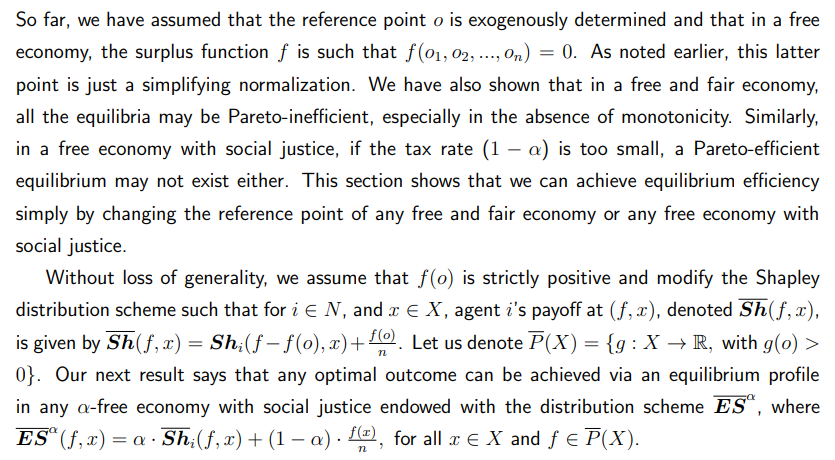
The Role of Reference Points in Achieving Equilibrium Efficiency in Fair and Socially Just Economies

The Role of Reference Points in Achieving Equilibrium Efficiency in Fair and Socially Just Economies

This article explores how a simple change in the reference point can achieve a Pareto-efficient equilibrium in both free and fair economies and those with social justice.
Share
Hackernoon2025/09/17 22:30