Hyperliquid is heading into one of its most scrutinized moments yet, as a $314 million token unlock scheduled for Saturday intensifies concerns aroundHyperliquid is heading into one of its most scrutinized moments yet, as a $314 million token unlock scheduled for Saturday intensifies concerns around

Hyperliquid Token Unlock Puts $314M At Risk As Transparency Fears Rattle Traders

2025/11/25 05:03
4 min read

Hyperliquid is heading into one of its most scrutinized moments yet, as a $314 million token unlock scheduled for Saturday intensifies concerns around transparency, market stability, and the long-term handling of its tokenomics.

According to Tokenomist data, the perpetuals-focused decentralized exchange will release 9.92 million HYPE tokens in a single “cliff unlock,” equal to 2.66% of the total supply.
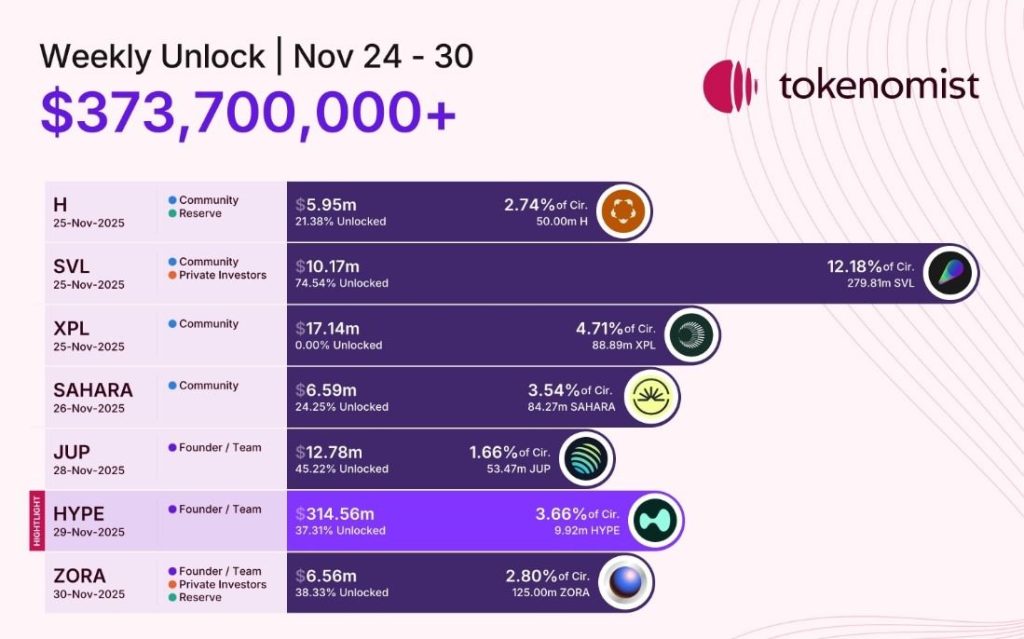
Source: Tokenomist

The entire allocation will be unlocked at once, a structure that has fueled questions over potential sell pressure and how the team intends to manage the newly released tokens.

Hyperliquid Faces Transparency Push as Community Fears Sell-Pressure

The unlock has ignited broad discussion within the Hyperliquid community. Earlier this week, an X user named Andy published an open letter urging the team to address the community before the release takes place.

He said that holders were already uneasy amid a wider market slump and a month-long decline in HYPE, which has fallen more than 23% over the past month and is now trading around $31.

“The team and airdrop recipients finally able to sell is going to ruffle feathers until you address the community head on,” Andy wrote, adding that many traders remain emotionally scarred from previous collapses following unlock events.

BitMEX co-founder Arthur Hayes also weighed in, warning that even if insiders commit not to sell, the market cannot rely on verbal assurances.

He pointed to Hyperliquid’s declining price-to-fully diluted valuation ratio since July, arguing that the market has already been pricing in dilution risk.

According to him, only substantial revenue growth can offset the uncertainty created by the increased supply.

Despite the concerns, not all community responses were aligned. Some argued that the team has no obligation to disclose how they plan to use their unlocked tokens, saying that publishing the schedule and allocation amount is sufficient.

Others labeled the open letter “desperation,” insisting that Hyperliquid’s contributors have “earned” their share and that the platform’s performance speaks for itself.

Hyperliquid remains one of the highest-volume venues in the decentralized perpetuals market, and traders note that it has maintained deep liquidity throughout the year.

Weak Momentum and Liquidity Outflows Keep HYPE Stuck Below Resistance

Market data shows that HYPE has struggled to keep bullish momentum ahead of the unlock. The token is down 14.2% over the past week and more than 22% in the last 14 days.

Source: CoinGecko

It currently trades nearly 46% below its all-time high of $59.30. Technical indicators also point to continued pressure.

HYPE attempted to climb above its 20-day EMA on Thursday but was rejected by sellers, and it slipped below the $35.50 support level on Friday.

Analysts warn that a daily close below that threshold could trigger a broader downtrend toward $28 and potentially $24.

Chart readings show that HYPE remains below major resistance zones, with supply clusters between $36 and $42 acting as a ceiling for recovery attempts.

Source: Tradingview

Indicators such as a 34 RSI and negative Chaikin Money Flow show weakening momentum and persistent liquidity outflows.

According to market analysts reviewing the chart, buyers will need to quickly reclaim the $35.50 region to avoid a deeper breakdown, while stronger relief would require a move above the 50-day SMA near $41.

The unlock comes at a time when perpetual futures activity in the broader market remains elevated despite price declines across major assets.

According to data from DefiLlama, daily perp volume across decentralized exchanges fluctuates between $28 billion and $60 billion.

Over the last 30 days, the four largest platforms, Lighter, Aster, Hyperliquid, and edgeX, processed more than $1 trillion in cumulative volume.

Source: DefiLlama

Lighter posted the highest monthly figure at $300 billion, followed by Aster at $289 billion, Hyperliquid at $259 billion, and EdgeX at $177 billion.

Hyperliquid also leads the sector in open interest, with more than $6.3 billion in active positions, suggesting continued reliance on the platform even as its token faces downward pressure.

Market Opportunity
TokenFi Logo
TokenFi Price(TOKEN)
$0.003428
$0.003428$0.003428
+10.40%
USD
TokenFi (TOKEN) Live Price Chart
Disclaimer: The articles reposted on this site are sourced from public platforms and are provided for informational purposes only. They do not necessarily reflect the views of MEXC. All rights remain with the original authors. If you believe any content infringes on third-party rights, please contact [email protected] for removal. MEXC makes no guarantees regarding the accuracy, completeness, or timeliness of the content and is not responsible for any actions taken based on the information provided. The content does not constitute financial, legal, or other professional advice, nor should it be considered a recommendation or endorsement by MEXC.

You May Also Like

Google's AP2 protocol has been released. Does encrypted AI still have a chance?

Google's AP2 protocol has been released. Does encrypted AI still have a chance?

Following the MCP and A2A protocols, the AI Agent market has seen another blockbuster arrival: the Agent Payments Protocol (AP2), developed by Google. This will clearly further enhance AI Agents' autonomous multi-tasking capabilities, but the unfortunate reality is that it has little to do with web3AI. Let's take a closer look: What problem does AP2 solve? Simply put, the MCP protocol is like a universal hook, enabling AI agents to connect to various external tools and data sources; A2A is a team collaboration communication protocol that allows multiple AI agents to cooperate with each other to complete complex tasks; AP2 completes the last piece of the puzzle - payment capability. In other words, MCP opens up connectivity, A2A promotes collaboration efficiency, and AP2 achieves value exchange. The arrival of AP2 truly injects "soul" into the autonomous collaboration and task execution of Multi-Agents. Imagine AI Agents connecting Qunar, Meituan, and Didi to complete the booking of flights, hotels, and car rentals, but then getting stuck at the point of "self-payment." What's the point of all that multitasking? So, remember this: AP2 is an extension of MCP+A2A, solving the last mile problem of AI Agent automated execution. What are the technical highlights of AP2? The core innovation of AP2 is the Mandates mechanism, which is divided into real-time authorization mode and delegated authorization mode. Real-time authorization is easy to understand. The AI Agent finds the product and shows it to you. The operation can only be performed after the user signs. Delegated authorization requires the user to set rules in advance, such as only buying the iPhone 17 when the price drops to 5,000. The AI Agent monitors the trigger conditions and executes automatically. The implementation logic is cryptographically signed using Verifiable Credentials (VCs). Users can set complex commission conditions, including price ranges, time limits, and payment method priorities, forming a tamper-proof digital contract. Once signed, the AI Agent executes according to the conditions, with VCs ensuring auditability and security at every step. Of particular note is the "A2A x402" extension, a technical component developed by Google specifically for crypto payments, developed in collaboration with Coinbase and the Ethereum Foundation. This extension enables AI Agents to seamlessly process stablecoins, ETH, and other blockchain assets, supporting native payment scenarios within the Web3 ecosystem. What kind of imagination space can AP2 bring? After analyzing the technical principles, do you think that's it? Yes, in fact, the AP2 is boring when it is disassembled alone. Its real charm lies in connecting and opening up the "MCP+A2A+AP2" technology stack, completely opening up the complete link of AI Agent's autonomous analysis+execution+payment. From now on, AI Agents can open up many application scenarios. For example, AI Agents for stock investment and financial management can help us monitor the market 24/7 and conduct independent transactions. Enterprise procurement AI Agents can automatically replenish and renew without human intervention. AP2's complementary payment capabilities will further expand the penetration of the Agent-to-Agent economy into more scenarios. Google obviously understands that after the technical framework is established, the ecological implementation must be relied upon, so it has brought in more than 60 partners to develop it, almost covering the entire payment and business ecosystem. Interestingly, it also involves major Crypto players such as Ethereum, Coinbase, MetaMask, and Sui. Combined with the current trend of currency and stock integration, the imagination space has been doubled. Is web3 AI really dead? Not entirely. Google's AP2 looks complete, but it only achieves technical compatibility with Crypto payments. It can only be regarded as an extension of the traditional authorization framework and belongs to the category of automated execution. There is a "paradigm" difference between it and the autonomous asset management pursued by pure Crypto native solutions. The Crypto-native solutions under exploration are taking the "decentralized custody + on-chain verification" route, including AI Agent autonomous asset management, AI Agent autonomous transactions (DeFAI), AI Agent digital identity and on-chain reputation system (ERC-8004...), AI Agent on-chain governance DAO framework, AI Agent NPC and digital avatars, and many other interesting and fun directions. Ultimately, once users get used to AI Agent payments in traditional fields, their acceptance of AI Agents autonomously owning digital assets will also increase. And for those scenarios that AP2 cannot reach, such as anonymous transactions, censorship-resistant payments, and decentralized asset management, there will always be a time for crypto-native solutions to show their strength? The two are more likely to be complementary rather than competitive, but to be honest, the key technological advancements behind AI Agents currently all come from web2AI, and web3AI still needs to keep up the good work!
Share
PANews2025/09/18 07:00
Token Terminal Taps LayerZero to Provide Institutional-Level On-Chain Data Transparency

Token Terminal Taps LayerZero to Provide Institutional-Level On-Chain Data Transparency

Token Terminal, a prominent platform for on-chain analytics and data, has partnered with LayerZero, a cross-chain interoperability network. The partnership aim
Share
Coinstats2026/02/12 17:30
Will the "red envelope rally" of Bitcoin during the Lunar New Year repeat itself this year?

Will the "red envelope rally" of Bitcoin during the Lunar New Year repeat itself this year?

Looking back at the past Spring Festival market trends, Bitcoin has almost always risen during the Spring Festival – from 2015 to 2024, it recorded positive returns
Share
PANews2026/02/12 17:12