Publicly listed crypto treasuries are turning defensive as market volatility prompts a wave of corporate share buybacks across the digital asset treasury (DAT) sector. Recently, Nasdaq-listed Upexi has authorized a $50 million share repurchase program, showing a broader shift toward capital preservation even as firms continue to hold massive Solana reserves on their balance sheets. Upexi Greenlights Share Buyback Amid 47% Stock Drop Upexi, a Solana-focused digital asset treasury company and consumer brands operator, said its board approved the buyback to provide “flexibility to purchase shares in the open market” depending on market conditions. The company emphasized that the program reflects confidence in its long-term strategy while maintaining a strong treasury position. The CEO, Allan Marshall, also added that the repurchase is a tool to enhance shareholder value and will be executed only when returns are attractive. The company’s treasury holds roughly 2 million SOL, valued at $283 million, representing about 0.35% of Solana’s total supply.Source: Sol Treasury Despite a recent decline in Solana’s price, from about $143 to $134, Upexi’s on-chain reserves remain among the largest institutional holdings in the ecosystem. The firm’s crypto-backed position has, however, been mirrored by sharp volatility in its own stock, which has fallen nearly 47% over the past month from a high of $6.50 to around $3.43.Source: Sol Treasury Upexi’s move comes amid a turbulent period for Solana-linked treasuries. According to institutional reserve data, the top 20 Solana treasury and ETF holders control 24 million SOL worth about $3.4 billion, or 3.5% of the total supply.Source: Sol Treasury Around half of these holdings are staked for yield at an average return of 7.7%, while the remainder remains liquid for balance sheet management. Forward Industries (FORD) leads with 6.8 million SOL valued near $966 million, followed by Solana Company (HSDT), DeFi Development Corp (DFDV), Sharps Technology (STSS), and Upexi rounding out the top five. These firms account for roughly 76% of all institutional Solana holdings, showing how companies use digital assets strategically. Solana Treasury Firms Trade Below Asset Value as Institutions Maintain Positions Market data shows that despite Solana’s price drop of nearly 7% in 24 hours, institutional positions have largely remained intact, with no major liquidations reported. Analysts view this stability as a sign of long-term confidence in Solana’s network fundamentals and its growing role as a blockchain for corporate treasuries. Public market valuations differ. Most Solana treasuries are currently trading at a discount to their net asset value (mNAV), indicating investor caution Upexi’s mNAV stands at 0.68, while Forward Industries sits at 0.82, suggesting cautious sentiment in equity markets despite strong on-chain balance sheets. The divergence between treasury value and stock performance has been a defining feature of the DAT sector. Upexi, which reported $66.7 million in net income in its most recent quarter, driven largely by $78 million in unrealized Solana gains, still faces investor skepticism tied to broader crypto market swings. Its stock previously surged more than 600% after revealing its Solana strategy earlier this year, but has since retraced sharply as digital assets weakened. Other treasuries act similarly. On November 6, Forward Industries authorized a $1 billion share repurchase program for flexibility amid volatility. Despite the short-term pullback in prices, the overall trend in corporate Solana holdings remains upward. The rise of Solana-focused treasuries marks an evolution from the Bitcoin treasury strategies that dominated earlier cycles. These firms use Solana not only as a store of value but also as a yield-generating asset through staking and validator participation. Companies like DFDV, which stakes its entire 2.2 million SOL holding, illustrate how treasury management in crypto is becoming more active and income-drivenPublicly listed crypto treasuries are turning defensive as market volatility prompts a wave of corporate share buybacks across the digital asset treasury (DAT) sector. Recently, Nasdaq-listed Upexi has authorized a $50 million share repurchase program, showing a broader shift toward capital preservation even as firms continue to hold massive Solana reserves on their balance sheets. Upexi Greenlights Share Buyback Amid 47% Stock Drop Upexi, a Solana-focused digital asset treasury company and consumer brands operator, said its board approved the buyback to provide “flexibility to purchase shares in the open market” depending on market conditions. The company emphasized that the program reflects confidence in its long-term strategy while maintaining a strong treasury position. The CEO, Allan Marshall, also added that the repurchase is a tool to enhance shareholder value and will be executed only when returns are attractive. The company’s treasury holds roughly 2 million SOL, valued at $283 million, representing about 0.35% of Solana’s total supply.Source: Sol Treasury Despite a recent decline in Solana’s price, from about $143 to $134, Upexi’s on-chain reserves remain among the largest institutional holdings in the ecosystem. The firm’s crypto-backed position has, however, been mirrored by sharp volatility in its own stock, which has fallen nearly 47% over the past month from a high of $6.50 to around $3.43.Source: Sol Treasury Upexi’s move comes amid a turbulent period for Solana-linked treasuries. According to institutional reserve data, the top 20 Solana treasury and ETF holders control 24 million SOL worth about $3.4 billion, or 3.5% of the total supply.Source: Sol Treasury Around half of these holdings are staked for yield at an average return of 7.7%, while the remainder remains liquid for balance sheet management. Forward Industries (FORD) leads with 6.8 million SOL valued near $966 million, followed by Solana Company (HSDT), DeFi Development Corp (DFDV), Sharps Technology (STSS), and Upexi rounding out the top five. These firms account for roughly 76% of all institutional Solana holdings, showing how companies use digital assets strategically. Solana Treasury Firms Trade Below Asset Value as Institutions Maintain Positions Market data shows that despite Solana’s price drop of nearly 7% in 24 hours, institutional positions have largely remained intact, with no major liquidations reported. Analysts view this stability as a sign of long-term confidence in Solana’s network fundamentals and its growing role as a blockchain for corporate treasuries. Public market valuations differ. Most Solana treasuries are currently trading at a discount to their net asset value (mNAV), indicating investor caution Upexi’s mNAV stands at 0.68, while Forward Industries sits at 0.82, suggesting cautious sentiment in equity markets despite strong on-chain balance sheets. The divergence between treasury value and stock performance has been a defining feature of the DAT sector. Upexi, which reported $66.7 million in net income in its most recent quarter, driven largely by $78 million in unrealized Solana gains, still faces investor skepticism tied to broader crypto market swings. Its stock previously surged more than 600% after revealing its Solana strategy earlier this year, but has since retraced sharply as digital assets weakened. Other treasuries act similarly. On November 6, Forward Industries authorized a $1 billion share repurchase program for flexibility amid volatility. Despite the short-term pullback in prices, the overall trend in corporate Solana holdings remains upward. The rise of Solana-focused treasuries marks an evolution from the Bitcoin treasury strategies that dominated earlier cycles. These firms use Solana not only as a store of value but also as a yield-generating asset through staking and validator participation. Companies like DFDV, which stakes its entire 2.2 million SOL holding, illustrate how treasury management in crypto is becoming more active and income-driven

Crypto Treasuries Turn Defensive as Solana Upexi’s Buyback Adds to Growing DAT Trend

2025/11/14 07:00
4 min read
For feedback or concerns regarding this content, please contact us at [email protected]

Publicly listed crypto treasuries are turning defensive as market volatility prompts a wave of corporate share buybacks across the digital asset treasury (DAT) sector.

Recently, Nasdaq-listed Upexi has authorized a $50 million share repurchase program, showing a broader shift toward capital preservation even as firms continue to hold massive Solana reserves on their balance sheets.

Upexi Greenlights Share Buyback Amid 47% Stock Drop

Upexi, a Solana-focused digital asset treasury company and consumer brands operator, said its board approved the buyback to provide “flexibility to purchase shares in the open market” depending on market conditions.

The company emphasized that the program reflects confidence in its long-term strategy while maintaining a strong treasury position.

The CEO, Allan Marshall, also added that the repurchase is a tool to enhance shareholder value and will be executed only when returns are attractive.

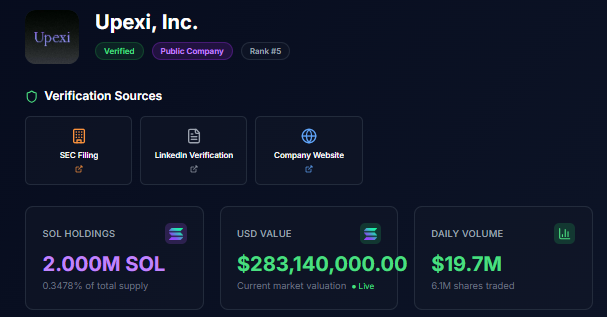
The company’s treasury holds roughly 2 million SOL, valued at $283 million, representing about 0.35% of Solana’s total supply.
Source: Sol Treasury

Despite a recent decline in Solana’s price, from about $143 to $134, Upexi’s on-chain reserves remain among the largest institutional holdings in the ecosystem.

The firm’s crypto-backed position has, however, been mirrored by sharp volatility in its own stock, which has fallen nearly 47% over the past month from a high of $6.50 to around $3.43.

Source: Sol Treasury

Upexi’s move comes amid a turbulent period for Solana-linked treasuries. According to institutional reserve data, the top 20 Solana treasury and ETF holders control 24 million SOL worth about $3.4 billion, or 3.5% of the total supply.

Source: Sol Treasury

Around half of these holdings are staked for yield at an average return of 7.7%, while the remainder remains liquid for balance sheet management.

Forward Industries (FORD) leads with 6.8 million SOL valued near $966 million, followed by Solana Company (HSDT), DeFi Development Corp (DFDV), Sharps Technology (STSS), and Upexi rounding out the top five.

These firms account for roughly 76% of all institutional Solana holdings, showing how companies use digital assets strategically.

Solana Treasury Firms Trade Below Asset Value as Institutions Maintain Positions

Market data shows that despite Solana’s price drop of nearly 7% in 24 hours, institutional positions have largely remained intact, with no major liquidations reported.

Analysts view this stability as a sign of long-term confidence in Solana’s network fundamentals and its growing role as a blockchain for corporate treasuries.

Public market valuations differ. Most Solana treasuries are currently trading at a discount to their net asset value (mNAV), indicating investor caution

Upexi’s mNAV stands at 0.68, while Forward Industries sits at 0.82, suggesting cautious sentiment in equity markets despite strong on-chain balance sheets.

The divergence between treasury value and stock performance has been a defining feature of the DAT sector.

Upexi, which reported $66.7 million in net income in its most recent quarter, driven largely by $78 million in unrealized Solana gains, still faces investor skepticism tied to broader crypto market swings.

Its stock previously surged more than 600% after revealing its Solana strategy earlier this year, but has since retraced sharply as digital assets weakened.

Other treasuries act similarly. On November 6, Forward Industries authorized a $1 billion share repurchase program for flexibility amid volatility.

Despite the short-term pullback in prices, the overall trend in corporate Solana holdings remains upward.

The rise of Solana-focused treasuries marks an evolution from the Bitcoin treasury strategies that dominated earlier cycles.

These firms use Solana not only as a store of value but also as a yield-generating asset through staking and validator participation.

Companies like DFDV, which stakes its entire 2.2 million SOL holding, illustrate how treasury management in crypto is becoming more active and income-driven.

Disclaimer: The articles reposted on this site are sourced from public platforms and are provided for informational purposes only. They do not necessarily reflect the views of MEXC. All rights remain with the original authors. If you believe any content infringes on third-party rights, please contact [email protected] for removal. MEXC makes no guarantees regarding the accuracy, completeness, or timeliness of the content and is not responsible for any actions taken based on the information provided. The content does not constitute financial, legal, or other professional advice, nor should it be considered a recommendation or endorsement by MEXC.

You May Also Like

The Channel Factories We’ve Been Waiting For

The Channel Factories We’ve Been Waiting For

The post The Channel Factories We’ve Been Waiting For appeared on BitcoinEthereumNews.com. Visions of future technology are often prescient about the broad strokes while flubbing the details. The tablets in “2001: A Space Odyssey” do indeed look like iPads, but you never see the astronauts paying for subscriptions or wasting hours on Candy Crush.  Channel factories are one vision that arose early in the history of the Lightning Network to address some challenges that Lightning has faced from the beginning. Despite having grown to become Bitcoin’s most successful layer-2 scaling solution, with instant and low-fee payments, Lightning’s scale is limited by its reliance on payment channels. Although Lightning shifts most transactions off-chain, each payment channel still requires an on-chain transaction to open and (usually) another to close. As adoption grows, pressure on the blockchain grows with it. The need for a more scalable approach to managing channels is clear. Channel factories were supposed to meet this need, but where are they? In 2025, subnetworks are emerging that revive the impetus of channel factories with some new details that vastly increase their potential. They are natively interoperable with Lightning and achieve greater scale by allowing a group of participants to open a shared multisig UTXO and create multiple bilateral channels, which reduces the number of on-chain transactions and improves capital efficiency. Achieving greater scale by reducing complexity, Ark and Spark perform the same function as traditional channel factories with new designs and additional capabilities based on shared UTXOs.  Channel Factories 101 Channel factories have been around since the inception of Lightning. A factory is a multiparty contract where multiple users (not just two, as in a Dryja-Poon channel) cooperatively lock funds in a single multisig UTXO. They can open, close and update channels off-chain without updating the blockchain for each operation. Only when participants leave or the factory dissolves is an on-chain transaction…
Share
BitcoinEthereumNews2025/09/18 00:09
Gold continues to hit new highs. How to invest in gold in the crypto market?

Gold continues to hit new highs. How to invest in gold in the crypto market?

As Bitcoin encounters a "value winter", real-world gold is recasting the iron curtain of value on the blockchain.
Share
PANews2025/04/14 17:12
XRP Multi-Year Accumulation Signals Potential 1000% Breakout

XRP Multi-Year Accumulation Signals Potential 1000% Breakout

The post XRP Multi-Year Accumulation Signals Potential 1000% Breakout appeared on BitcoinEthereumNews.com. XRP Builds Multi-Year Base as Whales Accumulate and Volume
Share
BitcoinEthereumNews2026/03/21 00:04