Balancer, a major DeFi protocol, has suffered a significant exploit, with approximately $116 million drained from protocol vaults. On-chain data shows large, unusual outflows from Balancer’s “0xBA1…BF2C8” address to an external wallet, including 6,587 WETH (~$24.5M), 6,851 osETH (~$26.9M), and 4,260 wstETH (~$19.3M). The scale and nature of the transfers point to a coordinated attack involving high-value assets across multiple vaults. Balancer has since confirmed the breach, stating that “around 7:48 AM UTC, an exploit affected Balancer V2 Composable Stable Pools.” According to the team, these pools have been live for several years, and some were outside the pause window, leaving them vulnerable. Pools that could be paused have been halted and are now in recovery mode, with the exploit confirmed to be isolated to V2 Composable Stable Pools. Balancer V3 and all other pools remain unaffected. The protocol says it is working with leading security researchers and legal teams to investigate and will release a full post-mortem. Balancer also warned users about fraudulent communications circulating in the aftermath, emphasizing that official updates will only come through its verified X account and official Discord. This incident marks one of the largest DeFi exploits of the year and has heightened security concerns across the sector. Related Reading: Whale Piles Into ASTER Shorts After CZ’s Comment – $52.8M On the Line Hacker Offloads Stolen Tokens Into ETH as Crypto Markets Face Broad Selloff According to Lookonchain, the Balancer exploiter has begun swapping the stolen assets for ETH, accelerating concerns that the attacker intends to consolidate and move value quickly before defenses or recovery mechanisms can engage. Converting large amounts of liquid-staking tokens and wrapped assets into ETH not only solidifies the hacker’s control over the stolen funds but also signals an intent to exit positions entirely rather than negotiate or return funds — a troubling sign for victims and the protocol. This development is unfolding during one of the sharpest pullbacks the market has seen in recent months. Ethereum has fallen below $3,500, a key psychological and technical level, while Bitcoin has broken under the $105,000 support, intensifying fears of deeper downside as liquidity thins and sentiment deteriorates. Altcoins, already under pressure from macro-driven derisking, are bleeding heavily, with capital rotation stalling and speculative flows evaporating. For Balancer, the timing compounds the severity of the crisis. A major security breach during a fragile market period magnifies losses, erodes confidence, and increases the risk of liquidity dislocations. The DeFi ecosystem is now closely watching both the hacker’s next moves and Balancer’s recovery plan as the sector navigates heightened stress on both technical and sentiment fronts. Related Reading: Balancer Protocol Sees $70M Exit In Suspected Crypto Exploit BAL Breaks Down Further As Market Selloff Drives Heavy Pressure BAL has entered another phase of sustained weakness, with the weekly chart showing a clear downtrend that has now intensified following the confirmed exploit. After trading near the $1 region for months, the token has broken lower, currently hovering around $0.80 and showing a sharp weekly decline. The chart reflects heavy selling volume, suggesting that the security breach accelerated an already fragile market structure. Technically, BAL remains below the 50-week and 200-week moving averages, reinforcing a long-term bearish trend with no immediate signs of reversal. Each attempt to establish support has been met with lower highs and breakdowns, indicating persistent distribution and a lack of sustained buyer interest. The recent spike in volume during the selloff confirms capitulation behavior rather than accumulation, as fear spreads across the DeFi sector. Related Reading: Bitmine Buys 44,036 Ethereum Worth $166M During Market Dip – Details Market sentiment around BAL has deteriorated further given the exploit’s timing. With Ethereum trading below $3,500, Bitcoin losing key support near $105,000, and altcoins bleeding across the board, risk appetite is at a low point. For BAL to show recovery signals, it would need to reclaim psychological support near $1 and stabilize volume flows. Until then, price action remains vulnerable, and further downside cannot be ruled out as confidence rebuilds slowly. Featured image from ChatGPT, chart from TradingView.comBalancer, a major DeFi protocol, has suffered a significant exploit, with approximately $116 million drained from protocol vaults. On-chain data shows large, unusual outflows from Balancer’s “0xBA1…BF2C8” address to an external wallet, including 6,587 WETH (~$24.5M), 6,851 osETH (~$26.9M), and 4,260 wstETH (~$19.3M). The scale and nature of the transfers point to a coordinated attack involving high-value assets across multiple vaults. Balancer has since confirmed the breach, stating that “around 7:48 AM UTC, an exploit affected Balancer V2 Composable Stable Pools.” According to the team, these pools have been live for several years, and some were outside the pause window, leaving them vulnerable. Pools that could be paused have been halted and are now in recovery mode, with the exploit confirmed to be isolated to V2 Composable Stable Pools. Balancer V3 and all other pools remain unaffected. The protocol says it is working with leading security researchers and legal teams to investigate and will release a full post-mortem. Balancer also warned users about fraudulent communications circulating in the aftermath, emphasizing that official updates will only come through its verified X account and official Discord. This incident marks one of the largest DeFi exploits of the year and has heightened security concerns across the sector. Related Reading: Whale Piles Into ASTER Shorts After CZ’s Comment – $52.8M On the Line Hacker Offloads Stolen Tokens Into ETH as Crypto Markets Face Broad Selloff According to Lookonchain, the Balancer exploiter has begun swapping the stolen assets for ETH, accelerating concerns that the attacker intends to consolidate and move value quickly before defenses or recovery mechanisms can engage. Converting large amounts of liquid-staking tokens and wrapped assets into ETH not only solidifies the hacker’s control over the stolen funds but also signals an intent to exit positions entirely rather than negotiate or return funds — a troubling sign for victims and the protocol. This development is unfolding during one of the sharpest pullbacks the market has seen in recent months. Ethereum has fallen below $3,500, a key psychological and technical level, while Bitcoin has broken under the $105,000 support, intensifying fears of deeper downside as liquidity thins and sentiment deteriorates. Altcoins, already under pressure from macro-driven derisking, are bleeding heavily, with capital rotation stalling and speculative flows evaporating. For Balancer, the timing compounds the severity of the crisis. A major security breach during a fragile market period magnifies losses, erodes confidence, and increases the risk of liquidity dislocations. The DeFi ecosystem is now closely watching both the hacker’s next moves and Balancer’s recovery plan as the sector navigates heightened stress on both technical and sentiment fronts. Related Reading: Balancer Protocol Sees $70M Exit In Suspected Crypto Exploit BAL Breaks Down Further As Market Selloff Drives Heavy Pressure BAL has entered another phase of sustained weakness, with the weekly chart showing a clear downtrend that has now intensified following the confirmed exploit. After trading near the $1 region for months, the token has broken lower, currently hovering around $0.80 and showing a sharp weekly decline. The chart reflects heavy selling volume, suggesting that the security breach accelerated an already fragile market structure. Technically, BAL remains below the 50-week and 200-week moving averages, reinforcing a long-term bearish trend with no immediate signs of reversal. Each attempt to establish support has been met with lower highs and breakdowns, indicating persistent distribution and a lack of sustained buyer interest. The recent spike in volume during the selloff confirms capitulation behavior rather than accumulation, as fear spreads across the DeFi sector. Related Reading: Bitmine Buys 44,036 Ethereum Worth $166M During Market Dip – Details Market sentiment around BAL has deteriorated further given the exploit’s timing. With Ethereum trading below $3,500, Bitcoin losing key support near $105,000, and altcoins bleeding across the board, risk appetite is at a low point. For BAL to show recovery signals, it would need to reclaim psychological support near $1 and stabilize volume flows. Until then, price action remains vulnerable, and further downside cannot be ruled out as confidence rebuilds slowly. Featured image from ChatGPT, chart from TradingView.com

Balancer Hacker Now Converting Loot to Ethereum: Stolen Funds Surge To $116.6M

2025/11/05 00:00
4 min read

Balancer, a major DeFi protocol, has suffered a significant exploit, with approximately $116 million drained from protocol vaults. On-chain data shows large, unusual outflows from Balancer’s “0xBA1…BF2C8” address to an external wallet, including 6,587 WETH (~$24.5M), 6,851 osETH (~$26.9M), and 4,260 wstETH (~$19.3M). The scale and nature of the transfers point to a coordinated attack involving high-value assets across multiple vaults.

Balancer Hacker Portfolio | Source: Lookonchain

Balancer has since confirmed the breach, stating that “around 7:48 AM UTC, an exploit affected Balancer V2 Composable Stable Pools.” According to the team, these pools have been live for several years, and some were outside the pause window, leaving them vulnerable. Pools that could be paused have been halted and are now in recovery mode, with the exploit confirmed to be isolated to V2 Composable Stable Pools. Balancer V3 and all other pools remain unaffected.

The protocol says it is working with leading security researchers and legal teams to investigate and will release a full post-mortem. Balancer also warned users about fraudulent communications circulating in the aftermath, emphasizing that official updates will only come through its verified X account and official Discord.

This incident marks one of the largest DeFi exploits of the year and has heightened security concerns across the sector.

Hacker Offloads Stolen Tokens Into ETH as Crypto Markets Face Broad Selloff

According to Lookonchain, the Balancer exploiter has begun swapping the stolen assets for ETH, accelerating concerns that the attacker intends to consolidate and move value quickly before defenses or recovery mechanisms can engage. Converting large amounts of liquid-staking tokens and wrapped assets into ETH not only solidifies the hacker’s control over the stolen funds but also signals an intent to exit positions entirely rather than negotiate or return funds — a troubling sign for victims and the protocol.
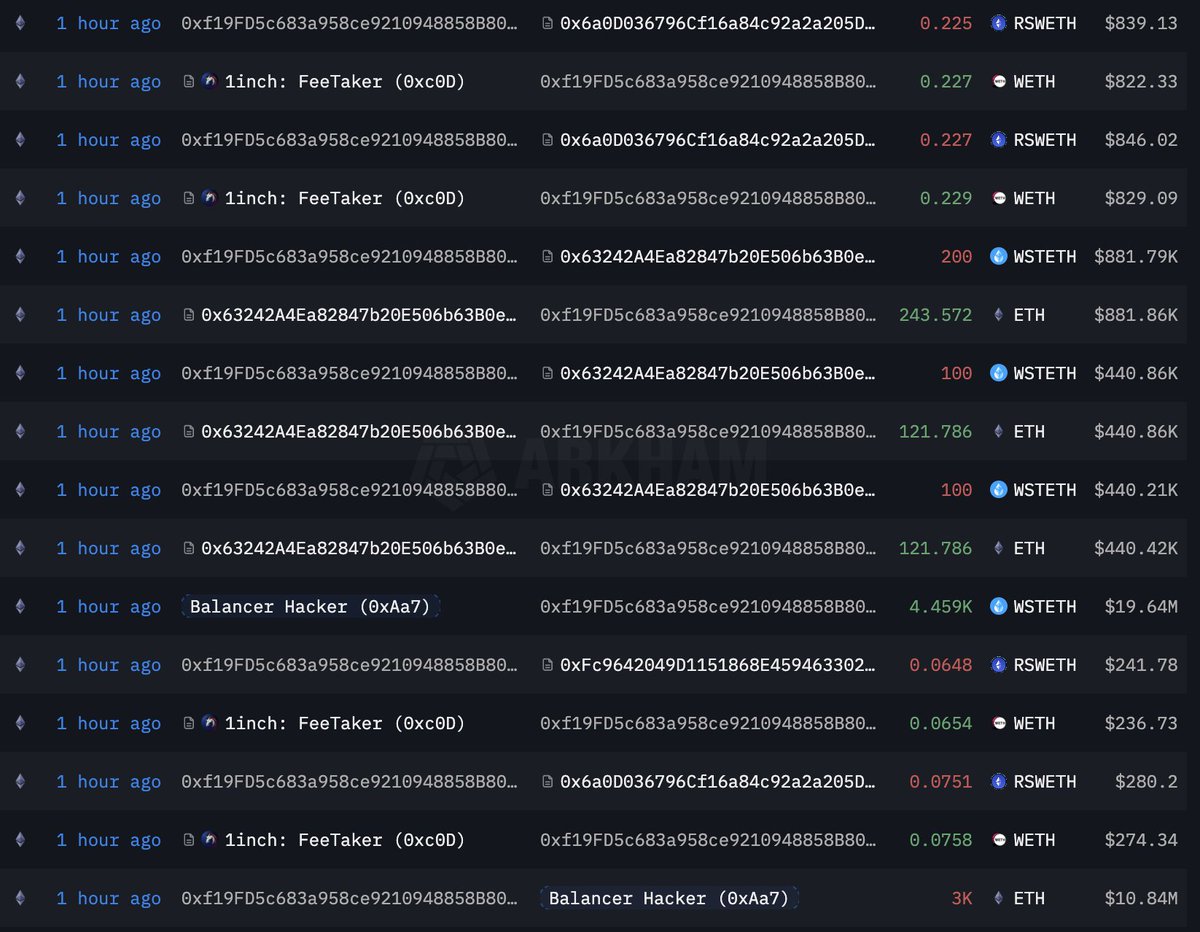
Balancer Hacker Swapping Stolen Assets | Source: Lookonchain

This development is unfolding during one of the sharpest pullbacks the market has seen in recent months. Ethereum has fallen below $3,500, a key psychological and technical level, while Bitcoin has broken under the $105,000 support, intensifying fears of deeper downside as liquidity thins and sentiment deteriorates. Altcoins, already under pressure from macro-driven derisking, are bleeding heavily, with capital rotation stalling and speculative flows evaporating.

For Balancer, the timing compounds the severity of the crisis. A major security breach during a fragile market period magnifies losses, erodes confidence, and increases the risk of liquidity dislocations. The DeFi ecosystem is now closely watching both the hacker’s next moves and Balancer’s recovery plan as the sector navigates heightened stress on both technical and sentiment fronts.

BAL Breaks Down Further As Market Selloff Drives Heavy Pressure

BAL has entered another phase of sustained weakness, with the weekly chart showing a clear downtrend that has now intensified following the confirmed exploit. After trading near the $1 region for months, the token has broken lower, currently hovering around $0.80 and showing a sharp weekly decline. The chart reflects heavy selling volume, suggesting that the security breach accelerated an already fragile market structure.
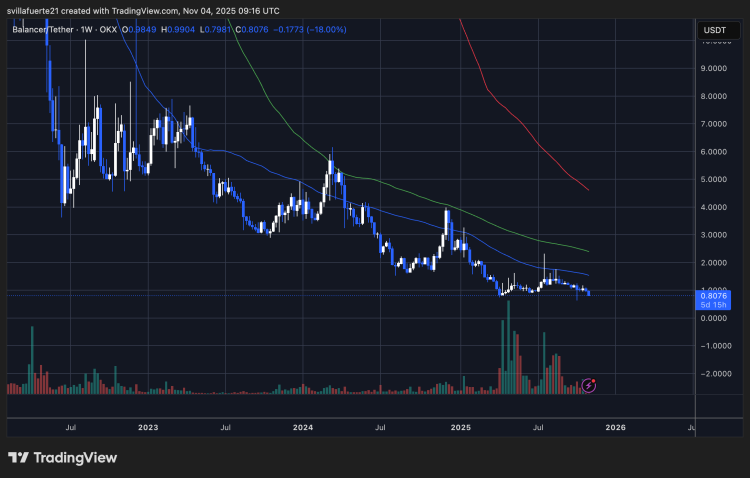
BAL downtrend continuation | Source: BALUSDT chart on TradingView

Technically, BAL remains below the 50-week and 200-week moving averages, reinforcing a long-term bearish trend with no immediate signs of reversal. Each attempt to establish support has been met with lower highs and breakdowns, indicating persistent distribution and a lack of sustained buyer interest. The recent spike in volume during the selloff confirms capitulation behavior rather than accumulation, as fear spreads across the DeFi sector.

Market sentiment around BAL has deteriorated further given the exploit’s timing. With Ethereum trading below $3,500, Bitcoin losing key support near $105,000, and altcoins bleeding across the board, risk appetite is at a low point. For BAL to show recovery signals, it would need to reclaim psychological support near $1 and stabilize volume flows. Until then, price action remains vulnerable, and further downside cannot be ruled out as confidence rebuilds slowly.

Featured image from ChatGPT, chart from TradingView.com

Market Opportunity
Nowchain Logo
Nowchain Price(NOW)
$0.000695
$0.000695$0.000695
+2.78%
USD
Nowchain (NOW) Live Price Chart
Disclaimer: The articles reposted on this site are sourced from public platforms and are provided for informational purposes only. They do not necessarily reflect the views of MEXC. All rights remain with the original authors. If you believe any content infringes on third-party rights, please contact [email protected] for removal. MEXC makes no guarantees regarding the accuracy, completeness, or timeliness of the content and is not responsible for any actions taken based on the information provided. The content does not constitute financial, legal, or other professional advice, nor should it be considered a recommendation or endorsement by MEXC.

You May Also Like

The Next “Big Story” in Crypto: Crypto Credit and Borrowing, Says Bitwise CEO

The Next “Big Story” in Crypto: Crypto Credit and Borrowing, Says Bitwise CEO

Bitwise CEO has recently predicted a major growth for the crypto borrowing and credit sector, calling it the next “big story.” The post The Next “Big Story” in Crypto: Crypto Credit and Borrowing, Says Bitwise CEO appeared first on Coinspeaker.
Share
Coinspeaker2025/09/18 22:16
SEC New Standards to Simplify Crypto ETF Listings

SEC New Standards to Simplify Crypto ETF Listings

The post SEC New Standards to Simplify Crypto ETF Listings appeared on BitcoinEthereumNews.com. The United States Securities and Exchange Commission (SEC) approved a new standard for crypto ETF listings on Wednesday. The standard is created to simplify the working of exchanges in terms of the process followed for crypto ETP listings. This makes it possible to to avoid the cumbersome route of case-by-case approval being followed so far. With this change, exchanges can bypass the 19(b) rule filing process. It is a review that can stretch up to 240 days and demands direct SEC approval before an ETF can launch. Instead of going through the tedious and lengthy review process, the SEC has set up a system that allows exchanges to act more quickly. Now, when an ETF issuer presents a product idea to exchanges like Nasdaq, NYSE, or CBOE, the exchange can move ahead as long as the proposal meets the generic listing standard. This means that strategies based on a single token or a basket of tokens can be listed without waiting for individual approval. New Standards Will Ease Crypto ETF Listings: SEC Chairman According to the Chairman of the SEC, Paul Atkins, this move is aimed at making it easier for investors to access digital asset products through regulated U.S. markets. He noted that by approving generic listing standards, the agency is helping U.S. capital markets remain a global leader in digital asset innovation. At the same time, the SEC approved the Grayscale Digital Large Cap Fund, a fund made up of Bitcoin, Ethereum, XRP, Cardano and Solana. Furthermore, the SEC also approved a new type of options linked to the Cboe Bitcoin U.S. ETF Index and its mini version. This step further expands the range of crypto-linked derivatives available in regulated U.S. markets. How Will SEC General Listing Standard Impact Altcoin Crypto ETF Market? The SEC’s updated listing standards could clear…
Share
BitcoinEthereumNews2025/09/18 21:38
Victra Named 2025 Recipient of Verizon’s Best Build Compliance Award

Victra Named 2025 Recipient of Verizon’s Best Build Compliance Award

Verizon Recognizes Victra for Industry-Leading Excellence in Store Design and Brand Compliance. RALEIGH, N.C., Feb. 3, 2026 /PRNewswire/ — Verizon has named Victra
Share
AI Journal2026/02/03 20:49