

Where Could Celestia (TIA) Price Go Next as Selling Pressure Begins to Fade?
Celestia (TIA) is one of today’s biggest winners. It’s up over 8% and trading around $0.4151. The broader market only managed a 1.1% bump, so TIA is pulling in way more attention than most other coins.
One thing helping is the Altcoin Season Index on CoinMarketCap jumped 13.33% to 51. That means money is starting to flow out of Bitcoin and into riskier altcoins. Doesn’t mean the rally will last, but it sure makes the ground softer for projects like Celestia.
On top of that, people are getting interested again in modular blockchains and the upgrades Celestia keeps rolling out. All of it’s giving investors fresh reasons to keep an eye on where TIA goes next.
Why Has Celestia (TIA) Struggled for So Long?
The TIA price has spent nearly two years moving lower after its explosive launch. Crypto analyst PnLzero believes the decline had little to do with Celestia’s technology. Instead, every recovery attracted another round of selling as early investors locked in profits following the token’s parabolic rally.
As liquidity faded and market interest cooled, sellers remained in control. That kept the TIA price under pressure even as the broader modular blockchain narrative continued to develop. Extended downtrends like this are common after rapid launches, especially when token unlocks and early profit-taking weigh on demand.
PnLzero argues the picture could begin changing once selling pressure is fully absorbed. In that scenario, even a modest increase in buying demand could improve the market structure.
The analyst believes the previous all-time high near $30 becomes the long-term reference point if buyers fully regain control, though any recovery would likely include periods of consolidation and volatility.
Read Also: Bitcoin Price Flashes Every Bottom Signal, Except One Thing Is Missing
What’s Supporting the Celestia Price Right Now?
Celestia continues improving its network performance through a series of technical upgrades. The Ginger upgrade reduced block times from 12 seconds to 6 seconds, immediately doubling data availability throughput and allowing transactions to reach finality more quickly. Faster performance makes the network more attractive for rollups that rely on Celestia for data availability.
Development is also moving toward even faster processing speeds. The Mammoth Mini testnet already pulled off some impressive numbers, 88 MB blocks, about 27 MB per second in throughput, and 3-second block times, all thanks to new networking tech. It’s still just a testnet for now, but it shows exactly where things are headed on the scalability front.
There’s more. The V8 protocol upgrade is also moving forward. It’s already running on the Mocha testnet, with a Mainnet Beta release coming next.
The upgrade introduces single-signature cross-chain transfers and zero-knowledge verified messaging, making interoperability easier for rollups built on Celestia. If developer adoption follows, demand for TIA could increase as more projects pay fees using the token.
Read Also: XRP vs HBAR vs XLM vs XDC: Which Crypto Has the Fastest Acceleration Path?
Here’s What the TIA Chart Is Showing
We had a look at the chart, and the long-term trend is still recovering from a prolonged decline that began shortly after the token reached its all-time high. The chart shows nearly two years of lower highs and lower lows before price began stabilizing near the current range, where selling pressure appears to be easing.
The illustration also identifies the current area as a potential accumulation zone. After months of sideways trading near historical lows, buyers have started returning, producing higher lows and improving momentum.
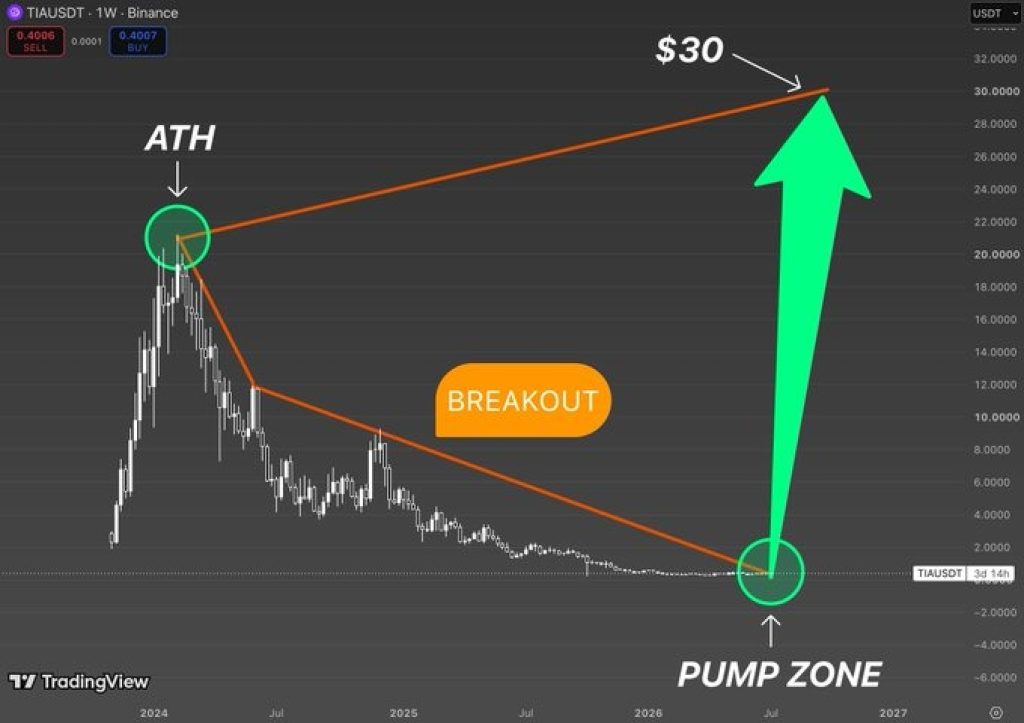 Source: X/PnLzero
Even though the recovery remains in its early stages, this is the first sustained period where sellers have failed to push the TIA price to fresh lows.
The next resistance comes from previous breakdown levels above the market. A move through those zones would strengthen the recovery and confirm that buyers are taking back control. Failing there could keep the TIA price trading within its existing range until stronger demand returns.
Read Also: $5,000 in Dogecoin (DOGE) Today: Here’s What It Could Be Worth by the End of September
Where Could Celestia (TIA) Price Go If Selling Pressure Finally Ends?
If buyers keep eating up whatever supply hits the market and TIA pushes past its nearby walls, the token could run to $0.60 or even $0.80 in the coming months. More adoption across the ecosystem would only fuel that fire.
The more likely, boring path? The Celestia price just trades sideways between $0.40 and $0.60 for a while. That gives the market time to build a solid base before making any bigger moves, especially as network upgrades keep rolling out.
Things get ugly if buyers can’t hold the current support zone. If that fails, TIA could slide back down to its recent lows. From there, any real upward move would have to wait until fresh buyers step back in.
Frequently Asked Questions

Price forecasts for Celestia vary, with one projection estimating TIA could trade around $0.34 in 2027 if it grows at an average rate of 5% per year. Actual performance will depend on market conditions, network adoption, and overall demand for modular blockchain solutions.
Celestia could appeal to investors who believe in the long-term potential of modular blockchain technology and data availability. However, the token remains highly volatile, and current market indicators point to cautious sentiment, making it important to weigh the risks before investing.
Subscribe to our YouTube channel for daily crypto updates, market insights, and expert analysis.
The post Where Could Celestia (TIA) Price Go Next as Selling Pressure Begins to Fade? appeared first on CaptainAltcoin.


You May Also Like

PMI-ACP Exam Preparation: How to Use a Simulator and Practice Questions Effectively

The Chemistry of UV Resistance: How Titanium Dioxide Protects Against the California Sun

Robotics Automation Prototyping: Engineering Kinetic Agility into End-Effectors



