

Vitalik Buterin Unveils "Extremely Lean Chain" Vision for Ethereum Consensus
Key highlights:
- Ethereum co-founder Vitalik Buterin has published a proposal to make Ethereum an “extremely lean chain."
- The core plan involves the radical slash of state requirements and offloading the bulk of bookkeeping burden to individual validators
- Buterin is eyeing a four-year roadmap for the third iteration of Ethereum to overhaul every component of the network
Barely a day after unveiling the roadmap for Lean Ethereum, Vitalik Buterin has published a new proposal to strip down the network’s proof-of-stake consensus layer. Dubbed the “Extremely Lean Chain,” the Ethereum founder is tinkering with the prospect of the network scaling to millions of validators.
Vitalik Buterin pushes the limit for Ethereum’s lean chain ambitions
The latest proposal to make Ethereum leaner will involve validators periodically generating STARK proofs of their participation and balance changes, rather than relying on the protocol to recompute this data. According to Buterin, the change will remove the burden of “end-of-epoch processing” from the protocol, unlocking a raft of benefits for the network. He wrote:
At the moment, Ethereum carries a substantial per-validator footprint underscored by a 48-byte public key, 32 bytes of withdrawal credentials, an effective balance, several epoch markers, and an active balance. In his post, Buterin noted that updating this data is one of the most expensive operations in the Ethereum consensus layer.
Right off the bat, Buterin’s proposal will ditch storing a validator’s full key on-chain and keep only a compact index into the deposit tree. Furthermore, Buterin is pushing for self-proven balances with all reward and penalty processing stripped from Ethereum's state-transition function.
Buterin added that in a more advanced version of the design, the concept of a permanent validator registry disappears, with validators required to register a fresh key each day. Meanwhile, the proposal will support shielded withdrawals with privacy and speed reaching a new zenith if the proposal is implemented.
Last week, Buterin warned that crypto’s biggest privacy breakthrough is still several years away. The Ethereum co-founder pointed to obfuscation as the last hurdle for advanced on-chain privacy functionality, adding that privacy coins are only a temporary fix.
A four-year roadmap for Lean Ethereum
The proposal landed after Buterin summarized a high-level research gathering in Berlin that set out a multi-year roadmap for Lean Ethereum. The roadmap, scheduled to come online over four years, is dubbed to be the “third major iteration” of Ethereum in the same class as the Merge.
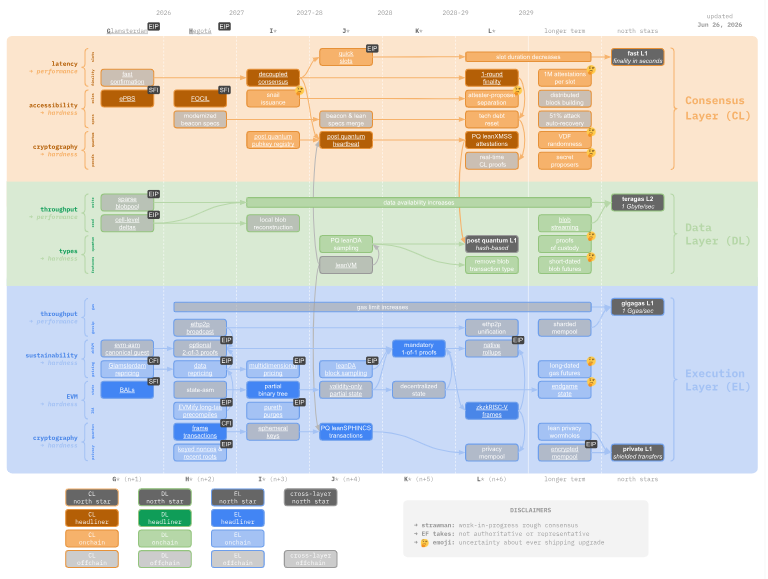
Source: Strawmap.org
According to Buterin, Lean Ethereum will replace almost every piece of the protocol, teeing up the network for a quantum-resistant future. Lean Ethereum will replace everything quantum-vulnerable with quantum-safe alternatives while prioritizing privacy as a “first-class goal.”
As part of the upgrades, the network will reduce computational overhead for verification by turning to recursive STARKS while introducing multidimensional gas pricing as part of a consensus overhaul.
The incoming changes come amid a wave of emerging independent research and development organizations angling to support the Ethereum ecosystem. Last month, Ethlabs and Ethereum Institutional launched with major ecosystem backing on the heels of a shrinking Ethereum Foundation.
In its defense, the Ethereum Foundation disclosed that it is transitioning into a leaner organization while actively decentralizing its power. In June, the organization slashed its budget by 40% and laid off around 20% of its employees.


You May Also Like

DataZapp: Smarter Marketing Data Strategies for Insurance Agencies Looking to Reduce Acquisition Costs

Saudi Arabia considers expansion of Red Sea oil pipeline

Pico and ITRS Partner to Bring Network-Derived Observability to Indian Financial Markets



