

Coinbase Stock Falls 35% From Its Highs Even as It Hits a Record Trading Share
Key Stats for Coinbase Stock
- 52-Week Range: $139 – $445
- Current Price: $165
- Street Target: $229
- TIKR Model Target: $313
- Market Cap: $43.6 billion
- Q1 2026 Revenue: $1.4 billion, down 21% quarter over quarter
- Q1 2026 Net Loss: $394 million
- Crypto Trading Volume Market Share: all-time high of 8.6%
Value your favorite stocks like Coinbase with TIKR’s Guided Valuation Model (It’s free) >>>
A Familiar Drawdown for a Company Used to Crypto’s Swings
Coinbase (COIN) just reported its second straight quarterly loss. Total revenue fell to $1.4 billion in the first quarter, down 21% from the prior quarter and 31% from a year ago, as crypto trading volumes across the entire market dropped more than 20% amid rising macro uncertainty. Transaction revenue, Coinbase’s most crypto-sensitive line, fell to $756 million.
The stock has felt it, with shares now trading around $165, down about 35% from earlier this year.
 Coinbase Stock Drawdowns. (TIKR)
The drawdown chart shows a stock that spent most of 2026 churning through repeated declines rather than a single sharp break. Coinbase hit its steepest drawdown of the year, just under 45%, back in February, then spent the following months recovering only to fall again each time crypto sentiment soured.
That pattern, drop, partial recovery, drop again, is the signature of a stock tightly bound to crypto prices rather than one facing a company-specific problem. The most recent leg down tracks the broader crypto market’s own struggles this year, not anything unique to Coinbase’s execution.
See analysts’ growth forecasts and price targets for COIN (It’s free) >>>
Why Coinbase’s Revenue Swings This Hard, and Why That Isn’t New
Coinbase’s business has always moved with the crypto market’s cycles, and the annual revenue history makes that unusually clear.
 Coinbase Stock Revenues. (TIKR)
Revenue hit $7.4 billion in 2021 during peak crypto euphoria, then collapsed to around $3.1 billion in 2022 and $2.9 billion in 2023 as the market cooled. It then rebounded sharply to $6.3 billion in 2024 and $6.9 billion in 2025 as trading activity returned.
That’s not a steady growth curve. It’s a business whose revenue compresses and expands with the crypto cycle itself, and the current quarter’s decline sits well within that same historical pattern rather than representing something new.
What has changed is what Coinbase does during the down years. The company’s crypto trading volume market share reached an all-time high of 8.6% in the first quarter, even as the broader market shrank.
Subscription and services revenue, which doesn’t depend on trading activity, reached $584 million and now makes up 44% of net revenue. And Coinbase still posted a 13th consecutive quarter of positive Adjusted EBITDA despite the net loss, meaning the core business generated cash even in a down quarter.
Those are the metrics that matter more than the headline loss when judging whether this downturn looks structural or cyclical.
Run your own Coinbase valuation in under 60 seconds (Free with TIKR) >>>
What Does the Valuation Model Say?
TIKR’s model uses a current price of $165 against a mid-case target price around $313, implying a potential total return of around 89% and an annualized return of around 15% over the next four and a half years.
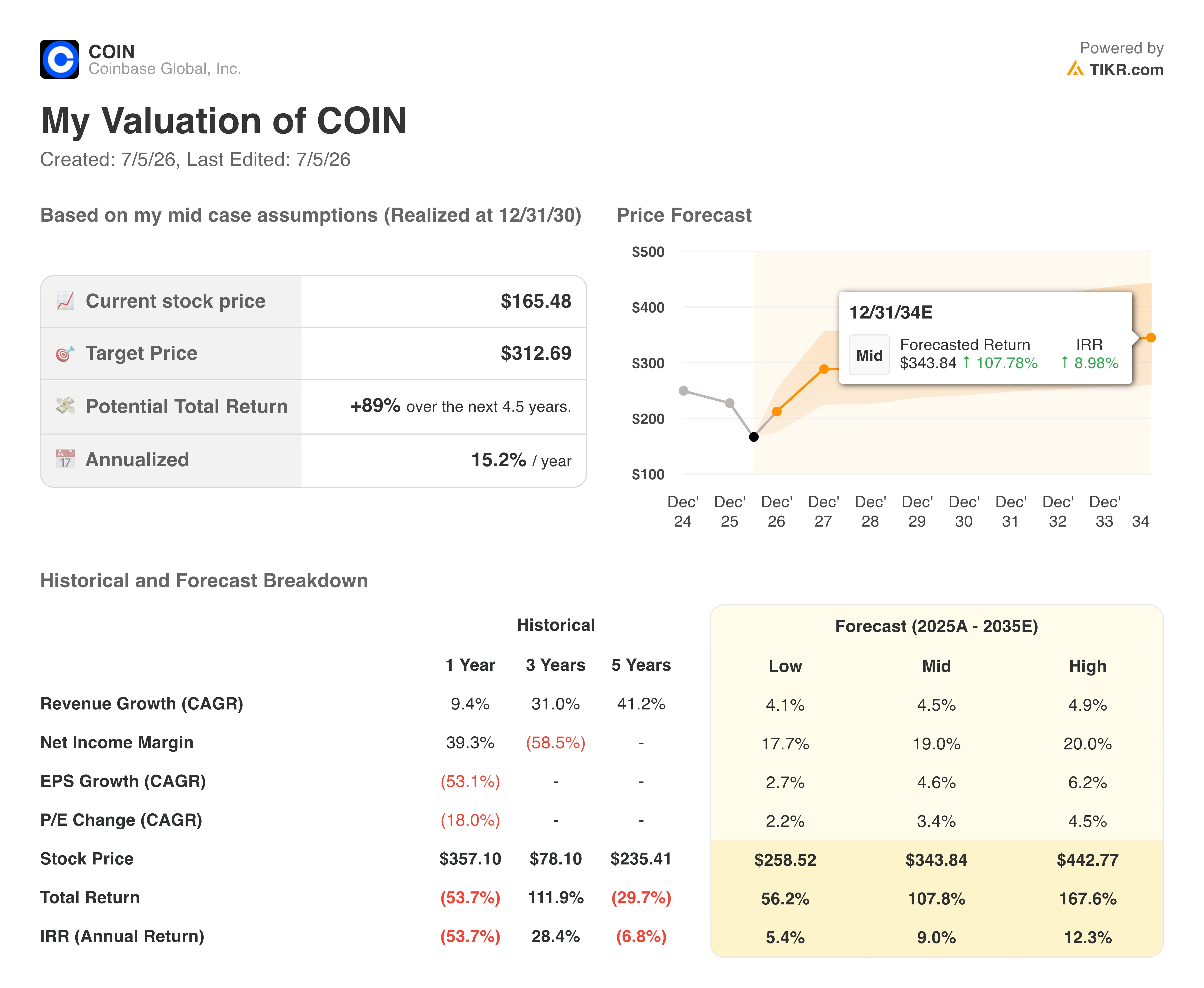 Coinbase Valuation Model. (TIKR)
The assumptions behind that target lean conservative relative to Coinbase’s history. The model’s mid-case has revenue growth of only around 5% a year going forward, a sharp step down from the 31% average annual growth Coinbase posted over the last three years, while net income margin is assumed to recover to around 19%.
In other words, the model isn’t betting on another crypto boom cycle to drive the return. It’s betting on Coinbase holding roughly current revenue levels while margins normalize from this quarter’s loss back toward profitability.
The Street’s own consensus target is lower, at around $229, suggesting analysts are pricing in less margin recovery than TIKR’s model assumes, or greater caution about how long the current trading downturn will persist.
Either way, both frameworks see meaningful upside from today’s price, which is notable for a stock that has already fallen this far.
Should You Invest in Coinbase Global
Coinbase’s drawdown looks like crypto’s usual boom-and-bust pattern playing out again, not a breakdown in the business itself.
Trading revenue is down because the entire crypto market is down, but Coinbase gained market share while that happened, kept subscription revenue growing, and remained cash flow positive despite the loss.
The real question is how long the current crypto downturn lasts and whether Coinbase’s diversification into subscriptions, derivatives, and stablecoins continues to reduce its dependence on trading volume by the time the next cycle turns.
Find out why Coinbase’s stock remains tied to crypto market momentum >>>
Looking for New Opportunities?
- See what stocks billionaire investors are buying so you can follow the smart money.
- Analyze stocks in as little as 5 minutes with TIKR’s all-in-one, easy-to-use platform.
- The more rocks you overturn… the more opportunities you’ll uncover. Search 100K+ global stocks, global top investor holdings, and more with TIKR.
Disclaimer:
Please note that the articles on TIKR are not intended to serve as investment or financial advice from TIKR or our content team, nor are they recommendations to buy or sell any stocks. We create our content based on TIKR Terminal’s investment data and analysts’ estimates. Our analysis might not include recent company news or important updates. TIKR has no position in any stocks mentioned. Thank you for reading, and happy investing!


You May Also Like

Was Michael Burry Right About Palantir? PLTR Is Still Down Over the Past Year

MAGA melts down as Bruce Springsteen torches Trump in new interview: 'He is a coward'

Microsoft (MSFT) Stock Drops as Company Announces 4,800 Layoffs Targeting Xbox



