

US Law Enforcement Drops Objections to CLARITY Act, Report Says
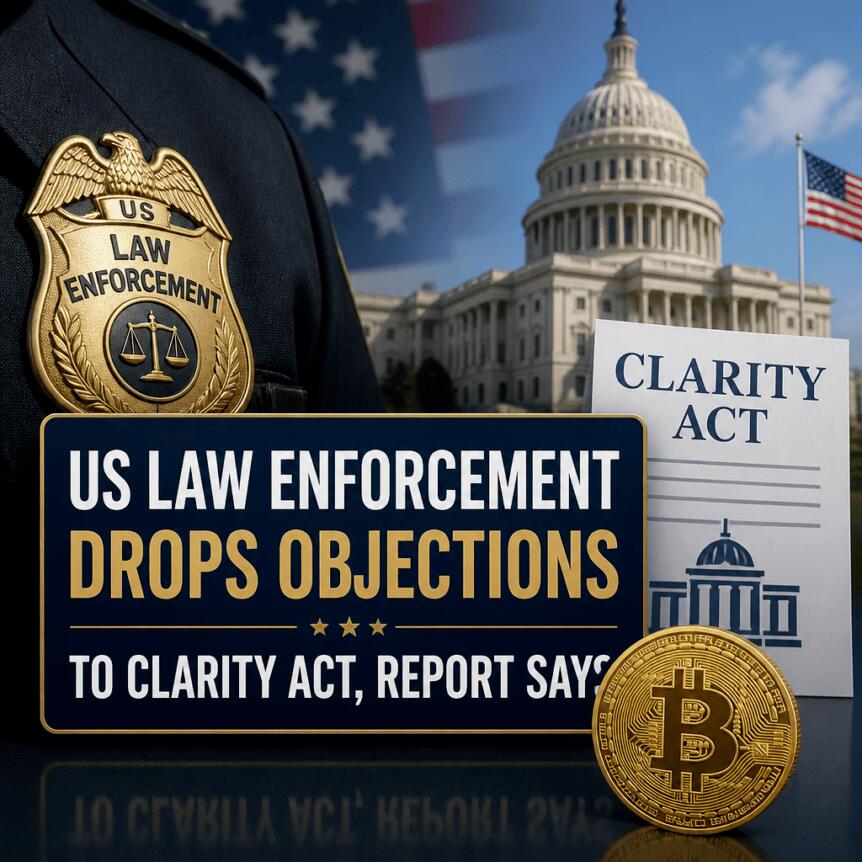
The Major County Sheriffs of America (MCSA) has dropped its opposition to the proposed CLARITY Act, shifting its position to “neutral” after lawmakers addressed concerns it raised in an earlier letter about how the bill could affect illicit finance investigations.
In a letter sent to US Senate Banking Committee chair Tim Scott and Senator Elizabeth Warren on Friday, the group said its stance changed after revisions addressing its objections to Section 604, a provision tied to the Blockchain Regulatory Certainty Act. The development removes a key resistance point from law enforcement stakeholders that had been flagged as a hurdle for the bill’s progress through the Senate.
Key takeaways
- MCSA moved from opposing the CLARITY Act to a neutral position after concerns raised in a May 14 letter about Section 604 were addressed.
- Section 604 is intended to protect blockchain and decentralized platform developers from liability for illicit activity committed by users.
- MCSA previously argued the provision could be exploited by criminals, complicating law enforcement investigations into crypto-related crimes.
- The CLARITY Act still faces delays in the Senate, with banking groups reportedly pushing to limit stablecoin yield arrangements.
- MCSA says it still wants changes—particularly to include state law enforcement in a Section 309 Treasury study of DeFi and illicit finance risks.
Why MCSA’s position shift matters for Senate momentum
Although the CLARITY Act has drawn bipartisan backing, its path to enactment has been slowed. Senators have had to balance support for clearer rules for blockchain and decentralized finance with objections from segments of the financial industry, especially around stablecoin-linked products.
Against that backdrop, MCSA’s shift is notable because it directly concerns the enforcement community—an area where legislators often expect operational consequences to be scrutinized. In its earlier stance, MCSA said Section 604 could create a loophole for bad actors, potentially making it harder for law enforcement to investigate criminal activity facilitated through crypto systems.
By describing its new posture as “neutral,” the group is signaling that revised bill language (or interpretive clarifications) has reduced enough of its concern that it no longer believes the provision should face outright resistance from sheriffs’ leadership.
What Section 604 does—and what law enforcement worried about
Section 604 is part of the Blockchain Regulatory Certainty Act embedded within the broader CLARITY Act. The provision aims to provide developers with regulatory certainty by limiting liability for illicit activity carried out by users on decentralized platforms.
In its May 14 letter, MCSA argued that this protection could be turned into a shield by criminals, enabling misuse without sufficient accountability and thereby complicating investigative work. That concern reflects a broader tension at the heart of many crypto compliance debates: striking a balance between preventing user harm and avoiding rules that inadvertently discourage legitimate development or overreach into decentralized systems.
According to MCSA’s Friday letter, the group’s earlier objections were addressed—enough for it to move to neutrality—suggesting lawmakers incorporated changes related to how Section 604 would operate in practice.
Stablecoin yield concerns remain a major drag on passage
Even as the CLARITY Act retains political support, the bill’s Senate timeline has been affected by resistance tied to stablecoin structures. The bill has largely been stalled by banking groups seeking restrictions on stablecoin yield, which they argue functions like an unregulated deposit product.
As characterized in earlier reporting, critics of yield-bearing stablecoins warn that such arrangements could lead to large-scale outflows from the traditional banking system, potentially reaching “trillions of dollars,” though the exact magnitude is framed as an industry concern rather than a specific forecast tied to the act itself.
The CLARITY Act has been waiting for a full Senate vote since May, when the Senate Banking Committee advanced it largely along party lines. That bottleneck means the bill’s prospects are still highly sensitive to how other constituencies—beyond developers and enforcement—view the practical effects of the proposed compliance regime.
Law enforcement support grows, but MCSA wants further amendments
MCSA’s change in stance is not the end of its engagement with the bill. The group said it still wants modifications to Section 309, which would require the Treasury Department to study decentralized finance and illicit finance risks.
Specifically, MCSA asked that state law enforcement be included in the section. The group’s position underscores how compliance studies and policy implementation often run into real-world capacity gaps: even well-designed legal frameworks can underperform if enforcement agencies lack the tools, training, and partnerships needed to act on the intelligence they receive.
In its letter, MCSA President Bob Gualtieri argued that Congress should provide the training, technology, and resources required to investigate increasingly sophisticated digital asset-enabled crimes. He pointed to a range of alleged criminal activity, including fraud, narcotics trafficking, ransomware, child exploitation, terrorism financing, and other offenses.
That emphasis highlights a key reason the law enforcement community continues to matter in the crypto policy conversation: not just whether legislation creates clearer responsibilities, but whether it is matched by implementation capacity at the local and state level.
What could happen next
With MCSA moving off opposition, the immediate “roadblock” narrative around enforcement stakeholders appears to be easing, but the CLARITY Act still depends on Senate scheduling and on overcoming financial-industry objections—especially around stablecoin yield. Investors and builders should watch whether the bill’s remaining concerns narrow enough to clear a full vote, and whether Section 309 modifications addressing state law enforcement involvement gain traction as lawmakers try to finalize the measure.
This article was originally published as US Law Enforcement Drops Objections to CLARITY Act, Report Says on Crypto Breaking News – your trusted source for crypto news, Bitcoin news, and blockchain updates.


You May Also Like

Evernorth CBO Explains What RLUSD Really Does to XRP

3 Resilient Defense Stocks to Buy in July


