

Securitize Forecasts $400M Funding Round Before US Launch
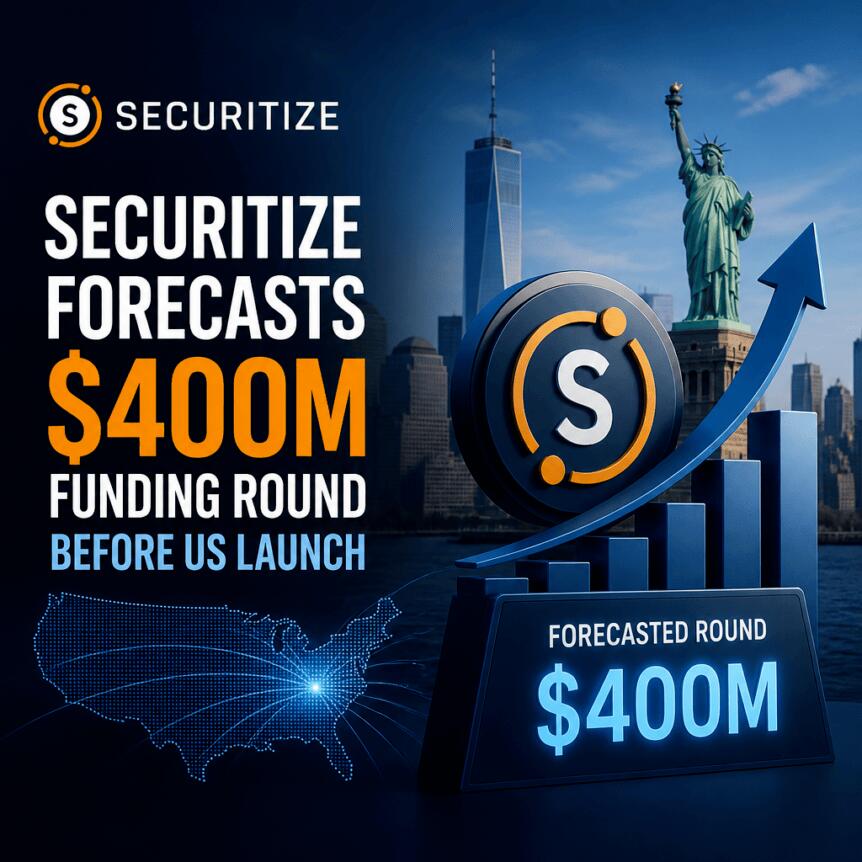
Securitize, a platform for issuing and managing tokenized securities, says it expects to raise roughly $400 million ahead of its planned public debut following a merger with Cantor Fitzgerald-backed SPAC Cantor Equity Partners II (CEPT). The update comes after the company reported final redemption results showing fewer shareholders than anticipated chose to exit the transaction.
In a statement released Friday, Securitize said that less than 30% of CEPT shareholders elected to redeem. With the deal structured to fund the company through merger proceeds and additional capital instruments, the firm estimates it will receive approximately $400 million in gross proceeds from the combination, including PIPE (private investment in public equity) financings, while excluding transaction-related expenses.
Key takeaways
- Securitize expects about $400 million in gross proceeds from its SPAC merger, supported by PIPE financing.
- Final redemption results from CEPT showed under 30% of shareholders redeemed, suggesting stronger-than-expected deal continuation.
- The transaction is scheduled to close on Wednesday, July 1, with trading expected to begin on the New York Stock Exchange on July 2 under the ticker SECZ.
- Securitize’s move highlights growing Wall Street engagement in tokenization as US regulators continue to scrutinize how tokenized securities are traded and implemented.
Redemptions come in lower than expected
SPAC mergers can hinge on whether public shareholders redeem their positions before the deal closes. In Securitize’s case, the company said its final redemption results indicate that fewer than 30% of CEPT investors opted out—an outcome that helped keep the merger on track and supported investor confidence.
Market reaction reflected that dynamic. CEPT shares rose on Friday, closing up 7% to $10.86 and extending gains in after-hours trading to around $11, according to available market listings.
For investors, the practical implication of lower redemptions is that less transaction capital is withdrawn at the last moment, which can reduce funding uncertainty right before a listing. While the merger’s final economics still depend on the deal’s full structure and closing conditions, redemption levels can serve as an early signal of whether the sponsor-backed plan has broad buy-in among the SPAC’s public shareholders.
Timeline: vote, closure, and expected NYSE debut
Securitize and CEPT said the business combination is expected to close on Wednesday, July 1, assuming shareholders approve the deal on Monday and other standard closing conditions are met. After the closing, the combined company is expected to begin trading on the New York Stock Exchange on Thursday, July 2, under the ticker SECZ.
The sequence matters for traders and market participants watching tokenization-linked listings. The gap between shareholder approval and the expected start of trading is when operational steps—such as completion of the transaction and readiness of post-merger listing—must align. Any changes in the schedule would be a key item for those tracking the tokenized-securities sector’s most prominent public-market entry points.
Why Securitize’s debut matters for tokenization
Securitize’s prospective public-market arrival is positioned as a milestone in the broader push to bring tokenized assets into mainstream finance—particularly as institutions increase their focus on tokenization infrastructure and regulated digital-asset rails.
“Reaching the public markets is a significant milestone for Securitize and a reflection of the growing momentum behind tokenization,” Securitize co-founder and CEO Carlos Domingo said in connection with the deal. Domingo also argued that the concept of major institutions embracing tokenized securities has shifted from “theoretical” to more mainstream over the past several years.
The company is backed by prominent financial institutions including BlackRock and Morgan Stanley, as well as established crypto players such as Coinbase and Circle. Securitize has also built credibility in the tokenization space by supporting the representation of assets on blockchains, and it has worked to translate that capability into regulated issuance and settlement processes.
Earlier this year, Securitize partnered with the New York Stock Exchange to create tokenized assets for the exchange’s upcoming tokenized securities platform, which is part of a wider trend of traditional venues exploring tokenized market infrastructure.
Regulatory backdrop: tokenized stocks still under scrutiny
The timing of Securitize’s public debut comes as US regulators continue to evaluate how tokenized securities should be handled in practice. Tokenization can span multiple categories—from tokenized real-world assets to digital representations of traditional stocks—raising questions about custody, transfer restrictions, market structure, and compliance.
Earlier coverage cited that the US Securities and Exchange Commission was reportedly prepared to allow trading of tokenized stocks under an innovation-related exemption, but that plan was delayed later after stock exchange officials raised implementation concerns. That context underscores why market participants will likely watch how Securitize and partners address operational and compliance details as public trading begins.
Other institutional commentary also points to growing expectations for tokenization adoption. For example, a report attributed to Standard Chartered suggested that tokenized assets active in decentralized finance could expand dramatically to $2.7 trillion by the end of 2030, projecting a 37-fold increase from earlier baselines. While such projections are longer-term and subject to change, they reflect how capital markets research firms are framing tokenization as an area with potential for significant expansion.
In the near term, what remains uncertain is how quickly regulatory clarity translates into broader market adoption beyond pilots and limited offerings—especially for tokenized equities where market structure questions can be complex. Investors should also keep an eye on whether tokenized-securities platforms built by major venues can achieve the liquidity, transferability, and compliance requirements needed for scale.
With CEPT’s lower-than-expected redemption rate and a clear path to an NYSE listing under SECZ, the next steps are straightforward: shareholder approval on Monday and the scheduled close on July 1. The bigger question for the sector is how regulatory guidance and real-world trading implementations evolve after these listings, and whether tokenization continues moving from concept and infrastructure into liquid, widely accessible markets.
This article was originally published as Securitize Forecasts $400M Funding Round Before US Launch on Crypto Breaking News – your trusted source for crypto news, Bitcoin news, and blockchain updates.


You May Also Like

Media Overlook First Federal Antifa Terrorism Convictions, No Agenda Show Charges

3 Reasons Investors Are Following Mutuum Finance (MUTM) Since Q1 2025

An Inherited IRA Quietly Adds Hundreds to Your Monthly Medicare Premium.



